
The Economics of Immigration and Deportation Immigration has been good for America



Mass deportation will be a disaster

More numbers! Bummer. If only there were some way to understand economics without numbers...
The Trump Administration seems to be elaborating its economic policies without using anything other than gut feelings. And maybe a little Grok. Sieg heil!
 S E E D E D C O N T E N T
The Trump administration is going after immigrants, and not just those in the country illegally. Trump is seeking to expel immigrants who have been in the United States for decades. His Justice Department says that it is prioritizing “denaturalization,” stripping immigrant citizens of their citizenship. ICE is clearly engaged in racial profiling, as legal residents and citizens have been arrested and detained in ICE raids based on their “ physical appearance .”
So the first thing I should say in this post is that human rights and the rule of law are by far the most important things at stake right now. Having the secret police — because that’s what ICE has become — assault and kidnap people, accuse them of trumped-up crimes, hold them incommunicado from legal representation and their families, and fail to give them proper medical care or food is a lot more important than the impact of these actions on GDP. Trump seeks to dehumanize immigrants, by calling them rapists, murderers and thieves. Yet, in fact, immigrants are on average more law-abiding than native-born Americans.
But economic issues matter too. Stephen Miller and his ilk claim that immigrants have inflicted massive economic damage, so it’s important to understand both the economic effects of past immigration and the likely effects of mass deportation and/or imprisonment. I include imprisonment because it looks increasingly likely that many of the people seized by ICE, rather than being sent out of the United States, will be incarcerated in inhumane facilities like Florida’s “Alligator Alcatraz.”
Today’s primer is therefore about the economics of immigration. In it I’ll provide evidence that overall economic effects of immigration have been generally positive. I’ll also discuss the one area that is somewhat up for debate — the impact of immigration on the wages of less-educated native-born citizens. There is, however, no ambiguity about the effects of Trump’s mass deportations, which will have a devastating economic effect.
Immigrants in the labor force
The foreign-born share of the U.S. population has been rising gradually for decades, but there was a big surge in immigration in the aftermath of Covid:
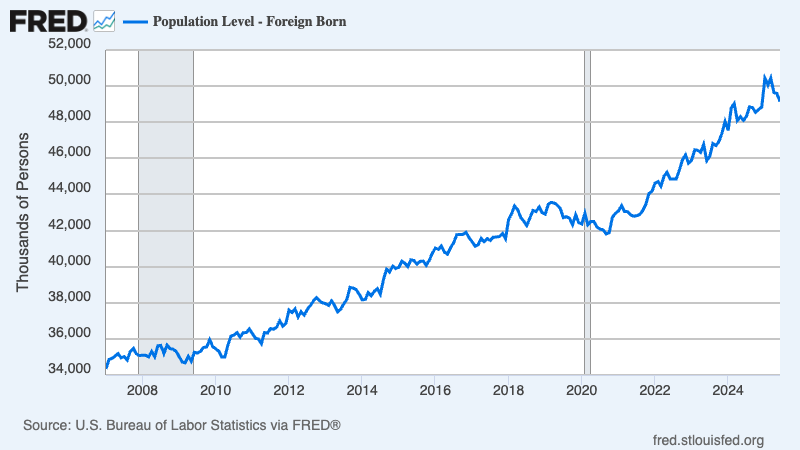
In case you’re wondering, these numbers come from a survey that has historically protected the information of respondents and should in principle cover undocumented as well as legal immigrants. That said, all such estimates should be taken with a grain of salt. But the general facts are clear.
Most new immigrants are working-age adults, who do in fact work after arriving. Total U.S. employment rose by 3.8 million from 2019, just before Covid, until last year. How much of that employment growth was accounted for by immigration? Basically, all of it. Here’s employment growth between 2019 and 2024, in thousands:
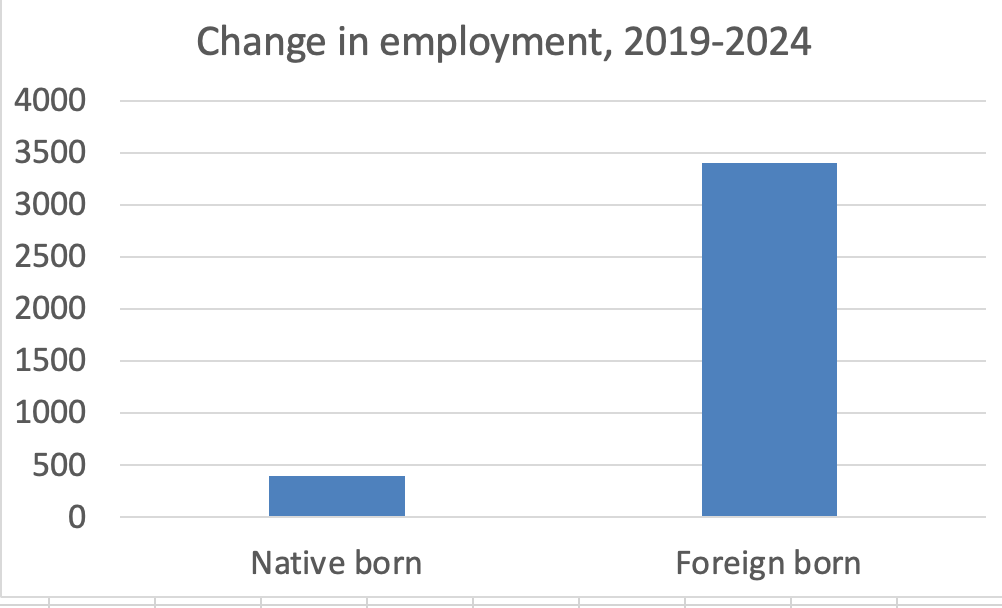
Source: Bureau of Labor Statistics
Why do I choose that specific time period? Because 2019 and 2024 were years of more or less full employment, and by comparing those two years I skip over the disruptions associated with Covid and the subsequent rebound. So this comparison, I’d argue, gives a good picture of underlying trends. And the underlying trend is that almost all growth in the U.S. labor force has come from immigration.
Some people look at a chart like this and infer that immigrants have been driving native-born Americans out of the work force. But we know that isn’t right, because unemployment among the native-born was historically low in both years:
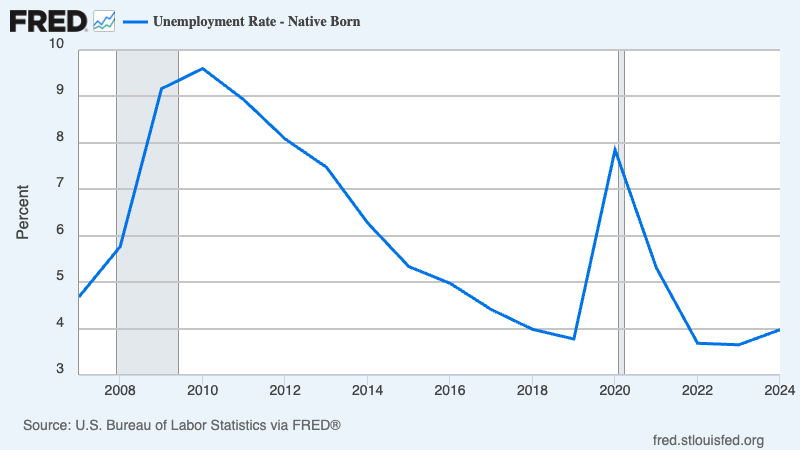
What we’re seeing, instead, is the baby boomer cohort reaching retirement age. As a result, the working-age native-born population in the United States has stopped growing. Most immigrants, by contrast, are working age. So immigrants have accounted for almost the entire rise in overall employment over the past five years. Without immigration since 2019, U.S. employment would barely have increased, and total employment would be more than 2 percent lower than it is.
If you want a picture of what’s happening, consider that one of the first big strains from Trump’s anti-immigrant policies has been a staffing crisis in nursing homes , which rely heavily on immigrant caregivers.
How has this immigration-led rise in employment affected the economy’s performance? And what will be the effect be if, as now seems likely, immigration will be drastically reversed or even go into reverse in the years ahead?
Immigration, growth and inflation
By definition, real GDP — the economy’s total output — equals the number of workers multiplied by average output per worker:
Real GDP = Total employment * Average real GDP per worker
Can we just take this formula and infer that immigration has increased GDP by the same percent that it has expanded the labor force? Not quite.
In principle, productivity — average real GDP per worker — could either rise or fall as a result of immigration. There are four factors to consider:
(a) An increasing labor force can become less productive on average due to diminishing returns if physical capital — buildings including housing and machinery — don’t rise in proportion
(b) Immigrants, especially undocumented immigrants, are on average less educated than native-born workers. This might tend to make them less productive
(c) In contrast to (b), immigrants can raise productivity if they bring a mix of skills that is different from and complementary to that of native-born workers
(d) Finally, there’s a selection effect: people who choose to migrate may be more motivated and driven than those who don’t. As a result, they may be especially productive
In principle, the net effect of these factors is unclear. What the data tell us, however, is that overall productivity growth since the immigration surge began — ignoring the spurious wiggles caused by the rise and fall of Covid — has, if anything, been somewhat higher than the pre-surge trend:
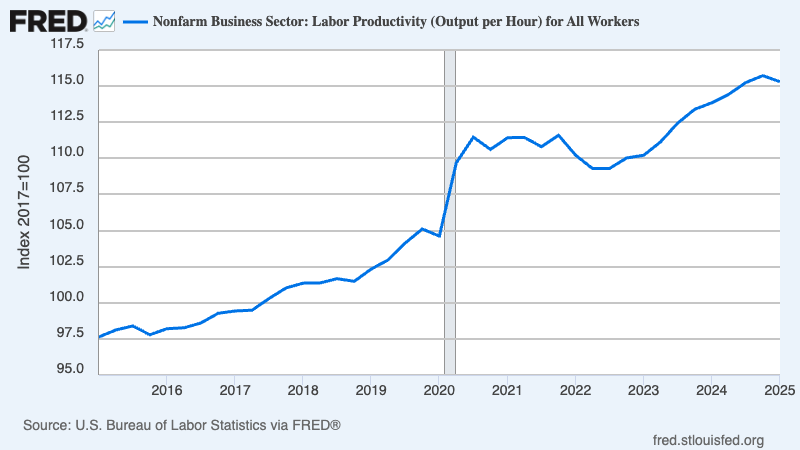
So it’s reasonable to conclude that the 2020s surge in immigration, which increased the labor force by about 2 percent, also increased real GDP by about 2 percent relative to what it would have been otherwise.
What happens when we bring immigration to a halt, and put it into reverse with deportations?
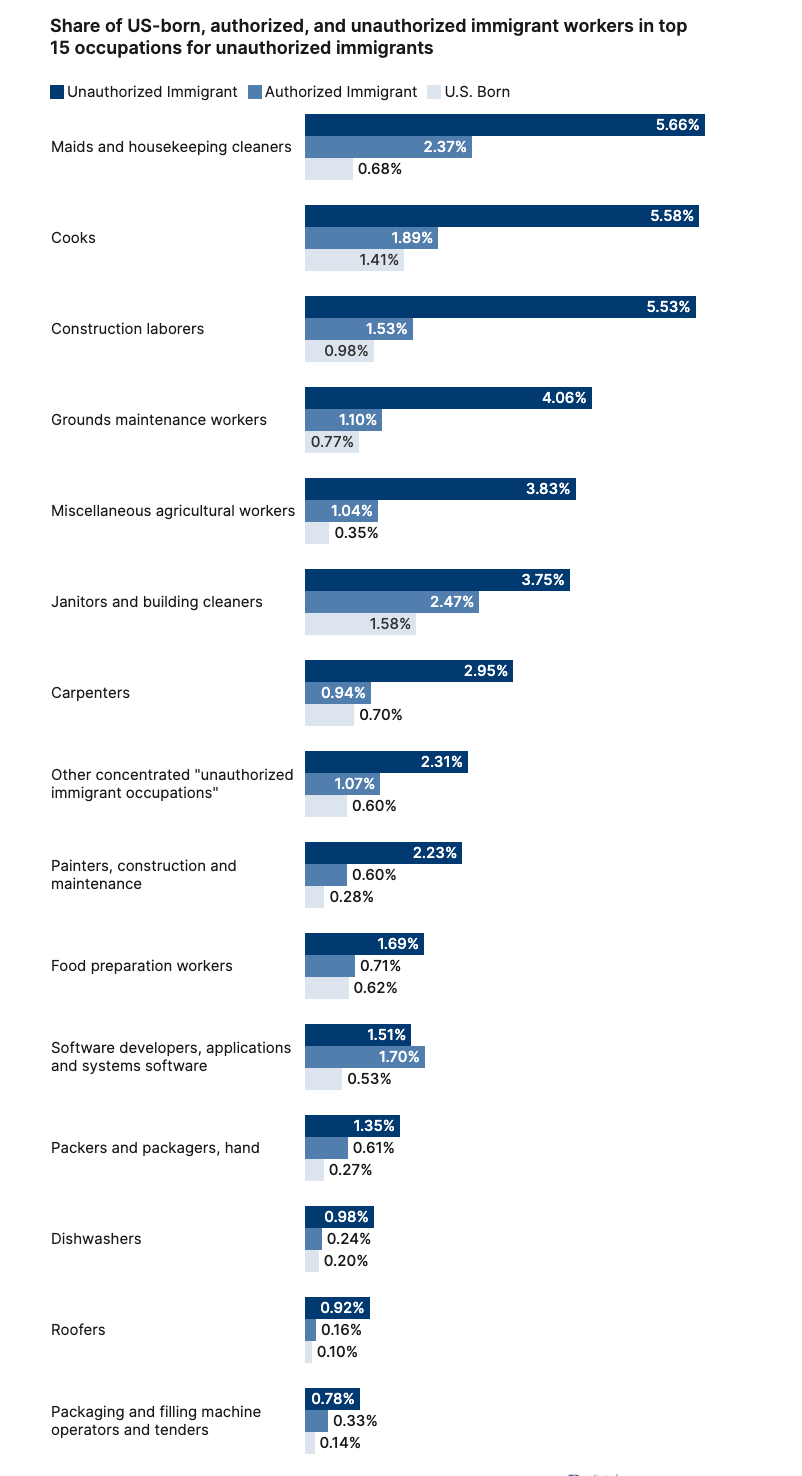
In point (c) above I noted that immigration can raise productivity if immigrants bring a set of skills that is different to and complementary to those of the native born. And they do. The evidence for his is that employment of immigrants, and especially undocumented immigrants, is highly concentrated in a few occupations and industries. Here’s the share of the undocumented work force, legal immigrants, and native-born workers in a variety of occupations:
Source: Brookings
Now there’s a serious crackdown on these workers: ICE is arresting close to 1000 people a day , many without criminal charges let alone convictions, and the administration has set a quota of 3000 per day. Moreover, many immigrant workers are not showing up for work for fear of arrest. All of this is leading to serious labor shortages in sectors like agriculture, food processing and construction, and hence higher prices for some goods and services. These sectoral disruptions of supply will — like the supply-chain disruptions that raised inflation in 2021-22 — raise the average level of prices.
In other words, mass deportations will probably have a significant effect in raising inflation.
Fiscal effects of immigration
How does immigration affect government budgets? It’s important to distinguish between state and local governments, on one side, and the federal government, on the other.
At the state and local level the fiscal impact of immigration is ambiguous. Immigrants pay taxes and in general expand local economies, which increases revenues. On the other hand, immigrants directly or indirectly increase the demand for public services. In particular, their children attend public schools.
Overall, the effect of immigration on state and local budgets could go either way, and the net effect probably isn’t large.
At the federal level, however, there’s no ambiguity: Immigration is enormously helpful for the budget. Why? The federal government mainly collects taxes on working-age adults, while its nondefense spending is largely on the elderly. This is obviously true for Social Security and Medicare, which are explicitly programs for retirees. It also turns out to be true for Medicaid: while most Medicaid beneficiaries are relatively young, most of the spending goes to the elderly or disabled, who tend to have much more expensive health conditions. In addition, Medicaid pays for much nursing-home care.
This reality is the reason declining fertility, which has left us with a growing senior population but a stagnant working-age native-born population, has led to significant problems for long-term federal finances.
Clearly, immigration mitigates those problems: An influx of working-age immigrants increases federal revenue while having little impact on federal expenses because they aren’t drawing on Social Security or Medicare, and only minimally on Medicaid. Granted, today’s immigrants will eventually collect benefits themselves if they have or eventually acquire legal residency. But they won’t collect benefits for decades, and some may never collect benefits at all.
The Social Security Administration, which issues long-term financial projections for the program, also does sensitivity analysis , in which it examines how those projections would change under different assumptions about key variables. One of these variables is net immigration. In the SSA’s central case, net immigration is assumed to average 1.244 million people a year, but it also considers a low-immigration scenario in which only 829,000 immigrants come and a high-immigration scenario in which 1.683 million come. The lower the assumed immigration, the worse is Social Security’s actuarial deficit — the amount by which revenues under current law will fall short of promised benefits.
Alert readers will already have noticed that the “low-immigration” scenario here involves far more immigration than the Trump administration wants — their goal is to have a net outflow of foreign-born residents. If they get their wish, Social Security and other social insurance programs, already under financial strain, will be in very dire straits.
Two more points about the fiscal impact of immigration. First, aside from retirement and healthcare, the federal government’s biggest expense is defense. Whatever you think we need to spend on defense, that burden is easier to bear, the bigger our domestic economy. Immigration contributes to economic growth, and therefore to our ability to project military power.
Second, we currently have large federal debt by historical standards — comparable, as a percent of GDP, to debt at the end of World War II. How did we pay off that debt? We didn’t, we just grew out of it: Federal debt in dollar terms was about the same when John F. Kennedy took office as it has been at the end of the war, but growth and inflation had reduced debt as a share of GDP from 120 to 50 percent. The point now is that ending immigration, and hence reducing future growth, will reduce our ability to grow our way out of today’s debt.
Immigration, then, has a clearly positive effect on the nation’s finances, and anti-immigration policies will do a lot of fiscal harm. There is, however, one area in which critics of immigration have a legitimate case to argue, although they’re probably wrong: the impact of immigrants on wages.
Immigration and wages
The foreign-born share of the U.S. population hit a low point in 1970, then began rising rapidly. Economic inequality in America also began rising, although a bit later, starting circa 1980, with real wages for many less-educated workers either declining or at best rising much more slowly than they had in the generation following World War II.
It was and is natural to ask whether immigration has hurt native-born workers. And there are two widely told stories to that effect. One story is ignorant and flatly wrong. Naturally, that’s the story believed by Trump officials. The other is much more sophisticated, and I myself took it seriously 30 years ago. So it’s important to understand how an accumulation of evidence has changed my mind and those of many but not all other economists.
Let’s start with the stupid. People like Trump and Miller often assert that immigrants are taking away jobs that should be going to native-born citizens. In effect, they’re saying that if foreign-born employment hadn’t increased between 2019 and 2024, the U.S. economy would have found 3.4 million native-born workers to take their place.
But where are these willing but idle U.S.-born workers? No, there isn’t a reserve army of able-bodied Americans sitting at home because immigrants have taken the jobs. The employed share of Americans in their prime working years is close to a record high, and many of the jobs immigrants fill are ones native-born Americans don’t want to do.
OK, there’s a much more sophisticated and defensible story about how immigration could be hurting some native-born workers. It goes like this: During the 1980s and the 1990s there was a significant rise in the wage premium associated with education. For example, workers with college degrees experienced larger wage increases than workers without those degrees. At the same time, the United States was experiencing large inflows of foreign workers with relatively little formal education. So it seemed plausible to argue that immigrants were making less-educated labor more abundant and hence driving down blue-collar wages.
This is a reasonable and coherent story, and some labor economists still defend it. During the 2000s, however, labor economists looked more closely at the evidence and concluded that immigrants were not competing head to head with native-born workers, even if they had similar levels of education. As a seminal 2006 paper by Ottaviano and Peri put it,
immigrants are imperfect substitutes for U.S.- born workers within the same education-experience-gender group (because they choose different occupations and have different skills)
We saw that reality in the chart above comparing the very different occupations of undocumented immigrants, legal immigrants and native-born workers.
If immigrants aren’t competing head-to-head with native-born workers, they can’t be driving those workers’ wages down. And in that case the last coherent argument that immigrants are causing economic harm goes away.
In fact, for the most part immigrants are complements to native-born workers, raising our standard of living by providing nursing home care, harvesting crops, doing crucial construction work, and more. The great majority of native-born workers will be hurt, not helped, by mass deportations.
In summary:
1. Immigration has been the main source of labor force growth in recent years
2. Immigration has led to faster economic growth
3. Mass deportation will slow the economy while causing inflation
4. Immigration has been a big help to our fiscal situation, while deportation will make it worse
5. The evidence doesn’t support claims that immigration has reduced wages for the native-born
As I said at the beginning, the most important reasons to oppose Trump’s attack on immigrants are the violations of human rights and rule of law. But his actions are terrible economics too.
Whatever
Tags
Who is online
117 visitors
Trump's immigration policies will hurt America's economy, and particularly will hurt the bottom two quintiles. But hey! Trump is a lame duck, so if the MAGA idiots finally "awake", he really doesn't give a fuck.
They continuously display, unless they are led, they know not, that or what it is, they are to give a fuck about
How does one conflate legal and illegal immigration?
Legal immigration + illegal immigration = total immigration
[deleted][✘]
Especially with mutually exclusive things.
[✘]
[✘] Simple question, if illegal immigration is so good for a countries economy then why don't all countries allow it?
The answer lies with those who don't:
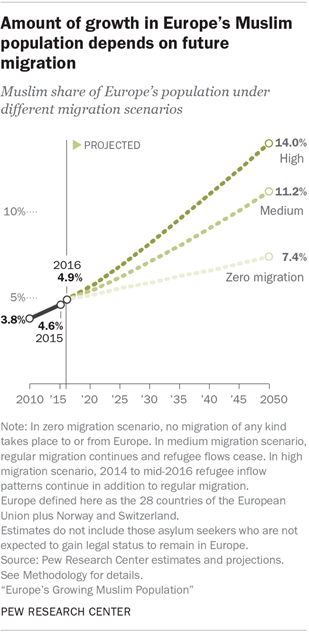
Thus, the pressure on European budgets and the rise of opposition parties.
Legal immigration vets those who want to immigrate and puts limits on how many people a nation wants to let in at any given time. It also promotes assimilation into the host nation's culture, which illegal immigration does not. And last but not least it can impact the will of the people.
Immigration is good and bad depending on what you want. Large scale Immigration depresses wages, it's good for businesses but bad for workers. Large scale Immigration drives up housing costs, good for Landlords and others who own a lot of real estate but bad for Renters and people who want to buy a Home. Immigration increases the population which increases the GDP but it also strains infrastructure and natural resources. Increases in population have reduced the quality of life in most parts of the world including the USA it just happens that our increases come from Immigration while in most other countries it comes from high birth rates.
No. Read the seed.
Of course all those purty graphs and charts don't take into account all the criminal element and all those new arrivals who got here, unvetted and unvaxxed, with no means of support,[✘]
Paul Krugman seems to enjoy confirming the old proverb that "figures don't lie but liars figure".
It really is necessary to confine discussion to legal terminology and classifications in immigration law. Under immigration law, only noncitizens who have been lawfully permitted to enter and permanently reside in the United States are immigrants. Only those lawfully permitted to enter and permanently reside in the US are provided Green Cards, become legal permanent residents, and are eligible for naturalized citizenship.
All other noncitizens, regardless of how they entered or how long they’ve stayed, are legally considered aliens, not immigrants. That includes those present in the US on temporary visas. That includes noncitizens who have not received lawful permission to enter and reside in the US. That includes asylum seekers paroled in the US. None of these aliens are considered immigrants under immigration law.
Why the semantics? Why does terminology matter? The legal system and government policy are required to conform to precise legal language of immigration law. The press, political activists, and economic experts are not constrained by that limitation. They are allowed to use imprecise language and terminology to present a biased viewpoint and advocate for measures that hide many consequences. Paul Krugman is relying heavily on imprecise terminology and coded language to advocate for what may be self-serving influence over public opinion. Krugman is not assuming the role of truthteller with his opinions disguised as factual analysis.
Krugman poisons the analysis by limiting discussion of public costs for education as an emotive appeal to self-identified progressives. But the true public fiscal impact of unauthorized residency includes emergency services and healthcare, increased demands on public utilities and services (like water, sewer, electricity, and gas), and increases in need for public services (like fire, police, and public safety). And that doesn't include the indirect costs of potential health, safety, and security risks.
Krugman highlights taxes collected from a low-income population of unauthorized aliens who cannot receive benefit from the taxes. Unauthorized aliens cannot lawfully work in the US but employers are required to pay FICA taxes on their wages. These unauthorized aliens cannot lawfully obtain a Social Security number and are ineligible for Social Security benefits. Krugman is advocating taxing the poor to justify lax enforcement of immigration law. Apparently these unauthorized aliens are only paying for the privilege of living in the US. That seems to be an antiquated robber baron attitude from our Victorian past.
Krugman boasts about unauthorized aliens boosting GDP. But that conveniently ignores that employers use unauthorized aliens to suppress wages, avoid labor protections, cut labor costs, and boost profit productivity in the wrong way. Is Krugman backhandedly endorsing the notion that increasing disparity to boost the bottom line is sound economic policy?
Paul Krugman has continued his practice of using figures to misinform, mislead, and justify a self serving point of view. The figures don't lie but Paul Krugman isn't telling the truth with those figures.
That's a very long post that says "I have no opposing data, but I don't agree."
I oppose Paul Krugman's interpretation of the data that appears intended to obscure and mislead.
Krugman has used the metric of 'foreign born' to hide the consequences for his advocating uncontrolled and unlawful entry into the country. The 'foreign born' includes naturalized citizens, foreign born birthright citizens, immigrants holding Green Cards, refugees, aliens permitted to be present on visas, as well as unauthorized nonimmigrants. Krugman is hiding the deleterious impact of unauthorized nonimmigrants behind the numbers of foreign born who are allowed to legally work in the US. Krugman is certainly not bringing any clarity to the issue of irregular and unlawful entry into the US.
Krugman points to the metric of native born unemployment to prove what? The FRED chart provides no information on the quality of jobs. Displacing higher wage workers into lower wage jobs with fewer benefits doesn't bode well for the future of native born workers, does it? Krugman's deliberate misrepresentation of unemployment ignores changes in labor force participation. Labor force participation is presented as a rate which can either mean people have dropped out of the labor force - or - the size of the population has been increased by adding non-working people. (Those not seeking work are not included in the unemployment numbers.) Labor force participation was higher in 2019 than in 2024, making Krugman's assessment a bit of an apples and oranges comparison.
Krugman's productivity chart provides clear evidence of job displacement by offshoring and by mechanization/automation. Increasing the number of widgets produced won't alter the data because what is shown is a ratio of output to input. The only way to increase national productivity is to reduce the number of labor hours needed to produce all the widgets. Krugman is celebrating that the economy can eliminate workers and reduce the number of jobs.
Why doesn't Krugman point out how the surge of unauthorized immigrants has been lowering disparities in the economy? The GINI coefficient decreased in years where unauthorized entry of aliens were essentially stopped by the pandemic. Was that because aliens illegally in the country weren't competing for government benefits? The pandemic stimulus didn't focus on those illegally in the country, did it?
No. He is showing the effects of all immigration. If you want data on a different subject, then you must find it yourself.
As for the GINI coefficient... shit happened during COVID. There's nothing in the data to support the causation you want to find.
The current controversy is not about the foreign born population. Krugman isn't addressing the issue most relevant at present, unauthorized aliens illegally present in the United States. Data concerning the authorized alien population is notoriously difficult to obtain. And Democrats throw up barriers to increase difficulty of obtaining useful information.
Krugman's analysis is skewed to obscure the the nature of the present controversy over unauthorized aliens illegal present in the United States. Krugman has moved the goalposts.
My analysis of the GINI coefficient is just as valid as Krugman's analysis of the foreign born population. Afghan refugees are foreign born but they are legally allowed to reside and work in the US. That legal status means those refugees compete with the native born on a level playing field. The native population cannot compete with those who have entered the country in an irregular and illegal manner. How can those constrained by laws compete with those who are not?