
New York Times's "Climate Forward"



Weekly recap of major limate-change news

Anyone, today, saying "cars don't pollute" is like a 16th century doctor saying "bleeding will cure you". It's blatantly stupid.
That doctor, at least, was not ignoring stacks of hard data.
 S E E D E D C O N T E N T
E.P.A. Is Said to Draft a Plan to End Its Ability to Fight Climate Change
According to two people familiar with the draft, it would eliminate the bedrock scientific finding that greenhouse-gas emissions threaten human life by dangerously warming the planet.
by Lisa Friedman

The E.P.A. has sent to the White House a draft plan to repeal a rule known as the “endangerment finding,” according to people familiar with the plan.Credit...Benjamin Rasmussen for The New York Times
The Trump administration has drafted a plan to repeal a fundamental scientific finding that gives the United States government its authority to regulate greenhouse-gas emissions and fight climate change, according to two people familiar with the plan.
The proposed Environmental Protection Agency rule rescinds a 2009 declaration known as the “endangerment finding,” which scientifically established that greenhouse gases like carbon dioxide and methane endanger human lives.
That finding is the foundation of the federal government’s only tool to limit the climate pollution from vehicles, power plants and other industries that is dangerously heating the planet.
The E.P.A. proposal, which is expected to be made public within days, also calls for rescinding limits on tailpipe emissions that were designed to encourage automakers to build and sell more electric vehicles. Those regulations, which were based on the endangerment finding, were a fundamental part of the Biden administration’s efforts to move the country away from gasoline-powered vehicles. The transportation sector is the largest source of greenhouse gas emissions in the United States.
The E.P.A. intends to argue that imposing climate regulations on automakers poses the real harm to human health because it would lead to higher prices and reduced consumer choice, according to the two people familiar with the administration’s plan. They asked to remain anonymous because they weren’t authorized to discuss the draft proposal.
The draft proposal could still undergo changes. But if it is approved by the White House and formally released, the public would have an opportunity to weigh in before it is made final, likely later this year.
Molly Vaseliou, a spokeswoman for the E.P.A., did not confirm the details of the plan. In a statement she said the E.P.A. sent the draft proposal to the White House on June 30, and that it “will be published for public notice and comment once it has completed interagency review and been signed by the Administrator.”
If the Trump administration is able to repeal the endangerment finding, it would not only erase all current limits on greenhouse gas pollution from cars, factories, power plants and other sources. It would prevent future administrations from trying to tackle climate change, with lasting implications.
“The White House is trying to turn back the clock and re-litigate both the science and the law,” said Vicki Arroyo, who teaches environmental law at Georgetown University. She called the evidence that climate change is harmful “overwhelming and incontrovertible.”
Since taking office, President Trump has abandoned U.S. efforts to tackle global warming. He also has moved to roll back virtually every federal policy aimed at curbing greenhouse gases from the burning of oil, gas and coal. His administration has encouraged more production and use of fossil fuels while stifling the growth of clean energy and electric vehicles.
In calling to repeal the endangerment finding, the draft E.P.A. rule does not appear to focus on the science or try to make the case that fossil fuels aren’t warming the planet.
Instead, it argues that the E.P.A. overstepped its legal authority under the Clean Air Act by making a broad finding that greenhouse gas emissions endanger the public welfare. It makes the case that the E.P.A. administrator has limited power that apply only to specific circumstances.
Joseph Goffman, who led the air office at the E.P.A. under the Biden administration, said the rule would all but certainly face legal challenges if it is finalized.
He said the Trump administration’s proposed rule conflicts with the 2007 Supreme Court ruling in Massachusetts v. E.P.A., a landmark case that found for the first time that greenhouse gases were a pollutant under the Clean Air Act. That led the E.P.A. to make the finding in 2009 that said that six greenhouse gases were harming public health.
In more than 200 pages , the E.P.A. at that time outlined the science and detailed how increasingly severe heat waves, storms and droughts were expected to contribute to higher rates of death and disease.
As U.S. Retreats on Climate, China and Europe Pledge to Go Green Together
A joint statement promised new efforts to cut emissions at a time when China is positioning itself as the world’s one-stop shop for clean energy technologies.
By Somini Sengupta

China installed more solar panels and wind turbines in 2024 than the rest of the world combined.
Credit...Gilles Sabrié for The New York Times
Two of the world’s three big climate polluters, China and the European Union, pledged on Thursday to work together to slow down planetary heating . Together they called the Paris Agreement, the pact among nations to address global warming, “the cornerstone of international climate cooperation.”
They didn’t mention the United States by name, but they didn’t have to.
America, the third member of the trio of top global climate polluters, has said that it will pull out of the Paris Agreement, and the Trump administration has rolled back policies and government-funded programs that were intended to spur the development of renewable energy in the United States.
The joint statement opened by saying, “in the fluid and turbulent international situation today, it is crucial that all countries, notably the major economies, maintain policy continuity and stability and step up efforts to address climate change.”
China and the European Union most certainly don’t agree on everything when it comes to tackling rising emissions. European officials have in the past been vocal in criticizing China’s widespread use of coal: China burns more coal than any country ever has. European officials have also criticized what they call China’s dumping of inexpensive electric vehicles on the global market.
And China has criticized the European Union’s new border tax based on greenhouse-gas emissions, which makes it costlier to sell Chinese products there, particularly steel. Beijing and Brussels also have major differences on geopolitics, including the Russian invasion of Ukraine.
But China has staked out an ambitious long-term policy of dominating the sale of clean-energy technologies to the world including solar panels, wind turbines, next-generation batteries and electric vehicles. What makes the joint pledge significant is that it represents an attempt to smooth the tensions over the trade of these products, particularly the export of Chinese EVs to Europe.
“In the absence of robust U.S. climate action, the EU and China still recognize the imperative of working together to confront a shared existential threat,” said Li Shuo, director of China Climate Hub at the Asia Society Policy Institute. “Amid deep divergences” in global climate policy, he said, the joint statement “offers a modest but meaningful source of relief.”
With years of generous state support for private companies, China is now the global front-runner in building and selling clean energy technologies.
At home it installed more solar panels and wind turbines in 2024 than the rest of the world combined. Its electric vehicles are sold in showrooms from Milan to Mumbai, and it is setting up electric vehicle assembly plants around the world , including in Thailand, Turkey and Brazil. Some of China’s biggest clean-energy manufacturing plants are in Saudi Arabia, a petrostate.
An analysis published Thursday in Carbon Brief , an online publication, said China’s export of clean energy goods in 2024 alone are expected to reduce global emissions by 1 percent.
Making these clean-energy products in China is itself a polluting activity, in part because China’s factories are so reliant on coal power. Researchers estimated the emissions produced by factories making this gear for export in 2024 amount to 110 million tons of carbon dioxide. And China is continuing to build out coal plants.
Carbon dioxide is a major greenhouse gas warming the world. Released into the atmosphere, it acts as a blanket, trapping the sun’s heat.
The joint statement on Thursday included a promise by both China and the E.U. to submit new targets for reducing their greenhouse gas emissions before November, when the international climate negotiations known as COP are held in Brazil.
The European Commission, the bloc’s executive arm, has proposed, ambitiously, to cut its climate pollution by 90 percent by 2040, compared with 1990 levels. That target has yet to be approved by the European Parliament. China has yet to release an updated target.
It remains unclear if the United States will send representatives to the climate talks in Brazil.
The statement didn’t mention whether the new Chinese and European targets would be aligned with what scientific consensus says is necessary to avert some of the worst effects of climate change. That would require limiting the world’s temperature increase to to “well below” 2 degrees Celsius compared with preindustrial levels.
“The fact that a joint statement was agreed and published at this moment in time is significant,” Kaysie Brown, who follows climate diplomacy at E3G, a European research and advocacy group. “It provides a timely and much-needed signal of renewed climate leadership at a moment when global ambition is faltering.”
FEMA Urban Search and Rescue Chief Resigns, Citing Agency ‘Chaos’, Colleagues Said
Ken Pagurek had told colleagues the Trump administration was causing ‘chaos’ inside FEMA and creating dangerous delays in disaster response.
By Lisa Friedman

Search and rescue personnel near the Guadalupe River in Texas on July 8 after catastrophic flooding.
Credit...Loren Elliott for The New York Times
The head of the Federal Emergency Management Agency’s urban search and rescue unit has resigned, telling colleagues he was frustrated by bureaucratic hurdles the Trump administration imposed that delayed the agency’s response to deadly flooding in Texas, according to three people familiar with his reasoning.
Ken Pagurek, who worked with FEMA’s search and rescue branch for more than a decade and served as chief for the past year, told associates that his concerns had been mounting since the start of hurricane season and that the administration’s changes to the agency were causing “chaos.”
He said he worried that a new policy that requires purchases of more than $100,000 be personally approved by Kristi Noem, the homeland security secretary, could hurt disaster response efforts that require speed and agility.
Experts have said that responses during a disaster can quickly total billions of dollars, and that requiring personal approvals for expenses of $100,000 and above could easily create bottlenecks.
“This decision was not made lightly, and after much reflection and prayer, it is the right path for me at this time,” Mr. Pagurek wrote in a resignation letter. His departure was first reported by CNN.
Mr. Pagurek could not be reached for comment.
The catastrophic flooding in the Texas Hill Country on July 4, in which 120 people were killed, was the final straw for Mr. Pagurek, according to the four people, who spoke on the condition of anonymity because they were not authorized to discuss personnel issues. FEMA was slow to deploy response and search-and-rescue coordination teams , according to half a dozen current and former FEMA officials and disaster experts. Several Democratic lawmakers have called for an investigation into the agency’s handling of the disaster.
Tricia McLaughlin, a spokeswoman for the Department of Homeland Security, said that FEMA did not experience any delays in deployments in Texas.
“It is laughable that a career public employee, who claims to serve the American people, would choose to resign over our refusal to hastily approve a six-figure deployment contract without basic financial oversight,” she said referring to Mr. Pagurek.
“We’re being responsible with taxpayer dollars, that’s our job,” she said. “Attempting to spin a personal career decision into some big scandal is ridiculous.”
On Monday, Representative Frank Pallone, the top Democrat on the House Energy and Commerce Committee, called for President Trump to “immediately fire” David Richardson, the acting administrator of FEMA, who had no experience in emergency management before Mr. Trump appointed him.
Ms. Noem has said that FEMA responded to the flooding better than it had to any other disaster in “many, many years” and said criticisms amounted to people “playing politics with what happened to Texas.”
The New York Times reported that the new policy requiring her personal approval for contracts larger than $100,000 had left FEMA call centers understaffed for five days following the July 4 floods. Internal documents viewed by The Times showed that thousands of calls to FEMA from flood survivors went unanswered. Ms. Noem has dismissed that as “fake news.”
The departure of Mr. Pagurek comes just weeks after the resignation of Jeremy Greenberg, who led FEMA’s disaster command center, which coordinates the national response to earthquakes, floods and other disasters.
Under the Trump administration’s drive to reduce the size of government, FEMA has lost about a quarter of its full-time staff . That has included 20 percent of the coordinating officers at the agency, who manage responses to major disasters, as well as the deputy regional administrator in the agency’s Region 6 office in Texas.
Michael Coen, who served as FEMA’s chief of staff under the Biden and Obama administrations, said the loss of institutional knowledge with the departure of senior officials like Mr. Pagurek was worrisome.
“The people that are there will work hard, but when you lose that experience its hard to replace,” he said.
The future of FEMA under the Trump administration remains uncertain. In March, Mr. Trump said he wanted to “phase out” the disaster response and recovery agency by the end of hurricane season in November, and to shift more responsibility for emergency management as well as more of the cost to the states.
FEMA, established in 1979 by President Jimmy Carter, coordinates the federal response to disasters, serving as a backstop for states if they cannot meet the needs on the ground. The agency’s role has grown more complex and expensive as climate change has made extreme weather events more frequent and severe. FEMA’s budget for the last fiscal year was roughly $35 billion.
Since the Texas floods, Mr. Trump has praised the agency and the White House has suggested the president now intends to reform it.
Chinese Car Giants Rush Into Brazil With Dreams of Dominating a Continent
As the likes of Ford and Mercedes retreat, Great Wall Motor and BYD are building factories and bringing affordable EVs and hybrids to one of the world’s biggest markets.
By Somini Sengupta
Workers in training at the new Great Wall Motor factory in Iracemápolis, Brazil.
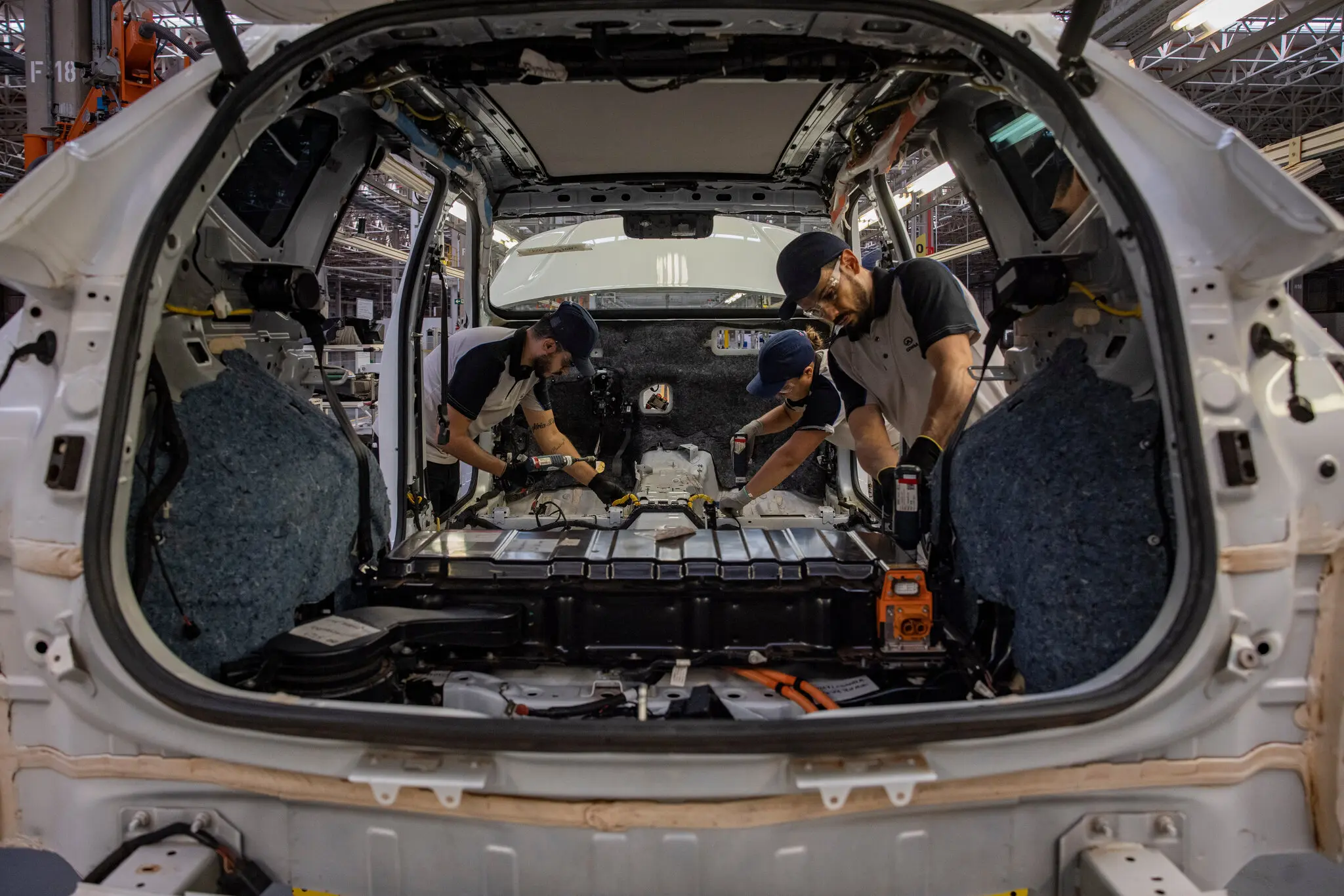
A two-hour drive beyond the traffic jams of São Paulo, past the vast valleys of sugar cane, one of the first Chinese battery-powered-car factories in the Americas is getting ready to open.
Its goal is to reinvent the way Brazil drives, and ultimately, the rest of Latin America, much as Chinese automakers have already done across much of Asia and want to do in Europe.
Until recently, this factory was run by Mercedes-Benz, the German giant of 20th century automotive innovation that churned out cars powered by gasoline. Today, it’s owned by Great Wall Motor, a company that decades ago made rugged pickup trucks for the Chinese countryside but is now one of China’s leading exporters of stylish, affordable electric cars.
The change in hands reflects a profound disruption for one of the world’s most vital industries. If American and European gas-guzzling cars once dominated global tastes and trends, that era appears to be fast turning to China’s favor.
Today, not only does China make and export more cars of all types than any other country in the world, Chinese firms dominate the global manufacture of battery-powered vehicles of the future. They also control the supply chain for virtually everything that goes into those cars.
China’s E.V.s are among the most advanced in the world. Some today go as far on a single charge as top-of-the-line Teslas, at lower prices. One Chinese carmaker, BYD, short for Build Your Dreams, has developed technology that can deliver a full charge in just 5 minutes, roughly the time someone might spend at a pump fueling up a gas-burning car.
Little wonder that Tesla sales in China are lagging, and that the United States, under both Presidents Joseph R. Biden Jr. and Donald Trump, have essentially banned Chinese car imports.
For China, that leaves the rest of the world.
Its electric and hybrid manufacturers have set up, or are in the process of setting up, factories in Hungary, Indonesia, Russia, Thailand, Turkey. These efforts, including Great Wall’s Brazilian factory, are part of a globe-spanning campaign by China to seize a major share of the world’s auto industry, a powerful source of revenues, jobs and also national prestige.
The technological upheaval is a moment of opportunity for China. While the Trump administration is trying to halt the advance of electric vehicles in the United States, Chinese leaders see E.V.s as a rare chance to crack a market long dominated by German, Japanese, Korean and American companies.

In cities like São Paulo, affordable Chinese E.V. s and plug-in hybrid cars are finding buyers.

New electric cars shipping out from Iracemápolis.
Toyota, General Motors, Volkswagen and their Western peers have struggled to master electric vehicles. But for China, the disruption is a gift. Beijing has lavished support on carmakers whose names — Great Wall Motor, BYD, SAIC — might not be familiar to Americans, but whose vehicles are flooding much of the rest of the world. They have become potent symbols of China’s economic and technological ascendance.
Western auto giants are alarmed.
“We are in a global competition with China,” Jim Farley, the chief executive of Ford Motor Co., said at the Aspen Ideas conference in June. “It’s not just E.V.s. And if we lose this, we do not have a future at Ford.”
In Europe, Chinese carmakers this year have doubled their market share for all cars to 6 percent, and now command about 20 percent of Europe’s EV market. This despite hefty tariffs that Beijing has been negotiating to try to cut . Showrooms for Chinese electric vehicles have opened from Milan to Mumbai, and Chinese car brands are an increasingly common sight in Thailand and India.
Now, in what reflects Beijing’s swelling industrial confidence and geopolitical influence, China is making its way into the big car-buying economies of Latin America.
Great Wall Motor took over the Mercedes plant in the industrial town of Iracemápolis, near São Paulo, after the German carmaker closed shop in 2021, blaming a slump in luxury car sales. BYD took over a Ford factory after years of poor sales and steep losses forced the U.S. car giant to end its long history of manufacturing in Brazil.
Mr. Farley at the time called the closures “difficult but necessary actions.” Ford had assembled cars in Brazil for a century, starting with the Model T.
“For the first time in decades, we’re seeing a real challenge to the dominance of American and European brands, not just in terms of market share, but in shaping the future of mobility,” said Natalie Unterstell, president of a climate research and advocacy organization called Talanoa Institute, based in Rio de Janeiro.
Brazil, the world’s sixth largest car market, is trying to take advantage of it, instead of being steamrolled. It’s prodding companies, no matter where they’re from, to make cars on Brazilian soil, the less polluting the better, while also imposing steadily rising tariffs on imports.
It hasn’t all been smooth sailing. There have been union clashes over Chinese labor practices. But the government’s overall message: If you want access to our car buyers, then come and create factories and factory jobs here.
“We don’t want to be an importer of technologies produced in other countries only,” said Rafael Dubeux, special adviser to the finance ministry, in an interview in the capital, Brasília. “We also want to take advantage of this profound change in the world, in manufacturing facilities, so that Brazil also has a part in the value chains that we think are the ones that will prevail.”

The Great Wall factory is likely to be the first Chinese-owned assembly line in Brazil to be fully operational.

Chinese and Brazilian employees were conducting testing and training at the plant recently.
The Brazilian appetite for Chinese electric vehicles has shocked the legacy Asian, European and American brands that had been making cars in Brazil for years. Chinese imports tripled between 2023 and 2024, according to Brazil’s National Association of Motor Vehicle Manufacturers. It immediately cried foul, accusing Chinese companies of flooding the market with cheap cars.
Brazil’s government responded by ratcheting up import duties on all cars and encouraging production at home.
Chinese automakers are complying. Sort of.
At least three Chinese firms are opening assembly plants in Brazil. In addition to Great Wall Motor and BYD, another Chinese automaker, Chery, has teamed up with a Brazilian company, Caoa, to produce cars in central Goias state.
Nevertheless, Marcio Lima Leite, head of the Brazil automaker association, remains worried. The new Chinese auto plants are mainly assembling cars with components imported from China, including the most valuable component, batteries. That, he said, will not advance the industry in Brazil.
“It’s very important to have competitiveness in Brazil, to produce the new technology in Brazil,” he said.
Chinese carmakers have had to bend to local needs in important ways. In Brazil, that means the needs of the powerful ethanol industry. Ethanol is produced from the country’s huge sugar cane crop, and Brazilian law requires every liter of gasoline to be a little more than 25 percent ethanol.
So the auto companies aren’t just making fully electric cars in Brazil. They are also having to make hybrids that run partly on the gas-ethanol blend and partly on batteries. “We need to produce what customers are looking for,” said Marcio Renato Alfonso, a Brazilian who worked for an American carmaker for many years and is now Great Wall’s director of research and development for Brazil. “High technology with an affordable price.”
He pointed to his own car, a plug-in hybrid SUV, the Haval 6 GT. It has a big enough battery that it can make the entire 170-kilometer (105 mile) trip from his office in São Paulo to the factory on a single battery charge, never once firing up its fossil fuel engine.
Global carmakers need Brazil. With a population of more than 200 million, it is Latin America’s biggest economy. But also, cars made in Brazil can also easily be sold in other Latin American countries, thanks to cross-border trade deals.
What do Brazilians want?

A BYD dealership in São Paulo using costumed characters and test drives of its E.V.s to lure in prospective buyers.
There was a party vibe one recent Saturday morning in front of the BYD showroom in the upscale São Paulo neighborhood of Villa Lobos. Banners promised discounts. Cheerleaders danced with balloons. Music blasted into the streets.
People streamed in, sipped glasses of chilled juice and inspected the price tags carefully. Some were wary of going fully electric. Others had done their homework and knew exactly how much they would save. There were fully electric models for sale and plug-in hybrids. There were big sedans and SUVs. Brazilians like their SUVs.
Around midday Juliane Rodrigues, a lawyer, showed up with her husband, Rafael Mendes, an insurance company analyst. They were ready to graduate from a 2009 Toyota Corolla borrowed from her grandfather. They were ready to buy their own wheels.
They took the lowest priced fully electric hatchback, the Dolphin, for a test drive. The range was fine for city driving, around 380 kilometers (236 miles), and so was the price, roughly $28,000, or 159,000 Reals. They didn’t mind that their apartment building doesn’t allow chargers in the garage. They could charge up in a supermarket lot nearby.
But Ms. Rodrigues had reservations about buying a BYD. Reservations about its name, to be precise. “Build Your Dreams,” she whispered. “So cheesy.”
Next, they went down the street to the Great Wall dealership. They took a sporty electric model, the Ora GT, for a test drive. She was smitten by the sunroof. He liked how easily it drove.

Rafael Mendes and Juliane Rodrigues shopping for a new car in São Paulo.

Alexandre Pacheco’s son, Victor, with the family’s BYD car.
Lastly, they tried a Great Wall plug-in hybrid SUV, the Haval H6. It cost more than they thought they would spend, just over $42,000, or 244,000 Reals, but it would allow them to make road trips without worrying about range. “We decided it was worth it,” she said.
Other buyers had other desires.
Alexandre Pacheco came to see if he could trade in his BYD plug-in hybrid for one made by Great Wall Motor. He liked his car. He wished he could keep it. “The savings I’ve been having — wow,” he said. It was just that for trips to the family’s beach house, the trunk was too small.
Would he consider going back to a gas fueled car? Absolutely not. “Sustainability. Comfort. Noise,” he said.
Oswaldo Rejas and his wife, Marcia Fernandes, were not at all sold on the all-electric models, saying they would take too long to charge. “Brazilians are impatient. Well, I am,” she said. At the Great Wall Motor dealer, they traded in their gas-powered SUV for a hybrid. To consecrate the deal, a DJ pumped up the music. Strobe lights flashed. The couple walked to a stage to get their pictures taken.
The Brazilian market for battery-powered cars is small, but growing at a fast clip. According to estimates by BloombergNEF, while only 6 percent of cars sold in 2024 were electric or hybrid, they are projected to dominate the market by 2037.
Following the lead of the Chinese brands, incumbent carmakers in Brazil, including the American brand General Motors, are making plug-in hybrids . Ford is also selling hybrids in its Brazilian showrooms.

Worker training at Iracemápolis.

E.V. chargers in a São Paulo parking garage.
From Model T to BYD
Along Henry Ford Avenue in the industrial city of Camaçari, what was once a Ford factory is now becoming a BYD factory.
This had been Ford’s newest plant. Every day, starting in 2001, it churned out hundreds of gas-powered cars. It employed some 5,000 workers. It also lost huge amounts of money.
In 2021, the Ford plant shut down .
“It was a shock,” said Júlio Bonfim, who was president of the metal workers’ union at the factory. “I imagined my son would also work at the plant. It didn’t happen.”
The state government offered BYD a basket of incentives to take over the plant. But almost as soon as the Chinese company arrived, it got enmeshed in a labor scandal.
Last December, Brazilian officials accused BYD’s contractor, Jinjiang Construction Group, with keeping 163 Chinese workers in “conditions akin to slavery” and in violation of Brazilian labor laws. It embodied the reckoning that Chinese companies face as they seek to expand in Brazil, which has robust unions.
The workers were sent back home. Construction slowed down. Company officials said they expect to start production later this year. When it does, Mr. Bonfim’s union insists that Brazilians must be hired to work the line. It has threatened to strike if Chinese workers are brought in.
BYD’s top executive for Brazil, Alexandre Baldy, said the firm had taken steps to address the violations. In May the labor prosecutor’s office filed charges against the carmaker and its contractors for human trafficking. The company said it plans to challenge the charges.

Entrance to BYD’s factory in Camaçari.

Construction at Camaçari was delayed by a labor scandal.
In the meantime, the Great Wall factory in Iracemápolis will almost assuredly already be fully operational. An opening ceremony is planned for August. Cars are due to roll off the factory floor soon after.
The factory first plans to produce one hybrid model and three plug-in hybrids, including the model that Ms. Rodrigues and Mr. Mendes recently bought.
Brazil has ample electricity, and most of it is renewable, from hydropower. But in a country that spans 3 million square miles, nearly as big as the United States, going electric is a challenge. Building charging infrastructure is costly and time-consuming. Moreover, cars that can run on ethanol are eligible for the same kinds of tax incentives as cars that are fully electric.
Great Wall Motor aspires to produce 50,000 cars annually within three years, Mr. Alfonso said. They will range in price from 219,000 to 324,000 Brazil Reals, or $37,000 to $55,000.
To Mr. Alfonso, it’s obvious why Chinese carmakers are expanding so quickly in Brazil. They had invested in new technology and new design. “If you’re not cost-competitive, you don’t have innovation, competing is tough,” he said. “Not only Americans, but everyone.”
Brazil, for its part, is trying to take advantage of Chinese ambition.
China is Brazil’s largest trading partner. It sells enormous amounts of soybeans and oil to Beijing, and is one of Beijing’s top customers of clean-energy technologies, including solar panels and batteries. Brazil’s president, Luiz Inácio Lula da Silva, met with Chinese president Xi Jinping on a state visit in May. He spoke glowingly of Chinese investments in Brazil, including in the automotive sector.
His remarks stood in sharp contrast to Beijing’s turbulent relationship with Washington over tariffs.
André Corrêa do Lago, a veteran Brazilian diplomat who will preside over the next round of global climate negotiations, said that because of low sticker prices and the global trade threat they represent, “some countries are a bit afraid of Chinese electric cars.”
That shouldn’t be Brazil’s concern, he said. “I look at it as very positive news. They are making electric cars much more affordable.”
Whatever
Tags
Who is online
86 visitors
These are stories from this week. This ONE week!
ONE fucking week! The incredible stupidity of MAGA's destruction of America's position in the world is incomprehensible.
The last story, about Chinese car manufacturing in Brazil is staggering.
Science is not a substitute for legislation. Repealing EPA's overzealous interpretation of regulatory authority only requires Congress enacting a Climate Change Act comparable to the Clean Air Act. The role of Congress is to oversee such authority. And expecting Congress to do its job actually strengthens democracy.
BTW, the European Union ranks as fourth largest greenhouse gas emitter; India is third. Even the greenhouse gas narratives are undergoing revisions of nuance now that CO 2 emissions are being addressed (and the market is becoming saturated). Agriculture and land use is now identified as a larger emitter than transportation. Fluorinated gases are now identified as a contributor, too. What this means is that the greenhouse gas culprit has become a moving target.
Scroll to the bottom chart that compares gross greenhouse emissions by country -- for 2020. The emissions by China and the Rest of the World swamps the emissions by the remaining 9 largest emitters. Eliminating North American and European greenhouse gas emissions is not going to stop climate change. Replacing all ICE vehicles in North America and Europe with EVs will not stop climate change. Offshoring North American and European industry is not going to stop climate change. Converting the entire electrical supply of North America and Europe to solar and wind energy won't make a dent in climate change. That's because North America and Europe are small emitters compared to the rest of the world. Maybe that's why the climate change narrative needs to be revised with more nuanced causes and culprits.
The average American produces half again as much greenhouse gas as the average Chinese.
The per capita data is misleading. Iceland has higher per capita GHG emissions than China. Gibraltar has higher per capita GHG emissions than the United States. According to your link, the Republic of Palau had the highest per capita GHG emissions in 2023. But expectations that achieving zero GHG emissions in Palau will stop climate change seems rather ludicrous.
The old adage was "the solution to pollution is dilution". Have the policies to open US borders for illegal entry been motivated by reducing per capita GHG emissions? Is the US government trying to use dilution to address climate change?
Misleading data won't alter the inconvenient truth that North America and Europe cannot stop climate change by reducing their combined GHG emissions. Yes, there are tangible benefits for reducing GHG emissions in North America and Europe but stopping climate change is not one of those benefits.
Especially when they have two residences, on two different continents and when they travel the globe to watch basketball games.
" Eliminating North American and European greenhouse gas emissions is not going to stop climate change. Replacing all ICE vehicles in North America and Europe with EVs will not stop climate change. Offshoring North American and European industry is not going to stop climate change. Converting the entire electrical supply of North America and Europe to solar and wind energy won't make a dent in climate change. That's because North America and Europe are small emitters compared to the rest of the world. Maybe that's why the climate change narrative needs to be revised with more nuanced causes and culprits.
Besides, fossil fuels remain reliable, abundant and cheap. The same can't be said of wind and solar; hydroelectric and geothermal not a factor in the US, and nuclear and hydrogen have not yet been developed to any great degree. The US electrical grod can't handle the anticipated loads of wished for electrical power.
For the foreseeable future, the use of fossil fuels will drive industry, power production (natural gas, and to a much lesser extent, coal) and transportation (commercial trucks, heavy equipment, farm machinery, train locomotives, airplanes, and ships).
Completely false. Pure nonsense.
Now you just have to prove it's false.
No. Greg put quotation marks in his post, indicating that he was citing a source, but he didn't give a link. The burden of proof is his. The seed had lots of data to the contrary.
Exactly like you didn't give a link when calling it "completely false". The burdon of proof that it's false is on you.
I copied Nerm's comment 2.0 and highlighted certain parts of it. The rest of the comment is common sense reality that can't be seriously disputed
We're waiting for you to disprove any of it by providing credible to the contrary,
Which you can't. Lazy, or just uniformed?
NewsTalkers has its own way of indicating a citation. You just hit the quotation-mark-button in the top left corner of any text box.
Or... NewsTalkers has its "link" button.
Or... you may want to think twice... several times... before citing Nerm as an expert on emissions.