
Krugman Twofer



The Media Can’t Handle the Absence of Truth
Trump/Brazil: Delusions of Grandeur Go South

Trump was with von der Leyen when he announced an American victory and insulted half of Europe. I watched von der Leyen. She remained utterly expressionless. Kinda like a duck letting the rain fall... and not caring one iota. In the days since, the EU has rolled back almost everything. A TACO!.
And then Donald declared himself the emperor of the world, entitled to interfere in an ongoing legal affair in Brazil. Which went over with Brazilians like "51st state" with Canadians. Surprise!
The Media Can’t Handle the Absence of Truth
And their diffidence empowers pathological liars
We have guests for the next couple of days, and it would be rude to spend the whole time chained to the computer. So this post and maybe the next will be short and somewhat meta.
On Tuesday I talked to Greg Sargent of the New Republic; transcript here . I highly recommend subscribing to Greg’s podcast!
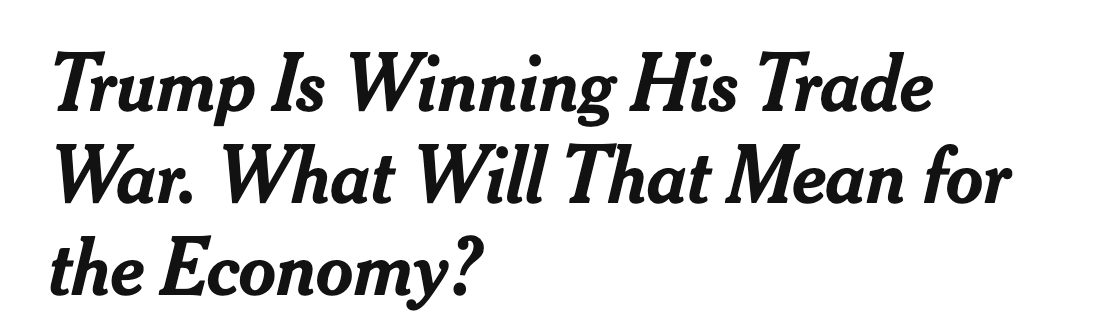
It was a good if depressing discussion, in part about Trump’s trade “deals” but also about how they are being (mis)reported. The question is how something like the agreement with the European Union, in which the U.S. imposed taxes on its own population while Europe made meaningless promises on investment and energy purchases, leads to headlines like this:
Long ago the economist Joan Robinson arguably pre-butted Trump’s argument for protectionism because, he claims, other nations are treating us unfairly:
The popular view that free trade is all very well so long as all nations are free-traders, but that when other nations erect tariffs we must erect tariffs too, is countered by the argument that it would be just as sensible to drop rocks into our harbours because other nations have rocky coasts.
But it’s even worse when a president mines our harbors based on the false claim that other nations have rocky coasts — and the media declare that he’s winning.
I’ve talked about the media’s problem with calling a lie a lie for many years — in fact, since my first year writing for the Times. Back then, faced with George W. Bush’s lies about taxes and Social Security, I suggested that if a candidate said the earth was flat, the headlines would read “Views differ on shape of planet.” Yet media organizations still haven’t figured out how to deal with it. I told Greg,
[T]o say that the president of the U.S. is making drastic policy changes in order to cure a problem that only exists in his imagination, that’s a very difficult … that sounds unbalanced. That sounds like you’re shilling for the Democrats, when it’s in fact just reporting the flat truth.
And so I think the media organizations have still not figured out how to deal with that. The fact of the matter is that Trump’s whole trade war is based upon a deluded version of how the world economy works. But aside from the fact that the Trump administration may try to punish your organization if you report that, it also just runs very counter to the “people want to sound objective.” And unfortunately, again, it’s the old Stephen Colbert line, “Reality has a well-known liberal bias.” If you report what’s really happening, it sounds liberal.
What I should have said is that this problem is a lot bigger than trade. International economics is my home turf, so I tend to focus on how Trump has destroyed the international trading system and brought back Smoot-Hawley-level tariffs based on the assertion that other countries are taking advantage of us and blocking our exports, which is pure fantasy. But there are worse things than tariffs, and they are also being justified with completely false claims.
What’s worse than tariffs? Mass deportation, with masked men claiming to be government agents — who can tell? — seizing people off the street, in some cases sending them to overseas gulags. All of this is being justified with claims that Americans are being terrorized by immigrant criminals. Trump:
You can't walk across the street to get a loaf of bread. You get shot, you get mugged, you get raped, you get whatever it may be.
In fact, crime has plunged:
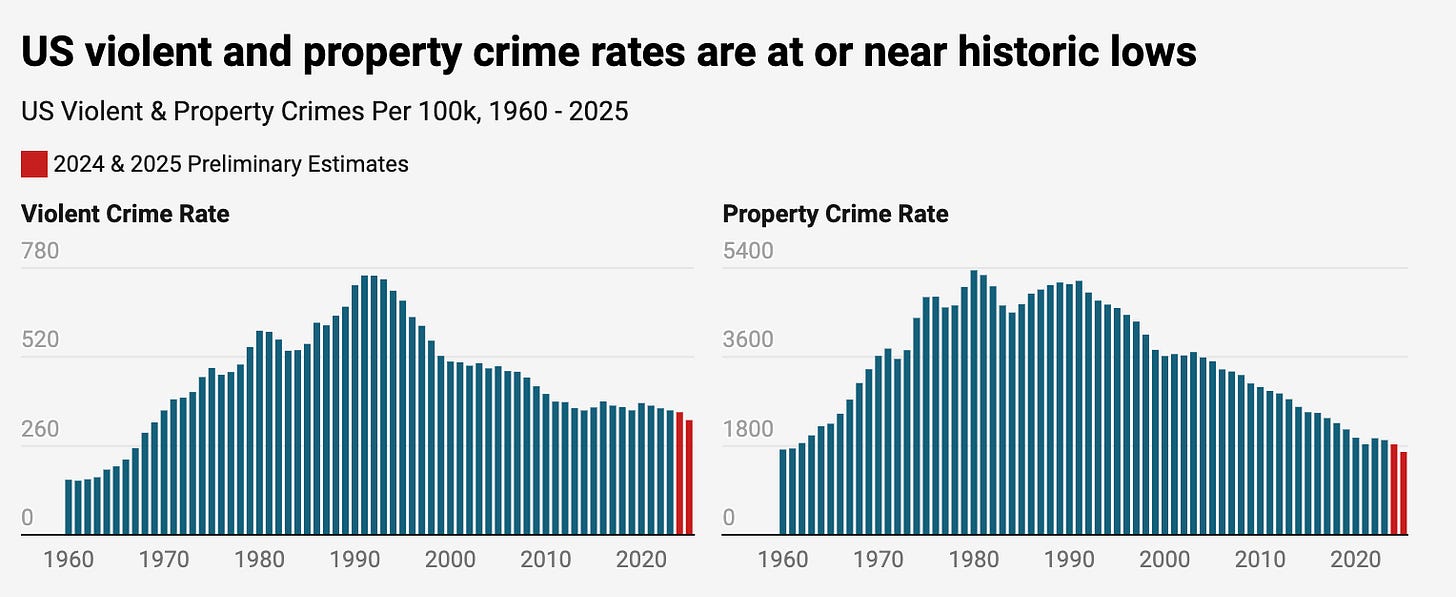
But how many headlines have you seen pointing out that Trump is destroying basic civil liberties in the name of fighting a nonexistent crime wave? There have been a few — my sense is that the media are a little more willing to call out lies about crime than lies about economics. But Trump’s hyping of a fake crime wave should be central to all reporting about his anti-immigrant policies, and it isn’t.
And then there are the attacks on universities. Not my field of expertise, but as far as I can tell the idea that universities have been taken over by wokeness, DEI, and all that is completely at odds with the evidence . Can you find antisemitism on college campuses? Of course, because you can find antisemitism everywhere. But I’m a lot more afraid of MAGA, which is infested with actual Nazis, than I am of a few leftist college students.
Anyway, no, Trump isn’t winning his trade war — except, possibly, in the media, which have apparently decided that shooting yourself in the foot and not facing retaliation is a victory.
Trump/Brazil: Delusions of Grandeur Go South
Trump thinks he can rule the world, but he doesn’t have the juice
Note: Trump announced a bunch more tariffs, some very high, late yesterday. Everything suggests that this is the new normal, unless the courts rule (as they should) that everything has been illegal. I’ll have a full analysis of the economics of Smoot-Hawley 2.0 in Sunday’s primer.
As I said yesterday , Donald Trump isn’t “winning his trade war.” He’s imposing a lot of tariffs, and so far nobody has stopped him even though his actions are clearly illegal. But “winning” a trade war, if it means anything, means using tariffs to extract meaningful concessions from other countries. And while some major trading partners, notably the European Union, are humoring Trump by pretending to make concessions, when you look at what they’re actually doing it’s just vaporware.
Is Trump an incompetent negotiator, easily hoodwinked? Maybe. But more fundamentally, he just doesn’t have the juice. The U.S. market is big, and denying other countries access to that market hurts them. But it doesn’t hurt them that much, and anyone imagining that America can use the threat of tariffs to force major policy changes abroad is suffering from delusions of grandeur.
Consider the case of Brazil.
In some ways Trump’s dealings with Brazil are exceptional, even in the context of his unprecedented break with 90 years of U.S. tariff policy. For one thing, Brazil is facing 50 percent tariffs — considerably higher than anyone else.
For another, Trump’s demands on Brazil are different in kind from what he’s demanding from anyone else. The European Union and Japan have been targeted because of alleged unfair trade practices, although exactly what these practices are has never been clear. Canada is being targeted over claims that it’s a major source of fentanyl, which is a lie but would be a real grievance if it were true. But Trump has explicitly linked tariffs on Brazil to the nation’s temerity in trying Jair Bolsonaro, the former president, for attempting to overturn an election he lost.
So Trump is an enemy of democracy and accountability for would-be authoritarians, but we knew that. Beyond that, it’s utterly illegal for a U.S. president to use tariffs in an attempt to influence another nation’s internal politics. Presidents do have considerable discretion in tariff-setting, but there are a limited number of allowed reasons for imposing temporary tariffs:
· To give a U.S. industry a breathing space against an import surge (Section 201)
· To preserve an industry essential to national security (Section 232)
· Unfair foreign practices (Section 301 and anti-dumping duties)
Presidents can also claim additional powers during an economic emergency — but Trump keeps insisting that the U.S. economy is doing great, which presumably means that there is no emergency.
Now, just about everything Trump has been doing on trade is illegal, but in the case of Brazil it’s completely blatant. I don’t think even the most cleverly unscrupulous lawyer could find anything in U.S. law that gives a president the right to impose tariffs on a nation, not for economic reasons, but because he doesn’t like what its judiciary is doing. (Famous last words?)
So the confrontation with Brazil illustrates in especially stark form the lawlessness of Trump’s tariff spree. It also, however, illustrates the gap between the amount of power Trump apparently thinks he has and the reality.
I keep seeing articles saying that the United States is Brazil’s second-most-important trading partner. That’s not even true, unless you ignore the fact that when it comes to international trade the European Union lives up to its name, presenting a unified front on tariffs. In any case, you should realize that we really don’t loom very large in Brazil’s overall export picture. Here’s the breakdown for last year:
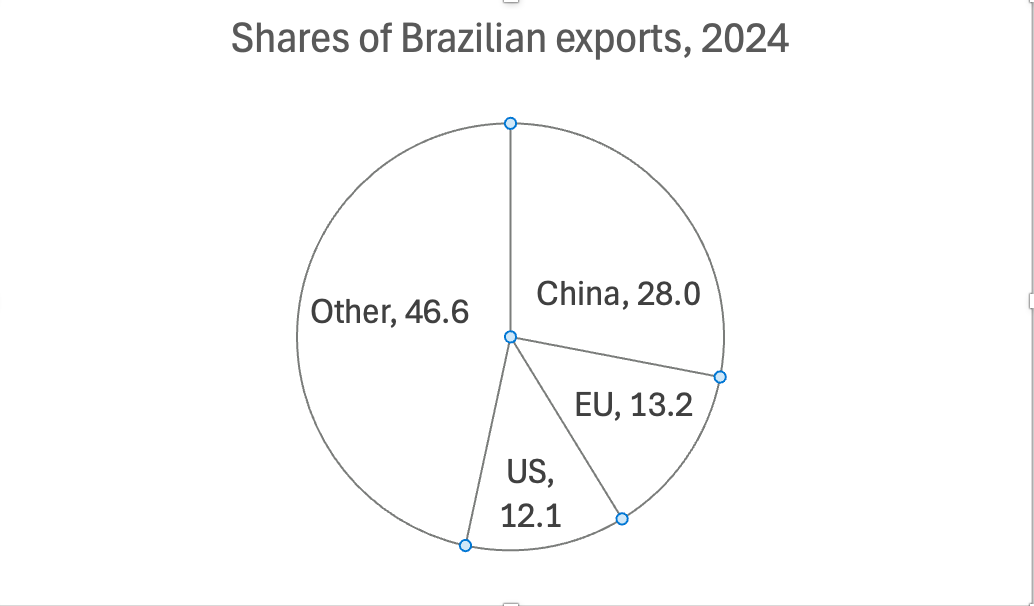
Do Trump and his advisors really think they can use tariffs to bully a nation of more than 200 million people into dropping its efforts to defend democracy, when it sells 88 percent of its exports to countries other than the United States?
Wait, there’s more: The Trump administration has exempted fresh orange juice — 90 percent of which is imported from Brazil — from its tariff. Apparently we need what Brazil sells us. And this is an implicit admission that, contrary to Trump’s constant assertions, U.S. consumers rather than foreign exporters pay tariffs.
What some of us want to know is why orange juice, which people can live without, is getting a break, while coffee, an absolutely essential nutrient, isn’t.
Sure enough, the tariffs seem to be backfiring politically. In an echo of what happened in Canada, where Trump’s pressure clearly saved the incumbent Liberal government from massive electoral losses, the threats against Brazil have done wonders for the popularity of Luiz Inácio Lula da Silva, the current president:
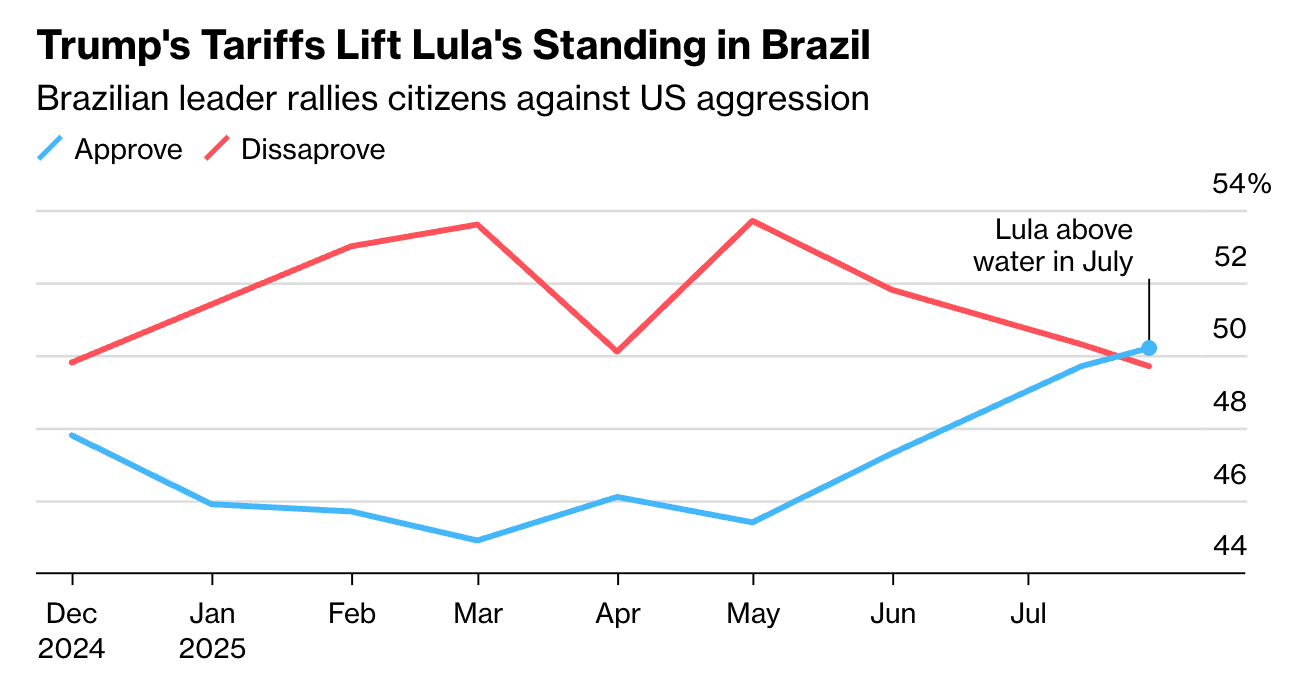
As I said, Trump may think he can rule the world, but he doesn’t have the juice, orange or otherwise. In fact, he is unintentionally giving the world a lesson in the limits of U.S. power.
Whatever
Tags
Who is online
132 visitors
China trade with Brazil is more than twice as much as with America. The EU also does more than the US.
So I'd need both "Why is this man laughing?" and "Why is this woman laughing?"
[✘]