
Job Creation Slows To A Crawl: Monthly Avg: 35,000 over Past 3 Months



Unemployment ticks up, manufacturing slumping, and participation rates and down.
It's not break glass yet, but it's remind yourself where you put the hammer.

There's been a bit of chortling among NT's MAGAs, about tariff doom-saying being proved wrong. Hold my beer...
You know how an airplane can follow a hyperbolic curve, giving its passengers a form of "free-fall"? Kinda cheating with the laws of physics? But not really, because when the plane pulls ouyt of the curve, the apparent gravity is much more that 1G.
Reality is a bitch.
 S E E D E D C O N T E N T
I well know that today is yet another Liberation Day (I was talking about it on Morning Joe at 6am!), but it’s also jobs day, so let’s dig into the jobs data, recognizing that the two are related, as I stress below.
Payrolls rose 73,000 last month, slightly less than expected, and the unemployment rate ticked up to 4.2%, as expected. But the big news is the payroll revisions—job gains for May and June underwent unusually large negative revisions, such that “employment in May and June combined is 258,000 lower than previously reported."
With July’s 73,000 increase, the 3-month average for payroll gains is only 35,000 per month; the private sector’s doing better—83,000 up in July and 52,000 per month over past three months. But as discussed below, if this job-creation slowdown persists, look for the unemployment rate to start climbing.
There’s just not a lot of heat in this report:
—The jobless rate went from 4.12% to 4.25%, i.e., just missing a two-tenths jump to 4.3%.
—The jobless rate rose 0.4 for Black workers to 7.2%, its highest since October 2021.
—Labor force participation ticked down a tenth for the overall labor force and for prime-age (25-54 year-old) persons.
— Manufacturing employment is down three-months in row for a cumulative loss of 37,000. Since its peak in early ‘23, its down 173,000. Because so much US manufacturing depends on imported inputs, I’m very concerned that Trump’s escalating trade war exacerbates this negative trend.
As I tweeted this AM , this administration refuses to face this fact re imported inputs, failing to grasp that kicking up the effective tariff rate to somewhere around 18%, the highest in a century (and in a world with much more trade), will hurt, not help, our manufacturers.
Here’s a WSJ headline on this that caught my eye:
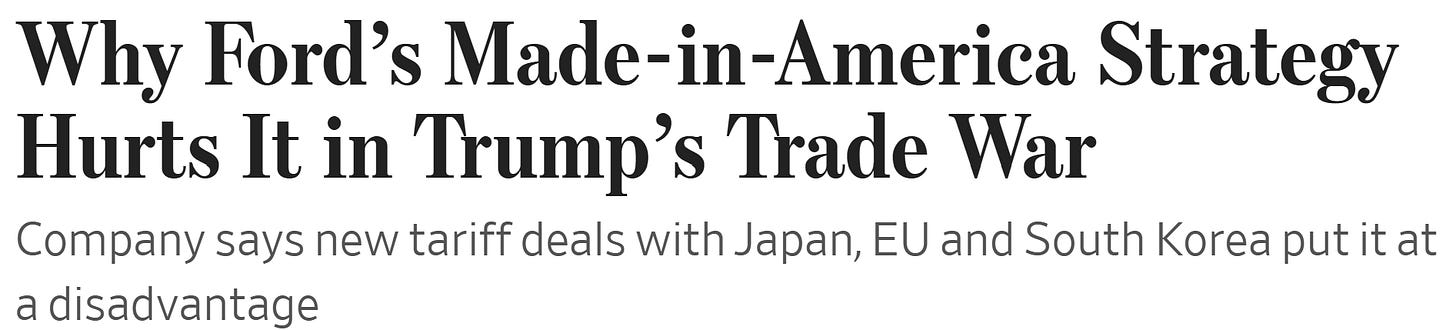
Ford “makes more vehicles in the U.S. than any other automaker,” but like most manufacturers, many of their inputs are direct or indirect imports.
Ford faces steeper tariffs on many parts as well as higher costs for imported aluminum, which is subject to 50% duties. Ford, one of the industry’s biggest users of aluminum, buys the material from U.S. suppliers who pass on a chunk of their tariff costs.
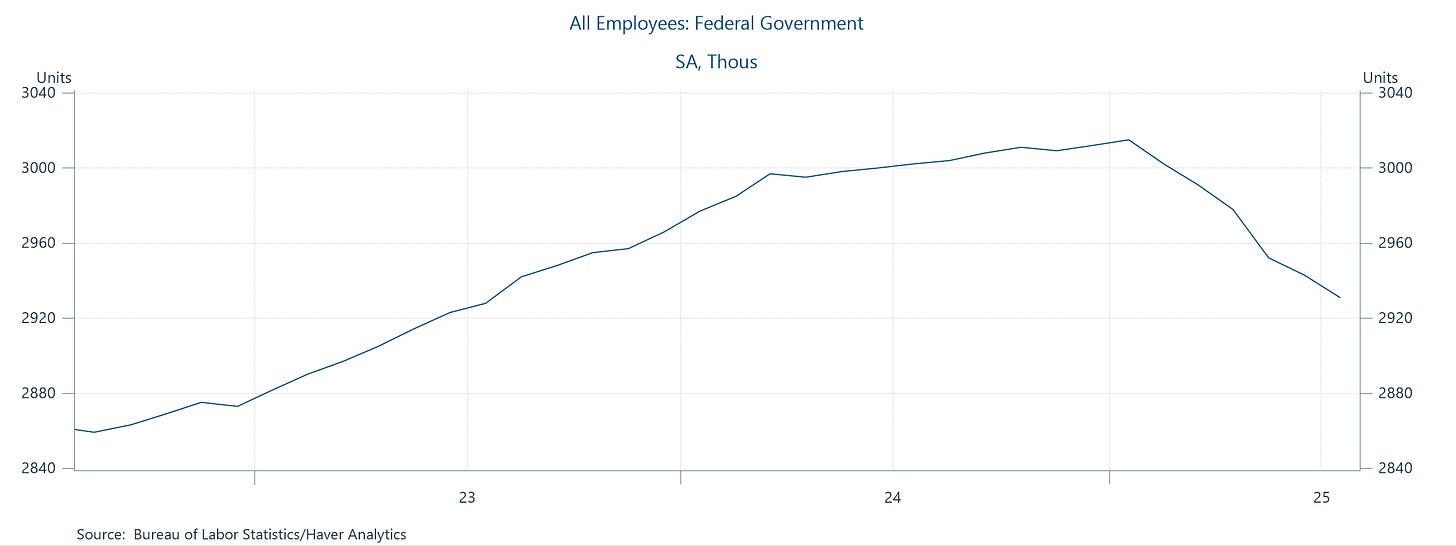
—Federal government employment continues to slide, down 12,000 in July and 84,000 since January.
A few brighter spots:
—Wage growth remains solid, at 3.9%, handily beating inflation.
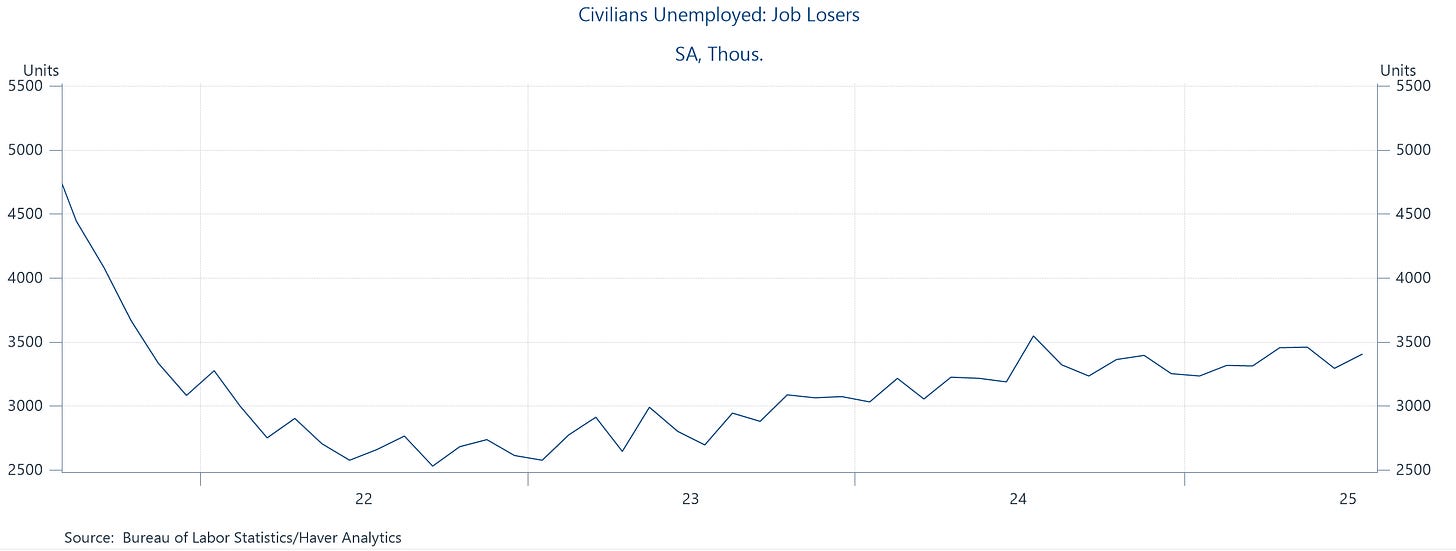
—Layoffs have been slowly trending up, but we’ve yet to see a spike that’s commensurate with severe labor market deterioration.
Finally, a few words about the Fed and the recent implicit debate between Powell and Waller on the labor market.
Federal Reserve governor Chris Waller was one of the dissenters on the Fed’s decision earlier this week to hold interest rates where they are. One of Waller’s key motivators for cutting rates is his view that the labor market is weakening :
…while the labor market looks fine on the surface, once we account for expected data revisions, private-sector payroll growth is near stall speed, and other data suggest that the downside risks to the labor market have increased. With inflation near target and the upside risks to inflation limited, we should not wait until the labor market deteriorates before we cut the policy rate.
Chair Powell, on the other hand, took the other side of that argument, repeatedly describing the labor market as solid during his presser earlier in the week.
Today’s report obviously leans Waller’s way. By “stall speed,” he means that job growth that is too low to prevent unemployment from rising. This is a reference to the “breakeven rate” which I’d put at somewhere in the neighborhood of 100,000 jobs per month right now, i.e., well above the recent trend, as per today’s revisions.
But Powell underscored another important part of this debate: labor supply. He noted the slower hiring rate (it ticked down a tenth in July), which, on its own, could put upward pressure on unemployment. But he also emphasized slower labor supply, due in part to Trump’s deportations and considerably slower immigration. Less labor supply lowers the breakeven number; if weaker labor demand (job creation) is met with weaker labor supply, the jobless rate could stay around where it is.
Here’s the excellent Jed Kolko on precisely this point :
US population growth has slowed sharply in the past 18 months, as the immigration surge of the early 2020s has ended and the population continues to age. Fewer jobs are needed to keep up with the growth of the labor force…I estimate the breakeven rate of monthly payroll growth in the jobs report needed to keep up with the labor force has fallen from 166,000 jobs in early 2024 to 86,000 jobs in June 2025.
Even if Jed’s right, we’re now trending below breakeven, though it takes a longer trend then three months to get these hydraulics moving.
The fact is that the hard data—growth, jobs, inflation—are starting to show what happens when the economy is relentlessly subjected to destructive economic policy. I can’t yet say where this leads, but what we’re seeing is consistent with what I expected, and, unless the policy onslaught reverses, we should expect more of the same.
Whatever
Tags
Who is online
92 visitors
DOGE and the Trump administration have shutdown 150,000 thousand jobs by forcing retirement, buyouts and shutting down necessary government agencies.
They are not done cutting jobs by tearing down necessary services so low job numbers are just starting. It's only going to get far worse.
Large big box stores are already announcing price increases from tariffs. Fewer customers with buying power will mean more jobs lost in retail.
Jobs will continue to decline by design even though Trump rants and fires the first person in the labor department to give the bad news on job numbers, they know those stats are true.
Firing the messenger isn't going to change the downfall in jobs and the economy.
Trump will hire the best liar for the job to appease MAGA who refuse to face the truth.