
More mad-king chaos - A Krugman twofer



About That Stock Market
The Emperor’s New Trade Deal

Chaos-monkey policies are beginning to leak into the data, so the mad-king shoots the messenger. SCREW THE DATA - THE STOCK MARKET IS FINE! Um........ no .....
The art of the deal, when one of the players has no idea what's going on...
About That Stock Market
Policy has gone mad; why aren’t stocks down?
The great majority of economists, in both the academic and business worlds, believe that Donald Trump is pursuing destructive economic policies. He has imposed high tariffs, undoing the effects of 90 years of trade negotiations. His deportation policies are already creating labor shortages and supply disruptions in multiple sectors of the economy. His Big Beautiful Budget Bill, aside from being cruel, is fiscally irresponsible. Deportations will undermine Social Security and Medicare. His drastic cuts to scientific research will undermine U.S. technology, and hence long-run economic growth.
Yet after briefly plunging when Trump announced his Liberation Day tariffs, stock prices have fully recovered. So I am often asked how this is possible. If Trump’s policies are so bad, how can the stocks be up?
My usual response is “I don’t give investment advice.” I may follow that up by quoting Paul Samuelson’s famous quip that the market had predicted nine of the last five recession.
But I thought it might be useful to say a bit more about how to reconcile the resilience of stocks with analysis showing that Trumponomics is very bad.
First, the long version of Samuelson’s quip: Stocks are not now and have never been useful predictors of the business cycle . Even when there were good reasons to be worried about a coming downturn, it’s very hard to find cases in which the stock market gave advance warning.
The way I see it, during any given period the market is driven by a narrative, positive or negative. The current narrative is strongly driven by optimism about AI. And it takes a major shock to change a market narrative. Nothing in history suggests that we should expect a really strong stock market reaction to the kinds of warnings we’re getting so far about Trumponomics.
Speaking of which: While Trump’s tariffs are very bad, there is — as I wrote in Sunday’s primer — a tendency, among both economists and other observers, to exaggerate the damage done by protectionism. Uncertainty about tariffs is definitely depressing business spending in the short run, but in that primer I estimated that Smoot-Hawley 2.0 will reduce long-run U.S. real GDP by 0.4 percent. The Yale Budget Lab, with a more elaborate model, comes up with very similar numbers:
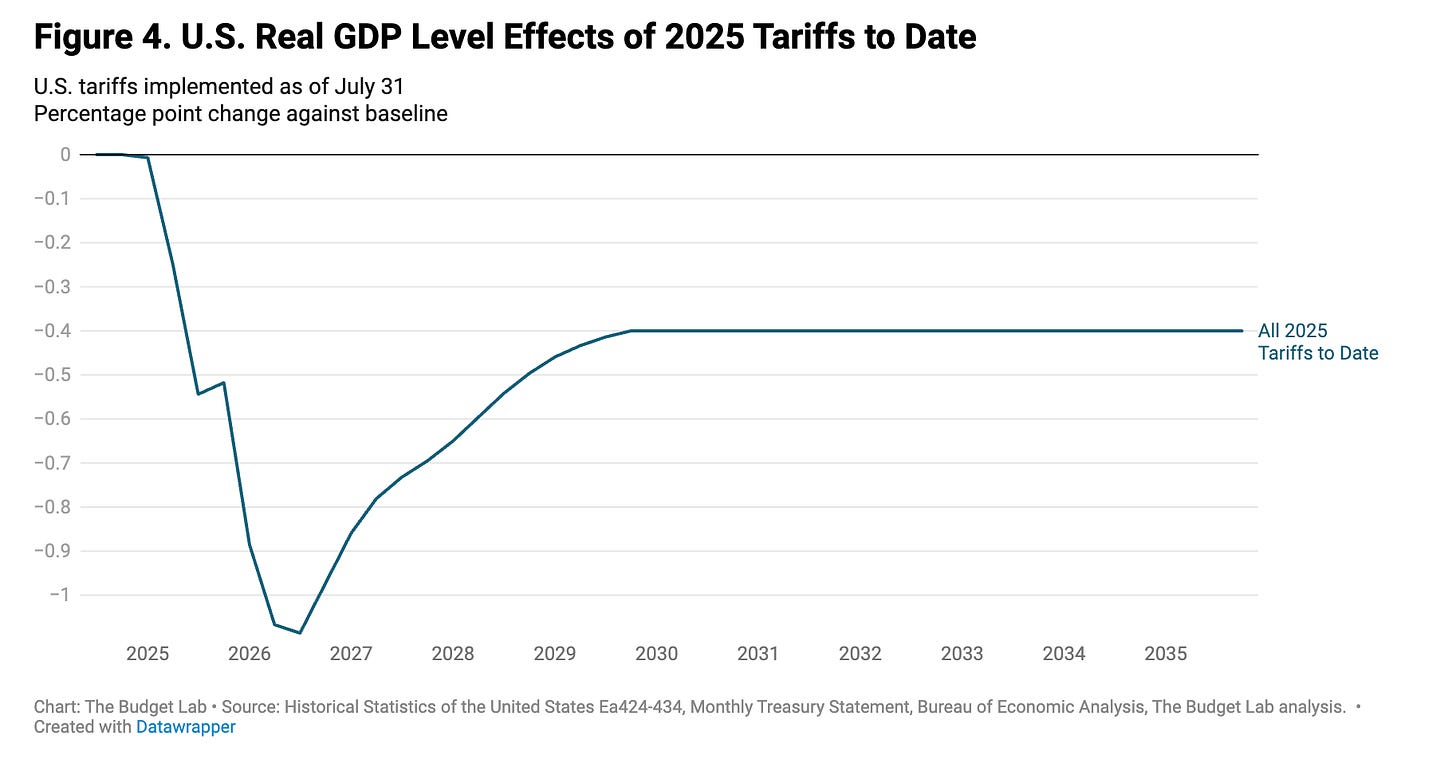
Now, losing 0.4 percent of GDP forever is a big deal. But it’s not so big that it’s hard to imagine other factors boosting stocks enough that the market goes up rather than down. I’d argue that other Trump policies, especially the evisceration of U.S. science, will eventually have much bigger negative effects on growth. But as I’ve suggested, the stock market is a lot less forward-looking than people imagine, and you wouldn’t expect these disastrous long-run policies to show up in today’s S&P 500.
Finally, Trump isn’t the only thing driving the economy and the market right now. As I mentioned, the current market narrative is largely driven by AI. And as it happens, Trump’s economic reign of error has coincided with a huge surge in investment related to AI. Here’s real spending on information processing equipment, which basically reflects the frantic construction of data centers:
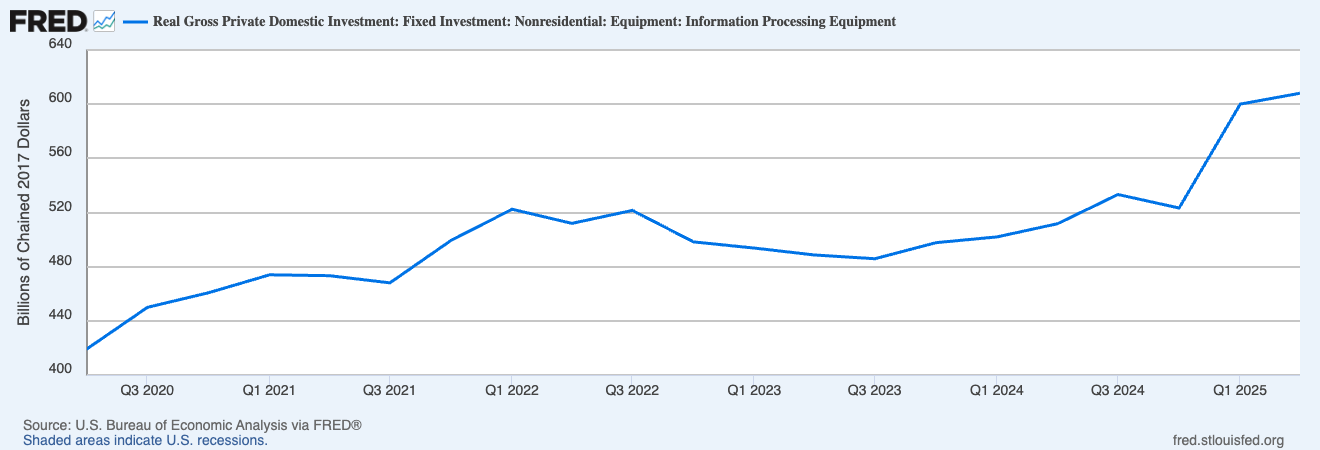
It turns out that this investment surge accounts for about half of U.S. economic growth in the first half of 2025. Without that surge we’d probably be looking at an economy at stall speed, that is, growing so slowly that it could easily slip into recession. And while stocks rarely predict recessions, they usually slump when recessions hit.
So if you ask why Trumponomics hasn’t caused a stock crash, one answer is that many of the market effects of Trump’s policies have been masked by the AI boom. In fact, there’s a pretty good case that if Trump hadn’t won and implemented his tariffs, we’d currently be dealing with overheating driven by AI spending.
Does this portend a future recession when the AI bubble bursts? Maybe. But that will have to be the subject of a future post, or maybe several posts.
Back to the question of how stocks can be up in the face of bad economic policies. To summarize my argument:
· The stock market isn’t actually a good predictor of the economy
· Trump’s policies are bad, but their medium-term adverse impact won’t be as big as many imagine
· The AI boom/bubble is masking some of the effects of bad policy
We’ll be paying for Trump’s bad policies for a very long time. But there’s no contradiction between that reality and a stock market that is holding up, at least for now.
The Emperor’s New Trade Deal
Tariffs are bad. A deluded president is worse.
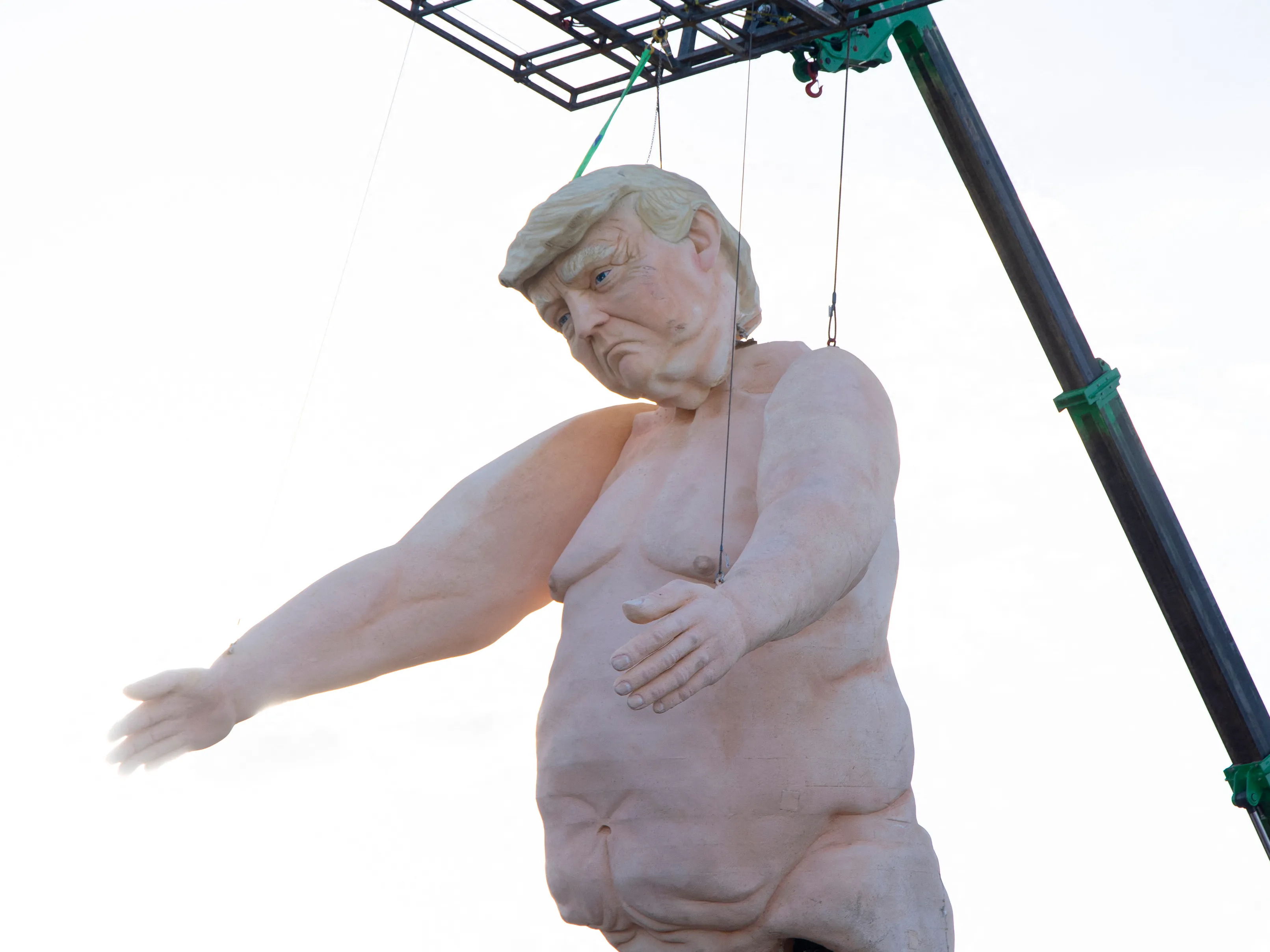
On Tuesday Donald Trump went on CNBC to explain why the European Union is facing a tariff of “only” 15 percent. But what he said was simply delusional — and the delusion should be even more concerning than the tariffs.
The Europeans, Trump asserted, had agreed to cough up $600 billion, which he described as a “gift,” not a loan. And he emphasized that this is “$600 billion to invest in anything I want. Anything. I can do anything I want with it.”
So Trump apparently believes that the European Union has agreed to provide him with a personal $600 billion slush fund.
In fact, as I pointed out after the “deal” was announced, the EU agreed to no such thing. In fact, it literally couldn’t have made such an agreement. European nations aren’t command economies in which government can tell the private sector where to invest, and in any case the European Commission, which negotiated with Trump, can’t tell the governments of member states what to do.
So think of it as the emperor’s new trade deal: Trump is strutting around, feeling very impressed with himself, but in substantive terms he’s stark naked.
Does it matter? I’ve seen some commentary to the effect that it doesn’t. Hey, it’s just another Trumpian self-aggrandizing fantasy, like his belief that we have zero inflation, he has a 71 percent approval rating and “people love the tariffs.”
But I don’t think we should feel reassured about Trump’s trade delusions because he’s lost touch with reality across the board.
What will happen if and when Trump realizes that Europe hasn’t actually promised what he thinks it has — or, as he’s likely to see it, that the EU has gone back on its promise? He’s already given us an answer: He’s going to put the tariff on Europe back up to 35 percent.
He may not be able to carry out that threat. In fact, there’s a very real possibility that the courts will rule many of the tariffs Trump has already imposed illegal (which they surely are) and order the administration to refund the money it has already collected.
But assume that the Supreme Court does its usual thing and decides that the Constitution allows Trump to do whatever he wants. How afraid should Europe be of the possibility that Trump will put the tariffs back up, higher than before?
Well, I’ve been trying to do the math, and as far as I can tell putting U.S. tariffs up from 15 to 35 percent would do less damage to Europe than many people imagine. Yes, it would hurt, but not all that much. By making a 15 percent tariff the baseline — what countries pay even if they do make “deals” — Trump has used up a lot of his trade war ammunition, greatly reducing the effectiveness of any further threats.
After all, Europe has never been all that dependent on access to U.S. markets. In 2024 the EU’s exports of goods to the United States were slightly less than 3 percent of its GDP — not a trivial sum, but not enough to make European prosperity dependent on U.S. goodwill.
Trump’s tariffs will make the EU even less dependent on the U.S. market. In Sunday’s primer I explained that the crucial number is the “Armington elasticity,” which measures how sensitive trade flows are to tariffs, and that a reasonable estimate of that elasticity is 3. If we go with that number, we would expect the 15 percent tariff currently in place to cut EU exports to America by roughly a third, to around 2 percent of GDP.
That’s a palpable hit, but not a huge one. Writing in the Financial Times , Richard Milne tells us that reports from European companies are showing surprising resilience. Furthermore, the loss of U.S. business will be partially offset by higher government expenditure in Europe, with Germany in particular boosting spending on both infrastructure and defense.
That’s with a 15 percent tariff. But what happens if Trump pushes tariffs up to 35 percent? My back-of-the envelope calculations say that this would reduce Europe’s exports to the United States by another 0.7 percent of GDP. That is, the hit to Europe if Trump makes good on his threats would be smaller than the hit he has already imposed with the tariffs he plans to keep in place regardless.
This makes sense if you think about it. The higher the tariffs Trump imposes on imports, the less other countries sell to America. And the less they sell to us, the less they have to lose if we push the tariffs even higher.
And that argument doesn’t even take into account the strong possibility that another round of Trump tariffs would provoke retaliation from Europe and other trading partners. The EU has so far chosen not to retaliate against Trump’s tariffs because its officials decided that making a deal, or at least seeming to make a deal, was better than getting into a tit-for-tat trade war. But if it turns out that Trump sees a deal not as the end of the story but simply as the jumping-off point for new demands, I suspect that even the timid bureaucrats in Brussels will eventually decide that enough is enough.
But again, at this point the math of the trade war matters less than the madness that lies behind it.
There has always been a whiff of megalomania about Trump’s tariff policy — a belief that he can use the threat of tariffs to compel other countries to do his bidding on multiple fronts, from promising not to move away from the dollar as a reserve currency to abandoning the prosecution of wannabe dictators who tried to overthrow democracy.
However, by making 15 percent tariffs the new normal — by keeping tariffs high even when countries make, or pretend to make, concessions to the United States — Trump has used up much of whatever trade ammunition he had.
However, Trump will be the last person to recognize that there are limits to his ability to bully the world, on trade or anything else. And that lack of awareness should worry us all.
Whatever
Tags




Who is online
92 visitors