
The secret of CIA’s ‘Kryptos’ sculpture, unsolved for 35 years, is up for sale


 S E E D E D C O N T E N T
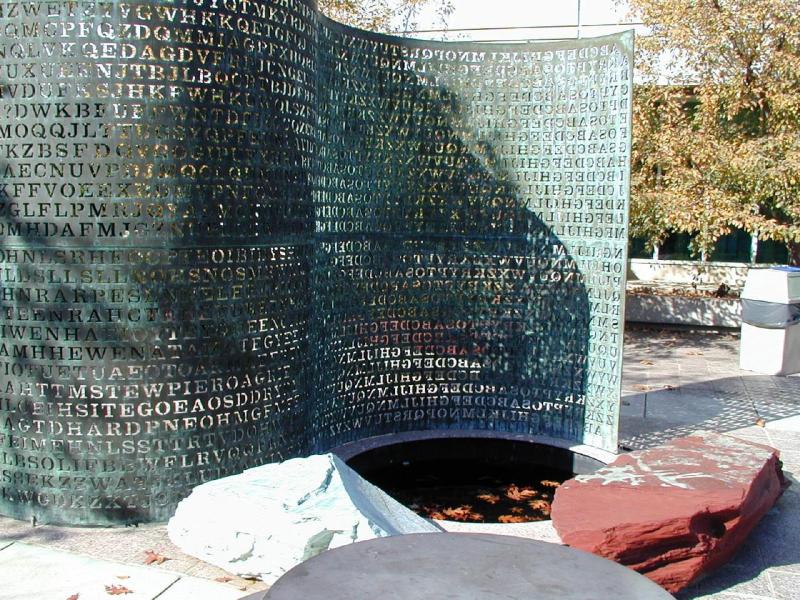
When artist Jim Sanborn talks about “Kryptos,” his sculpture at the CIA headquarters, and the famously unsolved secret code engraved in its copper panels, he sounds as if he’s talking about espionage, not art. The piece has “destroyed marriages,” he claims. It’s driven “unwanted guests” to his doorstep. Some aspiring code crackers have even “threatened my life,” Sanborn says, prompting the artist to outfit his home with panic buttons, motion sensors and cameras.
“I could keel over at any minute and I’d rest easier if I knew that things were in control somehow,” he said.
“If they don’t then (CLUE) what’s the point?” he writes. “Power resides with a secret not without it.”
The sale, which will be run by Boston-based RR Auction on Nov. 20 and whose proceeds will go in part to programs to help the disabled, includes the original, handwritten plain text of the K4 code as well as other documents associated with the work. The secret will be transferred via armored vehicle, the auction house said. It is expected to sell for between $300,000 and $500,000, according to Bobby Livingston, executive vice president at RR Auction, though he said he wouldn’t be surprised if it fetched more.
“The way cryptocurrency has really taken off, there’s a whole world out there that this appeals to,” he said.
Indeed, since Sanborn completed the sculpture in 1990, expecting its messages would be decrypted in just a couple of years, the piece has attracted a borderline fanatical cult following. It’s forged communities of decoders, been a subject of academic research, graced algebra textbooks and appeared in film, books and television, sparking a level of interest that most artists could only dream of receiving.
But managing the piece has also turned into something of a job for Sanborn, who is based on an island in the Chesapeake Bay. He has fielded tens of thousands of messages from would-be code breakers, which he says have surged amid “meaningless” AI-generated decryptions, and even instated a $50 fee for guesses to try to slow the submissions. These days, he is working on an AI-powered phone line that will respond to callers’ potential solutions, possibly using his voice.
Peter Krapp, a film and media studies professor who studies the culture of secret communications and cryptological history at the University of California at Irvine, lamented the idea of privatizing the solution through an auction, calling it “both sad and logical.” The knowledge that went into the piece “ought to be shared, not withheld — especially considering that other people, not just Sanborn, contributed to the making of Kryptos,” he wrote in an email.
Krapp says the work has become a “publicity coup” for the CIA, the public image of which has become tied to the artwork.
The piece has fascinated all kinds of people, who seem to have little in common beyond an interest in cryptography, Krapp says. “Some see it as a battle of wits, some as a test for their software, some as a hobby that keeps them engaged with cryptology after their active career at the bleeding edge has come to an end.”
For the conceptual side, Sanborn teamed up with Ed Scheidt, then the retiring chairman of the CIA’s Cryptographic Center, who spent months designing systems for encryption that Sanborn then adapted to hide his messages.
The first two portions of the piece are considered easy enough for almost anyone who has studied basic cryptography to decode. K1 translates to: “Between subtle shading and the absence of light lies the nuance of iqlusion,” an intentional misspelling. The second passage, which is longer, describes buried information and suggests “WW” — believed to be William H. Webster, the recently deceased former director of the CIA — knew where it was. The third portion, considered much more advanced, is a passage from the diary of British archaeologist Howard Carter that describes opening up King Tut’s tomb.
The fourth, of course, has yet to be cracked, and that’s not the end.
“K5 is going to be somewhat inscrutable, as well,” Sanborn said cryptically in the interview. Asked if he’s referring to more characters that will need to be decoded, he replied, “Well, I can’t say now, can I?”
Klaus Schmeh, an expert on the history of encryption, calls the progressing difficulty of the various portions a “clever strategy” to drive interest in the work. “Both the solved parts and the remaining mystery make this cryptogram attractive for puzzlers and the media,” he wrote in an email. He said he would like to see it finally solved, so “perhaps, other mysteries of this kind would then receive more attention.”
Sanborn has gone back and forth on whether he’s rooting for his code to fall. He mused to CNN in 2020 that he “wouldn’t be distraught if it ended tomorrow.”
But in a conversation about the auction this week, he appeared more sentimental.
“I’d rather it not, only because I’m an artist, and every artist is trained to make artwork which has lasting presence and lasting value,” he said, noting how one can look at a Van Gogh “a thousand times and see it in a new way.” And as long as “Kryptos” remains uncracked, there’s certainly something to look at.
Tags
Who is online
86 visitors
Pass ... I have enough trouble discerning my left side from my other left side.
I can't even decode a message when people write something in script ...
Gakdv csgpiz hvwd c c c c ui sqxed bbabbabbabab nn?
So close and yet so far ... the stuff of nightmares.
Soften the CIA's image?
My mom called them Murder, Inc