
The Rise of ‘Conspiracy Physics’

Category: Health, Science & Technology
Via: hallux • last year • 5 commentsBy: Dan Kagan-Kans - WSJ

 S E E D E D C O N T E N T
The internet is full of people claiming to uncover conspiracies in politics and business. During the pandemic, public health experts and pharmaceutical companies became popular targets. Now an unlikely new villain has been added to the list: theoretical physicists.
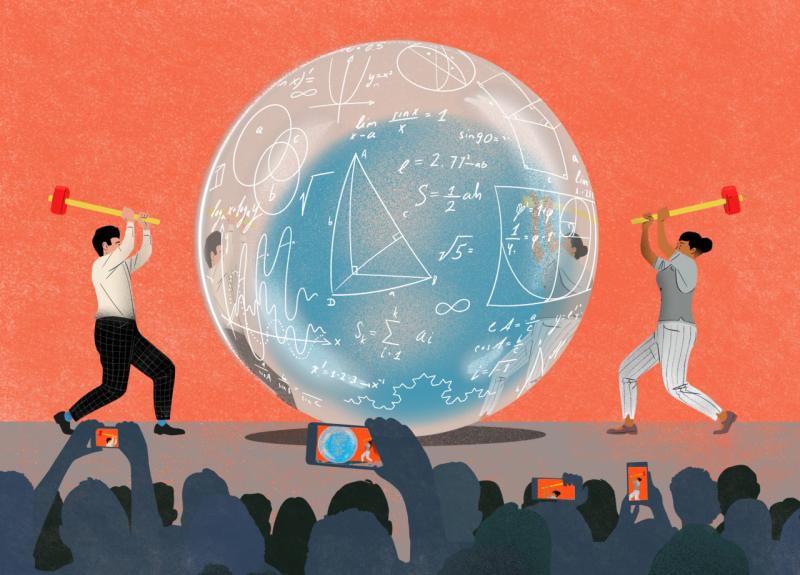
In recent years, a group of YouTubers and podcasters have attracted millions of viewers by proclaiming that physics is in crisis. The field, they argue, has discovered little of importance in the last 50 years, because it is dominated by groupthink and silences anyone who dares to dissent from mainstream ideas, like string theory.
Take Eric Weinstein, a podcaster and former managing director at Thiel Capital who coined the term “intellectual dark web.” In May, Weinstein appeared on Piers Morgan’s YouTube show to talk about Geometric Unity, his self-published theory of fundamental physics that claims to supersede Einstein and resolve some of the biggest mysteries in the universe, like what dark matter is made of.
When Weinstein complained that academia has ignored his work, another guest on the show, Sean Carroll, a physicist at Johns Hopkins University, tried to explain why by reading from it. “It says, ‘This document is an attempt to begin recovering a rather more complete theory which at this point is only partially remembered and stiched [sic] together from old computer files, notebooks, recordings, and the like dating back as far as 1983.’ And this is why this paper is not going to appear in the peer-reviewed literature,” Carroll explained. “It’s not serious. It’s a dog-ate-my-homework kind of thing.”
“How dare you,” Weinstein whispered. “Your intellectually insulting aspect reminds me of you as the Marie Antoinette of theoretical physics influencers.”
This resentment of scientific authority figures is the major attraction of what might be called “conspiracy physics.” Most fringe theories are too arcane for listeners to understand, but anyone can grasp the idea that academic physics is just one more corrupt and self-serving establishment. The German physicist Sabine Hossenfelder has attracted 1.72 million YouTube subscribers in part by attacking her colleagues: “Your problem is that you’re lying to the people who pay you,” she declared. “Your problem is that you’re cowards without a shred of scientific integrity.”
In this corner of the internet, the scientist Scott Aaronson has written, “Anyone perceived as the ‘mainstream establishment’ faces a near-insurmountable burden of proof, while anyone perceived as ‘renegade’ wins by default if they identify any hole whatsoever in mainstream understanding.”
Such renegades get a friendly reception from Joe Rogan, who regularly has Weinstein on his top-ranked podcast. Rogan’s blend of genuine interest in physics with just-asking-questions goofiness and suspicion of intellectual authority has created a template followed by other popular podcasters.
Chris Williamson, who became famous for competing on the British reality TV show “Love Island,” hosts a similar roster of scientists and skeptics on his popular show “Modern Wisdom.” “This is like ‘The Kardashians’ for physicists—I love it,” said Williamson about bitter attacks on leading physicists.
As with other kinds of authorities, there are reasonable criticisms to be made of academic physics. By some metrics, scientific productivity has slowed since the 1970s. String theory has not fulfilled physicists’ early dreams that it would become the ultimate explanation of all forces and matter in our universe. The Large Hadron Collider, the world’s largest particle accelerator, has delivered fewer breakthroughs than scientists expected when it turned on in 2010.
But even reasonable points become hard to recognize when expressed in the ways YouTube incentivizes. Conspiracy physics videos with titles like “They Just Keep Lying” are full of sour sarcasm, outraged facial expressions and spooky music. “String theory is not dead, it’s undead, and now walks around like a zombie eating people’s brains,” said Hossenfelder.
Even influencers who want to defend physics often follow the same playbook. Professor Dave, an anti-skeptic YouTuber with 3.95 million followers, has made a series of scathing videos about the controversies stirred up by conspiracists.
For a while, few professional physicists paid attention to their online critics or to calls for cleansing scientific corruption. But that’s changed as the Trump administration has cut billions of dollars from the budget of the National Science Foundation and plans to cut more. Career paths for physicists are vanishing or leading overseas. There’s a dawning awareness, Carroll says, of how much the field depends on public legitimacy.
Leonard Susskind, director of the Stanford Institute for Theoretical Physics, says physicists need to be both more sober and more forceful when addressing the public. The limits of string theory should be acknowledged, he says, but the idea that progress has slowed isn’t right. In the last few decades, he and other physicists have figured out how to make progress on the vast project of integrating general relativity and quantum mechanics, the century-old pillars of physics, into a single explanation of the universe.
In fact, cutting-edge ideas in physics can themselves sound a bit like conspiracy theories. The holographic principle, an idea first proposed by Susskind and Gerard ‘t Hooft in the early 1990s, implies that our reality might function sort of like a hologram, which is projected into three dimensions from a two-dimensional film. Ironically, the holographic principle is a favorite target of online conspiracy physicists, who attack it as not real science—untestable, impractical and simply too out there.
Dismissing difficult ideas as too wild is a core part of the appeal of conspiracy physics, allowing the audience to ignore how strange and unsettling the physical world really is. A similar kind of denial is the basis of many modern conspiracies: The moon landing was faked because humans can’t actually travel into space; 9/11 was an inside job because a plane can’t actually bring down a skyscraper. Don’t worry, these theories proclaim, crazy things aren’t possible (except for the massive cover-ups needed to conceal the truth).
Since appearing on Piers Morgan’s show, Eric Weinstein has taken to expounding additional theories about physics. Peer review was created by the government, working with Ghislaine Maxwell’s father, to control science, he said on “Diary of a CEO,” one of the world’s most popular podcasts. Jeffrey Epstein was sent by an intelligence agency to throw physics off track and discourage space exploration, keeping humanity trapped in “the prison built by Einstein.”
Didn’t you hear, Weinstein posted, Epstein sponsored a conference on gravity? When I asked Hossenfelder why she retweeted that one, she said, “There was definitely some sort of connection to the physics community. But I think a lot of people don’t know about it.”
Tags
Who is online
86 visitors
“How dare you,” Weinstein whispered. “Your intellectually insulting aspect reminds me of you as the Marie Antoinette of theoretical physics influencers.”
I believe he is referring to Marie-Antoinette Tonnelat a French theoretical physicist and not the falsely quoted Queen.
Is this guy an actual physicist or does he just play one on the interwebz?
Slightly off topic (seeder's privilege?) but it is replete with characters such as Eric:
looks like a lot of good stuff on there. When I have time, I want to read some of the stuff about chiropractic care. I've always thought that was quackery
The stuff on homeopathy is also 'fun'.