
The Beatitudes


A Call to Change the World

Warriors Come Out To Play-ay. Tabs, Fri., Feb. 6, 2026
Morning news roundup and things to read!
Rebecca Schoenkopf
February 5, 2026
The past two days have seen a growing struggle between Democrats, who are demanding accountability from the Trump administration, and Republicans trying to hide what the administration is up to.
Heather Cox Richardson
Alex Pretti’s Gun Rights
Many Trump administration claims conflict with reality.
Stephen Gutowski
Resignations, denials and excuses: Epstein fallout hits some harder than others
While the US president’s many mentions in the Esptein files seem to have no consequences, in the UK Starmer could be the first world leader to fall
Patrick Wintour, The Guardian
Something Bad Is Afoot
Tulsi Gabbard burying whistleblower complaints, Sen. Ron Wyden sending a cryptic and very public letter to the CIA director about 'CIA activities' ... not good!
Evan Hurst
Norway police investigate former PM Jagland over Epstein ties
World Economic Forum says it is reviewing the dealings of its CEO, Borge Brende, with the late sex offender.
John Power, al Jazeera
Did Trump secretly order an illegal recount of the 2020 election?
The President and his team have been caught in lies. New information is casting further doubt on the raid of a Georgia election office.
Miles Taylor
 S E E D E D C O N T E N T
Blessed are the poor in spirit, for theirs is the kingdom of heaven.
Blessed are those who mourn, for they will be comforted.
Blessed are the meek, for they will inherit the earth.
Blessed are those who hunger and thirst for righteousness, for they will be filled.
Blessed are the merciful, for they will receive mercy.
Blessed are the pure in heart, for they will see God.
Blessed are the peacemakers, for they will be called children of God.
Blessed are those who are persecuted for righteousness’ sake, for theirs is the kingdom of heaven.
Blessed are you when people revile you and persecute you and utter all kinds of evil against you falsely on my account.
Rejoice and be glad, for your reward is great in heaven.
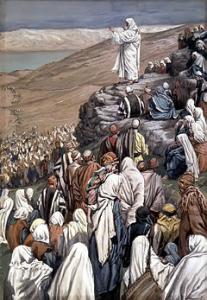
We don’t know the details of the setting, of course—the traditional images are evocations of centuries of imagination. Maybe it was a cloudy and windy day. Maybe these words were spoken inside someone’s home or a synagogue. Maybe they were shared in private only with a few intimate friends and confidants. Maybe the man never spoke these words at all and they are intended as a brief summary, written decades after the fact, of how he lived and called others to live.
But the Beatitudes are so beautifully poetic, so rich yet sparse, so gentle yet powerful, so all-encompassing and embracing that over the centuries they have seeped into the Christian ethos as the summary expression, as the “mission statement” of a religion and all it professes to stand for. The beauty and familiarity of the language can easily disguise what is most remarkable about the Beatitudes—they are a crystal clear call to radically uproot everything we think we know about value, about what is important, about prestige, about power, and even about God. They are a challenge to fundamentally change the world.
The Roman-dominated world into which these words came like a lightning bolt was not that different from our own. One’s status or rank in the social hierarchy depended on factors such as power, birth, economic status, education, gender, race—usually some combination of these. Those who lacked these qualities, whether through their own fault or because of matters entirely outside their control, had little opportunity to rise above their lowly state.
Throughout season two of “The Chosen,” Jesus’ notoriety continues to grow; about halfway through the season Jesus asks the disciples to help him plan for a “big sermon” that he intends to give soon. Some of the disciples are assigned crowd control (they are expecting thousands of people), while others are tasked with finding the perfect location for the event. Flyers are written and distributed throughout the towns around the Sea of Galilee. And Jesus asks Matthew, who has been taking notes on everything that has happened since he was called to follow Jesus some months earlier, to be his sounding board and provide critical input as he works through multiple drafts of the sermon.
By the time we reach the final episode of the season, the sermon’s content is set—except for the beginning. Creative writers and speech givers know that often the introduction is written last—Jesus goes off by himself overnight to reflect and pray. At dawn he awakens Matthew and says “I’ve got it . . . a map. Directions where people should look to find me.”
The Beatitudes follow; as Jesus blesses the poor in spirit, those who mourn, those who hunger and thirst for righteousness, the merciful, the pure in heart, the peacemakers, and the persecuted, the camera cuts to scenes of various disciples and followers who exemplify each category in Jesus’ introduction. When Jesus is finished with the blessings, with tears in his eyes Matthew asks, “How is it a map?” Jesus replies, “If someone wants to find me, these are the groups they should look for.”
Every once in a while we hear on the news or read online about a community in which a debate has arisen over whether it is permissible to put a plaque or a statue containing the Ten Commandments in a law court, a state house, or a public school. But imagine a community or a society with governing practices and policies infused with the energy, not of the Ten Commandments, but of the Beatitudes. Imagine a legislative body whose guiding North Star was the mercy and compassion of the Beatitudes rather than the cold and clinical justice of the Ten Commandments. How would such a community’s or society’s attitudes and policies concerning the poor, the disenfranchised, those who are struggling, those who have fallen through the cracks, change as it learned to see such “unfortunates” not as a problem, but rather as the very face of God?
An intriguing thought experiment, but ultimately the Beatitudes are not about transformed social institutions. They are about a transformational way of being in the world. The Beatitudes are far more than a beautifully poetic literary statement. They are the road map for how to carry faith into the real world. The world we live in is no more naturally attuned to the challenge of the Beatitudes than was the world in which they were first spoken. Individuals infected with the energy of the Beatitudes are those whose responsibility it is to help transform reality. The Beatitudes are a call to get to work.
Whatever
Tags
Who is online
77 visitors
Whan it rains, it pours. We had the Beatitudes yesterday, and then this came across my RSS feed today.
Vance Morgan is a Baptist-raised Episcopalian. Yes, that is also a thing...
If you want a litmus to separate good people from bad ones, the Beatitudes are pretty good!