
Revisiting Our Stagflation Call


I suspect a variant of this problem persists in '26, with sticky prices, low hiring, but decent growth.

Warriors Come Out To Play-ay. Tabs, Fri., Feb. 6, 2026
Morning news roundup and things to read!
Rebecca Schoenkopf
February 5, 2026
The past two days have seen a growing struggle between Democrats, who are demanding accountability from the Trump administration, and Republicans trying to hide what the administration is up to.
Heather Cox Richardson
Alex Pretti’s Gun Rights
Many Trump administration claims conflict with reality.
Stephen Gutowski
Resignations, denials and excuses: Epstein fallout hits some harder than others
While the US president’s many mentions in the Esptein files seem to have no consequences, in the UK Starmer could be the first world leader to fall
Patrick Wintour, The Guardian
Something Bad Is Afoot
Tulsi Gabbard burying whistleblower complaints, Sen. Ron Wyden sending a cryptic and very public letter to the CIA director about 'CIA activities' ... not good!
Evan Hurst
Norway police investigate former PM Jagland over Epstein ties
World Economic Forum says it is reviewing the dealings of its CEO, Borge Brende, with the late sex offender.
John Power, al Jazeera
Did Trump secretly order an illegal recount of the 2020 election?
The President and his team have been caught in lies. New information is casting further doubt on the raid of a Georgia election office.
Miles Taylor
 S E E D E D C O N T E N T
Last summer, Ryan Cummings and I wrote about stagflation —slower growth and higher inflation. We thought inflation would be closer to 3% than 2% by the end of the year (check) and that the unemployment rate would be around the mid-fours (also check). We worried that real consumer spending might slow—not check—though, as best we can tell, this slowing has occurred for lower-income households but not for higher income ones (we, of all people , should have accounted for the high-end-consumer-spending wealth effect from the AI-bubbly stock market).
But what about this year?
I’ve yet to share this imho worth-reading, new analysis from the Stanford Institute for Economic Policy Research wherein a number of authors—Ryan, Neale, ERIKA!…me—provide an efficient take on where we think things are headed re macro, markets, jobs, AI, affordability, etc.
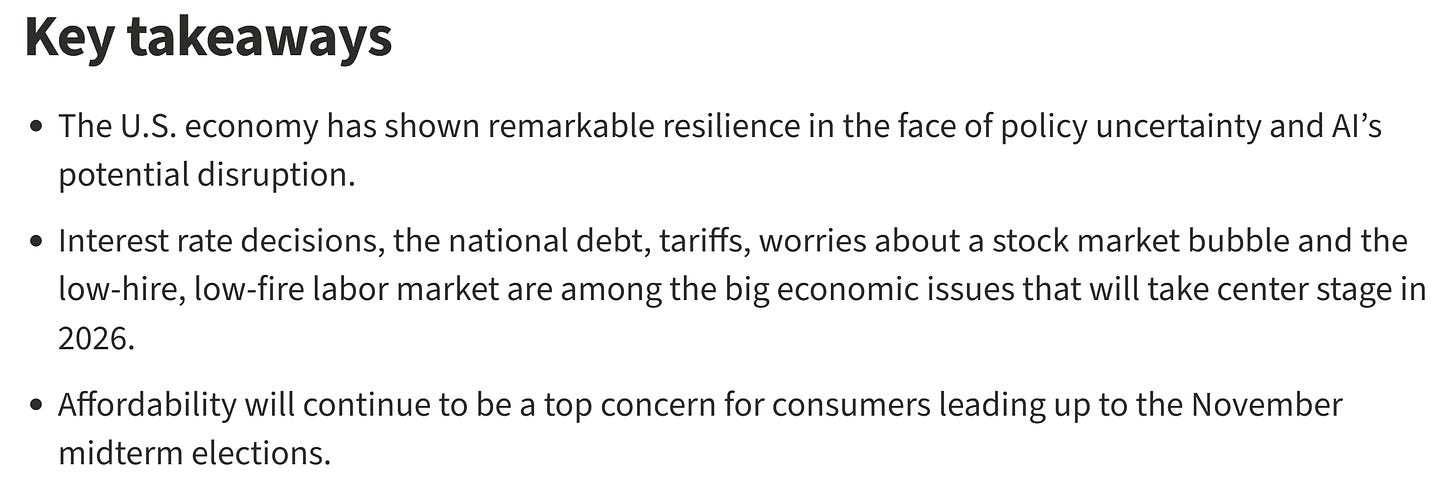
Put all of this together, add in some insights from a Brookings Event I attended yesterday on inflation, and I think we’re looking at a variant of stagnation, one wherein the job market stays uncomfortably soft, inflation stays uncomfortably elevated, yet GDP trucks along at or above trend (you may already see a conundrum herein—I’ll return to it in a moment).
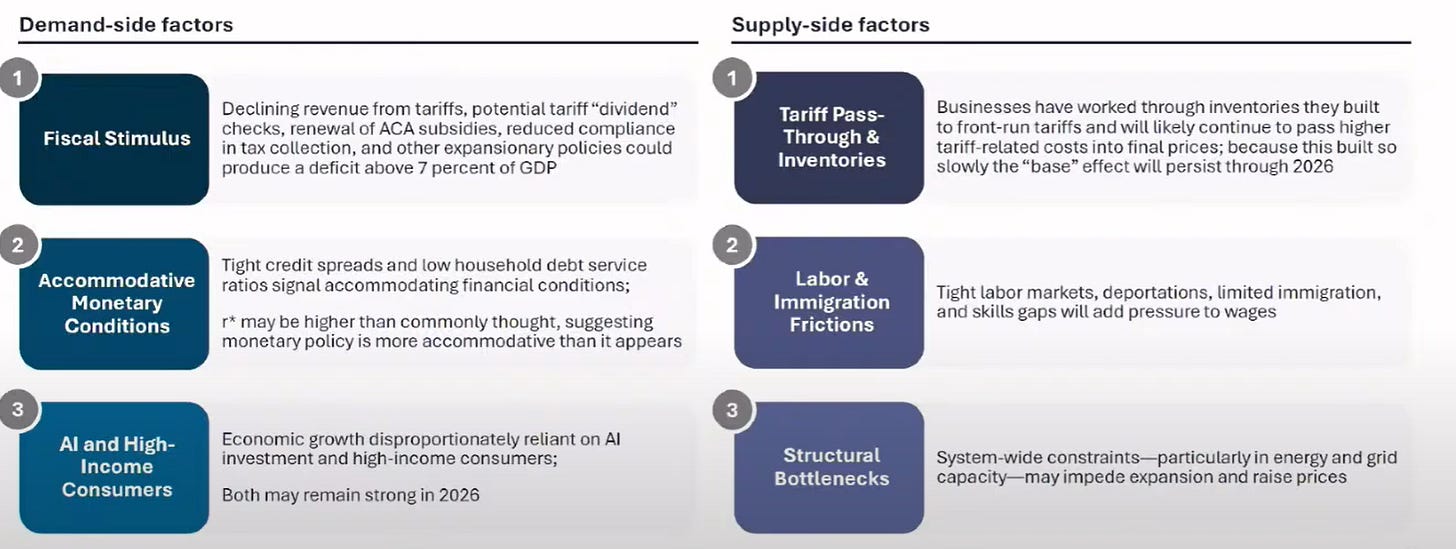
At Brookings, Peter Orszag built a case that inflation would not drift politely back down to target this year (contradicting the Fed’s base case). Peter’s case is built on the factors shown below: positive fiscal impulse from tax refunds, along with reduced compliance due to Rs shredding of IRS enforcement (a large and consequential shadow tax cut), K-shaped spending, and so on. Note his tariff point that more consumer pass-through is coming (yes, there’s the SCOTUS IEEPA case still to come…what a mess…).
It’s a plausible case, but there’s a hitch. Suppose I’m right that real GDP increases at a solid rate, say 2-2.5% this year, on the back of continued real spending, AI investment, fiscal spending, maybe some rate cuts. At the same time, as Erika argues, “meaningful downside risks” persist in the job market; we see ongoing low-hire, low-fire conditions, perhaps juiced even further by negative AI impacts on hiring.
By definition, that’s higher productivity, and higher productivity—it’s actually been somewhat elevated for awhile—is a supply-side factor that pushes back on inflation. With faster productivity, you can have more output per hour without added price pressures. To be clear, that doesn’t contradict Orszag’s case. But it suggests inflation may be more likely to stay around where it is now in the high twos rather than gliding back down to the Fed’s target.
Bottom line, not up front: I expect a variant of stagflation to persist this year, with sticky prices pressured by tariffs, deportations, Trumpian chaos delivering policy uncertainty. But GDP could power through, and stronger productivity could keep inflation from rising further.
What does this mean for average folks trying to get through their economic lives? I think it’s a problematic scenario in that regard, and that the risks to living standards in the bottom half, if not higher up the scale, persist. As we say in the SIEPR brief, affordability issues will continue to loom large, especially if inflation remains higher and stickier.
GDP’s great. Faster productivity growth is even greater. They’re absolutely necessary. But they’re not sufficient if they’re not reaching folks where it counts.
Whatever
Tags
Who is online
77 visitors
In the midst of all the harm done by Trump and MAGA, we need to remember that most Americans' biggest worry is the economy.