
Federal Reserve 101, Part II: The Global Financial Crisis of 2008 and Its Aftermath



Why the Fed did what it did and why its critics were wrong

Maine shaken by ICE raids as backlash threatens Republican Senate control
Workers and unions condemn ICE operation as ‘horrific’ as pressure builds on Susan Collins, facing re-election this year
Michael Sainato, The Guardian
TPUSA’s Halftime Show Is An All-American Tragedy
The Super Bowl is not American enough for MAGA.
Ariane de Gennaro
February 8, 2026
On February 9, 1950, Senator Joe McCarthy (R-WI) stood up in front of the Republican Women’s Club of Wheeling, West Virginia......
Heather Cox Richardson
The Glorious Spectacle of a Republican Gone Rogue
What does it look and sound like when a Republican lawmaker who has mostly been a cheerleader for Team Trump trades his pompoms for a shiv?
Frank Bruni
¡Viva La Puerto Rico!: Tabs, Mon., Feb. 9, 2026
News and things to read and watch!
Marcie Jones
Trump's Racism Isn't News
Donald Trump’s racist meme featuring Barack and Michelle Obama is shocking but utterly unsurprising.
Andy Borowitz
First Draft: 🏈 Bad Trump, Good Bunny
It’s not just the Super Bowl. MAGA’s culture war is epically backfiring. And as a blue wave builds, Trump is only escalating his crackdowns.
Asawin Suebsaeng
JD Vance Wins Gold In Getting Booed By Entire World
Protests! Athletes using their platforms for good! Olympics!
Marcie Jones
Donald Trump's opponents have something he does not. And it will bring him down.
The president's greatest vulnerability was staring us in the face all along
Miles Taylor
 S E E D E D C O N T E N T
Donald Trump has chosen Kevin Warsh , a harsh critic of the Federal Reserve who has called for “breaking some heads,” as the next Fed chair. Last week I wrote about what the Fed is and what it does. Today I’ll talk about the Fed’s policy record, with emphasis on the criticisms offered by Warsh and others.
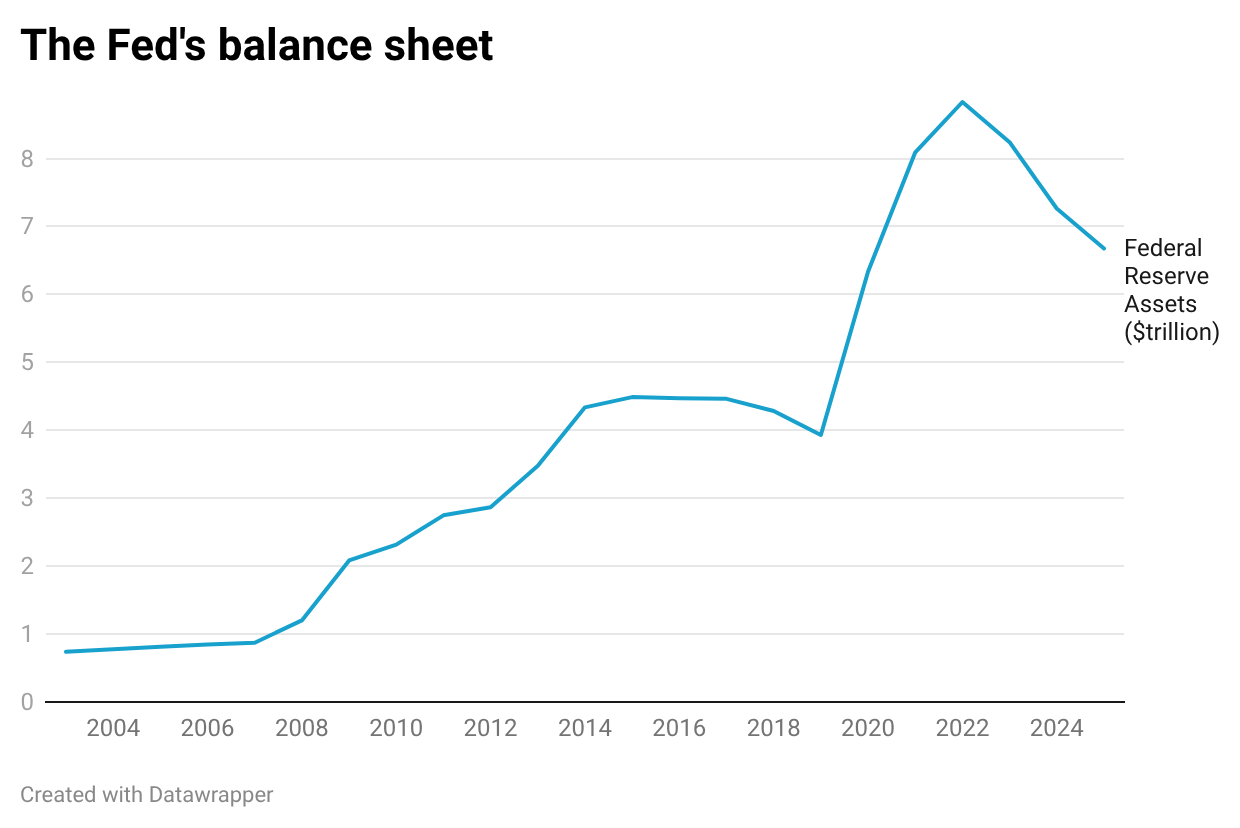
The history of the Fed is inextricably intertwined with the history of the U.S. economy. You can’t understand the Fed’s policy choices — how, for example, it came to own more than $8 trillion in assets — without understanding the challenges it faced. So today’s post will be structured around historical events and the Fed’s policy responses.
I don’t want to go too far back. There are huge controversies about Federal Reserve policy and its effects during the stagflation of the 1970s, and for that matter during the Great Depression of the 1930s. But these historical controversies aren’t directly relevant to current policy debates.
Nor, I realized while drafting this post, is this the place to discuss recent events — in particular the post-Covid inflationary shock of 2021-2023. To include the debate over that shock would make this post too long. So that’s for next week.
Today I will focus on events and policy disputes after the mid-1980s but before Covid. As I explained last week, by 1985 the Fed’s tight money policy, under the direction of Fed Chair Paul Volcker, had broken the back of persistently high inflation – a hangover from lax monetary policy during the Nixon Administration and oil shocks. Taming inflation cameat a high cost -- an extremely severe recession.
In the aftermath of those epochal events both the U.S. economy and Federal Reserve policy settled into an extended period of relative calm, which economists sometimes call the Great Moderation. However, calm never lasts. In 2008 the United States and the world economy as a whole were wracked by the global financial crisis. The Fed’s response to that crisis was deeply controversial, with harsh criticism coming especially from the political right.
Then, just as the Fed was trying to “normalize” its policies, Covid struck, followed by a severe bout of inflation. The Fed’s response also remains deeply controversial — but that’s for the next primer.
Why does this history matter? Because, to a remarkable extent, attacks on the Federal Reserve today are coming from the same people who were vituperatively critical of the Fed during the global financial crisis and its aftermath. Over time, the Fed’s choices in response to the crisis were overwhelmingly vindicated by the economy’s response to those choices, which refuted the claims of the Fed’s harsh critics. But the turning of the political wheel has now put the people who were proved wrong about monetary policy in charge of Trump administration policy. And, in the person of Kevin Warsh, in charge of the Fed itself. So monetary policy disputes from the global financial crisis era remain all too relevant.
Federal Reserve policy before the global financial crisis
The US entered the 1980s with double-digit inflation, which the Volcker Fed brought down with four years of tight monetary policy: a sharp reduction in the growth of the monetary base, which led to soaring interest rates. This policy caused a severe double-dip recession with unemployment rising above 10 percent. But the medicine worked: by 1985 inflation had subsided to around 4% and the economy was recovering strongly. Inflation continued to drift down gradually over the years that followed, allowing the Fed to eventually set 2 percent as its inflation target. And between 1985 and 2008 the real economy was relatively calm. True, there were two recessions: a slump in 1990-91 driven largely by problems in commercial real estate, and a slump in 2001 caused by the bursting of the 90s technology bubble. Both resulted in extended periods of relatively high unemployment. But neither recession was as severe as the Volcker recession of 1979–1982 or the recession caused by global financial crisis of 2007-2009.
An aside: How does the Fed assess inflation? It uses the Personal Consumption Expenditure price index (PCE), which is similar to the Consumer Price Index but differs slightly in detail. In particular, the Fed focuses on “core PCE,” which excludes food and energy prices. This is not because the Fed doesn’t think the prices of groceries and gasoline matter, but because they’re highly volatile. Experience has shown that “looking through” their fluctuations gives a more accurate assessment of underlying inflation. Here’s headline and core PCE from 1985 until the eve of Covid:
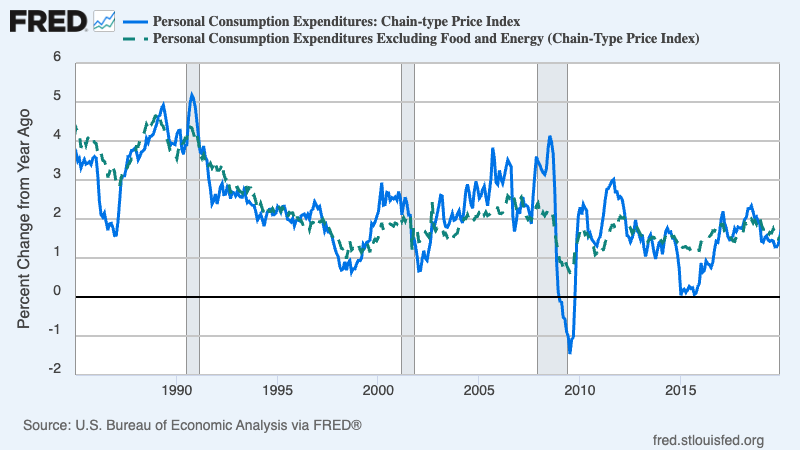
Headline inflation — the solid blue line — fluctuated erratically over this period, with some big ups and downs associated with fluctuations in world oil prices. However, these fluctuations always proved temporary, while core inflation — the dotted green line — was fairly stable until the post-Covid shock.
Now on to policy. As I explained in last week’s primer, the Fed is effectively able to set the Federal funds rate, an overnight interest rate, through open market operations . Before the financial crisis, these operations always involved purchases and sales of short-term U.S. government debt. I should have clarified that in recent years the Fed has used other tools that it also considers forms of open market operations, as well as changing the interest rate it pays on reserves .
The details don’t matter much: The Fed has always been able to set very-short-term interest rates. These very-short-term rates, in turn, influence but don’t fully determine longer-term rates, which exert the most influence over the economy. For example, Fed rate cuts since 2024 have been reflected in a significant decline in interest rates on car loans , but so far only a small reduction in mortgage rates .

From 1985 until the global financial crisis, with inflation fairly low and stable, the Fed adjusted interest rates mostly in an attempt to keep the economy on an even keel. It cut rates (solid blue line in chart below) when unemployment (dotted green line) was high, hoping to boost the economy. It raised rates when unemployment was low, attempting to avoid an overheated economy that might lead to higher inflation:
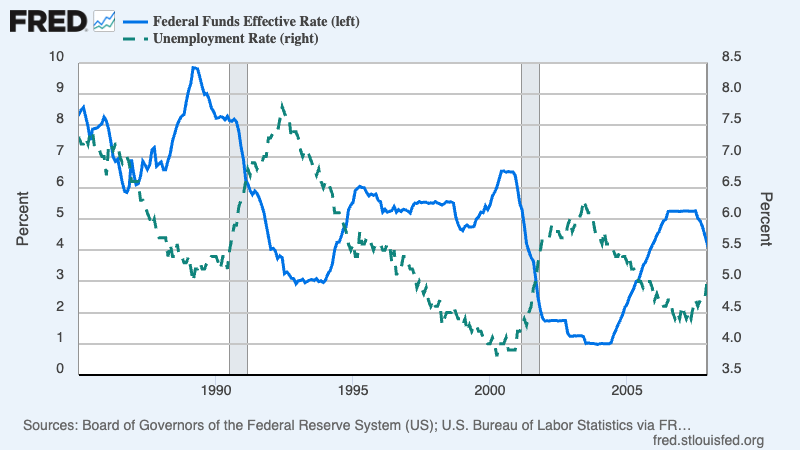
The Fed itself and many outside observers considered this to be a period of highly successful monetary policy. Alan Greenspan, the Fed’s chair from 1987 to 2006 — almost the whole period — was treated with almost worshipful respect. And there was widespread belief that the problem of monetary management had been largely solved.
Not so much, it turned out.
Federal Reserve policy during and after the global financial crisis
US economic recovery from the bursting of the 90s tech bubble was driven by a housing boom — a boom that, as eventually became clear, turned into a housing bubble. The same dynamic was also taking place in Europe. When that bubble deflated, starting in 2005, the economic consequences were severe. Real estate is a very big sector: The plunge in housing prices when the bubble burst wiped out wealth equal to 40 percent of GDP, the equivalent of $12 trillion today. The plunge in home construction slashed total spending by more than 4 percent, the equivalent of a trillion-dollar plus hit today.
The housing bubble was financed in large part by loans from “shadow banks” — institutions that operated like banks in many ways, but were neither regulated like conventional banks nor backstopped by federal deposit insurance. In fact, shadow banks grew as a way of skirting government regulations on banking. However, that lack of regulation made them vulnerable to old-fashioned bank runs if the public lost confidence. And that’s exactly how it played out: the housing bust led to enormous losses in the shadow banks, which in turn created a 21 st -century version of the bank runs of the early 1930s. Financial disruption intensified the “Great Recession” – the worst slump since the Great Depression of the 1930s.
After Lehman Brothers – a prime nexus in the shadow banking system -- failed in September 2008, the U.S. financial system was in full-blown panic as financial markets froze. But the Fed did what it didn’t do in the 1930s – in 2008 it moved aggressively to contain the panic. In particular, the Fed quickly set up special lending facilities to provide credit where the private sector suddenly couldn’t or wouldn’t. For example, the Fed created a Commercial Paper Funding Facility to buy short-term business debt in order to satisfy the liquidity needs of businesses across the country. This facility quickly bought $350 billion in such debt, then wound down its holdings as the financial system eventually stabilized.
Unlike in the 1930s, the American financial system did stabilize, thanks to the Fed’s actions and other emergency measures. By the summer of 2009 the panic had subsided, and the financial system was operating more or less normally.
However, the economy as a whole was not OK. The housing bust and financial panic caused the worst economic slump since the 1930s. The Fed responded by slashing the Fed funds rate (the solid blue line) from 5.25 percent in July 2007 to zero by the end of 2008, in the hope that low interest rates would spur borrowing and lift the economy.
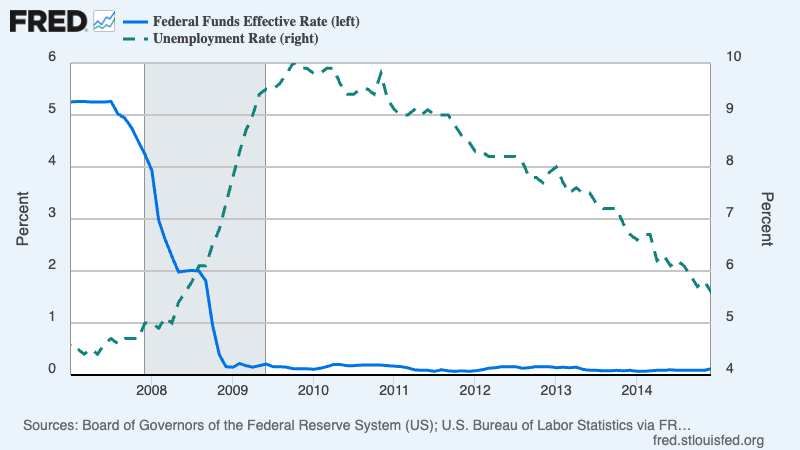
But the slump was so deep that zero interest rates weren’t low enough to revive the economy. Furthermore, the Fed couldn’t cut interest rates below zero: if they did people would just have accumulated piles of currency rather than depositing in banks who would turn them into loans. Thus the Fed found itself in a situation in which the normal monetary policy tool – the interest rate – was inadequate because the economy was so deeply depressed.
This problem — known either as the “zero lower bound” or, for historical reasons, as the “liquidity trap” — wasn’t a complete surprise either to economists or to the Fed. It was recognized as an issue in the 1930s. Although largely forgotten, it resurfaced in 1990s Japan, where zero interest rates weren’t low enough to stop persistent deflation. And while many U.S. economists dismissed Japan’s problems as irrelevant to America, some did not.
In particular, in the early 2000s there was a small group of U.S.-based economists (some were foreign nationals), which Scott Sumner calls the Princeton School, who were deeply troubled by Japan’s problems and saw them as something that could happen here — which they did. I was one of those economists. Another was Ben Bernanke, who would soon move to the Fed and become chair in 2006, just in time for the crisis.
In research papers written before the crisis, Bernanke argued that the Fed could gain traction, even at the zero lower bound, by using other tools at its disposal – mainly by expanding the menu of assets it buys. Historically the Fed conducted open-market operations only in short-term federal debt, typically 3-month Treasury bills, which had a near-zero yield by the end of 2008. But longer-term interest rates, such as the yield on 10-year bonds, were still positive. Bernanke and others asserted that buying these long-term bonds could boost an economy at the zero lower bound by pushing down long-term interest rates.
The Fed began putting these ideas into practice in November 2010. The Fed calls what it was doing LSAPs, large-scale asset purchases. Everyone else calls it by another of those obscure names with historical roots that for some reason are pervasive in monetary affairs: “quantitative easing” or QE for short.
During the heat of the crisis, the Fed instituted emergency support programs that resulted in a much larger Fed balance sheet – that is, the value of the assets it owned. Once QE began, however, the Fed balance sheet doubled again. The Fed purchased long-term bonds from banks, paid for by adding to bank reserves held at the Fed (as usual, with money created out of thin air). Thus, because bank reserves are a component of the monetary base, QE led to a huge expansion of the monetary base.
QE was deeply controversial — a controversy that resonates to this day, especially in Kevin Warsh’s attacks on the institution he is going to lead. So let’s take a look at that controversy and what the evidence says.
The debate over quantitative easing
The Fed’s decision to begin quantitative easing wasn’t an obviously political choice. It can be, and I would argue should be , seen as a logical response to a liquidity trap – that is, the problem of persistently high unemployment with zero short-term interest rates.
Yet criticism of the Fed’s actions came overwhelmingly from one side of the political spectrum. This probably reflected conservatives’ general aversion to activist policy combined with opposition to boosting the economy while a Democrat was president.
Most famously, in 2010 a Who’s Who of conservative intellectuals — only some of them with backgrounds in economics — circulated a harsh open letter to Bernanke demanding that he call off his plans. The letter warned that “the planned asset purchases [that is, QE] risk currency debasement and inflation.” Kevin Hassett, who is now head of the National Economic Council and was on the short list to become Fed chair, was one of the signatories. Kevin Warsh, who was then on the Fed’s Board of Governors, would have been barred from signing the letter, but his speeches at the time suggest that he held similar views.
The intellectual basis for the open letter’s warning was the correct observation that QE would lead to a large rise in the monetary base. And under normal conditions you would in fact expect a very large rise in the monetary base to lead to inflation, as it had in the 1970s.
But economists who had thought seriously about monetary policy at the zero lower bound were quite sure that Bernanke’s post-financial-crisis monetary expansion would not be inflationary. I addressed this issue specifically in a 1998 paper inspired by Japan’s problems that I think can fairly be considered the starting point for modern liquidity trap theory. That paper argued on theoretical grounds that a big expansion of the monetary base would just sit there in bank reserves rather than fueling inflation. I also showed that this was in fact what happened in the 1930s.
Moreover, Japan itself instituted a program of quantitative easing between 2001 and 2006 , which not only didn’t cause inflation -- it didn’t even stop deflation.
So the Bernanke Fed was confident that it wasn’t risking “currency debasement.” And it was right. The chart below compares growth in the monetary base (solid blue line) with the rise in consumer prices (dotted green line) from August 2008, just before Lehman fell, to the end of 2014:
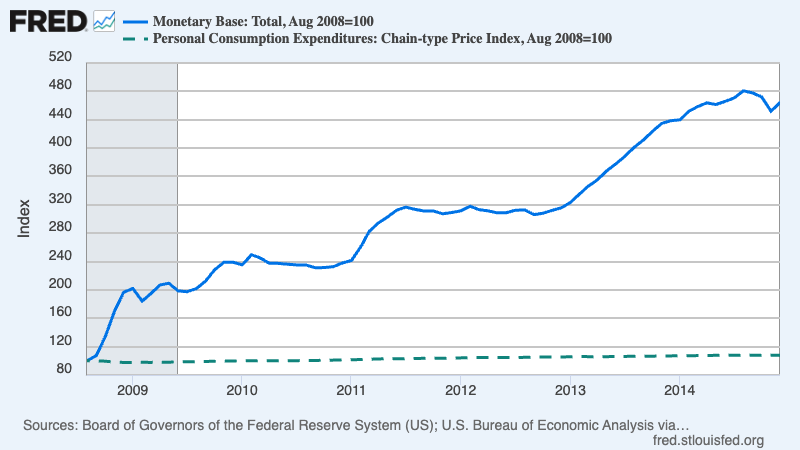
The monetary base increased almost fivefold over that period, with no visible effect at all on consumer prices.
In 2014 Bloomberg contacted some of the signatories to the 2010 letter, to get their reaction to the failure of their inflation warnings to come true. None of those contacted would admit to having been wrong.
Nor did prominent critics of the Bernanke Fed let up on their criticism in the face of compelling evidence that their warnings had been a false alarm. Instead, the nature of their criticism shifted in a completely different direction. Rather than continuing to argue that quantitative easing was inflationary, they began arguing — equally strenuously — that QE was distorting capital markets.
A good and obviously relevant illustration of this pivot was a 2015 Wall Street Journal op-ed by Michael Spence and none other than Kevin Warsh titled “The Fed Has Hurt Business Investment.” Larry Summers (I know, I know) called it “the single most confused analysis of U.S. monetary policy that I have read this year.” It’s certainly confusing and hard to parse. But the core argument, as I read it, was that QE has driven up asset prices, and that as a result “QE has redirected capital from the real domestic economy to financial assets at home and abroad,” that the Fed’s policy had “bias[ed] investments to paper assets over investments in the real economy.”
This argument conflates two different meanings of the word “investment.” When we talk about business investment, we mean spending on capital goods like buildings, equipment and software — spending that consumes real resources. We use the same word for purchases of stocks and bonds, but buying paper assets doesn’t use real resources — it’s just a transfer of money from the buyer to the seller, and there’s always seller for every buyer. An individual can choose to buy paper claims rather than build stuff; the economy as a whole can’t. So the critique that the Fed, by buying long term bonds in exchange for credits to banks’ reserves, somehow lowered overall spending on capital goods in the economy just doesn’t make sense. Hence Summers’ ire.
Overall, is there any solid evidence that QE damaged the economy? Not that I’m aware of. So why the vehemence? The best guess is that attacking QE for causing economic distortions circa 2015 was a way to retroactively justify previous attacks on the Fed, even though the Fed was right and the critics were wrong about inflation.
All that being said, did QE succeed in its goal of boosting the economy and reducing unemployment? There is a huge research literature on that question, which is distressingly short on clear results. Some economists believe that it did help, although unemployment remained high for a long time despite QE. Others, myself included, remain skeptical to this day.
That’s not a ringing endorsement for a program that, as the chart that opened this post showed, led to a huge expansion of the Fed’s balance sheet, more than $8 trillion at its peak. But it’s not clear that this large balance sheet does major harm. True, the federal government pays part of the interest on its debt to the Fed rather than to the public. But the Fed pays interest on bank reserves, so federal interest payments still flow to the private sector, just indirectly.
As I see it, the furor over QE was, in retrospect, much ado about not much. But the legacy of the debate over quantitative easing hangs over current events.
Why this history matters now
The big debates about post-crisis monetary policy were a long time ago, and the world today looks very different, especially after the big post-Covid spike in inflation — which I’ll talk about next week. But as I said, the turning of the political wheel has brought the Fed’s post-crisis critics to power, even though they were wrong. And they haven’t given up. While Kevin Warsh criticizes the Fed over the inflation of 2021-2023, his insistence that the Fed has lost its way and needs fundamental reform, including breaking heads, still centers on claims that the Fed’s big balance sheet is a huge problem .
So it’s important to understand that the Fed didn’t end up with a lot of assets as a result of some runaway attempt at empire-building. It bought assets in an attempt to help the economy through a very difficult period. And the initial attacks on that effort, from the same people now demanding fundamental change, were dead wrong about the economic consequences.
Still, are they right now? To be continued …
Whatever
Tags




Who is online
86 visitors