
Krugmanpalooza



Billionaires gone wild
How the Kakistocracy Became a Quackistocracy
Turning Our Back on Clean Energy
Who Is Paying the Trump Tariffs?

Understanding the Power of Revealed Preferences in Gov't Spending
Why the claim that "Washington's spending is out-of-control!" is nonsense.
Jared Bernstein
History Shows How the Transition to Tyranny Begins: By Punishing the Weak and Defying the Courts
From Hitler to Putin to Orbán and Trump, the first step is always the same: act illegally, dare anyone to stop you, and behave like losing in court is only a delay…
Thom Hartmann
Judge Ruins Trump Admin's Plans For Orwellian Removal Of Slavery Exhibit
Ignorance is strength!
Robyn Pennacchia
FALSE HERRING! Tabs, Wed., Feb. 18, 2026
Read this post for all the latest news of wearing jeans in saunas.
Evan Hurst
The Boss strikes back!
Lucian K. Truscott IV
The American Revolution Started Over This Kind of Abuse: Have We Forgotten?
Once the government decides who qualifies for Fourth Amendment protection, rights stop being rights and start being privileges handed out by those in power…
Thom Hartmann
The Fallacy Fallacy
Why you shouldn't go looking for faulty reasoning everywhere.
Maarten Boudry
Attacking AOC While ‘Sanewashing’ Trump
Prem Thakker
Laissez Les Bons Temps Rouler! Tabs, Mardi Gras, Tues., Feb. 17, 2016
Drink 'em if you got 'em.
Evan Hurst
Why Is Trump Strangling Cuba?
How Miami elites may be behind the current blockade causing a humanitarian crisis in Cuba.
Juan David Rojas
The Sound of Freedom Shattering at 3 AM
The danger the Bill of Rights was written for isn’t the one Americans usually watch for.…
Thom Hartmann
Billionaires Gone Wild
Understanding the oligarchs’ power grab and the dire threat to American democracy
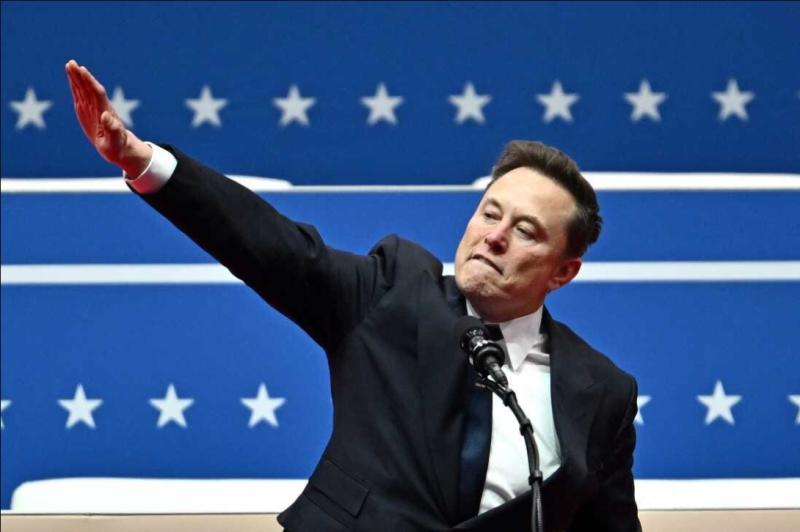
A few stories about centibillionaires — men whose net worth exceeds $100 billion — and their role in our society:
· In 2022 Elon Musk, the richest man in the world , purchased Twitter . Since then he has turned the platform into a racist cesspool, overrun by literal Nazis.
· Last year Skydance Media , run by David Ellison — the son of Larry Ellison, the world’s 6 th richest man — acquired Paramount, which includes CBS. The new management put Bari Weiss, a conservative pundit with no relevant experience, in charge of CBS News. The network that once featured Edward R. Murrow has been going downhill ever since. On Tuesday night CBS management, responding to an obviously partisan demand from the Trump-appointed head of the FCC, prevented Stephen Colbert from running an interview with Democratic Senate candidate James Talarico.
· Paramount is now trying to acquire Warner Brothers, which would give the Ellisons control of CNN.
· Jeff Bezos, the world’s 5 th richest man, bought the Washington Post in 2013. He followed a hands-off approach for a decade, but in 2024 he began heavily intervening, preventing an endorsement of Kamala Harris, then requiring that the opinion section focus on “personal liberties and free markets.” He has now gutted the newsroom, leaving the paper that brought down Richard Nixon a shell of its former self.
Furthermore, standard measures of political spending show an explosion of billionaire money seeking to influence American elections. Since the Roberts Supreme Court’s “Citizens United” ruling the percentage of total contributions accounted for by billionaire money has skyrocketed:
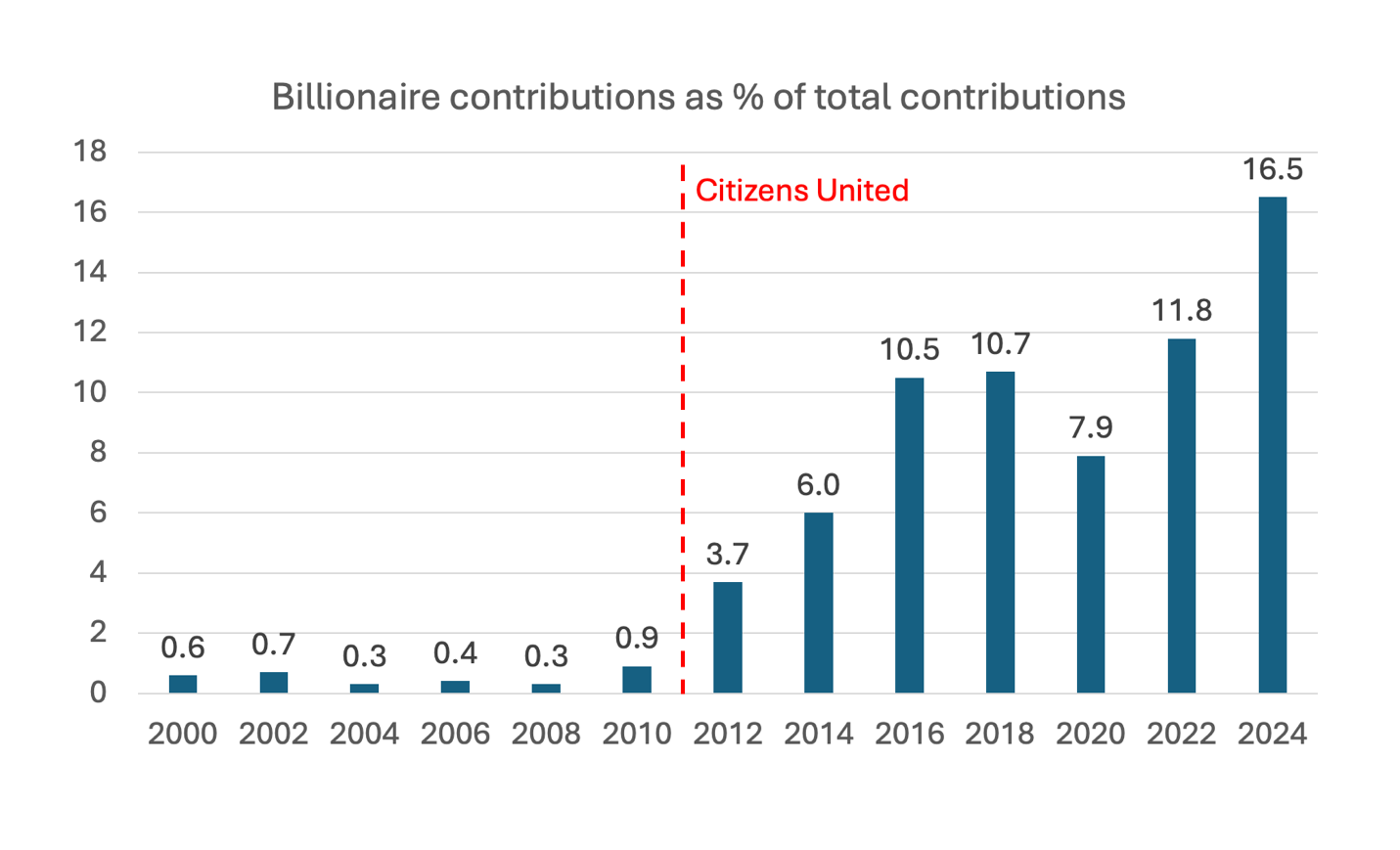
Source: Americans for Tax Fairness
For those who need a refresher, Citizens United was a 2010 ruling by a narrow majority on the Supreme Court that effectively removed all restrictions on political spending by wealthy individuals and corporations. Such spending must be undertaken by nominally independent organizations, but in practice so-called Super PACs (political action committees) coordinate closely with candidates and parties. The result of the ruling, which you can see in the chart, was an explosion of political spending by billionaires as well as industry lobbying groups. Citizens United is what enabled both Elon Musk and the crypto industry to play huge roles in the 2024 election.
Some of the rise in billionaire spending can be explained by growth in the number of billionaires — but not much. The number of U.S. billionaires rose 85 percent between 2010 and 2023, from 404 to 748 . But billionaires’ share of political contributions rose by 1700 percent.
In short, we are in the midst of an unprecedented power grab by America’s oligarchs. This power grab is arguably the most important fact about contemporary U.S. politics. In many ways MAGA is just a symptom.
What lies behind this power grab? An extraordinary concentration of wealth at the very top.
Last month I interviewed Gabriel Zucman , one of the world’s leading experts on wealth inequality (among other things.) Zucman has been producing charts on wealth at the very top — the 0.00001 percent, which currently means 19 people. He shared his latest data with me; it looks like this:
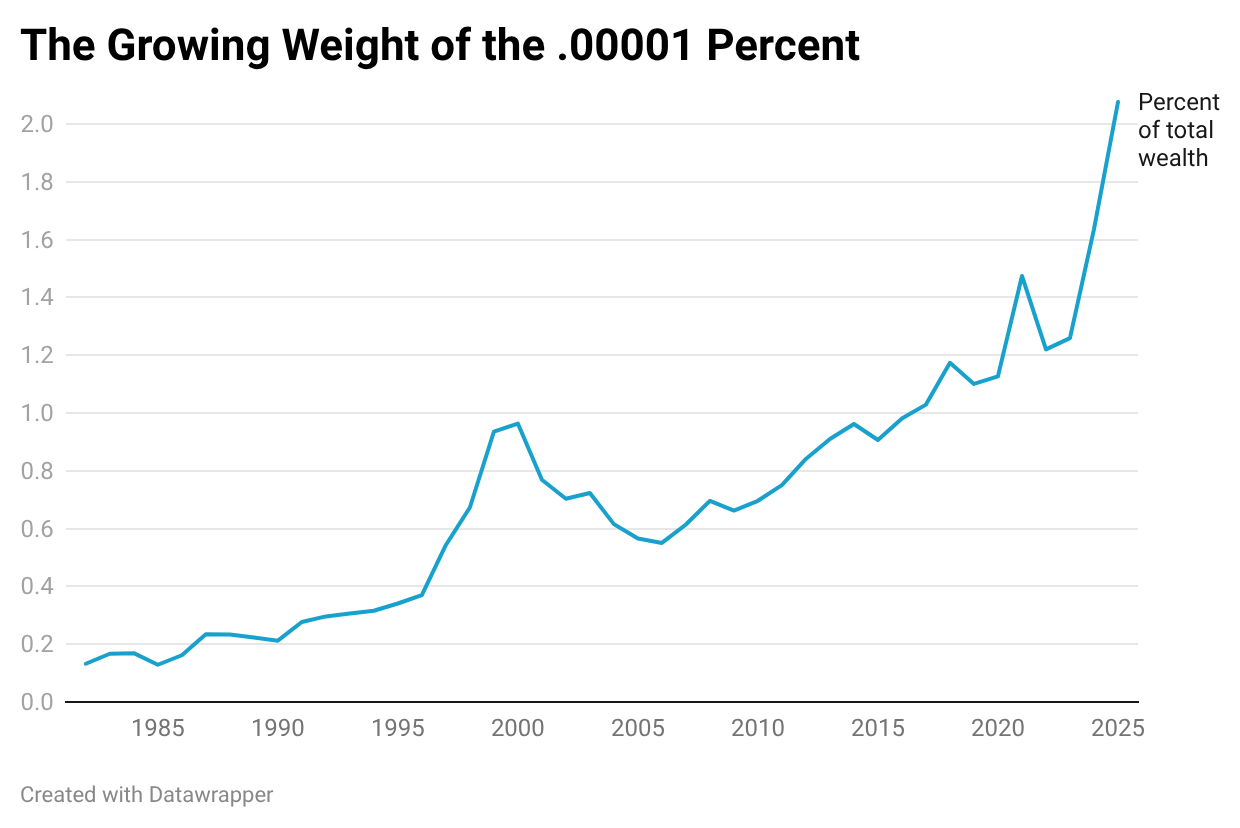
Source: Gabriel Zucman
Wealth in America is now more concentrated in a few hands than it was during the Gilded Age of the late 19 th and early 20 th century. Money has always been a potent source of political influence, so this vast increase in concentrated wealth at the top inevitably translates into increased power.
However, after Citizens United America experienced an increase in oligarchic power far surpassing even what one might have expected given soaring wealth at the top. At this point it’s clear that we have experienced a fundamental change in the way our society works. Everything that is downstream of the American political system – federal and state governments, the courts, regulatory power, economic policy, health policy, media independence – and of course democracy itself – is under extreme threat from the tidal wave of billionaire influence.
Let me offer three reasons surging wealth at the top has caused a lurch away from democracy.
The first reason is a bit wonkish, but here goes: Political scientists and economists have long argued that highly concentrated interest groups are more politically effective than diffuse groups, an argument that goes back to Mancur Olson’s classic 1965 book The Logic of Collective Action .
Here’s a hypothetical example: Suppose that spending $1 billion on political influence would enrich a plutocrat by 1 percent of their wealth. Someone with “only” $30 billion in assets wouldn’t find this spending worth it: $1 billion in outlays produces only $300 million in capital gains – a loss of 70%. But someone with $300 billion in assets would gain $3 billion by spending $1 billion on political influence – a profit of 200%. In other words, because buying political influence is expensive, we would expect that the growing concentration of wealth within the plutocrat class will increase that class’s political spending and, therefore, its power.
Second, some forms of de facto political action – such as buying your own global media platform — can only be undertaken by men of truly immense personal wealth. Musk spent $44 billion to buy Twitter; 20 years earlier there were no individuals with that much money.
Finally, and crucially, billionaires haven’t just spent money to influence policy. They have also spent money to change the rules in ways that make money more powerful. Years of plutocratic investment in institutions from the Heritage Foundation to the Federalist Society prepared the ground for the Supreme Court’s Citizens United decision, which then opened the floodgates for vastly increased plutocratic influence.
Something comparably transformative has happened in the past year. Billionaires didn’t just help Donald Trump regain the White House, they helped create new de facto ground rules under which he can use his office for personal enrichment — which hugely expands the influence of those with the means to make him richer.
What are the ultra-wealthy doing with their vastly increased power? They are, of course, twisting policy in ways that will make them even richer, at the expense of everyone else. Anyone who imagines that the unthinkably rich aren’t greedy, because they can already afford to buy whatever they want, doesn’t understand human nature.
That said, even billionaires care about more than their own personal wealth. Unfortunately, their non-monetary goals are often worse than their greed.
Put it this way: Elon Musk hasn’t turned X, the former Twitter, into a platform promoting white supremacy and a safe space for Nazis as part of a strategy to enlarge his fortune. He has done it because it serves his personal agenda and reflects his values.
Today’s post is more about understanding where we are than about a call to action. Still, the obvious question is what can be done in the face of billionaires gone wild. The answer, clearly, is that any project to save American democracy must include a push to reduce the extreme concentration of wealth at the top.
We know that this can be done, because it has been done. In his famous Madison Garden speech of 1936 FDR declared war on “Government by organized money,” and he won that war. Progressive taxation and mass unionization drastically reduced the wealth and even more drastically diminished the power of big money.
To say that a comparable project is impossible today is to say that democracy can’t be saved. And I’m not willing to accept that. Are you?
How the Kakistocracy Became a Quackistocracy
Corruption is a germ’s best friend
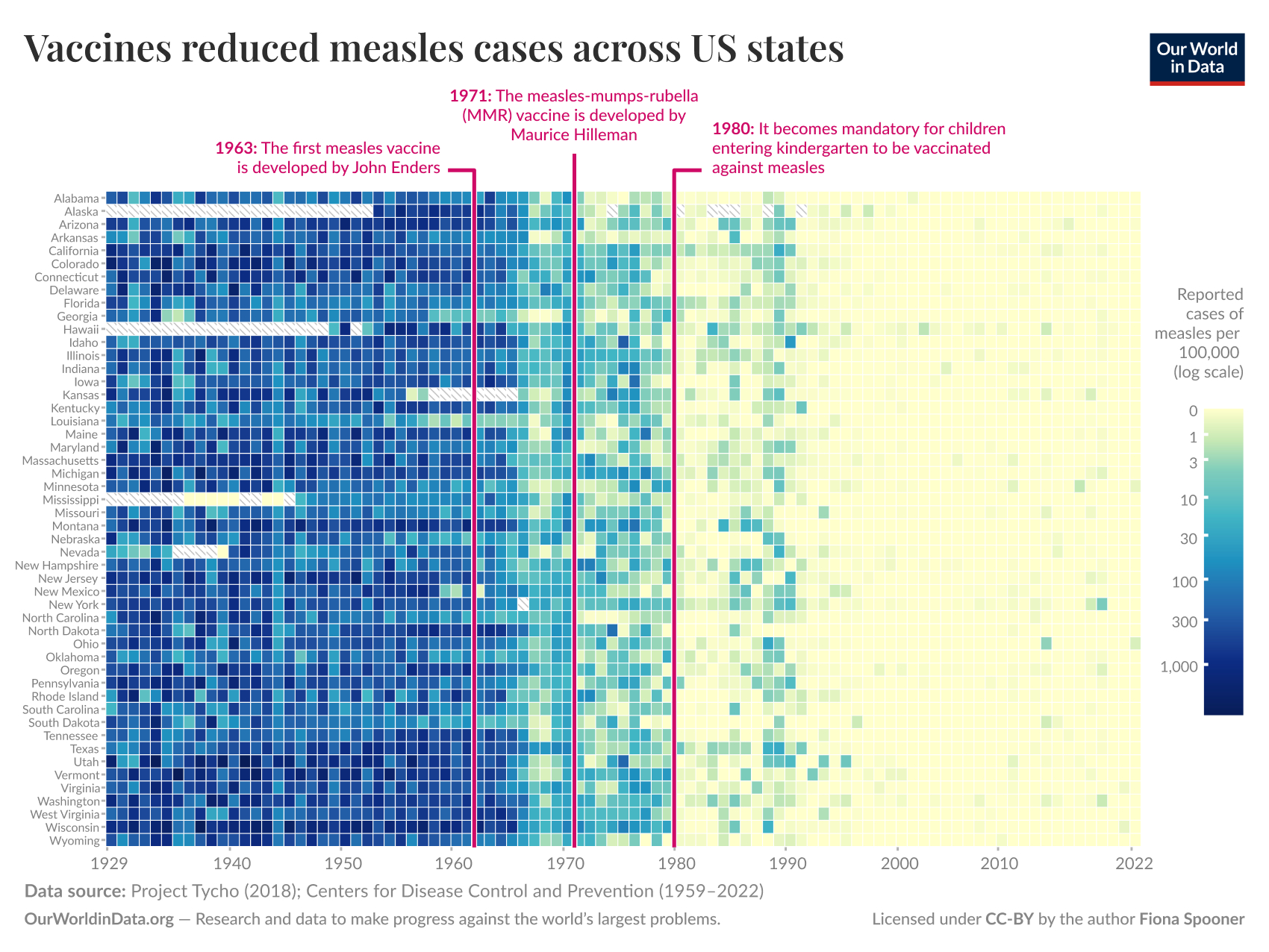
Childhood vaccination is one of public policy’s greatest success stories. People who view the 1950s through rose-colored glasses, seeing them as an era of American greatness, miss many ways in which life was much worse then than now, ranging from gross racism and sexism to high poverty rates among the elderly. One often-overlooked feature of the “good old days” was that many children contracted, and some died from, infectious diseases that have now been almost eliminated — or had been almost eliminated, until today’s right-wing anti-vaccine agitators set the stage for their comeback.
In many ways the Trump administration’s hostility to vaccines is similar to its hostility to clean energy, which I wrote about yesterday . Both policy swerves will kill Americans. If Trumpists succeed in forcing the U.S. to burn more coal, thousands will die from air pollution. Only a year into the Trump 47 administration, there is already a resurgence in almost conquered diseases due to the anti-vax MAGA crusade. Both these sudden policy serves are economically destructive: A 2024 report from the Centers for Disease Control estimated that each dollar spent on childhood vaccination has saved around $11 in societal costs.
Moreover, the Trumpists aren’t content with just cutting off federal funding — they’re determined to stop anyone else from doing the right thing. The Trump administration has imposed a blockade on privately funded wind and solar projects, while RFK Jr.’s allies are pushing to prevent states from implementing childhood vaccine mandates .
And the damage from the assault on vaccines continues to widen. Last week the Food and Drug Administration refused to review Moderna’s new mRNA-based flu vaccine. They didn’t reject it based on evidence; they wouldn’t even look at it, in line with RFK Jr.’s evidence-free, dogmatic assertion that mRNA technology, which gave us Covid vaccines, is useless and harmful. Pharmaceutical companies, understandably, are retreating from vaccine development .
The motivations behind the crusade against clean energy and the crusade against vaccines are also similar. The conspiracy-theorizing hostility to science and expertise in general that underpins both movements also predisposes people to become right-wing extremists, which means that their movements are now in power. The headline on a 2023 article in The Guardian captured this perfectly: “ ‘Everything you’ve been told is a lie’: Inside the wellness-to-fascism pipeline.”
Last but by no means least, in both cases it’s crucial to follow the money.
It may seem strange to think of the wellness industry as a corrupt and corrupting force comparable to the fossil-fuel sector. But wellness is big business. McKinsey estimates that U.S. spending on wellness is running at around $500 billion a year, while spending on nutritional supplements alone was close to $70 billion last year.
And sellers of nutritional supplements, unlike companies selling pharmaceuticals, are effectively allowed to make false, outlandish claims about what their products do. Here’s how the National Institutes of Health summarized the law:
Dietary supplement labels may include certain types of health-related claims. Manufacturers are permitted to say, for example, that a supplement promotes health or supports a body part or function (like heart health or the immune system). These claims must be followed by the words, “This statement has not been evaluated by the Food and Drug Administration. This product is not intended to diagnose, treat, cure, or prevent any disease.”
In other words, it’s OK to peddle snake oil with false medical claims as long as you mumble some content-freeboilerplate.
And where do the snake-oil salesmen peddle their wares? Largely on right-wing media. After all, that’s where they can find customers who have the right mix of anti-intellectualism and disdain for experts. And the snake-oil purveyors are, in turn, a key part of the extreme right’s financial ecosystem.
I wrote about this almost five years ago . The relationship between quack medicine and right-wing extremism has a long history. As the historian Rick Perlstein has documented , extremists have been marketing medical snake oil, and snake oil purveyors have been financially supporting extremism, since the days when misinformation had to be disseminated through paper newsletters. This mutually beneficial relationship continued through the eras of talk radio, cable TV, and now podcasts.
But now we have entered a new era. As many observers have noted, the Trump administration is a kakistocracy: rule by the worst. A history of personal corruption is no longer a bar to high office — it’s practically a requirement.
Under Trump 47, people who have enriched themselves by peddling medical misinformation are no longer just influencing policymakers. They have become policymakers. Robert F. Kennedy, Jr., who appears to have made millions in salary and book royalties thanks to his anti-vaccine screeds, is now the secretary of health and human services. Dr. Oz is running Medicare and Medicaid.
In short, the kakistocracy is also a quackistocracy.
And the reign of the quacks will condemn thousands, perhaps millions of Americans — many of them children — to gratuitous illness and in some cases death.
Turning Our Back on Clean Energy
Why does MAGA hate the planet?
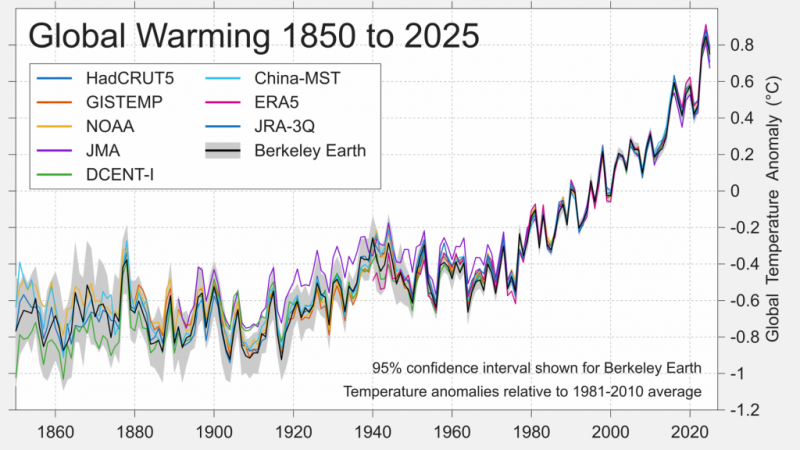
Source: Berkeley Earth
It has been a brutal winter in much of the United States. Weather is a chaotic system in which extreme events are always happening somewhere. But as I am sure you have noticed, extreme weather events — catastrophic storms and flooding, punishing droughts, and yes, extreme cold snaps — are becoming more common as a result of climate change.
For climate change is not just continuing: it’s accelerating. Multiple estimates find that 2025 was one of the warmest years on record for the planet, exceeded only by 2024 and 2023. Indeed, Berkeley Earth reports that “The warming spike observed in 2023 to 2025 has been extreme and suggests an acceleration in the rate of Earth’s warming.”
In other news, the Trump administration has gone to war against any and all efforts to limit climate change. The administration is also imposing a “ blockade ” against wind and solar projects, delaying or even revoking permits, whether or not these projects have received federal subsidies.
Now, there isn’t a genuine scientific dispute about the reality of global warming and its causes. There isn’t even a serious dispute about the costs of fighting climate change: the economics of green energy are more favorable than they have ever been.
So what’s going on? The Trump administration hates science and science-based policies in general; look at its war on vaccines, which will end up causing an enormous number of deaths. Its assault on universities threatens the best scientific research centers in the world. Its irrational treatment of immigrants means the best and brightest from the around the world no longer want to come here. But in the case of energy, its destructive policy largely reflects the corrupting influence of big money.
I’ll explain in a minute. First, some background.
Almost 40 years have passed since James Hansen’s landmark Senate testimony warning about global warming. He was right. Climate science has been overwhelmingly vindicated by reality.
However, the economics and politics of climate policy have played out very differently from what almost anyone expected.
As late as the 2010s, many observers — myself included — would have said that the big problem in addressing climate change was who would bear the cost. Policies to limit greenhouse gas emissions, everyone believed, would slow the growth of the economy and of real incomes. True, anti-environmentalists were grossly exaggerating these costs. In 2009 I wrote that
[T]he best available economic analyses suggest that even deep cuts in greenhouse gas emissions would impose only modest costs on the average family.
But what we knew at the time nonetheless said that there would be significant costs to slowing global warming. And this was problematic, because the costs of limiting emissions would be incurred right away, while the benefits of reduced warming would accrue decades later — and many of them would go to other countries. So action on climate appeared to require (a) international cooperation (b) persuading voters to accept costs now in exchange for a better world many years in the future.
And it was all too easy to be pessimistic about the prospects both for cooperation and for persuading voters to accept even modest future-oriented sacrifices.
Then came the renewable energy revolution . Solar and wind power have become cost-competitive with fossil fuels — they are, in particular, clearly cheaper than coal. Huge progress in batteries has rapidly reduced the problem of intermittency (the sun doesn’t always shine, the wind doesn’t always blow.) There’s now a clear path for a transition to an “ electrotech ” economy in which renewable-generated electricity heats our homes, powers our cars, and much more.
This transition would make us richer, not poorer. In fact, nations that for whatever reason fail to take advantage of electrotech will be left behind in global competition.
And at this precise moment — a moment in which acting to accelerate the energy transition would increase, not reduce, economic growth — the U.S. government has been taken over by people who want us to go backward on energy. The Trump administration has even introduced a mascot, “Coalie,” in an attempt to make an extremely dirty fuel cute. But coal isn’t cute. Even if we ignore the role of coal in climate change, coal-burning power plants caused hundreds of thousands of excess U.S. deaths between 1999 and 2020.

What explains this extraordinary rejection of progress and embrace of energy know-nothingism?
Money may not be the whole story, but it’s a lot of the story.
Indeed, much of what is happening to American democracy has its origins in the long-term strategy of the billionaire Koch brothers . The Kochs spent decades promoting right-wing politics in general, with a special role in the takeover of the Supreme Court by the Federalist Society. But an important part of their agenda, and hence that of the right-wing movement as a whole, has always been to keep America burning the fossil fuels on which their wealth rested. If you want to know more, read Lisa Graves’ book on the Roberts Supreme Court, “ Without precedent ”.
At this point, moreover, it’s not just about normal channels of political influence, nor it just about domestic billionaires. We now live in a time in which U.S. policy is shaped by sheer, naked corruption (enabled in part by the Koch takeover of the courts). Notably, Middle Eastern petrostates, which have a strong interest in blocking the energy transition, have played a huge role in enriching the Trump family .
It’s somewhat surprising that other big-money interests haven’t pushed back. After all, crippling the development of renewable energy is bad for business, and especially bad for the electricity-hungry crypto and AI industries, which ordinarily have a great deal of sway with the Trump administration. But maybe they have decided that special treatment, and especially a green light for their own unethical behavior, matters more than affordable energy.
If there’s any good news here, it is that from a global point of view this malignancy may not matter very much. America is not the world. In fact, at this point we’re responsible for only a small fraction of global greenhouse gas emissions:
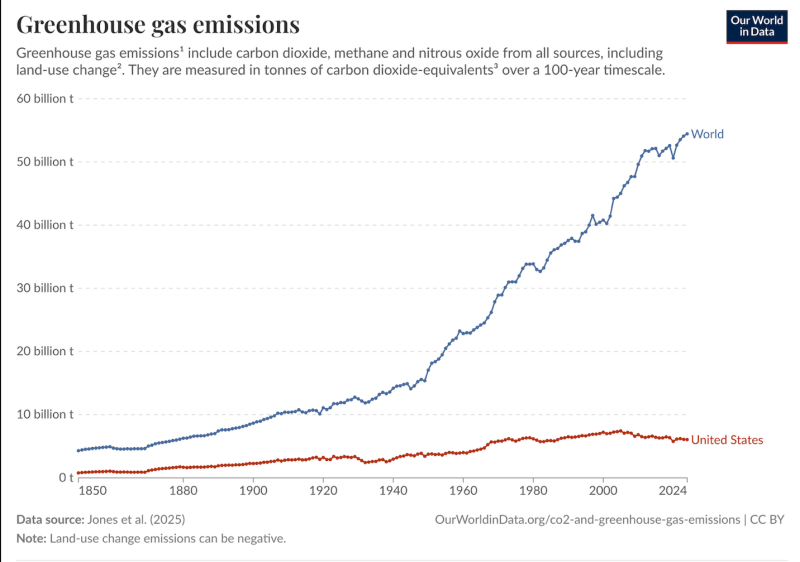
So America’s hard turn against renewables and climate action won’t be decisive for the climate future as long as other countries continue to move ahead on green energy, which they are. For the most part, all MAGA will do is help make the United States backward, poorer, sicker and irrelevant.
Who Is Paying the Trump Tariffs?
A wonkish guide for the confused
WARNING: TODAY’S POST WILL BE EVEN WONKIER THAN USUAL
Until recently the question of who pays tariffs wasn’t controversial among economists. The overwhelming consensus was that under normal circumstances tariffs — taxes on imported goods — are passed on to consumers in the form of higher prices. There are caveats and exceptions to this consensus, but these caveats are well understood and for the most part don’t apply to the tariffs imposed by the Trump 47 administration.
Once tariffs became a centerpiece of Trump’s economic policy, however, views about their impact became politicized, and Trump supporters were obliged to echo his claim that foreigners, not U.S. consumers, bear the tariff burden. There was a slightly comical demonstration of this politicization during a recent House Financial Services Committee hearing, when Scott Bessent was asked whether, before joining the Trump administration, he had sent a letter to hedge fund investors declaring that “tariffs are inflationary.” At first, Bessent denied having written that. Confronted with proof that he had, he declared that he had been mistaken.
But who is, in fact, paying the Trump tariffs? Two reports released last week — the Congressional Budget Office’s latest report on the budget and economic outlook , and a study released by the Federal Reserve Bank of New York — both concluded that the tariffs are overwhelmingly being borne by U.S. households and firms. But Friday’s report on consumer prices showed fairly low inflation, rather than a big price spike from tariffs.
So are Trump officials right? Are studies concluding that Americans, not foreigners, are paying the tariffs wrong?
No and no. The evidence that foreigners aren’t paying the tariffs, which means that Americans are, is rock-solid. And the seemingly mild impact on measured inflation (the qualifier “measured” is important) isn’t a mystery once you do the math. Conventional economic analysis says that the tariffs should have pushed consumer prices around 1 percent higher than they would otherwise have been. Parsing the data to isolate the tariffs’ effect suggests that they have in fact raised prices by something close to that amount.
But I understand why the seeming contradictions between economic reports are confusing. So I thought I would postpone my next primer on the Federal Reserve and write today about who is paying the Trump tariffs.
What economic theory says about tariffs and prices
Tariffs are taxes. Specifically, they are excise taxes , taxes levied on the sale of particular goods or services. The U.S. federal government imposes many other excise taxes, for example on the sale of airline tickets — 7.5 percent of the fare — and gasoline — 18.4 cents per gallon. In addition, state governments also impose a number of excise taxes, for example on cigarette sales.
Tariffs are excise taxes levied on the domestic sale of goods produced abroad. The principle of how these taxes work should be the same as the principles we apply to other excise taxes — the basic economics doesn’t change simply because tariffed goods cross a border. And when economists — or, for that matter, anti-tax advocates — estimate the burden of taxes, they normally assume that excise taxes are passed on to consumers in the form of higher prices. There’s no reason to believe that the price effects of taxes on the sale of goods produced abroad are any different.
Now, in practice excise taxes sometimes lead to cuts in sellers’ prices, and therefore don’t fall completely on consumers. Here’s why: by raising prices to consumers, excise taxes induce those consumers to buy less of the goods being taxed. And reduced demand for their products can induce sellers to shave a few percent off their prices. The size of this effect depends on how easy it is for sellers to reduce production or divert sales to markets where they don’t face excise taxes. (For readers who’ve taken economics, I’m talking about the elasticity of supply.)
We would, however, expect this effect to be small when it comes to U.S. tariffs. Why? Because although the U.S. has a huge economy and is a very big market, we’re still a relatively small part of the world economy as a whole. In 2024 the United States only accounted for 13 percent of total world imports. This means that foreign companies selling into the U.S. market are likely to respond to tariffs mostly by diverting their sales to other markets rather than by slashing prices. In fact, the EU has experienced a surge of Chinese imports as Chinese exporters re-directed goods that would previously have gone to the US.
OK, one more complication: Nations that impose tariffs often see their currencies rise, and a stronger dollar would, other things equal, lead to lower import prices. However, the dollar has declined, not risen, over the past year. Why this has happened is an interesting story, but not one we need to go into now.
The bottom line is that conventional economic analysis predicts that U.S. consumers, not foreign producers, will pay the bulk of U.S. tariffs. Is this what has actually happened?
The data show that foreigners aren’t paying the Trump tariffs
The U.S. Bureau of Labor Statistics collects data on import prices — the prices paid for goods purchased from abroad at their point of entry into the United States, that is, before payment of tariffs. The study just released by the New York Fed, carried out by Mary Amiti, Chris Flanagan, Sebastian Heise, and David E. Weinstein, uses these prices to estimate the “incidence” of the Trump tariffs — who paid them. The authors explain:
Suppose foreign exporters charge $100 for a good, and the importing country decides to levy a 25 percent tariff on it. If the foreign price remains unchanged at $100, the duty paid is $25, increasing the import price to $125. In this case, the tariff incidence falls entirely on the importer; in other words, there is 100 percent pass-through from tariffs to import prices, and therefore on U.S. consumers and firms. In contrast, the exporter might lower its price in order to avoid losing market share. If foreign exporters respond to the tariff by lowering their price to $80 (i.e., $100 divided by 1.25), the price paid by importers will remain $100 (with $20 in duties paid to the government). In this case, 100 percent of the tariff incidence falls on foreign exporters, who now receive $20 less for the same good; in other words, there is zero pass-through from the tariff since the import price is unchanged.
So what do the data actually look like? Amiti et al calculate two measures of the increase in tariffs since January 2025 (I’ll explain the difference between the measures shortly):
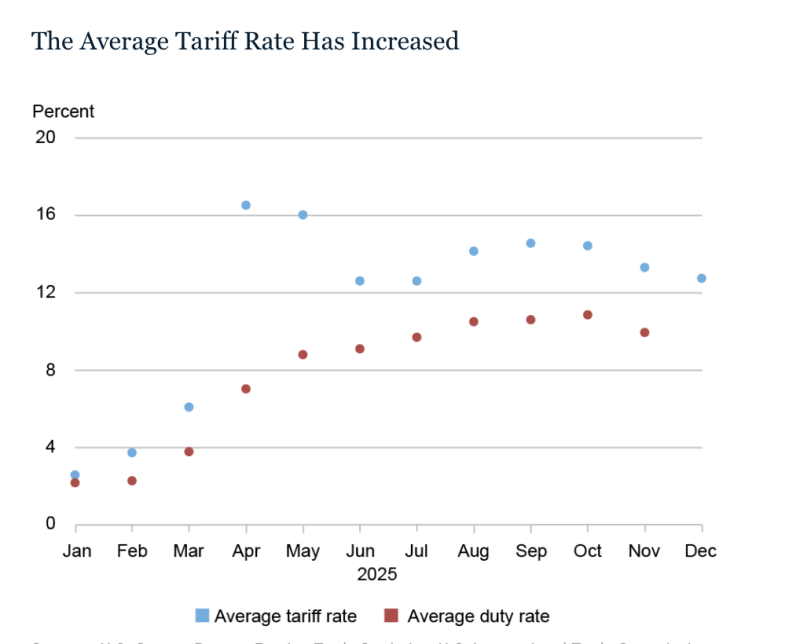
Chart 1 Source: Amiti et al
To prevent a 10 percent tariff hike from translating into higher consumer prices, import prices — the prices that foreign exporters receive — would have to have fallen by about 9 percent. A quick look tells us that we haven’t seen anything like that:
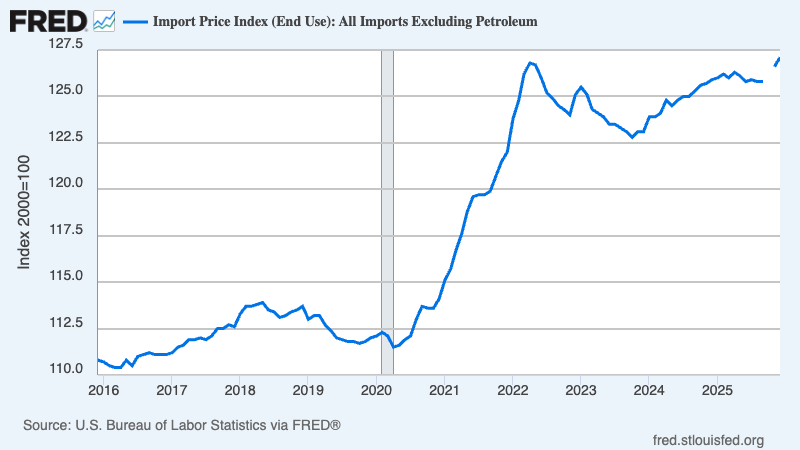
Chart 2
The measure that I use for import prices excludes petroleum because the price of oil fluctuates wildly for reasons that have nothing to do with tariff policy — e.g., who we’re bombing this week. The prices of non-oil imports shot up during the supply-chain snarls of 2021-2022, then fell. Since the massive tariff hikes of April 2025, the prices of imports (excluding oil) have gone up, not down.
Amiti et al do a much more careful assessment, breaking imports into finely divided categories and applying a number of controls. Their conclusion, however, matches what one gets from a quick-and-dirty overview: Foreign suppliers bore very little of the burden of tariffs. As you can from the data in the last column of the table below, the overwhelming share of the cost of the tariffs fell on Americans – either producers or consumers. Over time that share ranged from 94% to 86%.
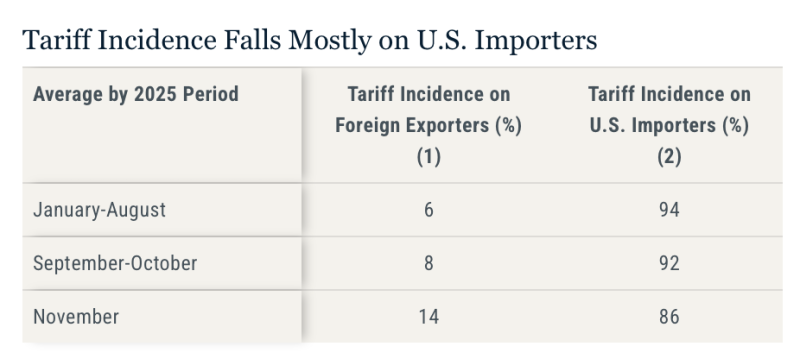
Chart 3 Source: Amiti et al
But the fact that foreign exporters are not paying the tariffs doesn’t necessarily mean that consumers are paying the full amount. It’s possible that U.S. businesses have reduced their profits and eaten the cost of the tariffs, at least initially. Many economists have asserted that this is in fact what has happened — that while foreigners haven’t absorbed a large share of the cost of tariffs, U.S. businesses have so far paid much of the cost rather than raising prices to consumers.
As I’ll explain in a moment, I think that the extent to which businesses are eating the tariffs has been exaggerated. The fact is that most of the cost of the tariffs, probably more than 80 percent, has been passed on to consumers. But is it possible to directly compare estimates of the impact of tariffs on the prices received by foreign producers with an estimate of the impact on U.S. consumer prices?
The answer is, not easily. Standard consumer price data don’t distinguish between imported and domestically produced goods. Furthermore, even when you buy something imported, much of the price is usually domestic costs such as transportation and store markups.
So while it’s safe to say that U.S. businesses and consumers have paid more than 90 percent of the cost of the Trump tariffs, pinning down how much of that 90 percent fell on consumers versus the share still being absorbed by businesses is tricky,
That said, there are ways to estimate how much tariffs have raised consumer prices, which I’ll get to soon. First, let’s talk about how much we should have expected tariffs to raise prices.
Why it was wrong to expect consumer prices to soar as a result of the Trump tariffs
Suppose the Trump tariffs had been fully passed on to consumers. How much would we expect this to have raised overall consumer prices?
The answer is, around 1 percent.
When I tell people this number, they’re often surprised — they thought it would be bigger. Given all the hue and cry over tariffs, how can their expected impact on prices be fairly modest?
There are two answers. First, despite globalization, most of what Americans buy is either domestically produced or contains a lot of domestic value. Even when the item you buy says “Made in China,” the cost of buying it from China isn’t the whole price. A San Francisco Fed study found that “nearly half the amount spent on goods and services made abroad stays in the United States.” In 2024 imports of goods were only 11 percent of GDP.
Second, the actual rise in effective tariffs, while substantial, hasn’t been as big as headline numbers suggest. Look back at Chart 1. The blue dots show average tariff rates as announced. These rates shot up in April 2025, after “Liberation Day.” However, they came down significantly as Trump TACOed (Trump always chickens out).
Even more important, the impact of tariffs was blunted by carve-outs and exemptions. Notably, most imports from Canada and Mexico still enter tariff-free under the U.S.-Mexico-Canada free trade agreement. The red dots show the “average duty rate” — customs duties collected as a percentage of import value. This rate is up a lot, but not as much as the announced rates suggest, only about 8 percentage points.
Suppose we multiply the increase in average duty rates, 8 percentage points, by the share of imports in spending, 11 percent. This tells us that the tariff hikes should have raised consumer prices by 0.08*11 = 0.88 percent.
An alternative way of calculating the likely effect of tariffs on prices is to simply think of the tariff hike as a tax increase and ask how big that increase was as a percentage of total spending. The Congressional Budget Office’s most recent Monthly Budget Review shows receipts from various taxes in the first four months of fiscal 2026 — October, November, December, and January — compared with the same months the previous year:
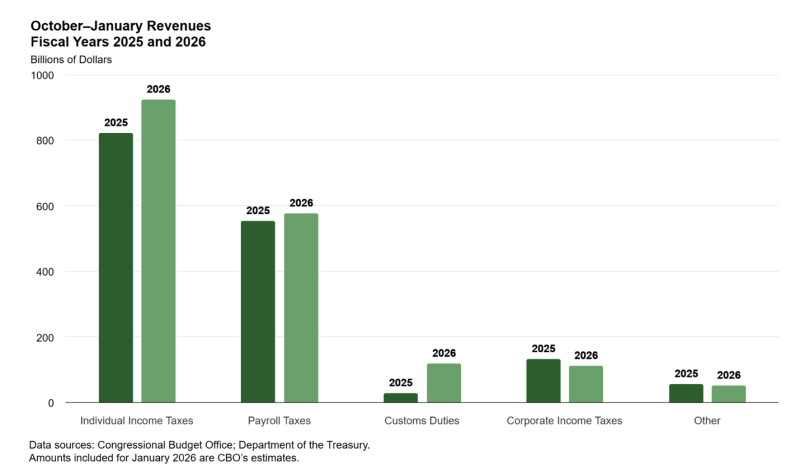
Chart 4 Source: Congressional Budget Office
Notice how small customs duties under Trump 47 are compared with income and payroll tax revenue. This serves to puncture the administration’s hype about tariffs as a revenue gusher.
We can estimate the size of the tax imposed by the tariffs relative to the size of the economy. Tariff receipts were about $90 billion higher in the last four months than in the corresponding months a year ago, or $270 billion at an annual rate. GDP in the third quarter of 2025 was $31 trillion at an annual rate. So the tax hike was 0.27/31 = 0.87 percent of GDP.
One might expect consumer prices to rise by slightly more than the direct tax effect. For example, in the steel industry , domestic producers raised their own prices in response to higher imported steel prices. But this happens only when domestic producers compete directly with imports. Many of the Trump tariffs have hit imports in industries in which there is no significant domestic production, such as apparel.
The Yale Budget Lab’s model predicts a 1.2 percent rise in consumer prices as a result of current tariffs (although I’m not sure whether this model fully accounts for the gap between announced and effective tariff rates).
Overall, a reasonable estimate of how much tariffs “should” have raised prices is in the vicinity of 1 percent. How does that compare with actual experience?
Estimating the effects of tariffs on consumer prices
Let’s be frank: A quick look at the Consumer Price Index — still the most widely cited measure of inflation — does not show any obvious impact of tariffs. Economists overwhelmingly try to judge inflation trends by looking at “core” inflation, which excludes volatile food and energy prices. This measure was declining steadily before the Trump tariffs, and has continued that decline (to limit clutter, I’m only showing data for successive Januaries):
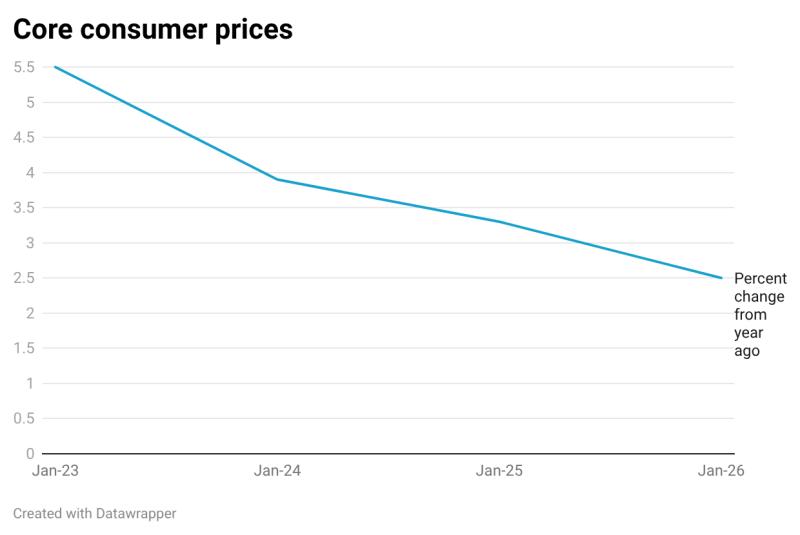
Chart 5 Source: Bureau of Labor Statistics
Why can’t we see any effect of tariffs? Let me say right away that no, the Trump administration isn’t cooking the books. I’m not saying that they wouldn’t do so if they could, or that they won’t try in the future. But the process of producing monthly inflation reports involves a large number of professional civil servants, and we would know if that process had been corrupted. Not happening yet.
However, there is one known issue that is distorting recent inflation numbers. Due to the government shutdown last fall, the BLS was unable to collect data for two months. And for technical reasons involving the bureau’s methodology, those two missing months are still distorting one-year inflation rates, causing an understatement of price increases, especially for shelter.
There’s a general principle here that goes beyond current political disputes. I’ve been economisting for half a century (yikes). Over those years I have repeatedly encountered data that seem to contradict conventional economic analysis. In most — not all — cases, however, the problem turned out to be with the data, not conventional analysis. So if you see data that seem to say that the consensus among economists is all wrong, you should be suspicious of the data. This is especially true if the data tell you something you want to hear — if, for example, you are a Trump supporter who wants to believe that tariffs don’t raise prices.
So how can we cross-check the low inflation number the BLS just reported? One way is to look at another number. The Federal Reserve deemphasizes the CPI, preferring the Personal Consumption Expenditures price index, which is similar and relies on some of the same underlying data, but is different in detail, among other things placing a lower weight on shelter.
Unfortunately, PCE data comes in later than CPI, and we don’t yet have the numbers either for December or January. However, multiple economists produce “nowcasts” of PCE, estimates of what the number will be once reported. These estimates are closely clustered around 3, so that’s what I put in Chart 6:
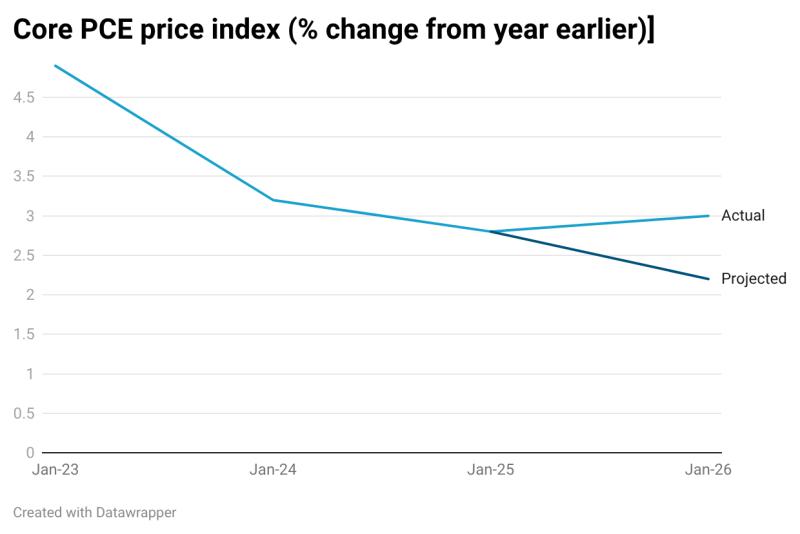
Chart 6 Source: Bureau of Economic Analysis and Survey of Professional Forecasters
Unlike the Consumer Price Index, the PCE price index has not shown continuing disinflation. Before the Trump tariffs, most economists believed that inflation would continue to fall. The line in Chart 6 labeled “Projected” is the average prediction for inflation over the course of 2025 from the late 2024 Survey of Professional Forecasters . The gap between that forecast and actual inflation is about 0.8 percentage points, not far short of the extra 1 percent inflation conventional analysis would predict.
Another way to gauge tariffs’ impact is to look at narrower measures of inflation that focus on the prices we expect tariffs to affect. The Trump tariffs apply only to physical goods as opposed to services. Some economists I highly respect like to look at core goods inflation , which excludes food, energy, and also used cars. That measure of inflation jumped sharply after the Trump tariffs.
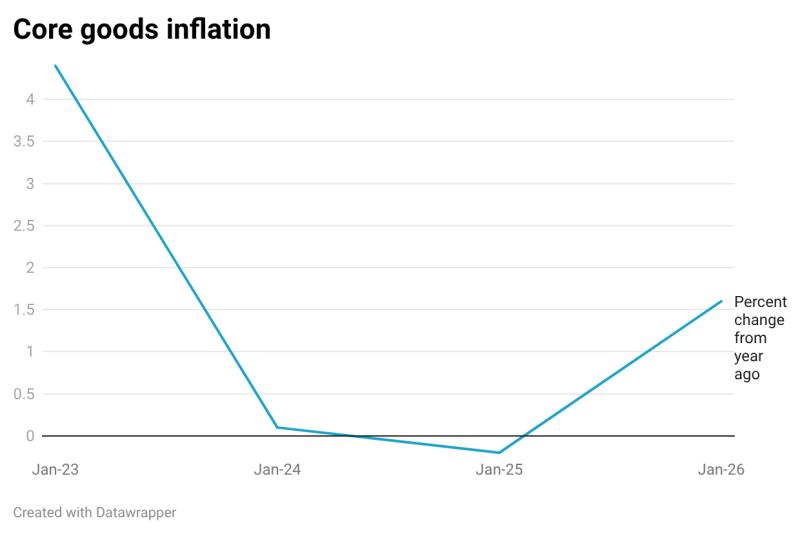
Chart 7 Source: BLS
Finally, I’ve been looking at a new indicator, the Tariff Tracker produced by the HBS Pricing Lab. The lab is run by some of the same people who produced the Billion Prices Index , which was invaluable in the “Inflation truther” years after the global financial crisis, and uses similar methodology. It scrapes the internet to get prices charged by some major retailers, dividing the goods tracked between domestic and imported products to estimate tariffs’ effect. The lab is able to back out an estimate of how much tariffs have raised the CPI:
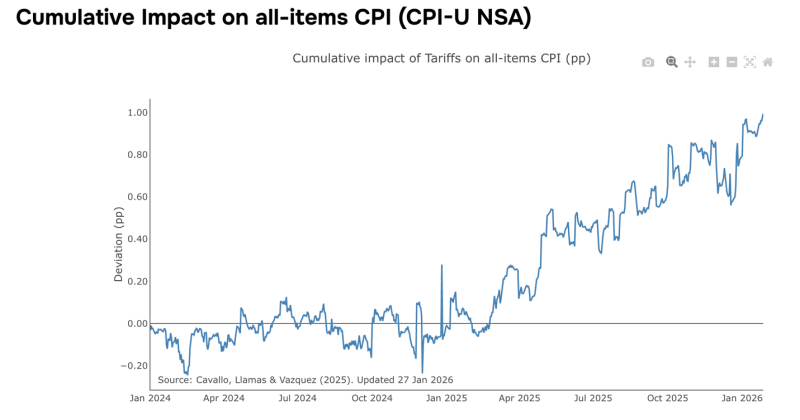
Chart 8 Source: HBS Pricing Lab
Their answer is … 1 percent, right in line with what conventional economic analysis predicts.
My overall take on how tariffs have affected consumer prices runs as follows: Conventional economics predicts that tariff increases on the scale we’ve seen should have a significant but not huge effect on consumer prices — a bump to inflation, not a runaway surge. Tariffs aren’t the only thing happening to prices, so the effect of tariffs is muddied by other factors, including measurement issues resulting from the government shutdown.
But if we focus our inquiry to reduce the noise, it becomes clear that tariffs haven’t been borne by foreigners and have, for the most part, been passed on to consumers. There’s a widespread perception that the limited effect of tariffs on inflation presents a puzzle for conventional economic analysis, but this puzzle evaporates on close observation.
This leaves one final question: How much tariff-driven inflation is still in the pipeline?
Are there still big price hikes ahead?
Serious economists I follow are unanimous in accepting what CBO and Amiti et al say: The failure of import prices to fall shows that foreigners have not borne the cost of the Trump tariffs, which have therefore fallen on U.S. households and businesses. There is, however, a widespread perception that tariffs have not yet had as much effect as expected on consumer prices, seemingly implying that businesses have been absorbing tariff costs. Since we can’t expect that to go on indefinitely, this might imply substantial tariff-driven inflation still to come once businesses pass the costs on.
If I’m right, however, this is a mostly false alarm. A careful look at the evidence says that tariffs mostly have already been passed on to consumers. There may be some price increases still to come, but they are at most a fraction of 1 percent on the overall cost of living.
My guess is that the analysis in this post will leave a number of readers unhappy. Readers who want to see Donald Trump vindicated — do any such people read this Substack? — won’t like my conclusion that he was wrong and conventional economists were right. Readers who want to see disaster looming won’t like my conclusion that the worst impact of tariffs has probably already happened.
But the truth is that in practice the Trump tariffs have been a smaller story, at least in macroeconomic terms, than either their proponents or many of their opponents believe. As I have been arguing for some time , the crackdown on immigration and the pogroms against immigrants already here are a bigger economic story, even in the short run and especially in the long run.
Whatever
Tags
Who is online
93 visitors
Data.
For those interested in reality...
Hmmmmm....
I could be wrong but.
Based on the size of the response, that doesn't seem to be a really large number of people here..... . . .
Based on the size of the response, that doesn't seem to be a really large number of people here..... . . .
Needs more Virgo energy, eh?
All of Krugman's data doesn't change reality. Federal spending really is out of control because 75% of the budget is mandatory spending and servicing debt. The only 'control' for this spending is raising taxes. But that does not address Congressional redirection and misuse of taxes for those mandatory programs. Those claiming to be fixing the system of mandatory spending (through taxes or cuts) have only done a bait-and-switch to kick the can.
A services economy, that creates jobs for unproductive middlemen, will naturally concentrate money in the hands of a few. A services economy functions by extracting and skimming money from productive activities in the economy. The middlemen assume a position of being the toll keeper for transactions in the economy. By placing themselves in a position to obstruct the transactional marketplace, the middlemen can basically capture fees without making a productive contribution to the economy. The role of middlemen in a financialized services economy is to sustain rent seeking, debt creation, inflationary expansion, and concentrating money in the economy. A services economy is very good at creating money but is very bad at creating wealth.
Charts and data may obscure the problem but doesn't provide any sort of pragmatic solution. Taxing the rich only shifts the middleman toll keeping from private control to public control. That does not address the underlying issue of an economy prioritizing monetized debt through services rather than creating wealth through productive activities.