
BYD’s 1,500-kW Charger Could Make EV Charging Go as Quick as Filling Up Gas

Category: Alternative Energy
Via: bob-nelson • 8 months ago • 15 commentsBy: Rex Sanchez - Autoblog


This technology represents a major leap beyond typical 350-kW fast-charging rates, with the potential to dramatically reduce charging times

Meanwhile, American "technology" is "clean coal".... 
 S E E D E D C O N T E N T
Racing the Gas Pump
Electric vehicles have come a long way in making themselves more appealing to buyers, particularly by addressing range anxiety through improved DC fast-charging capabilities. However, most models — including the Hyundai Ioniq 5 — still require around 20 minutes to charge from 10 to 80 percent, which is considerably longer than the few minutes it takes to refuel a gasoline-powered car.
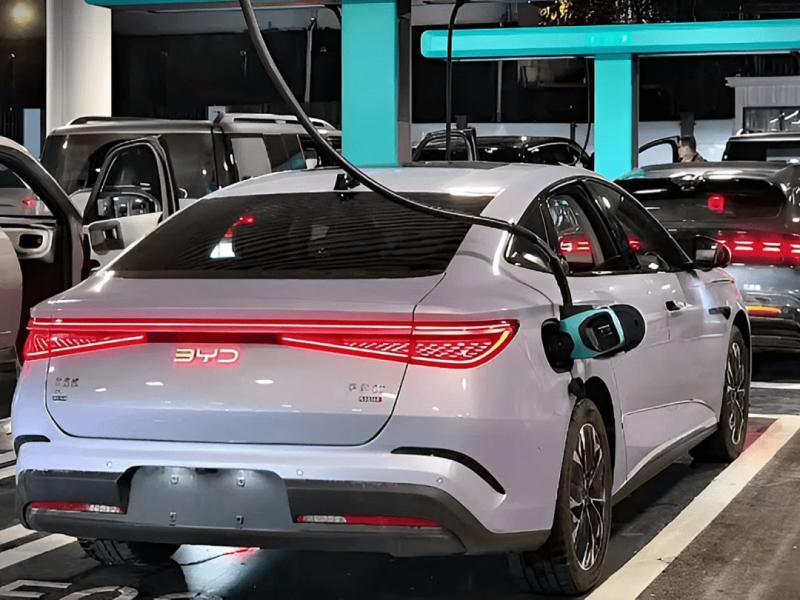
BYD — the automaker that bested Tesla in BEV sales last year — may have a potential solution to that concern. BYD is testing new charging stations in Shenzhen, China, capable of delivering up to 1,500 kW. That’s roughly three times the peak output of Tesla’s V4 Supercharger . Tesla ’s 500 kW capability, however, is currently limited to the Cybertruck , as most of the brand’s other models — including 400-volt EVs like the Model 3 — are not engineered to safely handle that level of charging power.
Key Points
- BYD is testing 1,500 kW charging stations, tripling Tesla’s V4 Supercharger output.
- New stations allow overhead plug access and are designed for ultra-fast "Flash Charge" vehicles.
- BYD aims for 4,000 self-operated and 15,000 partnered stations, but official rollout timeline is unknown.
Charging on Steroids
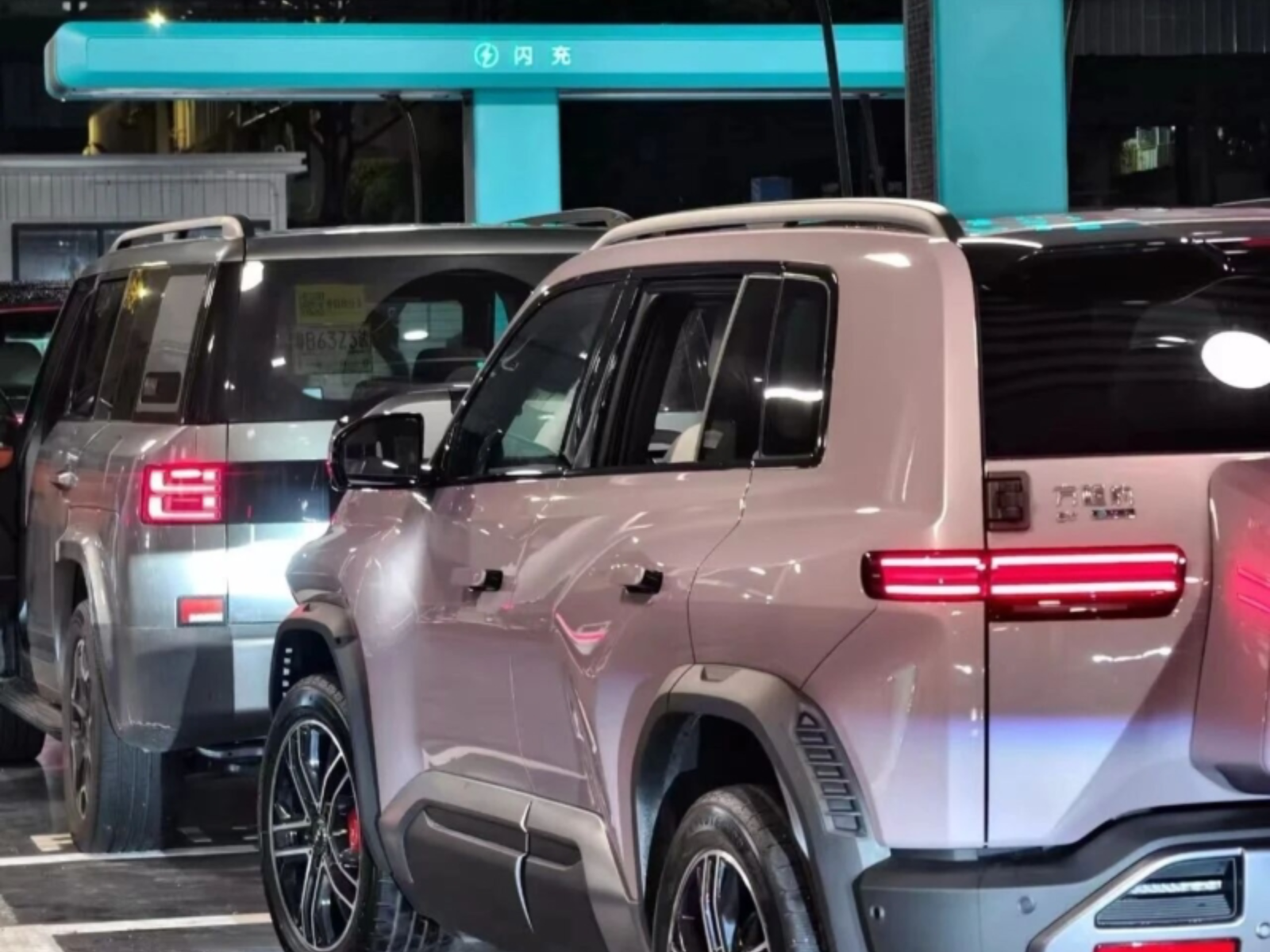
The in-development charging station in China adopts a layout similar to traditional gas stations, allowing vehicles to simply pull up to an overhead plug rather than maneuvering into a parking space or backing in — a setup commonly seen at conventional EV charging sites, including locations like the Tesla Diner . The chargers are reportedly liquid-cooled and mounted to T-shaped gantry structures, operating on a 1,000-volt electrical architecture designed to support ultra-high charging speeds for models with the “Flash Charge” badge.
As a safety precaution, the charging process is said to automatically cut off at 97 percent state of charge.
The Next Chapter for EVs
This technology is just one of many EV charging solutions emerging from China. Another notable example is the battery-swap station, which — as the name suggests — replaces a depleted battery with a fully charged one in a matter of minutes. Last month, Nio — the automaker behind the 1,341-horsepower EP9 — set a record of 146,649 battery swaps completed in a single day.
Whatever
Tags
Who is online
86 visitors
Our Skoda Elroq was a new model just a couple years ago. ***sigh***
But since we charge at home, we really don't need gas-station speed. I wonder how many ICE owner fill their cars up at home?
I used to when I was growing up, but that was because we lived on a farm and had our own underground gas and diesel fuel tanks. hehe...
This tech looks promising as the refuel time is a big one on my list of why I haven't gone with an EV yet. I like to jump in the car for trips and the environment for long distance EV travel just isn't there yet. Providing a fast (5 minute) recharge time can help with the hesitancy to make the move.
I do wonder what this new technology will add to the costs of the vehicle and what the impact might be for older EV's. Time will tell I guess. But as my current vehicle is only three years old I won't be making the jump anytime soon.
Having to stop for a charge isn’t that bad. Last time I was traveling with people in a Tesla we stopped and did car karaoke for 15 minutes while the car got enough charge to finish the trip. It was a nice change of pace.
Luddites today talk about EVs and green energy in general like their ancestors talked about gasoline cars in 1900.
I guess we'll always have those people in some form or another.
I really don't see any way my next car/truck won't be an EV.
While I do believe that eventually EV's will make up a very great majority of vehicles that are in use, I doubt that anybody on this site will see that happen. While the idea I think is good, the technology isn't there yet and the infrastructure to support that is a long ways off.
My plan (and hope) is that my current car is the last car I buy.
I dunno, a couple of these kids are pretty young.
I also think that's going to happen a lot faster than many of us believe it will. I think predictions like 2035 are moronic, but I think the infrastructure will get built out pretty quickly.
When we first converted to automobiles from horses and buggies, roads and highways weren't paved and gas stations were not a thing. All of that infrastructure exists currently, so all we really need to do is add electric capability to existing petrol stations.
But further, as Bob points out, the vast majority of electric vehicles will be charged at home overnight.
I'm a little too young to hold that as a realistic hope.
I disagree here. It's not just adding the capability to existing petrol stations, the generation and transportation of electricity also needs to be increased and upgraded. How many years now have we been hearing about brown-outs in California? It takes a good bit of time and money as well as resources to build those transmission lines. Adding in the increased consumption from AI data centers, it's rather obvious that we don't have the generation capability needed for all of this. While EV's can be charged overnight at home, how many can be on a charger before the entire grid to that neighborhood is overloaded?
All of which will happen alongside, as well as increased rooftop production.
Well that's why I said "all electric by 2035" are moronic. California's desperation to demonstrate their self-righteousness caused them to jump headfirst into the deep end of the pool while there was still only a foot of water in the bottom. The rest of us aren't that stupid.
This is going to take a couple decades, and it's probably going to include things like net caps on AI data centers or BYOP arrangements and variable kwh pricing to level grid loads. We're already seeing some of that. There are probably a dozen electric providers in Texas that offer free electricity between 9pm and 6am.
The economics on this are just so overwhelming the technology is going to work out. There is too much money at stake. But it's not going to happen along some arbitrary Gavin Newsome timeline.
The only reason why this is not happening massively already is dogmatic hostility from MAGA.
The economics would be overwhelming - as is the case in most of the world already - if we didn't have "Coalie" and "Drill, baby, drill!". Despite MAGA opposition, alternative energies are being built faster, even in the States, than fossil tech.
"All electric by 2035" is not going to happen... but massively majority by then... is probably going to happen.
The infrastructure bill allowed 7.5 billion for ev infrastructure. Biden signed the bill in november 2021. Do you know how many charging stations biden got built as of early 2025. It’s in the tens, lol, that’s right, tens. And you want to sit there and blame maga? Smdh.
Meh. I don't know about "massively already", but yeah, the MAGA folks have definitely thrown this baby out with the "woke" bathwater.
It's easy to point fingers at one side, but it's also inaccurate. Look at what nuclear power does for France and then think about how far ahead the US would be if we'd shoved the "no nuke" hippies back into their mushroom closets where they belong.
We need all the energy we can produce. So yeah, drill. Mine. Put the windmills up and the solar panels everywhere. Build the reactors. Usage is not going down.
Majority? Nah. The economics don't work very well unless you're reasonably affluent, and that isn't going to change that quickly.
The average age of a passenger car in the US is around 14 years old. If you're driving a 14 year old car, you're probably going to replace that with another used car, and there aren't that many used EVs.
If you can afford the $50k EV and the solar panels to charge it, the math works great. But most people aren't there.
The economics of extraction/generation/storage are vastly favorable for electricity. There are now lots of reasonably priced EVs, and prices are falling fast.
If you only look at the US, you don't know what's going on.
EU safety rules are tougher than US rules... but affordable EVs are available there. Both European- and Chinese-made.
US manufacturers offer only expensive (high-margin) cars, while the government blocks less expensive imports.
The consumer is screwed. As usual.
I repeat: if you only know the American context... you know nothing.
BYD is definitely pushing the envelope in Megawatt Charging Systems (MCS) worldwide. However, in order to accept a 1MW fast charge, the vehicle and battery must be designed for that capacity, including dual charging ports.
Currently there are only 3 models of passenger EVs in the world that can accommodate; The BYD Han L (sedan), the BYD Tang L (SUV - 5 min charge 400km range), and a modified Mercedes-Benz eActros 600 that must undergo a 1MW retrofit. Mercedes is working on their AMG GT XX which will be designed with 1.04MW charging capability. In the US, almost all passenger vehicles that can accept "fast" charging (say using a Tesla V3 supercharger - 250-350kW) are rated for 350kW max, most much lower than that.
The MCS standard development in the US has been focused primarily on trucks, and buses, not so much passenger vehicles. And the quickly growing passenger vehicle charging infrastructure is based on mostly Level 2 charging - 7 to 19kW ( 4 -10 hour full charge) and about 1/4 are Level 3 DC fast charging stations 50 to 350kW (20-60 minute full charge).
Given there are already 5 to 6 million EVs on the road in the US, none of which can use a 1MW or 1.5MW charging system, major vehicle replacements would be required here to implement/utilize BYD's 1.5MW MCS charging systems. More than likely the infrastructure in the US will need to be setup to accommodate legacy chargers/vehicles as well as the new MCS chargers and vehicles.
To build a station that could accommodate multiple 1.5MW chargers like this, would require massive electrical services that go far beyond the standard Utility pad-mount transformer and 480V customer distribution system. In PG&E's territory for example, the maximum standard size pad-mount transformer they will set for a 480V service is 3000kVA. That would accommodate 2, maybe 3, of these chargers. Sounds like these chargers will likely require at least 1,000V service as well, which is not a standard delivery voltage for PG&E. Most of the existing electrical services for charging stations in the US currently serve many multiple Level 2 & 3 chargers, but would very likely not have the capacity to add even one of these 1.5MW chargers.
More than likely a large medium or high voltage substation will be required to serve multiple chargers of this type. On PG&E's 12kV distribution systems, the limit on one substation distribution circuit is 12MVA. That would cover maybe 8 to 10 of these 1.5MW chargers were they all called to fully charge that many vehicles simultaneously. The service costs and impact to Utility distribution systems will be enormous.
This sounds like a great idea, but actual implementation in the US will be a huge commitment and it will be interesting to see if the financing of that commitment will work in places like California where electricity prices, and costs to implement infrastructure of this magnitude, are far higher than they are in China.