
Jared Bernstein Twofer


Keep Kicking the Ball in Your Own Goal and Eventually You’re Going to Lose; Also, Job Trends
A Jumble of Thoughts About War, Gas Prices, and Who's Responsible for This Mess

Biden left an economy that was humming along just fine. All Trump had to do was NOTHING, while claiming credit.
Of course he had to fuck everything up...
Weekly Wrap: Keep Kicking the Ball in Your Own Goal and Eventually You’re Going to Lose; Also, Job Trends
Two related reflections on the current US economy: war impacts and declining job gains
Own-Goal Kicks
In my write up of last Friday’s surprisingly negative jobs report, I wrote the following:
Let’s not pull punches. Most of this fragility is policy driven. Trump chose to layoff hundreds of thousands of federal workers. He chose to carpet the globe with tariffs, and not just one-and-done, but at an uncertainty-generating on/off again cadence. He chose to go to war. He chose to ignore affordability concerns and push prices higher than they’d otherwise be. Economic counterfactuals are unknowable, but had he done none of the above and simply taken credit for the good economy he inherited, I’m confident we’d be in a better place. As I’ve long argued, policy matters, even if it can take a while to show up.
Most Americans have been feeling economically insecure for a while now, even amidst solid GDP growth, faster productivity, and, pre-Trump, strong job gains and very low unemployment. There are many reasons for that disconnect, including high levels of income and wealth disparity—if productivity growth doesn’t reach your paycheck, you’re not likely to applaud it—chaos and uncertainty, the lawlessness of the Trump admin (though this is a continuation of a troubling trend, never has the nation or Congress been less engaged in the decision to go to war), nervousness about the impact of AI on jobs.
But mostly, it’s what these days we’re calling “affordability.” People are unhappy about the gap between what they earn and the cost of key family budget items, including housing, heathcare, childcare, groceries, etc.
Given that reality, if they could , a normal regime would avoid two policies that raise prices: sweeping tariffs and Middle-East war. To be clear, “if they could” is important. There is nothing wrong with asking Americans to sacrifice in a just, necessary war. But this isn’t that. There’s no clear rationale, no planning beyond taking out Iran’s (repressive, oppressive) leadership, no clear way to protect protesters, change the regime, end their nuke program, shut down their drone and ballistic missile attacks.
I’ve stressed that when it comes to economic impacts of the war, the key word is “duration.” The longer the war lasts and the longer Hormuz remains shut, the deeper the disruption to global energy supplies and global commerce. And there’s a potential non-linearity here, meaning that supply damages, and thus the costs, could rise even more quickly than they have thus far. The cause would be shut-in of production due to the exhausting of storage space. I.e., if oil producers can’t ship their inventories, and thereby run out of places to store them, they’ll be forced to reduce or stop production.
I’m more worried about that now than I was a week ago, because I’m watching Iran’s reaction to the US/Israel attacks. In the past, their response to such attacks was quite measured. Remember after the last Israeli attack when they forewarned Israeli forces that missiles were incoming, such that the Israeli shield blocked almost all of them for getting through, and that was that?
This time, in an effort to disrupt global economics (see here for a useful rundown of the impacts, which go well beyond oil), they’re escalating, taking the war to the UAE, Saudi Arabia, Qatar (a critical natural gas hub upon which Europe depends), Kuwait, Oman, and beyond. Trump says they’re running out of missiles, and perhaps that’s true. I wouldn’t trust that guy to tell me what time it is. But they’re also using inexpensive drones, so the destruction is far from over and duration may be moving in the wrong direction.
What we seeing now is what I’ve meant when I said ever since Trump re-took office: bad policy eventually starts hurting people. It takes a while, especially with some powerful cross-currents, like strong AI-related investment, not to mention the fact that most workers’ wage growth is still beating inflation, a positive result we saw even in last week’s jobs report, where wage growth was >1% above inflation.
But you know how people like me—and I’ve worked for two presidents—are always saying “presidents don’t have that much to do with the economy.” Well, this one does, and he’s pushing it hard in the wrong direction. That’s particularly dangerous because he inhabits an alt reality that denies all of the above (i.e., the bad parts) and his lackies assure him he’s right about that.
The good news is that the majority of people, and most importantly, voters, are increasingly recognizing all of the above. How that disapproval is manifested depends on democracy continuing to function.
When the Trend’s Not Your Friend
Friday’s employment report generated a lot of discussion about how much to discount the jumpy monthly change in payrolls, the one that came in at -92,000. I, along with many others, cautioned readers not to put too much weight on the monthly number and to instead focus on the trend. Let’s dig into that a bit more today.
First, the payroll job number that comes out (usually) on the first Friday of the month has always created a bit of a communication problem. For the last report, virtually every headline I saw yesterday led with the big, -92K miss, which is, I grant you, a spicy, click-bait number.
But because of the monthly noise is these data, where “noise” means the statistic (an estimate of the nation’s change in payrolls) differs from the actual value, seasoned data-watchers never tire of repeating “not matter how tempting it is, don’t over-torque on one month’s data!” Good journalists also emphasize this, but headline writers have different incentives. Thus, my non-economist friends who know I track this stuff invariably ping me with texts like “whoa—92K job loss! Recession??”
For those of us who muck around in high-frequency data, the trend, not the data point, is what matters. But what do we mean by “trend,” and what did I mean on Friday when I said “the trend is no longer our friend?”
The trend is nothing more than a smooth line constructed to cut through the data, averaging out its ups and downs. A picture here is worth many words. Here’s the recent trend in private-sector, monthly payroll changes (I’m using private sector here to capture the non-DOGE impacts on jobs; not that those aren’t very important, as I emphasize in every recent jobs post, but this is the way to get at the job-change trend among non-gov’t employers).
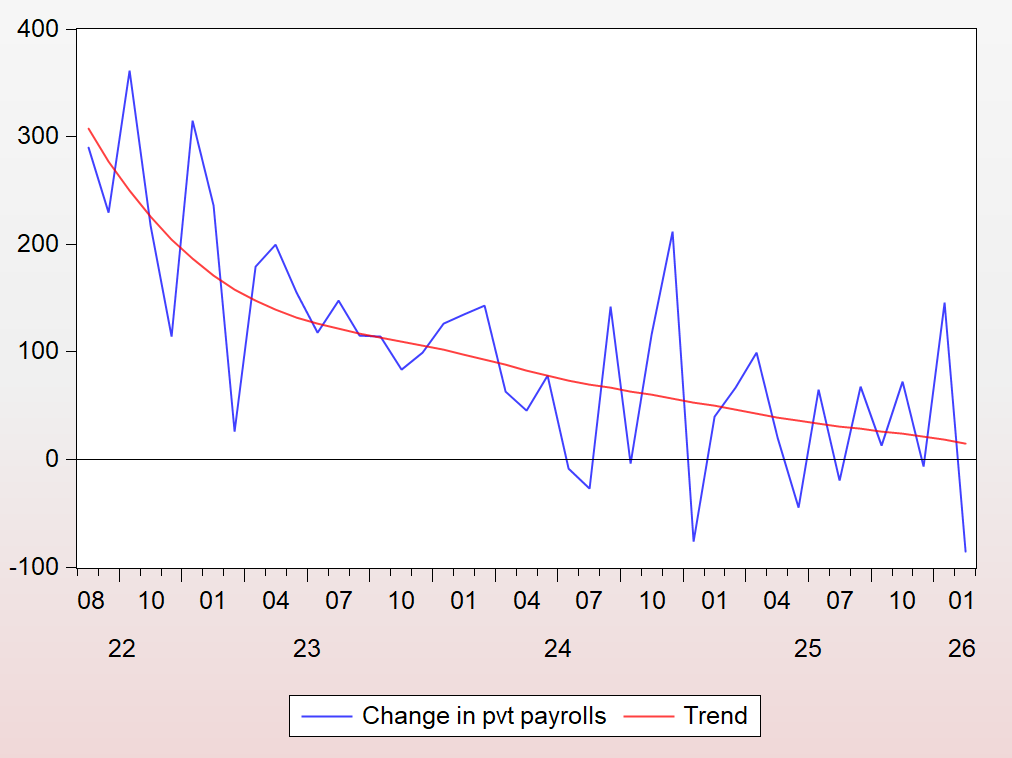 Source: BLS, my analysis, numbers in 000’s.
You see that while the most recent print was a big negative, the trend is still above zero. In fact, it’s 15K, which, as I said, is too low to keep the jobless rate from rising and too close to downright stall speed.
You also see a the reason why we’re careful not to over-emphasize one-month’s data. The swing from a big positive private-sector gain in Jan (+146K) to a big negative (-86K) is a very good e.g. of why not to go there. BTW, I checked (using rolling variances) and yes, the monthly job-change data are more choppy now than usual, but not that much more.
That’s all fascinating measurement stuff (right??), but what’s the chance that unfriendly trend starts to bend up? Well, the thing about trends is that they tend to persist, so it will take a number of months of stronger gains to bend the trend. Given that we’re stuck in a very low-hire place, and that current federal economic policy is just about uniformly awful (see first entry above), I’d guess the likelihood of notable improvement in the job market is low. Most forecasts have the year-end unemployment rate at 4.5%. At this point, I’d take the over on that.
A Jumble of Thoughts About War, Gas Prices, and Who's Responsible for This Mess
The silence and inaction of Congressional Republicans is beyond shameful
My head is spinning with the news this AM, all of which, to be clear, is totally predictable (I wrote just yesterday about war-duration concerns). Rather than organize thoughts, let me just spill them out, with apologies if the smoke from my hair-on-fire gets in your eyes. I’ll also highlight some pieces you’ll want to read.
—Josh Boak’s take at AP on current econ conditions is a good place to start :
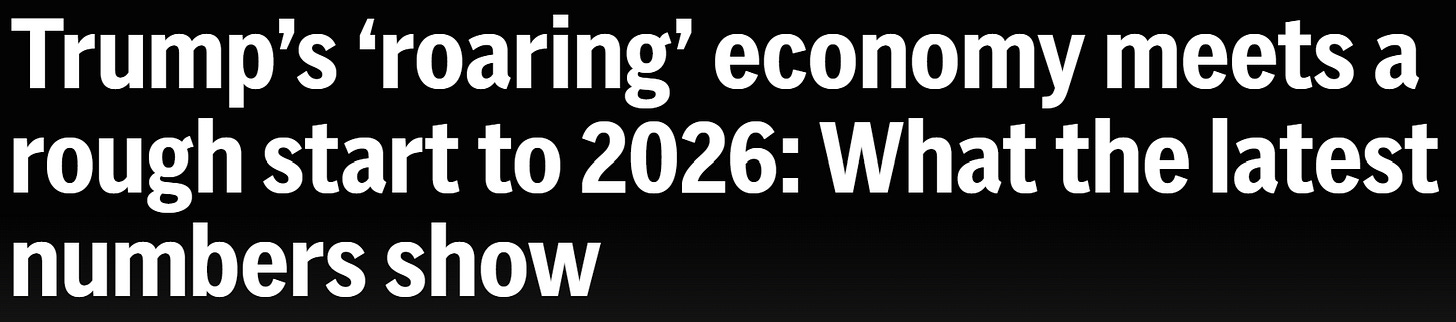
WASHINGTON (AP) — President Donald Trump promised that 2026 would be a bumper year for economic growth, but instead it has kicked off with job losses , rising gasoline prices and more uncertainty about America’s future. In his State of the Union address less than two weeks ago, the Republican president confidently told the country: “The roaring economy is roaring like never before.” The latest batch of data on jobs, pump prices and the stock market suggests that Trump’s roar has started to sound far more like a whimper.
—This slide from Neale (my guest for LdL tomorrow at noon ET!) and Ryan provides a powerful comparison of the gas price increases of various conflicts . As I write, the WTI oil price is circling around $100/barrel, up from $64 a month ago.
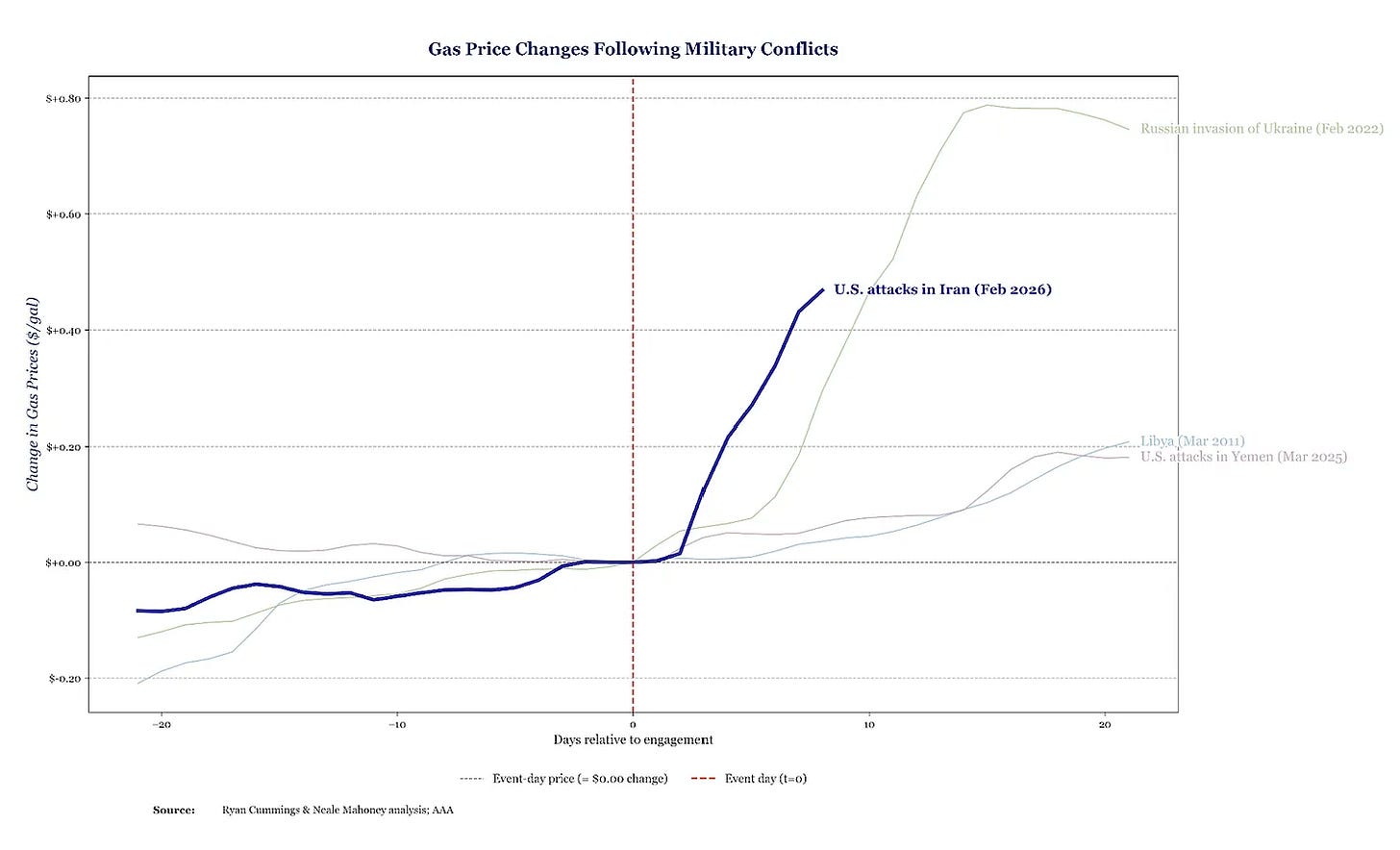
Robin Brooks recently pointed out that the oil/gas price disruption from Russia’s invasion of Ukraine affected the roughly 10% of the global oil supply that Russia provides. Well, twice that share enters world markets from the now-shut-down Strait of Hormuz. Yes, some of that will find other routes to markets, but probably very little. The point is we shouldn’t be surprised that in their figure above, the gas price, up almost $0.50 from a week ago, is rising even faster now than it was in Feb of ‘22.
—What can be done to help US consumers facing this price spike in the near term? See Neale/Ryan on this also. The answer, aside from ending this benighted conflict, is “not much.” I’m surprised the admin hasn’t announced a release from the Strategic Reserve, which I still think is coming. I suspect their hesitancy is political: it will signal this isn’t the smooth, Maduro-style in-and-out operation they’d like to think it is. The Rs also went nuts when Biden did a SPR release in ‘22, in tandem with other countries, to help lower the global price. So, perhaps that’s a constraint too, though I don’t think this squad worries a ton about hypocrisy.
But it’s also true the SPR is a) only a bit more than half full, b) the US oil producers, all Trump allies, don’t relish the competition, and c) it takes some time for its releases to hit the market. It’s not like there are delivery trucks standing by, waiting for the POTUS to say the word. The gov’t must solicit bids from private refiners, select contracts, and schedule deliveries. That takes a few weeks to a few months.
Neale/Ryan go through the other options, but as I know from hard-won personal experience, none of them amount to much at all.
—The Iranians have replaced Ayatollah Ali Khamenei with his son , Mojtaba Khamenei, who appears to be a chip off the old block. Trump deems the selection as “unacceptable” and is threatening that the new leader “is not going to last long.”
Meanwhile, as I described yesterday, Iran continue to strike broadly in the Middle East, where our allied countries are quite reasonable complaining that we failed to notify them and ignored their warnings.
Yesterday, the Energy Sec’y, Chris Wright, said that tanker traffic through the Strait will soon resume and claimed a large tanker had just gotten through. But when pressed, his department would not confirm that claim or name the vessel. In fact, the ship that got through appears to have been a small tanker with “connections to Iran.”
Besides confirming that these jokers are in way, way over their heads, all of this threatens to extend the duration of the conflict, and as I’ve consistently argued, its economic impact is directly linked to its duration.
—Who’s Responsible? I should have led with this one. Obviously, the president stands atop the responsibility pile, along with those around him who never fail to endorse his worse instincts. But it’s the MIA Congressional Rs they deserve a heavy dose of blame here (many Ds are making good noises but they have little power). Throughout Trump’s second term, I and many others have inveighed against the fact that these do-nothing men and women are still drawing a paycheck, but this is beyond the pale. I can think of few more profound Congressional responsibilities than taking a stand on the decision to go to and stay at war.
Their abrogation of this responsibility is beyond shameful.
More to come…
Whatever
Tags
Who is online
86 visitors
welcome to trump's "golden age in america" ...
And his supporters keep denying what is right in front of their faces.
They are never going to admit they made a mistake and that he's the most incompetent fool to ever grace the White House
“…the most incompetent fool to ever grace the White House…”
As history will undoubtedly show. But let’s cue the Biden, Obama, Clinton deflections. Hell, remember how bad Buchanan was?
This is today and it will only get worse tomorrow and the transgressions and attacks on our democracy must be condemned today and tomorrow.
That's not actually true, and borders on silly. Look at the graph in the article, which shows job growth declining since 2022....and which doesn't mention the Biden Administration's gross misreporting of those numbers at the time. (I'm sure someone will be along to blame Trump for that, along with the sinking of the Lusitania.)
AI alone is a massive disruptor, starting at the low end of white and gray collar workers. Claude does not care who the president is.
We've been in a "K shaped recovery" for several years now. That predates Trump.
This, however, is true. Many of the things he has done have been executed so poorly that one wonders if he's using withdrawal from Afghanistan as a blueprint.
It is difficult to imagine what was going on in his head last year with the season of 48 hour tariffs and nobody knowing WTF he was going to do next. People do not invest into uncertainty. You can grow your way into a better economy, but you need private investors willing to take risks. Nobody wants to do what when the tariffs can change randomly at 3am.
those detention centers that trump is hastily trying to complete before the midterms will come in handy in the future ...
And continuing to grow in sophistication ... thus threatening higher level jobs (including, ironically, computer scientists and software engineers).
Best to not presume there is a long-term consideration in Trump's actions. He is as impulsive as child and acts in ways that he believes will benefit him, regardless of the impact on others.