
How to Burn Less Oil



Reducing our dependence should be easy.
But it will be hard to do it fast.

"How to Burn Less Oil "
Maybe start by not being dogmatically hostile to alternative energies??
 S E E D E D C O N T E N T
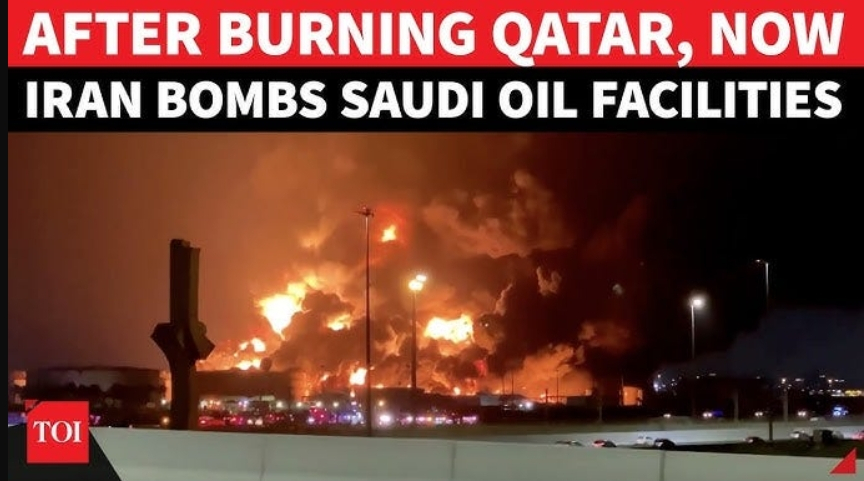
The world economy must find a way to function while burning less oil.
That may sound like a call to action, but in the short run it’s simply a statement of fact. Until the Iran war began, 20 percent of the world’s oil supply was shipped through the Strait of Hormuz. Barring a deal with Iran, which is nowhere in sight, or military action that eliminates almost all threats to shipping — which is very hard to achieve in this modern age of drone warfare — there is simply going to be less oil available for months, maybe even years, to come.
And in the longer run, we’re now having an object lesson in the strategic risks of depending so much on oil — risks that add to the already compelling environmental case for moving away from fossil fuels in general.
But how hard will it be to reduce our dependence on the black stuff? Can the world economy prosper while burning much less oil than it has in the past?
The answer depends on the time frame. Even with oil costing $100 a barrel — indeed, even if it goes to $150 — it will be very hard to reduce overall oil consumption quickly.
That’s because in the short run – which means several years — the only way to consume less oil is for people to change their behavior, mainly by driving less. So to induce a major decline in oil consumption prices would need to go high enough that people turn to carpooling, working from home, taking the bus where that’s an available option (which for most Americans it isn’t.) Or, in the worst-case scenario, oil prices will have to reduce consumers’ purchasing power so much that the economy falls into a recession, which would among other things reduce the demand for oil.
In the longer run, by contrast — defined as a period long enough to replace a large fraction of vehicles on the road — there is much greater potential for consuming much less oil, with small or zero adverse effects on economic growth and purchasing power. This was true even before the technological innovations that have made electric vehicles (EVs) competitive with internal consumption vehicles (ICEs). Fuel-efficient vehicles provide most of the benefits of gas-guzzling SUVs, and consumers may not realize how much money they save. And now that EVs are competitive, drastic reductions in gas consumption are possible with minimal disruption.
Finally, if we make different decisions about how we live and work, the world could easily thrive while burning only a fraction as much oil as it does now.
Why we consume so much oil, and how that logic is changing
Why does the world consume so much oil? The answer is that petroleum is amazing stuff. Until very recently petroleum distillates — gasoline, diesel, jet fuel and bunker fuel for ships — were vastly superior to all available alternatives as a way to power most transportation. And about two-thirds of oil consumption is for transportation, with much of the remainder being industrial uses, including manufacture of petrochemicals.
What made petroleum products so great for transportation? Two attributes. First, they’re easy to handle. Unlike natural gas or, worse, hydrogen, oil-derived fuels don’t have to be treated with great care, supercooled and/or held at high pressure. A tank filled with gasoline or diesel at outdoor temperature works just fine.
Second, oil-derived fuels have high “energy density” — that is, they have high energy content per unit of both weight and, especially, volume. This long made them the overwhelmingly dominant choice for any vehicle that needs to carry its energy supply with it. Back in 2013 the Energy Information Agency published a chart making this point very clear:
With one exception, the data points in that chart are still valid. But that one data point has changed drastically. A technological revolution has both made batteries vastly cheaper and given them greatly increased energy density. As a result, electric vehicles (EVs) are now competitive in both cost and performance with internal combustion vehicles(ICEs), and EVs have been rapidly displacing ICEs in much of the world:
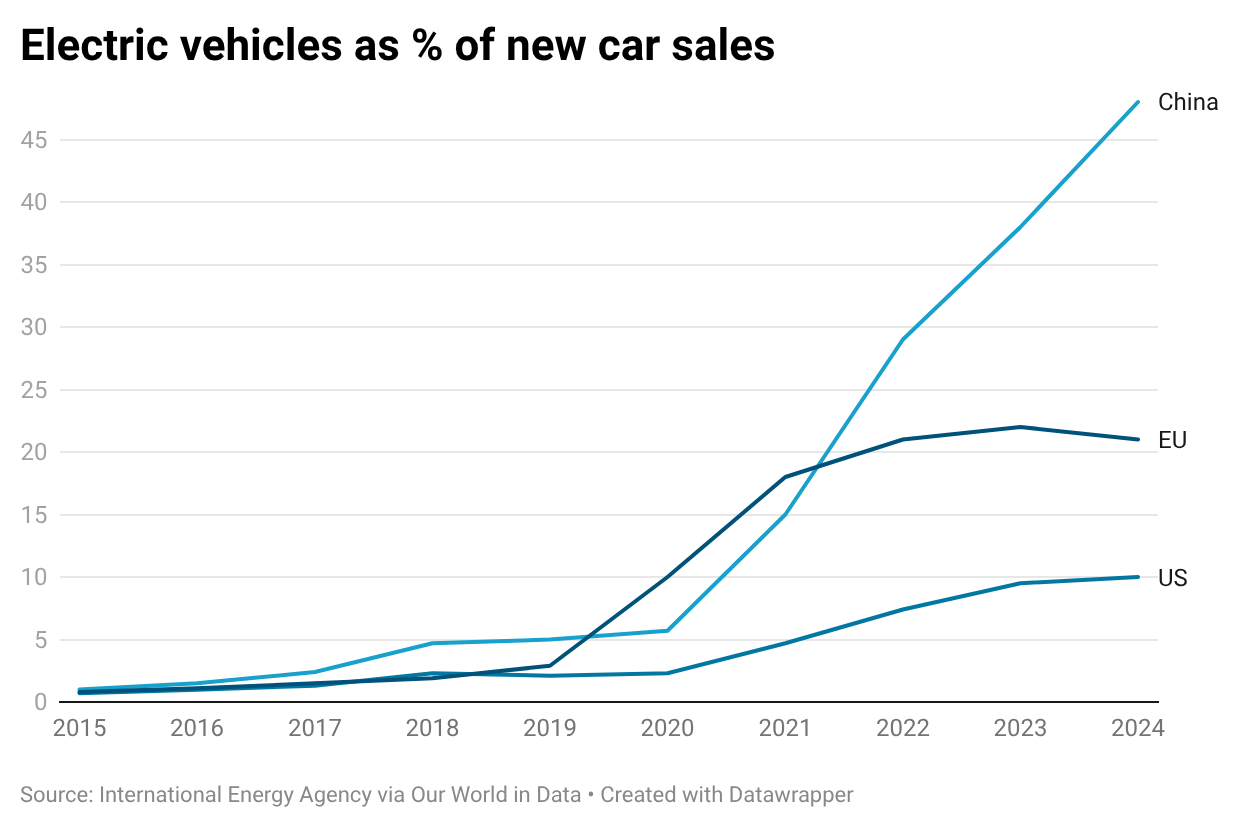
Unfortunately, the Hormuz crisis is taking place in a world in which the transition away from oil-fueled vehicles is still in its early stages. It seems quite likely that the crisis will accelerate that transition. But even a drastic shift toward purchases of electric vehicles won’t make a significant difference to oil demand over the next few months, because the stock of vehicles turns over slowly: A year from now around 93 percent of the vehicles on the road will be the same cars that are on the road now. So how will the world cope with the cutoff of a large fraction of oil supply?
The demand for oil in the short run — and the crucial question of elasticity
Products derived from oil are mostly used to power vehicles, and even if the crisis lasts for many months — which seems all too likely — the world will basically be stuck with its existing fleet of vehicles. After all, while high gas prices will shift the demand for new vehicles to EVs or highly efficient ICEs, even very high prices won’t induce people to scrap and replace vehicles that are already on the road.
So the Hormuz shock means that we’re going to have to drive less in the short run.
OK, some oil could be saved if people would drive more slowly. High-speed highway driving drastically reduces mileage. There was a reason America tried to establish a 55-mile-per-hour speed limit in the 1970s:
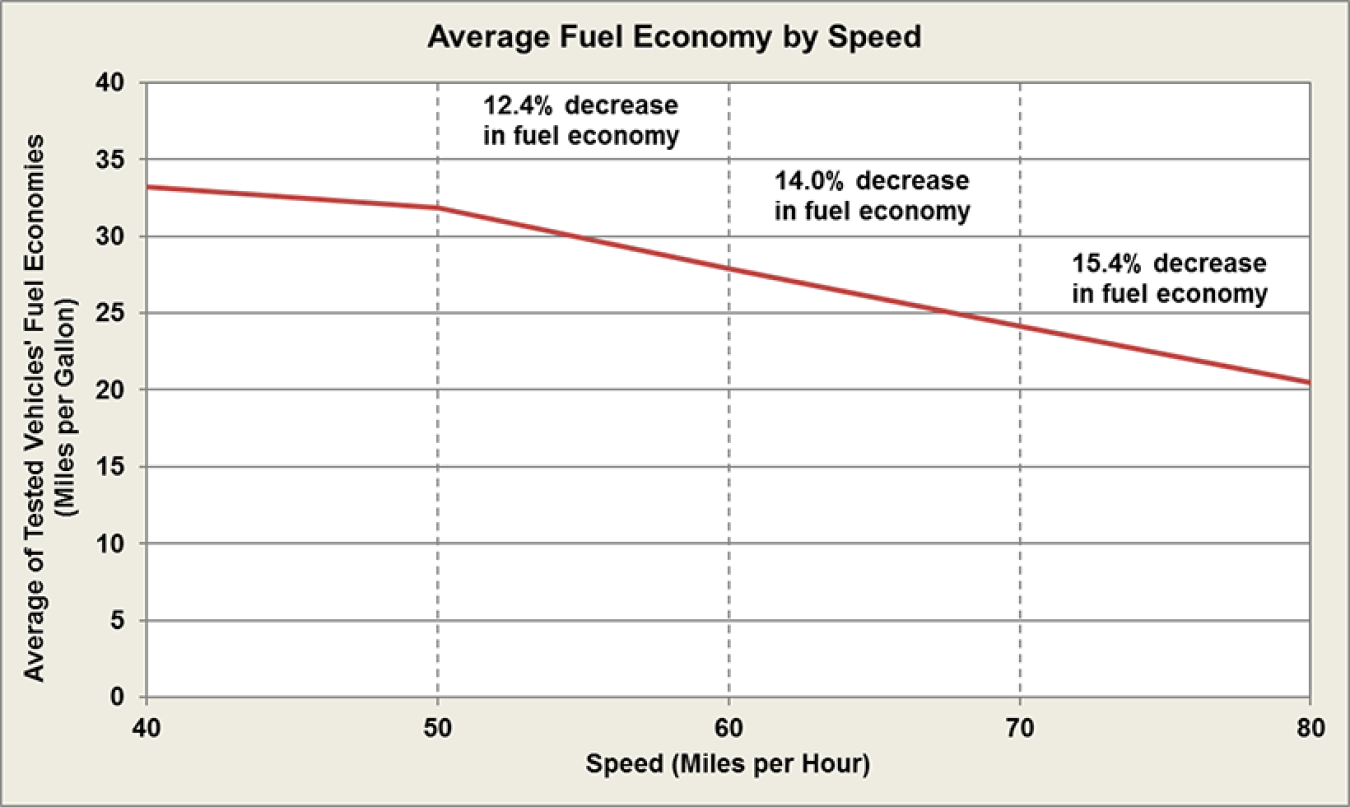
But even if people could be persuaded to slow down, which seems implausible — hey, I spent many years driving in New Jersey — it wouldn’t be enough. To deal with the loss of Persian Gulf oil, driving worldwide needs to fall.
In principle, driving could be reduced by government action that encourages or requires the public to change its behavior. Indeed, the International Energy Agency “is calling for people to cut oil demand by working from home more, flying less and driving slower.” The IEA’s call is implicitly aimed at governments, since they’re the players that would have to get that message across to the public.
However, it’s basically impossible to believe that the Trump administration, which came into office promising energy abundance, will suddenly become an advocate of energy conservation. Other countries may do more, but in practice the global adjustment to reduced oil supply will come overwhelmingly through higher prices that reduce oil consumption. But how high will prices need to go in order for the reduction in worldwide oil demand to equal the loss of oil supply due to the Hormuz shock?
The answer depends on the price elasticity of oil demand. To calculate the price elasticity of oil demand, we have to answer the following question: if the price of oil rises by 1 percent, by how many percent will consumption fall, other things equal?
From previous oil price shocks, we know that this elasticity in the U.S. is very low. So if, for example, the price of oil rises by 10 percent, U.S. oil demand will almost certainly fall by at most 2 percent – and probably less. That is, the U.S. price elasticity of demand for oil is 0.2 or less.
This low number has been documented by many econometric studies, but let me make the point by reposting a chart from last week’s primer , showing how vehicle miles driven were, or actually weren’t, affected by the big run-up in gasoline prices after Russia invaded Ukraine in 2022:
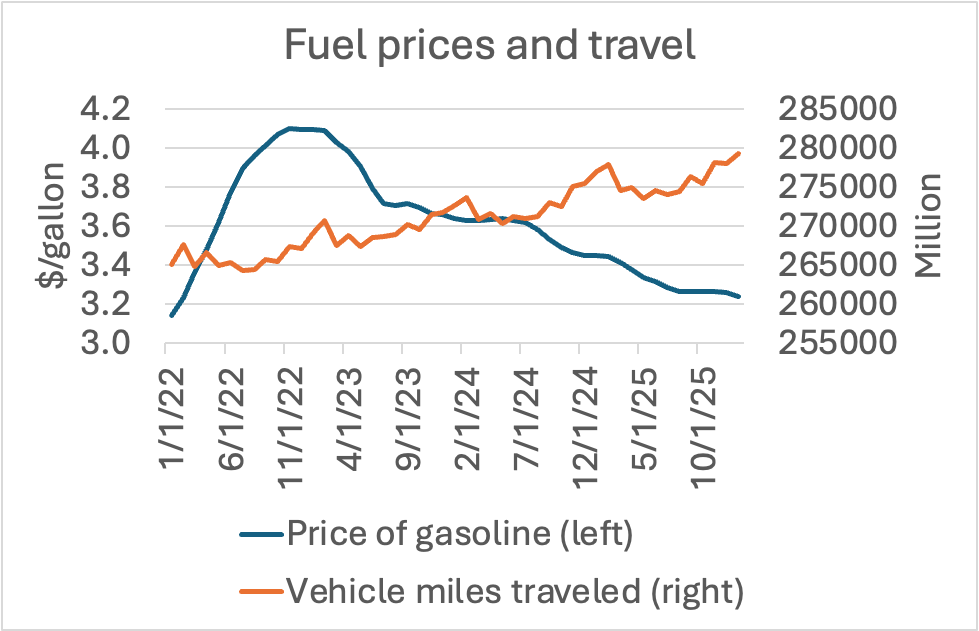
Source: FRED
Driving wasn’t visibly dented at all by high gas prices. Now, that lack of response reflected offsetting forces: The U.S. economy was still recovering from Covid and this put driving, other things equal, on an upward trend. But a large response of driving to gas prices would have more than offset the underlying upward economic trend. So this historical natural experiment shows that the U.S. price elasticity of oil demand is low.
Unfortunately, our assessment of the current oil market’s dynamics depends on exactly how low. Yesterday I posted a conversation with Robin Brooks , who has been doing extremely interesting real-time modeling of the Hormuz crisis, and who argues that apocalyptic scenarios aren’t justified. He points us to empirical estimates of the price elasticity, and his preferred number is 0.15, both for the U.S. and for the world. But it could be as low as 0.1. As I will now show, there is a big difference in outcomes if the price elasticity is 0.1 rather than 0.15.
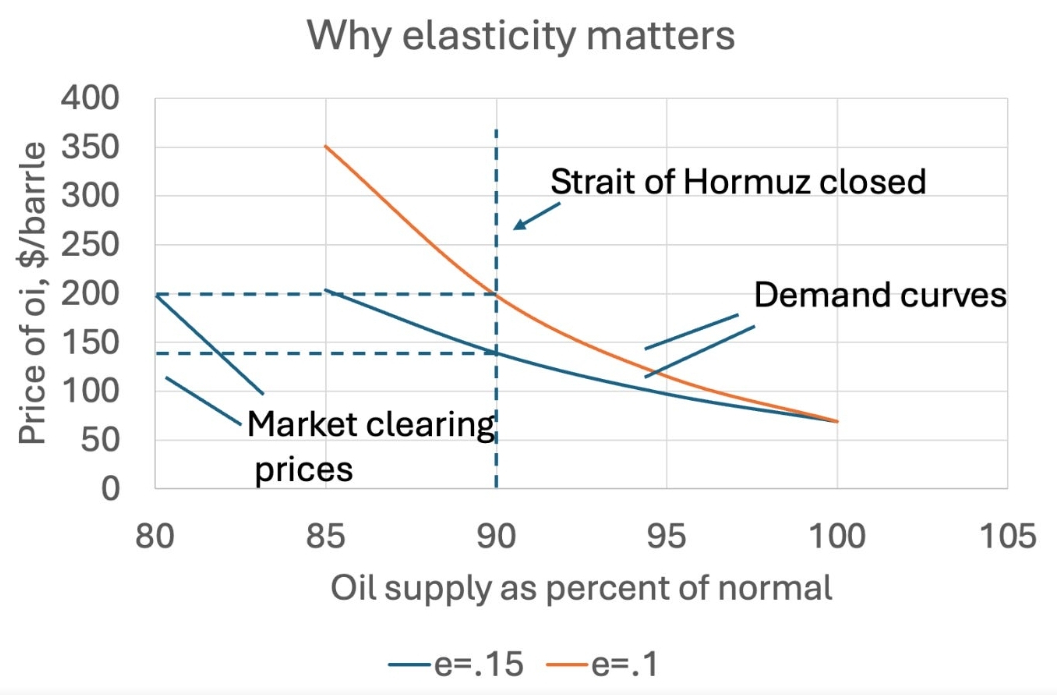
In the figure below I’ve drawn two hypothetical demand curves, showing how world oil demand as a percentage of its normal level might depend on its price. One curve assumes an elasticity of 0.15 (blue line), the other an elasticity of 0.1 (red line).
Faced with a cutoff of some oil supply, the world price of oil must rise enough to choke off enough demand to compensate for the loss. In the figure I assume that world oil supplies are reduced by 10 percent — not 20, because some oil is getting out because Saudi Arabia has a pipeline to the Red Sea and tankers carrying Iranian oil are being allowed to transit the Strait. Then this figure shows the implications for Brent oil prices, using the 2025 average price as a baseline:
Source: Author’s imagination
By my calculations, if the price elasticity is 0.15, this scenario would push the price of oil to $139. If the elasticity is only 0.1, the price goes to $198. If the supply disruption is more than 10 percent because of attacks on oil facilities or a cutoff of Iranian oil (!), look out above.
Given these risks, there really is a good case for serious non-price efforts to promote reduced oil use. But as I said, it’s very hard to imagine such efforts happening in the United States. Some countries, mainly developing nations, have begun conservation efforts, but the major consumers in Europe and Asia have not.
So unless the oil begins flowing again very soon, the short run will be ugly. The question, which I fear we’ll see answered, is just how ugly.
Give us a few years, however, and the picture looks much more benign.
How demand can adjust in the medium run
I bought my first car in 1979. It was an econobox — a small Mazda hatchback. Many Americans were making similar choices at the time: Soaring gasoline prices led to a widespread shift away from the big cars that dominated U.S. sales until 1973. Fuel efficiency of new cars rose more than 60 percent between the early 1970s and the mid-1980s:
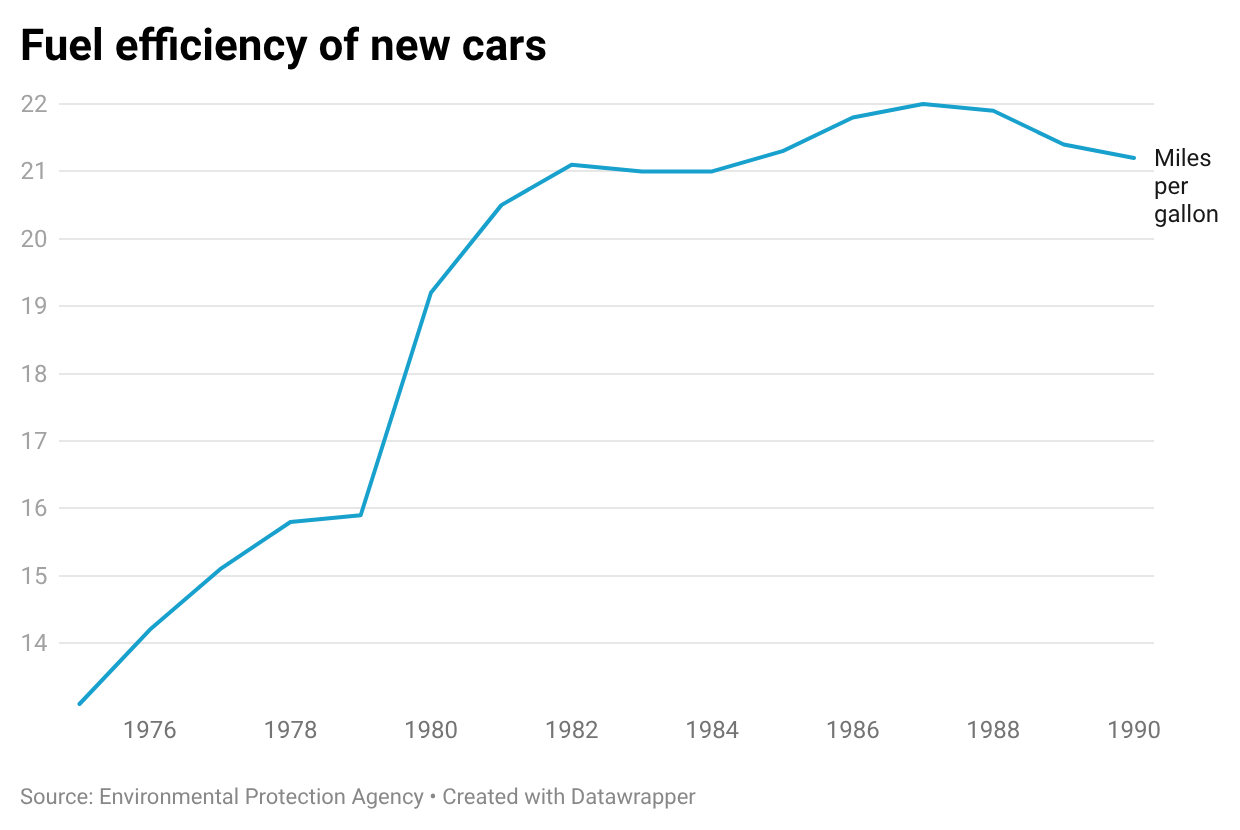
This trend only stalled and then went into reverse after the big decline in oil prices in 1985, which was followed by the rise of SUVs.
As I just explained, even large increases in fuel prices have only small effects on gasoline demand in the short run. But gas prices have a substantial effect on what kinds of vehicles people purchase. And this can lead to large effects on demand if high prices are sustained long enough that fuel-efficient vehicles make up a large share of the fleet of vehicles on the road. This was true even before electric vehicles became a realistic option and is even more true now.
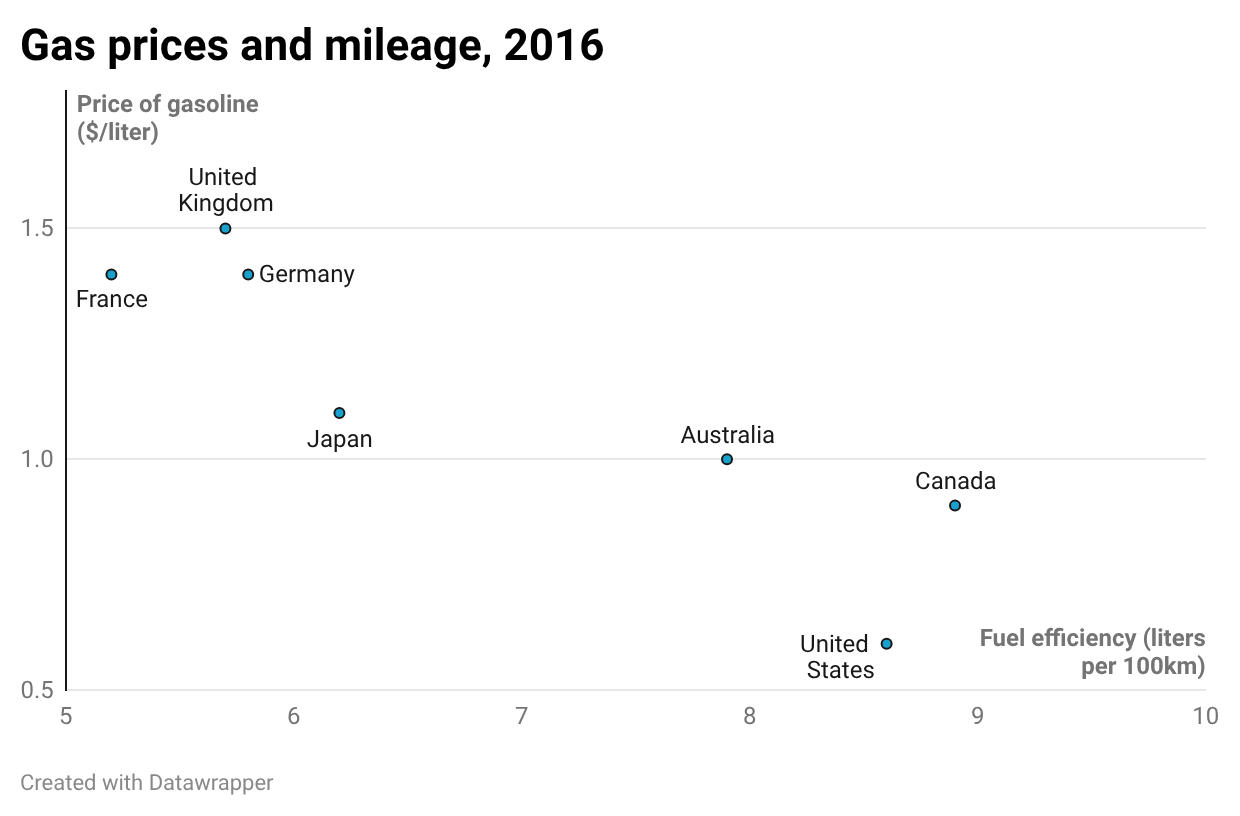
We can see this longer-run response of demand to prices — the effect once there has been time to replace many vehicles — by looking at international comparisons. Gasoline has always been much cheaper in the United States than in Europe, for the simple reason that Europeans tax gas heavily and we don’t. Canada and Australia also have low prices at the pump. And the low-gas-price nations burned much more fuel per mile than the high-price nations, even before the rise of EVs. Here’s a comparison for 2016:
Source: International Energy Agency
OK, some of this disparity may reflect geography as well as price differences: the low-fuel-efficiency countries also have low population density, which may encourage the use of bigger cars. But the truth is that most Americans, like most people across the advanced world, live in big metropolitan areas. If our urban areas sprawl much more than Europe’s, that’s a choice rather than a fact of nature. More about that choice in the next section.
The moral of this analysis is that there is ample scope for running the world’s economies with much less oil given time to switch over to more fuel-efficient vehicles. The problem is that we are talking about a lot of time, multiple years rather than months.
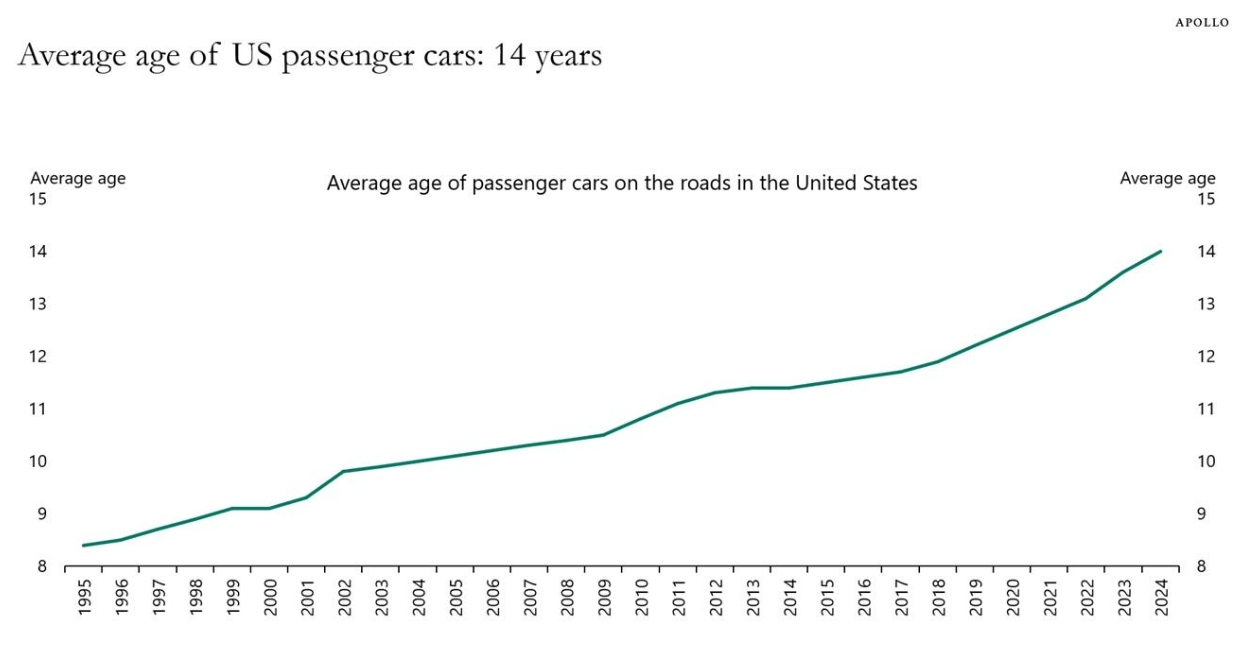
Why? Because the stock of vehicles on the road turns over slowly. The average age of U.S passenger cars on the road has risen to an astonishing 14 years, up from less than 9 years in the 1990s:
Source: Apollo Academy
This rising age of the average car partly reflects increased durability: Cars are better built than they used to be. But it also reflects a change in auto company strategy: Cheap cars like the econobox I bought in 1979 have become largely unavailable, so less affluent consumers must rely on used cars instead.
Unfortunately, this means that the fleet of vehicles in service turns over slowly. Even if oil prices go very high and stay there, much of the world will be stuck for years with internal combustion cars that have relatively low fuel efficiency.
And a truly fundamental change in energy demand, while perfectly possible given current technology, will (a) take even longer and (b) require collective action coordinated by governments.
Oil demand and how we live
The price elasticity of oil demand is very low in the short run, essentially because it’s very difficult to get people to drive less. The price elasticity is much higher over the longer term, largely because high fuel prices lead people to buy more fuel-efficient vehicles or, nowadays, eschew internal combustion engines entirely.
But can higher prices also induce people to drive less over time? There are, in fact, large differences between advanced nations in how much people drive: passenger miles on roads per capita are only about half as much in Europe as they are in the United States. Some of that is presumably a response to high European fuel prices. But much of it surely reflects differences in the way people live and work. As one report , admittedly a work of advocacy, put it,
Residents of [European] countries often enjoy communities where more destinations can be accessed on foot, by public transportation, or by intercity rail.
One way to see the importance of living and working arrangements in oil demand is to compare U.S. states. Gasoline prices don’t vary as much among states as they do internationally, but they are substantially higher in California than they are in the rest of the country. Yet Californians, while they drive less than the average American, drive far more than residents of New York, where gas prices on the eve of the Iran war were slightly below the national average:
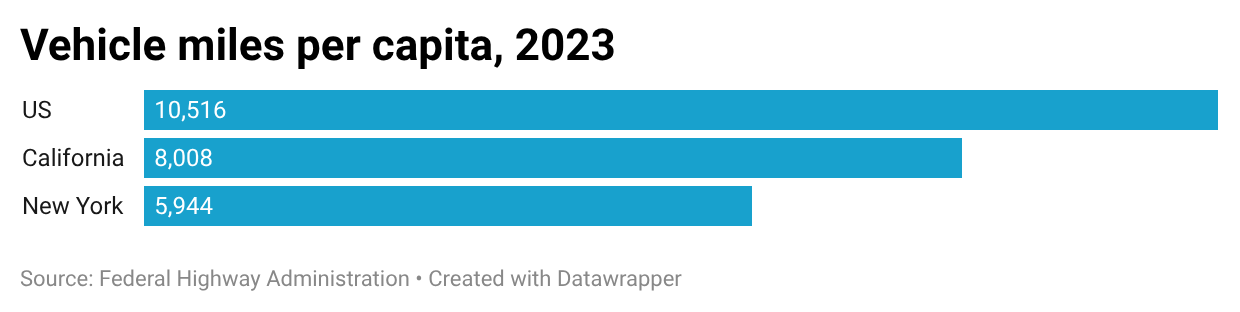
There is, of course, no mystery about these data. About 65 percent of New York State’s population lives in the New York metropolitan area, which has far higher population-weighted density than any other U.S. metropolis — about 2 ½ times the density of Los Angeles or San Francisco. This high density goes along with much greater availability of public transportation, even in the New York suburbs. So New Yorkers, like many Europeans, don’t need to drive as much as most Americans.
And yes, although gasoline isn’t especially expensive in New York, parking is.
The point for oil demand is both that public transit uses less energy than cars and that the portability and high energy density of petroleum products are much less crucial for public transport than they have historically been for individual vehicles.
But widespread availability of public transit and the high density it makes possible don’t happen automatically, even in the face of very high oil prices. They require active public policy, and also require many years, sometimes decades, of lead time.
So let’s return to the question at the beginning of this post: Can the world economy prosper while burning much less oil? The answer is clearly yes, given sufficient time and supportive public policy. A decade from now we could easily manage with substantially less oil than we burn now. Two decades from now it’s easy to imagine a world economy that has almost completely weaned itself from petroleum.
Unfortunately, the crisis in the Strait of Hormuz is happening now and could get much worse in the months ahead. In the long run we’ll be fine, but in the long run …
Whatever
Tags
Who is online
86 visitors