
Is America Suffering from the “Resource Curse”?



Why the U.S. is the last big petrostate and why that is bad for everyone

Krugman is an economist. Nobel Prize, much to President Trump's chagrin. This a an example of him doing econ.
I'd be happy to see a MAGA seed something equivalent from a reputed right-wing economist.
Oh, wait ... there's no such thing a "reputed economist" on the right.
 S E E D E D C O N T E N T
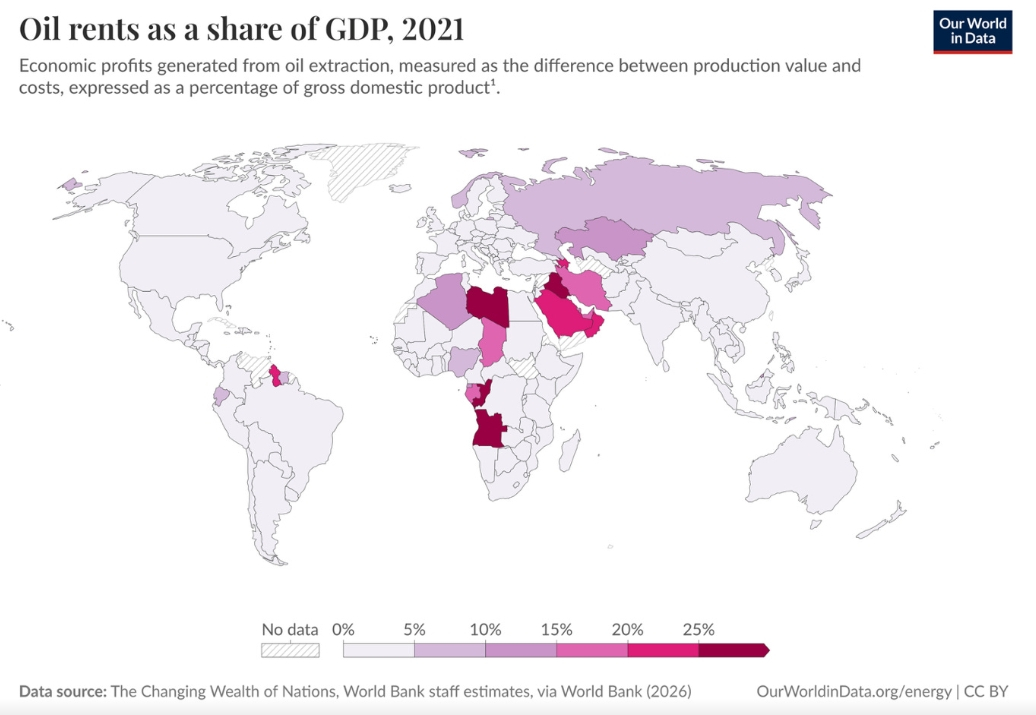
Oil rents are the difference between the value of oil produced and the cost of producing it
Kuwait, Saudi Arabia and the United Arab Emirates are petrostates — nations whose economies are driven by oil and gas. As a result, their politics are deeply shaped by their natural resource wealth. Iran is also a petrostate despite the fact that it exports significant quantities of manufactured goods. It’s a petrostate nonetheless because most of these are goods that make use of its oil and gas, like fertilizers and petrochemicals. The main exception has been Iran’s growing exports of military hardware, especially missiles and drones.
Russia is also widely considered a petrostate: John McCain famously called it “a gas station masquerading as a country,” although Matt Klein argues that this overstates the case. And critics of the Trump administration often accuse it of trying to convert the U.S. into a petrostate, at an especially inopportune moment. In my recent conversation with David Roberts , he declared that
the US is basically aligning itself as the last big petrostate. We’re going to go down with the fossil fuel ship, and China is aligning itself as the first electrostate.
Last month Rana Faroohar of the Financial Times basically said the same thing.
At this moment in history critiques of economic reliance on fossil fuels often focus on changing energy technology. At a time of rapid progress in renewable energy and general economic electrification, many argue, as Roberts does, that clinging to fossil fuels means missing the boat.
However, warnings that reliance on oil or other natural resources can be a trap have been prominent in economic discourse for decades. They were widespread long before the current renewable energy revolution began and were largely separate from concerns about the environment. The term resource curse , coined by Richard Auty in 1993, refers to a familiar though controversial proposition in development economics. It says that nations rich in natural resources, especially minerals including oil, tend to do worse in the long run than resource-poor nations. As we will see, the resource curse proposition claims that countries with economies heavily tilted towards natural resource extraction are afflicted by a tendency towards backwardness compared to countries less dependent on natural resource extraction.
Historically, most discussion of the resource curse has been concerned with small or poor nations. At this point, however, many are arguing that the United States faces some of the same issues
The economic consequences of natural resource abundance
The best survey of the resource curse discussion I’ve found is a 2012 paper by Harvard’s Jeffrey Frankel. Frankel noted that it’s easy to come up with examples of resource-poor nations that have thrived and resource-rich nations that haven’t, but harder to find a systematic statistical relationship between resource abundance and economic growth. Still, the examples are striking enough that we should definitely take the resource curse argument seriously.
Frankel suggested six channels through which mineral wealth could make a nation poorer in the long run. One, downward trends in commodity prices, he dismisses as inconsistent with the evidence. And I would consolidate his 3 rd and 6 th channels as being essentially the same thing. This leaves us with four ways natural resource abundance can be a bad thing. Restating Frankel’s points slightly, they are:
· Commodities like oil have highly volatile prices, creating risks for economies that depend on them too much
· Natural resource exports can crowd out manufacturing and other sectors that offer greater potential for future growth
· Natural resource abundance can feed autocracy, corruption and oligarchy
· Natural resource abundance can feed anarchy, even promote civil war
Of these, the first two channels are economic, and I will discuss them next. The second two are matters of political economy and will be discussed in the next section.
The destabilizing effects of commodity price volatility : Let’s start with volatility. This is indeed a huge issue for petrostates whose whole economies are built around oil and gas exports. A few weeks ago I posted this chart of the real, i.e., inflation-adjusted price of oil over time:
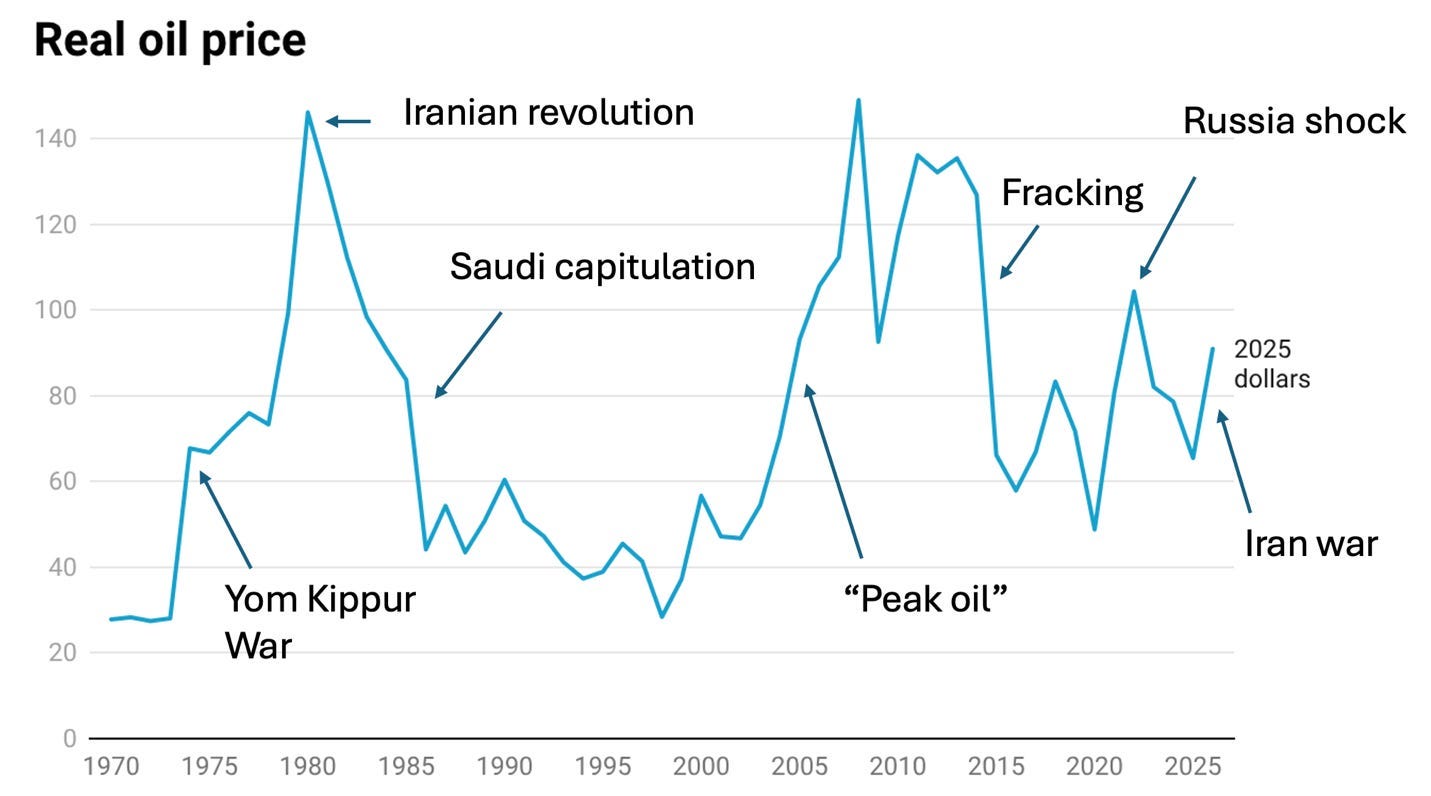
The extreme swings in this chart have been difficult for oil-importing nations — the big rise in oil prices between 1973 and 1980 was a major factor in the rise of stagflation. But they have been even more destabilizing for nations that derive a large part of their national income from oil exports. So yes, putting all your economic eggs in one basket, er, barrel is a problem.
Crowding out of manufacturing and damage to long-run growth : The role of mineral wealth in crowding out manufacturing is subtler but may be extremely important.
Resource abundance as a cause of deindustrialization is known in the economics literature as the “Dutch disease.” Why? In 1959 the Dutch discovered the huge Groningen gas field. Production began in 1963, and rapidly ramped up, with the Netherlands becoming a major natural gas exporter for decades. Production of gas was ramped down after 2014 and ended in 2024 because subsidence due to gas extraction was causing earthquakes.
The initial surge in gas exports was followed by a notable contraction in the Dutch manufacturing sector , which shrank from 22 percent of GDP in 1969 to 16 percent in 1979. In 1977 The Economist labeled the phenomenon the “Dutch disease,” attributing manufacturing’s woes to the gas industry’s success.
The logic of the Dutch disease runs as follows: If large amounts of money are flooding into a country because it is exporting large amounts of oil or gas, this will increase the value of its currency, other things equal. Or if the exchange rate is fixed, domestic inflation will increase as the inflow of money puts pressure on domestic prices. Either way, the nation’s manufacturing sector becomes less competitive against foreign rivals. Hence the country’s domestic manufacturing output and employment shrink.
Why is it bad if a nation produces more minerals while manufacturing fewer goods? The usual argument is that manufacturing is characterized by more “learning by doing” than extractive industries: nations that have large manufacturing sectors tend to get ever better at manufacturing, causing a virtuous circle that feeds economic growth, while nations that live off their resources, even if initially richer, miss out on this opportunity to diversify and grow technologically.
Consider the longstanding conundrum of why Asian economies surged ahead of Latin American economies, which started out much richer — for example, Korea, now a highly advanced economy, still had substantially lower GDP per capita than Brazil in the 1970s. While there are many possible explanations, one compelling explanation is that manufacturing costs in Brazil, Argentina etc. were relatively high because of their resource wealth. So when modern globalization took off, export-oriented manufacturing located in resource-poor Asia rather than Latin America. This led to a cumulative process of high growth in Asia that bypassed the Western Hemisphere.
As we’ll see shortly, there’s an even stronger economic argument about the adverse effects that are generated when fossil fuel wealth crowds out renewable energy.
Let me also note in passing that natural resources aren’t the only possible source of Dutch-disease-type problems. Discussions of the long-term decline in British manufacturing often invoke the role of the City of London as a hub of global finance . The primacy of the City of London led to huge British exports of financial services, which have in turn kept the pound stronger than it would have been otherwise, rendering U.K manufacturing uncompetitive.
Back to natural resources: the Dutch disease isn’t inevitable. Norway, with large revenues from North Sea Oil, has largely although not completely “sterilized” the effects of those revenues on the domestic economy by putting oil revenues into a huge sovereign wealth fund that invests the money abroad. Perhaps even more important, Norway has managed to remain a vibrant democracy despite its oil wealth.
But it’s the exception that proves the rule. Let’s now turn to the adverse political effects of resource wealth.
The political consequences of natural resource abundance: Autocracy and anarchy
None of the petrostates I name-checked at the beginning of this post is remotely democratic. That is not an accident.
The map at the top of this post showed oil rents — the value of oil output in excess of production cost. In economics jargon, as opposed to normal English, “rent” has a specific meaning: It is unearned income, income that accrues to some people or institutions without requiring that they make an effort or commit resources to production. Unlike wages or returns on investment, who gets rents is in a sense arbitrary, depending on who is assigned the property rights or, in some cases, who has the power to seize them.
The existence of large rents can have profound political consequences. Here’s how Frankel puts it:
In high-rent countries the natural resource elicits a political contest to capture ownership, whereas in low-rent countries the government must motivate people to create wealth … [this theory] is thought to fit Middle Eastern oil exporters especially well. In this region, governments’ access to rents, in the form of oil revenue, may have freed them from the need for taxation of their peoples, and that this in turn freed them from the need for democracy.
Large economic rents may be captured by authoritarian governments, strengthening their hold on power. If such governments are also corrupt, a large part of the rents can easily end up in the hands of well-connected individuals. So it’s not an accident that petrostates are generally characterized by oligarchy as well as autocracy.
There’s also a further grim possibility associated with natural resource wealth: civil war. When there are large economic rents that can be appropriated by those in power, they can also potentially be appropriated by other actors with guns. After Africa experienced a wave of civil wars in the 1990s, the World Bank in particular sponsored extensive research into the causes of civil war. Although there has been much criticism of that research (as there typically is for any bold thesis), my assessment is that the basic point stands: while considerations such as ethnic divisions matter too, one major factor determining how likely a nation is to experience civil war is whether there are large resource rents that men with guns can potentially seize. This can include oil, although the need for viable infrastructure makes oil less easily targeted than, say, blood diamonds.
Overall, then, the resource curse is real. While resources are a source of national wealth, large resource-related rents can have significant economic and especially political downsides.
So, to what extent is America today suffering from the resource curse?
The resource curse, American style
The U.S. is not a petrostate in the sense Saudi Arabia or even Russia are. Mining of all kinds, which includes oil and gas extraction, is only 1.2 percent of GDP . Oil rents, which are 24 percent of Saudi GDP and 9.7 percent of Russian GDP, are only 0.6 percent of U.S. GDP. America remains a nation in which income comes overwhelmingly either from wages or as a return on productive investment.
Yet we are unique among the world’s biggest economies in the scale of our oil and gas production relative to the size of our economy. There are three economic superpowers in today’s world: China, the United States and the European Union. China and Europe both import most of their oil and natural gas, but the U.S. is self-sufficient in gas, exporting a significant amount as LNG, and thanks to the rise of fracking after 2010 we now produce more oil than we consume.
How are we affected by the our relatively abundant supply of fossil fuels?
First, I would argue that we have been quietly suffering from a mild case of the Dutch disease.
Until fracking took off in the early 2010s the U.S. ran persistent trade deficits in petroleum and petroleum products, but these deficits then shrank rapidly and became a surplus:
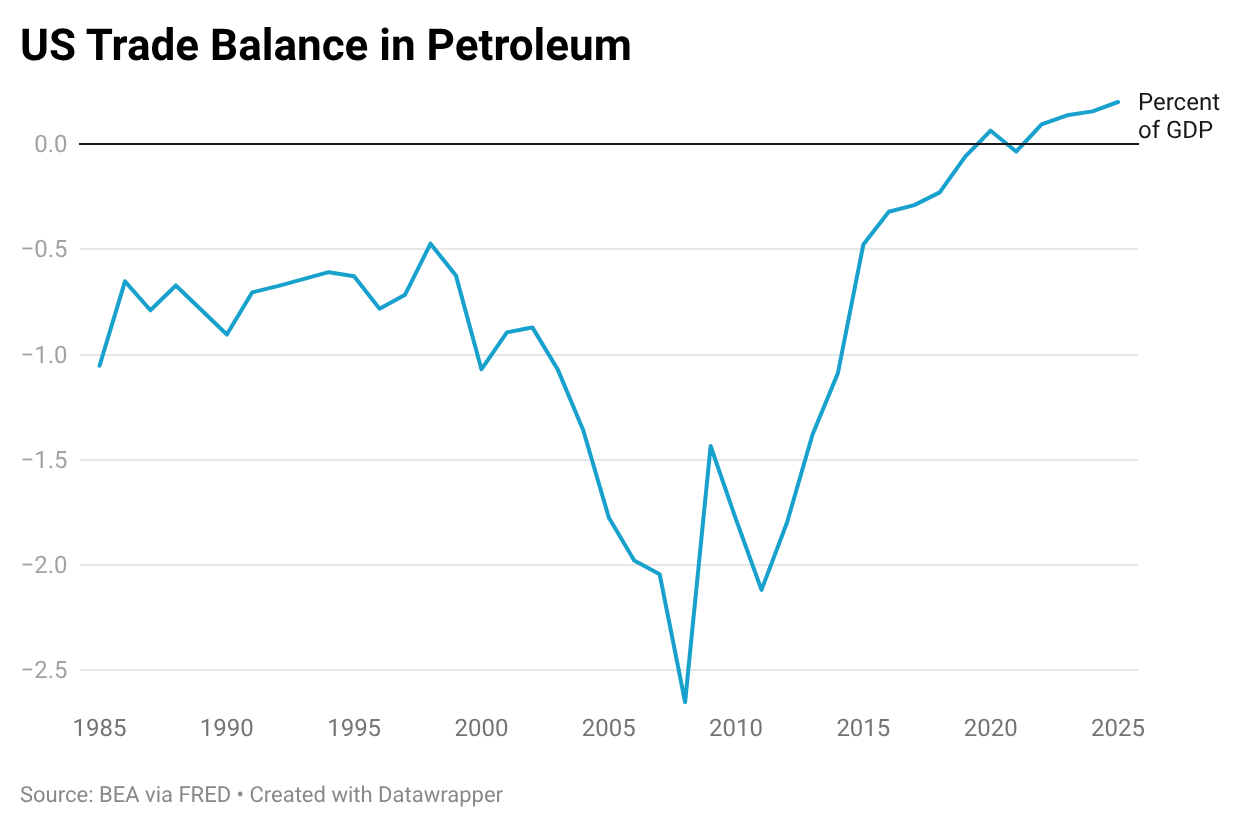
Now, a central proposition in international economics is that the balance of payments always balances. That is, the total value of what America buys from other nations — goods, services and assets — always equals the total value of what other nations buy from us. So if we import less oil than in the past, we must be either buying more of other kinds of imports or selling fewer exports.
There’s no obvious reason to believe that rising U.S. oil production has reduced our surplus on financial account — net sales of assets, aka inflows of capital to the United States. So the elimination of our oil deficit must have been offset in a rise in our deficit in other goods and services, most likely greater imports of manufactured goods. And a higher trade deficit in manufactured goods means less value-added and employment in manufacturing than we would otherwise have had.
This is, by the way, the opposite of what many fracking enthusiasts initially claimed. When U.S. natural gas prices began falling after 2010, there were many predictions that this would lead to a manufacturing boom, because low energy prices would give U.S. manufacturing a competitive edge. However, such predictions failed to take the logic of international trade into account.
I won’t get into the details, but my back-of-the-envelope calculations suggest that the fracking boom has made U.S. manufacturing around 10 percent smaller than it would have been otherwise, and reduced manufacturing employment by about 1.3 million workers.
There’s also a phenomenon that is conceptually similar to the Dutch disease but causes adverse impacts on renewable energy rather than manufacturing. Until around 2010 renewable energy was dominated by hydropower, but since then solar and wind power have experienced revolutionary technological progress. The United States has, however, been much slower than the other economic superpowers to take advantage of this technological revolution:
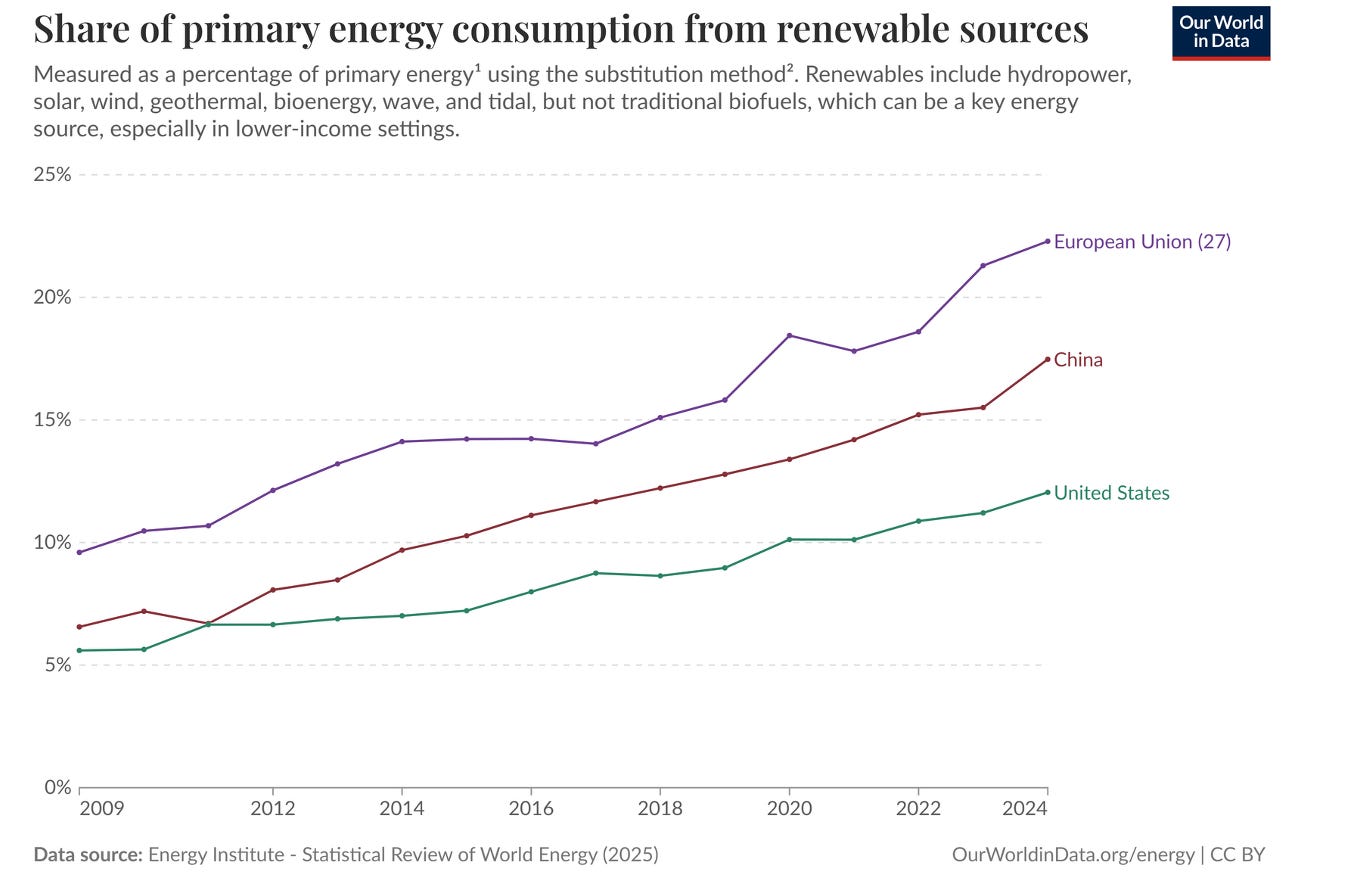
Why is the U.S. lagging so badly on renewable energy? Policy has made a major difference in the past and is making a huge difference now that the Trump administration is doing all it can to block clean energy. But there is also a non-policy explanation: The renewable energy revolution occurred at roughly the same time as the fracking revolution, and the U.S. has been slower than the other superpowers to turn to solar and wind for electricity generation, in particular, because fracking has given us access to cheap natural gas.
But if utilities choose natural gas over solar and wind because it is or was still somewhat cheaper, why is that a problem? Recall that one of the arguments for the resource curse hypothesis was the claim that economic development was historically driven by learning by doing in manufacturing, and that resource abundance, by discouraging manufacturing, deprived nations of the chance to get on that ladder.
And the case for huge learning-by-doing effects in renewable energy is overwhelming – considerably stronger than in manufacturing. Some of these effects spill over internationally, but not all of them. To the extent that America’s abundant fossil fuel resources have deterred investment in renewable energy, they have also contributed to a growing technological lag behind other economies — China in particular — that are forging ahead.
That is part of what David Roberts meant when he spoke to me about how America is “aligning itself as the last big petrostate” while China is “aligning itself as the first electrostate.”
As I’ve emphasized, however, the effects of having valuable natural resources go beyond straight economics. The political consequences of resource wealth can also help turn what should be a blessing into a curse.
The U.S. lag in taking advantage of the renewable energy revolution is partly a result of the availability of cheap natural gas, but it’s also the result of policy: In the past, the U.S. did much less than China or Europe to promote renewable energy, and since 2024 U.S. policy has turned actively hostile to renewables. Some of this difference in policy may be attributable to cultural attitudes, but a large part can be attributed to the political influence of U.S. fossil fuel interests — interest that doesn’t have a counterpart in Europe or China because the other economic superpowers don’t have the same reserves of oil and gas. (Right-wing parties in Canada and Australia, like MAGA, are aligned with fossil-fuel interests.)
Not to put too fine a point on it, Donald Trump has a personal animus against wind, while many in his party generally dislike the idea of clean energy, but the huge political contributions the oil and gas industry has given to Republicans — and the industry’s long-term role in promoting climate denial, claims that renewables aren’t practical, and so on — have also done a lot to set America heading down a different energy path from the rest of the world.
What about the role of natural resources in promoting authoritarianism and oligarchy? A few years ago most commentators would probably have laughed off any attempt to draw analogies between the United States and Putin’s Russia, let alone Middle Eastern petrostates. I doubt that many are laughing now.
In fact, there’s an indisputable case that fossil fuel interests, especially but not only the Koch brothers, played a key role in the unraveling of U.S. democratic norms. For example, as documented in Lisa Graves’ Without Precedent , the Koch brothers have spent vast amounts of money over several decades to influence the composition of the Supreme Court – the very Supreme Court that virtually immunized Donald Trump from the consequences of his actions.
However, to document how fossil fuel money subverted American democracy is a huge subject, which I will have to return to on another day.
Let’s return to my initial questions. Is the resource curse real? Yes. Abundant natural resources aren’t always a bad thing, as the case of Norway shows. But in all too many cases an abundance of natural resources has severely hurt the countries that possess them, leading to sub-par economic growth while promoting autocracy, oligarchy and corruption.
Is the U.S. suffering from its own version of the resource curse? Yes. Notably, our production of oil and gas has hindered our energy transition, and the political influence of the fossil fuel sector is a primary reason our democracy is in danger.
I am not, however, suggesting that we blow up our oilfields! The resource curse isn’t ineluctable. The downsides of resource abundance can and should be fought – for example, by promoting renewable energy and limiting the corruption of our democratic institutions by fossil fuel money. Maybe the current energy crisis will even serve as a wakeup call and get us to do the right thing.
Whatever
Tags
Who is online
86 visitors
What is Paul Krugman babbling about? The "Dutch Disease" has very little relevance to the United States, as Krugman admits. Building an economy on export of energy can short circuit industrial development. But the United States is not suffering from "Dutch Disease".
Krugman completely ignores the reason oil is of overwhelming importance to the United States -- the petrodollar. If oil exporters were not demanding payment in US dollars then the dollar would collapse and American influence around the world would be in the toilet. If the global need for dollars collapses the resulting inflationary devaluation of the dollar would be massive. That's why the United States has a vested interest in continued use of oil even if the US is not a major exporter of oil. Oil exports are not holding back American manufacturing or America's transition to clean energy. In the United States an abundance of natural resources, like oil and coal, should be an economic boon to supply domestic industry.
The US vested interest in the petrodollar is why the war with Iran has become problematic. Iran is directly attacking the petrodollar by demanding payment for safe passage through the Strait of Hormuz in Chinese yuan. Iran is trying to force shippers to register with the Chinese CIPS payment system and make transactions in petroyuan. The petroyuan/CIPS system bypasses western sanctions, establishes a firewall against American influence, and undermines the global demand for dollars. The Iranian demands are a proof-of-concept validation that there is a viable alternative to the petrodollar/SWIFT system. And the Arab states are watching.
Krugman can spin all sorts of deflections and diversions about 'green' technology. But even advocacy for that transition undermines the petrodollar which is a non-trivial source of US influence around the world. China already has a head start on 'green' technology so replacing the petrodollar with a solardollar would be gross wishful thinking. Krugman ignoring the growing threats and risks to the US dollar won't make them go away.
Of course they're not. But it's Krugman. He long ago traded sound economics for political commentary.
He utterly ignores any contributing factor that would be inconvenient to his political argument.... no matter how obvious that factor may be... and then declares the remaining loose correlation as some sort of proof that his political view is now validated.
Example...
Never mind that Saudi Arabia and the Emirates have never been remotely democratic. Please do not under any circumstances notice or attend to the fact that these places were completely undemocratic for thousands of years before oil was ever discovered there. The Royal House of Saud has ruled in Arabia for 300 years.
But no... the absence of democracy is all because of the oil... the production of which didn't start until the 1930s.
It is also inconvenient to recognize that Russia is more democratic today than it was at the end of WWII. And Krugman ignores petrostates in South America (which have had a communism problem). Mexico is a petrostate, a manufacturing state, and a democracy. Canada seems to be an oil exporting democracy, too.
The Middle East is responsible for only 20% of global oil production and 40% of global oil exports. There's a lot of oil unaccounted for by focusing on the Middle East. And Krugman ignores that the Middle East also controls a third of global fertilizer and helium exports and half of sulfur and naphtha exports. The Middle East doesn't just export oil.
No no... you didn't catch that? Nah, he gets even more idiotic about them.
Conundrum. Yessireeebob. Nobody can figure this out. The entire world is perplexed, bordering on flummoxed.
It's one of the great mysteries in the history of civilization as to how high corruption societies were overtaken by low corruption societies. And who could possibly have foreseen anyone with the work ethic of the Japanese and Koreans overtaking Venezuela, Brazil or Argentina?