
A ‘Handmaid’s Tale’ sequel answers questions the original forgot to ask


 S E E D E D C O N T E N T
“There were signs of what was coming,” the offscreen voice informs us. “Candidates running for office had said things openly about women, about gays. But they were still elected. People thought they were speaking in hyperbole.”
Here we are, in a country that may feel both familiar and foreign; a regime you’d beaten back once only to see a resurgence of power — no, dear, it wasn’t a dream, we’re doing trade wars and religious extremism again — in a place that lambastes processed foods but is drowning in so much beef tallow that the world itself tastes like a cow.
That’s right, blessed fruits, we’re back in Gilead again. Oh, you thought we were talking about someplace else? Haha no.
It’s hard to overstate the cultural impact of Atwood’s 1985 dystopian bestseller, in which a theocracy solves its problem of a declining birth rate by forcing fertile women to be ritualistically raped.
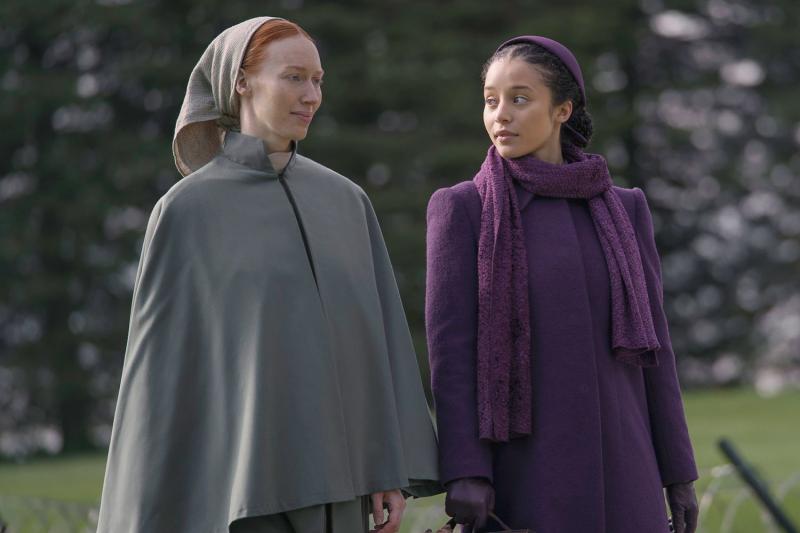
But in “The Testaments,” nearly everyone we meet is a hellish boss, or will soon become one. The plums at Agnes’s school are there to learn how to control their households and surrounding culture, by manipulation, abuse and violence if necessary.
They are also there to learn to police one another. In one scene, the meek Hulda is informed that her first task as a newly menstruating girl is to determine a punishment for her friend Shunammite, who has committed a small infraction. To the approval of the teachers, Hulda haltingly says that the girl’s hands should be whipped, and then she is made to physically restrain Shunammite while an instructor rains down blows. Afterward both girls roll their eyes about the incident, as if it’s just one of those annoying things that happens at school.
What else are they supposed to do? Y’all, they’re teenagers . So now suddenly they have to deal with their periods while also figuring out how to commit multiple human rights violations.
In other words, while “The Handmaid’s Tale” explored how you can become a normal person suddenly living in an authoritarian regime, “The Testaments” explores how you can become a normal person running one. For June, accepting her subjugation required clinging to small moments of hope and joy. For Agnes, Hulda and their friends, accepting their domination requires more complex mental gymnastics: They must believe that their acts are not only acceptable but righteous.
That mental journey is no more clear than in the character of villainous Aunt Lydia, one of the few characters carried over from the first series. In flashbacks, we see her begin as a dedicated schoolteacher in pre-Gilead times, and then become a pragmatist who realizes that pretending to support the new regime is the only way to save her life, and finally a convert who understands that truly believing in her work is the only way to live with herself. After all, if she’s not punishing and degrading women for the betterment of their souls, then maybe she’s just doing it because she likes it?
As a sequel, “The Testaments” feels unnecessary. We don’t need to live in Gilead anymore; it’s probably better for everyone’s mental health if we don’t. Even one season in, you can already see signs that this series is going to fall into the same traps of its predecessor: escape attempts that go nowhere, rapists everywhere you look.
But it is a compelling examination of the stories we tell ourselves. What lies we need to uphold to be the heroes of our own narratives. What happens to our psyches when we just can’t bear the weight.
I keep thinking about a scene with one of the few characters who is not part of the regime — Daisy, a smart-mouthed orphan from Canada who is recruited to become a Gilead Pearl Girl. Pearl Girls are the country’s version of missionaries; they are sent out into the world to bring back vulnerable young women to boost Gilead’s population and fertility rates. When Daisy first encounters her own recruiters on a Toronto street corner, she is wise to their tactics. She knows that when they offer her a shower and a hot meal, they’re doing it to lure her in.
But as she stands in the middle of a forced prayer circle, the other girls hands laid gently upon her, chanting that she, Daisy, is loved, that she is not alone, that she will never be alone, she is moved by this in spite of herself. She realizes they believe what that they are saying feels true to them. They do love her. They do want to save her.
It’s the moment that Daisy begins to appreciate the complexity of the Gilead regime — that it was founded by bad people, but now it’s kept in order by good people who have lost the plot. We’re not learning sympathy for the devil, exactly, but we’re learning it for the devil’s earnest administrative assistants.
Tags
Who is online
88 visitors
Success! Bad deeds are rewarded.