
The end of sex? How human reproduction could soon change forever.


 S E E D E D C O N T E N T
Until about a century ago, humans always created embryos and babies in the same old, largely random way – through sex. Then some started using artificial insemination and, 45 years ago, in vitro fertilisation. Important as these technologies have been, they still involve human eggs and sperm.
Thanks to stem cell technologies, though, that will shift.
The step change will be in vitro gametogenesis (IVG) – turning skin cells into induced pluripotent stem cells, then turning those into eggs and sperm. IVG is tremendously exciting to millions of couples, but it does raise some tricky questions.
For example, if we could make eggs from skin cells, 90-year-olds could become genetic parents. So could nine-year-olds, miscarried foetuses or people who have been dead for years, but whose cells were frozen.
Also consider this: what if we could make sperm from women’s skin cells, or eggs from men’s? It could soon be a reality. In 2023, Japanese scientists announced that they had made eggs from a male mouse’s skin cells and, using ‘normal’ mouse sperm, had produced mouse pups.
To take this idea further, what if we made both eggs and sperm from the same person and used them to make embryos?
Your ‘unibaby’ wouldn’t be a clone, but closer to you than your siblings. An even more radical idea called ‘multiplex parenting’ could involve making embryos from four people that would then be used to make eggs and sperm.
Turn that fertilised egg into a baby and you’ve got a child with roughly equal genetic contributions from four parents – or eight, or sixteen, or more.
Developing technology
Another technology that could end reproduction as we know it is the power to modify an embryo’s DNA . Targeted editing of particular sequences in a cell’s DNA has become possible thanks to a revolutionary tool, invented in 2012, targeting CRISPR (Clustered Regularly Interspaced Short Palindromic Repeats) DNA sequences (below).
In November 2018, Chinese scientist He Jiankui announced the birth of two girls whose embryos he had ‘CRISPRed’ earlier that year. Unfortunately, he did this work in secret, in ways that violated both human research ethics and Chinese law.
A Chinese court sentenced him to three years in prison, and the court of international opinion condemned him as a renegade. (Those first two babies are now over five years old, but China has released no information about their health or genetic makeup.)
When you edit DNA in an early embryo, you edit the DNA in what will become all of its cells – including its eggs and sperm. You therefore make a change that can be passed on to that embryo’s descendants indefinitely.
The most plausible use of this DNA-editing technology is to prevent diseases or disabling conditions in children. The most frightening, though implausible, use is to use it to create ‘super babies’ who would not only have greater abilities, but would also pass them on to their offspring.
Some think that we should never be allowed to change the DNA of our descendants, potentially forever; others think that we shouldn’t use it now, because it’s not proven safe or effective.
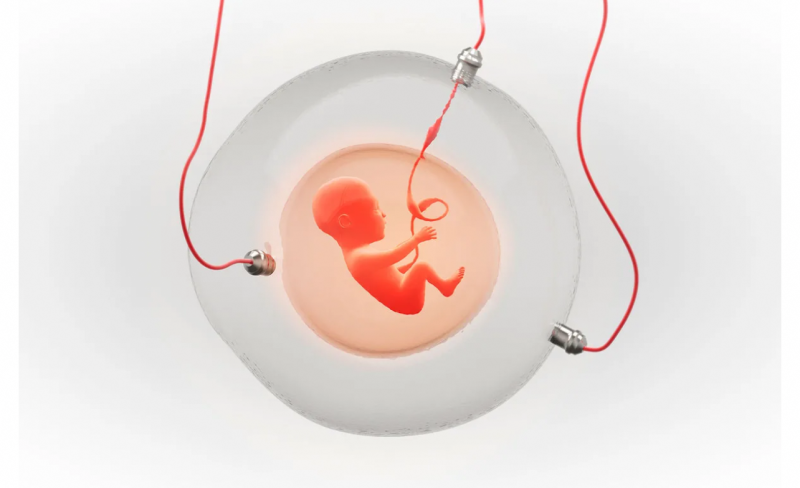
Another technology that could make sex for reproduction further redundant is the development of artificial wombs. Over 90 years ago, in Brave New World , Aldous Huxley predicted ‘hatcheries’ in which human foetuses would develop in bottles.
In 2017, researchers reported keeping neonatal lambs born a week or two early alive in fluid-filled plastic bags. More recently, the US Food and Drug Administration held a public meeting to consider whether, when and how to run trials with such artificial wombs on babies.
These devices are, in effect, early incubators. They might push back viability for premature infants a week or two, from (at best) about 22 weeks of pregnancy to nearer 20, but that baby would still need to have spent four and a half months developing inside a woman.
This advance could be wonderful for premature infants and their parents, but would not make much difference for most of us.
What about a ‘true’ artificial uterus – one that could take a six- or seven-day embryo and help it develop over nine months into a healthy newborn? That would remove not only the sex from making babies, but pregnancy as well. Some might welcome it. Others would, no doubt, be concerned.
All this might not be implausible in the far future. A major area of long-term research today is using stem cells to grow human organs. The focus is on vital organs for transplants – kidneys, livers, hearts – but if they can be grown, why not a uterus?
Imagine that organ, grown from a woman’s stem cells, hooked up to a machine that would provide blood, sugar, oxygen and all the necessary hormones , as well as waste treatment – then add in an embryo. Such a ‘womb in a box’ could, in theory at least, take the place of a womb in a woman.
But should it? Our children and grandchildren will likely need to make that decision.
This is an amazing time to be involved in medicine and biology. Our knowledge is expanding astonishingly. Our ability to make good use of that knowledge is growing more slowly, but steadily. Our understanding of the consequences of using new technologies – and our agreement on what limits, if any, should be placed on it – are growing more slowly still.
Making babies artificially is not an exception, though it is special in one important way. I am able to consent to an experimental procedure, agreeing to the risks in return for potential benefits to myself or to science. Babies can’t consent; nor can embryos.
That doesn’t mean that we shouldn’t ever use new technologies in reproduction, but it does mean that we should be especially careful to test the technologies to make sure that they are safe and effective – for the babies.
We need to emphasise their welfare first, then the broader effects on our societies.
Tags
Who is online

130 visitors
I don’t even know what to say about this.
Well, the headline is clearly misleading as the article says nothing about humans not wanting to have sex anymore thus no threat of there being an "end of sex". I mean, they say that these technologies " could make sex for reproduction further redundant" but the reality is that the VAST majority of the sex humans are having isn't for reproduction.
So, it's pretty safe to say that reproductive technology is not going to have any significant effect on the amount of sex people are having and certainly will not "end sex". The only thing that might do that would be some infectious brain eating worm that turned everyone into a mindless incel magaite.
It is a weirdly couched concept considering that the people most likely to consider procreation as the only legitimate reason for sex would also be the ones most likely to disparage this method of making babies. My bewilderment is more focused on that it is even remotely possible for one person to make a baby using only their own skin cells.
It's also possible for a human male to impregnate their own grandmother, but I wouldn't recommend it. I think a unibaby would basically be the genetic equivalent of crossing the streams. Humanity would have a "total moronic reversal" with intelligence dropping faster than a fake wrestler off the ropes. We'd turn into "Idiocracy" within just one generation.
We'd turn into "Idiocracy" within just one generation.
I think we’re past that already. Our current elected POTUS is even less intelligent than President Dwayne Elizondo Mountain Dew Herbert Camacho, and his cabinet is equally incompetent.
The return of the Hapsburg Jaw
The potential for leading to a genetic bottleneck and disaster if such technology ever replaces the old-fashioned method is a danger. Sci-fi has already addressed this danger several times.
Too often, humans are smart, but not wise.
You gotta break a few eggs to make an omelette … literally.
Axlotl Tanks from Dune
The Book of Jubilees (4:1, 9) names Cain's wife as Awan and Seth's wife as Azura, both identified as daughters of Adam and Eve. It has been a genetic downhill race ever since and Lilith paid the price ... thou shalt not have a matriarchal society.