
This Bold Theory Says We’re Not Earth’s First Advanced Civilization


 S E E D E D C O N T E N T
If an advanced civilisation lived on Earth millions of years ago, would we be able to tell?
Humans have long been fascinated by the possibility of finding technologically advanced beings elsewhere in the Universe, but what if such a civilisation had lived right here on Earth, long before humans evolved ?
In 2018, physicist Prof Adam Frank and Dr Gavin Schmidt, a climate modeller, published a paper exploring whether modern scientists would be able to detect evidence of an advanced industrial civilisation that ended millions of years ago.
They named this possibility the ‘Silurian hypothesis’, after an advanced reptilian race from the BBC’s long-running sci-fi show Doctor Who . They concluded that while it's extremely unlikely, evidence for such a civilisation might be hard to find.
Focusing on a period between 400 million and 4 million years ago, the researchers pondered what evidence might be left behind by this hypothetical society.
In just a few hundred years, our industries have made a huge impact on the world’s climate and ecosystems. But if the human race vanished, within a few hundred million years, any direct evidence of our society – or a previous one like it – would almost certainly be gone.
Our biggest cities would disappear in a geological blink of an eye, due to erosion and tectonic movements.
Instead, scientists searching for a long-lost civilisation would need to look for the geological fingerprints of their activities.
Industrialised civilisation would likely have many of the same needs as modern humans, including producing large amounts of energy and food. So, we might expect them to leave similar markers in Earth’s rocks and sediments, such as evidence of massive carbon emissions, global climatic changes and sea-level rise.
The problem is that in the geological record, climate change caused by a fossil-fuel burning civilisation is hard to distinguish from climate change caused by natural forces.
In fact, there's an eerie similarity between modern climate change and events in Earth's history known as 'hyperthermals'. One such even occurred around 55 million years ago, when global temperatures rose by up to 8°C (14.4°F), but hyperthermals tend to coincide with intense tectonic activity.
Another problem: the longer an advanced civilisation lasts, the more evidence it’ll leave behind. But to survive a long time, a civilisation would need to become sustainable, which would leave less of a geological mark.
A society powered by wind and solar energy, for example, wouldn’t leave as much evidence as a fossil-fuel powered one. This paradox explains why we would be unlikely to find any signs of a past civilisation, if one existed.
The Silurian hypothesis pushes us to consider what traces of evidence humanity will leave behind. Answering these questions might help refine our search for advanced civilisations on other planets.
Tags
Who is online

78 visitors
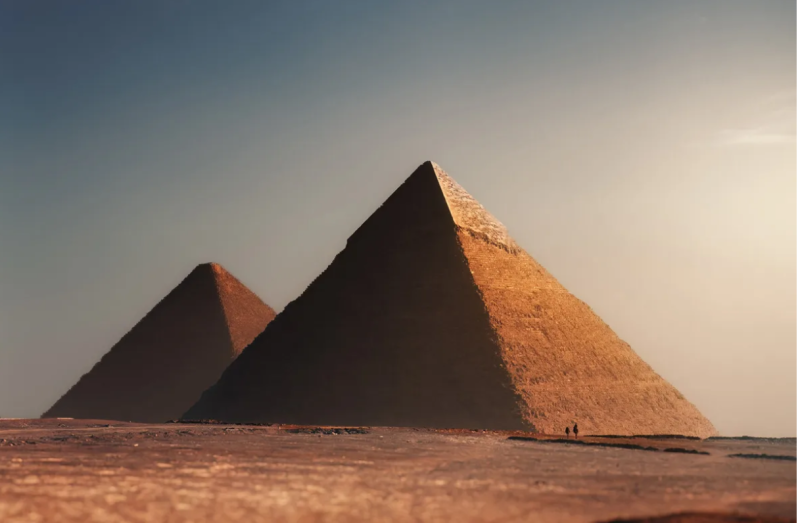
I think when we see pyramids as evidence of long lost civilizations, we trick ourselves into thinking that ancient civilizations will definitely leave traces of their existence. This is ignorant of the reality of how vast time is, and we struggle to comprehend how even the oldest fossils in known existence would, with enough time, wither into features indistinguishable from nature itself.
Technically, everything within our universe, including humans and their pyramids, are 'nature itself' and the traces of that nature can be tracked all the way back to the origins of our universe 13.8 billion years ago. And the traces of our existence would be traceable just like background radiation by a more advanced future civilization potentially produced by the amazing nature of our universe. Technology is just a form of nature we've decided to assign the property of not being of nature because it's usually presented as metallic or powered by electricity, yet metal and electricity have existed in nature long before we did. I think only in the minds of humans would we try to distinguish ourselves or our creations as something apart from nature which is the height of hubris in my estimation. Though I will also admit that at times I believe the idea of human creations being 'unnatural' stems from their often destructive 'nature'. But there again, it's only perspective that differentiates between destruction and construction. Is there really any difference between "I made a wooden table out of a tree" and "I made a pile of woodchips out of a wooden table"?
This could end up being a very interesting discussion of what ifs .
I remember reading in passing years ago ( blink of a eye or a minute tick of a tock , in the cosmic timeline ) that some radiological findings in the area of india and asia , seem to infer that at some time in the before recorded history that a nuclear blast occurred that doesnt happen naturally and in nature , it was passed off as fringe , but the what if is , what if what could be considered humanity , wiped itself out almost to extinction ? and humanity as we know it are the survivors ?
Another question , what if humanity is actually refugees from somewhere else ? people wondered for years if there was life on Mars , what if humanity are the actual refugees from mars after a cataclysmic civilization planet killing disaster ?
We know life leaves a mark in the geologic record that can last hundreds of millions of years. We have found evidence of life on Earth 2 billion years ago. So, it would be reasonable to conclude that evidence of our lives will be present far into the future.
Evidence of hominid intelligence is a recent discovery going back 2 to 3 million years (depending upon how intelligence is defined). We hominids made our marks in the geologic record with our tools.
Evidence of 'civilization' only goes back about 10,000 years. And that evidence is found in foundations of structures, garbage pits, slag heaps, and burial grounds. We discard the evidence of our civilization just as our ancestors did. Our modern 'forever' chemicals will make an indelible mark on the Earth. And our legacy will be found in the genetics of plants and animals far into the future. No doubt in several hundred million years our civilization will be found in a compacted layer of asphalt, concrete, refuse, chemical residue, and metal alloys that are not found in nature.
There's a whole Netflix show called Ancient Apocalypse, where this guy, Graham Hancock runs around the world asking, "Could this be?" questions. Without quantifiable evidence it's only questions.
There are whole industries based on coming up with bullshit hypotheses that are marketable to gullible morons with nothing better to do than sit at home and consume. Ghost Hunters, Bigfoot Hunters, Ancient Aliens, Ancient Apocalypse, Fox News, I mean, there really is no end to them. And the fact is, they'll keep showing up with a giant pot of fresh bullshit as long as there is a demand for bullshit and a fiction they can monetize.
That was always a really bad name, considering that there's a geologic period called the Silurian that occured a little before the time period of their Dr. Who inspired "Silurian hypothesis'. That just makes things confusing. You'd think they would have taken that into consideration.
At least they acknowledge that it's extremely unlikely.
And here's the rub – sedimentary deposits from 400 million to 4 million years ago are not in short supply, and many of those layers are not fossil poor, they are fossil rich. They are the source of most of the fossils studied by paleontologists, beginning with the Devonian period when land animals first started to thrive.
This statement is such a head scratcher. I just don't understand it. I guarantee that hard, non-biological artifacts from our civilization will be preserved in sedimentary deposits every bit as much as biological fossils will. Much more easily, too. Think about how much junk we've produced since the industrial revolution, and how much of it has ended up in landfills, rivers, and the oceans. It's everywhere.
As I mentioned, many deposits in the time period they're focusing on are fossil rich. Professional and amateur fossil hunters alike find everything from giant dinosaur bones to tiny rodent teeth in those layers, but nobody is finding non-biodegradable artifacts of an advanced civilization, which would certainly have to be there. No nails, screws, nuts and bolts, other metal objects, glass, plastics, ceramics, or tools of any kind. Not to mention remains of architectural structures: stone, concrete or otherwise.
I think the Silurian hypothesis is a bust. It just didn't happen.
It may depend on how the planet continues to terraform through those millions of years. Tectonic plates can move dramatically over that time (think Pangea), pushing evidence into places where it won’t be protected from degradation. It’s all just a thought exercise anyways. We wouldn’t learn anything from a civilization that old anyways. I just like that it encourages out of the box thinking and a more thorough realization of how vast planetary time is. I feel like those of us who are not religious are more amenable to these concepts that those who are convinced that some god put humans here for a reason.
Of course there was an advanced civilization before man, it was called Eve.