
'The 21st-Century gym-toned bodies put me out': Four things Jane Austen adaptations get wrong - according to experts


 S E E D E D C O N T E N T
A new film adaptation of the English novelist's Sense and Sensibility adds to a long line of attempts to translate Austen's timeless stories to the screen. But these are their common mistakes.
Jane Austen's timeless novels are always being re-adapted.
And there are two more major adaptations coming this year: Georgia Oakley's film version of Sense and Sensibility and a new TV series of Pride and Prejudice. They add to a long line of attempts to translate the works of the beloved 19th-Century author to the screen.
Each generation will have their favourites, and it is a truth universally acknowledged that no film or TV take on a book can ever be entirely faithful to the original text. But there are certain aspects of Austen adaptations that always rile up passionate Janeites.
Here are four things they consistently get wrong – according to experts.
1. They focus on fairytale romance
Romance takes centre stage in most Austen adaptations. But "Austen is much more focused on the heroine", Sutherland says. "She's a psychological novelist... that's what interests her." Austen presents the reader with imperfect heroines who face moral challenges and social obstacles independent of their male love interest – which makes them all the more relatable to modern women.
And while Austen may not have the same haunting allure as the gothic Victorian writers who came after her, she does touch on some heavier themes. In Mansfield Park, for example, she explores infidelity and gambling , while she references slavery on multiple occasions across her works (though it's greatly disputed what her thoughts on slavery were).
Of course, Austen's fairytale romantic moments are important – like Captain Wentworth's ardent love letter to Anne in Persuasion – but by promoting romance from a sub-plot to the main plot, adaptations can overlook Austen's class critique and her depiction of the bleak reality for women in the Regency era (around 1795-1837). Apart from Emma Woodhouse, the protagonist of Emma, most of the heroines in Austen's stories face financial precarity.
"Austen knew her market," says Sandie Byrne, professor of English at the University of Oxford. "And she had to have the girl getting the boy, and the 'happy ever after' to sell her books – but she doesn't make the big kiss, or the proposal, or the wedding the climax of the book, and there's no description of the church and the fuss."
Plus a woman's need for security wouldn't have ended after marriage – her security would always rely on her husband's character and how they managed their finances . "The adaptations tend to show a rosy glow – everything's tied up and finished," Byrne says.
2. They get the costumes and styling – and teeth – wrong
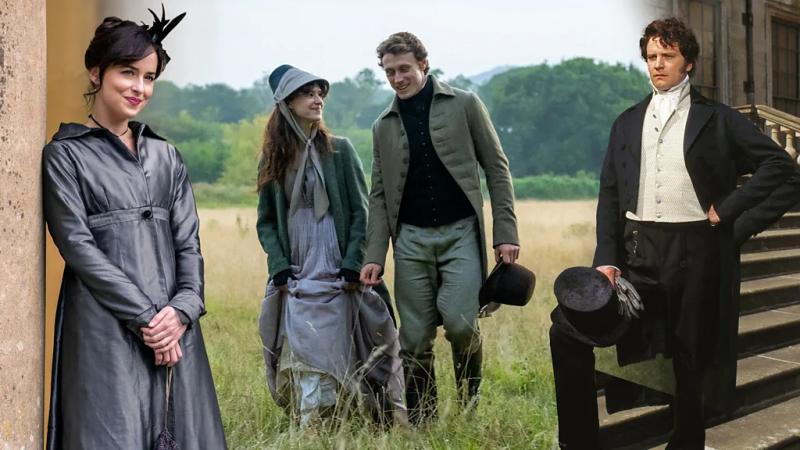
"Where are the bonnets?!" erupted Austen enthusiasts when Oakley's Sense and Sensibility trailer debuted, featuring scenes of 19-year-old Elinor (Daisy Edgar-Jones) and 17-year-old Marianne Dashwood (Esmé Creed-Miles) frolicking around with their long hair down. (To confirm, flimsy-looking bonnets do appear, albeit rarely, throughout the film.)
In the Regency era, only very young girls would wear their hair down. Older girls would strictly wear a bonnet, says Byrne. "It's a sign of being grown up, that you put your hair up and your hemlines down."
Style choices in Austen adaptations are always a point of contention – from costume to make-up and hair.
Netflix's 2022 Persuasion featured Anne Elliot (Dakota Johnson) wearing rosy lipstick and mascara, leading to a plethora of online makeup tutorials and accusations of Johnson having "iPhone face" – a slang term used to describe actors in period dramas who look as if they've seen modern technology.
"What puts me out is hair and teeth and 21st-Century gym-toned bodies," says Juliette Wells, a professor of literary studies at Goucher College in the US. "And I definitely think about orthodontia and veneers, and what lovely teeth most young actors have, [but] how very few characters in Austen are described as having good teeth. Presumably most of them did not."
No matter how accurate the costumes may be, if an actor meets 21st-Century beauty standards, they won't match historically accurate portraits from that period, she adds. "That puts us at a distance from Austen."
Films will also often try to be authentic by dressing people in the fashion of the day when the book was published, Byrne says, but most people made clothes last a long time.
"If you were very rich, you changed your clothes a lot… [but] most people in the echelon that Jane Austen is writing about didn't have that many clothes. And they made them last. They weren't slaves to fashion."
3. They don't capture Austen's language and pacing
Austen is renowned for her witty dialogue and sparkling, omniscient narrative voice.
"And that's what we read Austen for, isn't it? We read it for the irony, we read it for the humour, we read it for the satire and we read it because it's subtly subversive," Byrne says.
But capturing that verbal sophistication is a challenge on screen. And Austen is not a very visual novelist, says Byrne. "That's the odd thing about her. She doesn't encourage you to see things so much as to hear things."
However adaptations often take an approach that more closely follows the visual romantic style of Charlotte Brontë, says Kathryn Sutherland, a senior research fellow at the University of Oxford. Oakley's Sense and Sensibility very much plays into this – it's visually stunning, and the naturalistic cinematography of England's countryside sets a romantic tone.
"But Austen is more thrifty… she does so much more through conversation," Sutherland says. "Film has increasingly muted conversation… It even muffles dialogue, so you don't always hear it properly. There has been a downplaying of the spoken, and a raising of the visual."
Wells misses the precision of language most of all. One of the great pleasures to be found if you go from an adaptation to the original novel, she says, is how meticulous Austen is with her word choices. "And no adaptation could possibly convey that pleasure," she says.
In some adaptations, Austen's more famous lines are "padded with what can seem, to my ear, ridiculously 21st-Century ways of expressing characters' thoughts". (Lest we forget "Now we're worse than exes, we're friends" from Netflix's Persuasion.)
And Austen's pacing is very slow – she takes her time with scenes, conversations and character development, Wells says. "Austen gives you the opportunity to notice a character's resistance to her [or his] own change." But that does not necessarily suit the demands of the big screen.
4. They cast too glamorously
Besides some actors being far too old for their characters – like Alan Rickman playing Sense and Sensibility's 35-year-old Colonel Brandon when he was 49 – actors simply being too good-looking can give away the plot.
Austen rarely describes what her characters look like. Instead, she reveals their attractiveness through their actions.
So, casting incredibly handsome actors, Sutherland says, "kind of foreshortens the plot. You know immediately just looking at them that these are the heroes. And so there's a sense in which a certain amount of the drama is lost, and it's mainly through [the] glamorisation of the hero."
Edward Ferrars (Hugh Grant) in Ang Lee's 1995 Sense and Sensibility is a prime example. When, in an invented scene for the film, he playfully fences with young Margaret Dashwood, he is automatically cast as the dashing, sympathetic hero, Sutherland says – "but it also has the effect of, in a way, undermining the development of the plot. You know the outcome before the first few frames are over."
Ironically, Austen specifically introduces Ferrars as "not handsome" – but tell that to Hollywood.
Sense and Sensibility is out on 25 September in the UK and 16 October in the US.
Tags
Who is online
88 visitors
She's back and that's a good thing ... one hopes.
I can't stand fair gender perfection. I like one-offs, they try harder ...
... beware, the overachievers can be viscious.
... define vicious
... viscous with teeth
... here in the US, it's usually advisable to feed them first. the traditional french/canadian work up an appetite sex before a 3 hour dinner doesn't fly in the preliminary rounds here, and the double header concept is pretty much well into a committed relationship ...
I would not want to watch a movie the reviewer would make... boring with ugly people. Thought I'll admit I'm not the target audience for Jane Austen anyway.... unless she's hiding a desert eagle under that skirt.
I don't know if I've seen any TV or movie adaptation of Austen's books. They don't interest me. Nor does Austen for that matter
I saw Pride Prejudice and Zombies in the movie theater when it came out in 2016. It wasn't very good.
You got what you paid for ... gore!
I try to be an aware consumer. LOL...
I don't imagine it was very good
it's hard to compare to the slicing and dicing that went on with GoT
Abraham Lincoln Vampire Hunter was better.
The long, loose hair really bugs me. It would have been considered scandalous for a woman to be seen that way by anybody other than her close family, servants who had access to her bedroom, and medical personnel. A woman didn't go to the dining room or parlour until she was fully dressed, which included having her hair up.
yeesh, what a stickler for historical accuracy. gratuitous sex and violence is what gets my attention ...
That's my favorite author they're messing around with there. She already did them the favor of writing a script that's been a proven hit multiple times. The least they could do is buy some combs and hairpins and learn how to use them.