
Appeals court panels issue split decision on Obamacare USA Today by Richard Wolf 7/22/2014


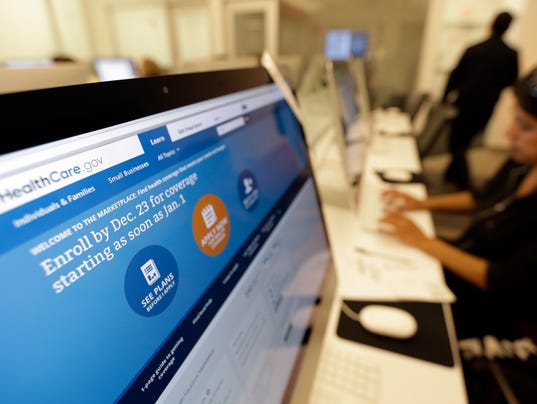
WASHINGTON A federal appeals court dealt a potentially major blow to President Obama's health care law Tuesday, ruling that participants in health exchanges run by the federal government in 34 states are not eligible for billions of dollars in tax subsidies.
The 2-1 ruling by a three-judge panel of the U.S. Court of Appeals for the D.C. Circuit, which will be appealed by the government, threatens the framework of the health care system for about 5 million Americans without employer-provided health plans.
Just two hours after that ruling, a separate federal appeals court panel in Richmond unanimously upheld the law and its system of subsidies and tax credits, putting it in opposition to the D.C. appeals court. That could raise the potential of a Supreme Court showdown.
"If there is a split in the circuits, then I think the Supreme Court would have to step in," said Elizabeth Wydra, chief counsel at the liberal Constitutional Accountability Center.
The legal case, filed by a coalition of states, employers and individuals, had been considered a long shot effort to derail the Affordable Care Act, also known as Obamacare. Federal district judges in the District of Columbia and Virginia previously had ruled for the government. Two similar cases remain pending in Indiana and Oklahoma.
The D.C. appeals panel ruled that as written, the health care law allows tax credits to be offered to qualified participants only in state-run exchanges. The administration had expected most if not all states to create their own, but only 16 states did so.
The court said the Internal Revenue Service went too far in allowing participants in other states served by the federal exchange to qualify for billions of dollars in government assistance. The aid has helped boost enrollment figures to more than 8 million.
"We reach this conclusion, frankly, with reluctance," Judge Thomas Griffith said. "At least until states that wish to can set up exchanges, our ruling will likely have significant consequences both for the millions of individuals receiving tax credits through federal exchanges and for health insurance markets more broadly."
Judge Harry Edwards dissented, calling the challenge "a not-so-veiled attempt to gut the Patient Protection and Affordable Care Act" and warning that the panel's ruling "portends disastrous consequences."
$36 BILLION IN SUBSIDIES JEOPARDIZED
The federal subsidies offered through the exchanges have reduced monthly insurance premiums by 76% for those who qualify, federal health officials say. The average monthly premium dropped from $346 to $82.
In 2016, an estimated 7.3 million people in the 34 states with federal exchanges would receive subsidies totaling $36 billion, according to the Urban Institute. To qualify for subsidies, participants must have incomes below 400% of the federal poverty line, or $95,400 for a family of four.
White House press secretary Josh Earnest said the ruling may be "Interesting to legal theorists," for consumers it "does not have any practical impact on their ability to receive tax credits right now."
"It is pretty obvious what the congressional intent was here," Earnest said -- to let every American buying insurance on a government exchange to get a subsidy "regardless of whether it was state officials or federal officials running the marketplace."
In the Virginia case, Judge Roger Gregory of the U.S. Court of Appeals for the Fourth Circuit noted that "widely available tax credits are essential to fulfilling the act's primary goals."
"Congress was aware of their importance when drafting the bill," he said. "The IRS rule advances this understanding by ensuring that this essential component exists on a sufficiently large scale."
The problem for supporters of Obamacare is that a majority of states purposely did not set up health exchanges because their governors and legislatures objected to the law. So it's not likely they will rush to do so now.
If allowed to stand, the ruling would blow a major hole in the law, since tax credits or subsidies are what make the private health insurance policies offered on the exchanges affordable to most Americans without employer-sponsored insurance plans.
If the subsidies are invalidated in 34 states, then many of the tax penalties imposed on employers and individuals for non-compliance with the law also would be eliminated. Employers pay a penalty when their workers get subsidized on the exchange. Individuals get penalized if they don't buy affordable insurance, but the subsidies often are what make it affordable.
'POPULAR RESISTANCE TO THE LAW'
Michael Cannon, a Cato Institute health economist who helped devise the legal challenge, said the refusal by so many states to create health exchanges led to the court ruling. "This is popular resistance to the law," he said.
"This illegal rule would have cost employers crippling fines, destroyed jobs, and forced Americans to pay for insurance that they didn't want or need," said Sam Kazman, general counsel of the Competitive Enterprise Institute, which coordinated the lawsuit. "The court's decision put an end to the administration's power grab that the IRS rule represented."
Proponents of the law expect the ruling to be reversed by the full appeals court, which includes seven judges appointed by Democratic presidents and four by Republicans. Two senior judges who could sit in on the case make the ratio 8-5.
President Obama tilted the court in Democrats' direction with three appointments made last year after Democrats changed Senate rules to prevent Republicans from blocking confirmation votes.
The ruling "represents the high-water mark for Affordable Care Act opponents, but the water will recede very quickly," said Ron Pollack, executive director of the health consumer group Families USA.
Robert Weiner, a former associate deputy attorney general who oversaw the defense of the health care law, said without that expected reversal "there could be questions as to the ability of customers to buy and insurers to sell insurance on the federal exchanges."
"We could well see dislocations in the insurance market, with prices of health insurance skyrocketing in the states with federal exchanges," Weiner said.
The D.C. court's decision is the second in less than a month to go against Obama administration implementation of the health care law. In June, the Supreme Court ruled that closely-held corporations that object on religious grounds to offering insurance coverage for contraceptives can sidestep that rule.
Other challenges to the law remain pending in federal courts -- including a long-shot effort to derail the entire law by contesting the way it was passed by Congress in 2010.
The only states not affected by the ruling are those that created their own health exchanges: California, Colorado, Connecticut, Hawaii, Idaho, Kentucky, Maryland, Massachusetts, Minnesota, Nevada, New Mexico, New York, Oregon, Rhode Island, Vermont, Washington and the District of Columbia.
Tags
Who is online
47 visitors
Obamas Law Professor: I Wouldnt Bet on Obamacare Surviving Next...
President Obamas old Harvard Law professor, Laurence Tribe, said that he wouldnt bet the family farm on Obamacares surviving the legal challenges to an IRS rule about who is eligible for subsidies that are currently working their way through the federal courts.
I dont have a crystal ball, Tribe told the Fiscal Times .But I wouldnt bet the family farm on this coming out in a way that preserves Obamacare.
More: ...
It looks like this is bound to end up B4 SCOTUS .
The wise thing was having Congress being a part of Obamacare, I don't think Congress will be happy if they lost their health Care, if all Americans cannot have health Care, Congress members should have no Health Care...
So you're saying what ... that it won't end up B4 SCOTUS ?
It depends on the final judicial decision.
Its all or nothing, Its Health Care for all or Health Care for NONE!!!!! and go ahead and call me a communist, As far as I know, the system as it currently stands, is more of a communist nature than not, all the Leaders have good Health Insurance and a vast number of TAXPAYERS have none...Just as it was in Animal Farm...