
The Republicans Are Convinced That Crime Is a Winning Issue. The Evidence Is Not So Clear.



 S E E D E D C O N T E N T
...It has become a Republican cliché: When the polls look ominous, the party often conjures the image of a menacing Black man. The classic example is the George H.W. Bush and Republican attack ads featuring Willie Horton , a Massachusetts inmate who had stabbed a man and raped a woman while on a weekend furlough. Michael Dukakis, the Democratic nominee, was governor at the time, even though the furlough program had originated under a Republican predecessor. As Lee Atwater, Bush’s brass-knuckles campaign manager, bragged, “By the time we’re finished, they’re going to wonder whether Willie Horton is Dukakis’s running mate.”
In his 2017 inaugural address, with violent crime at a 50-year low , Fearmonger-in-Chief Donald Trump railed against “the crime and the gangs and the drugs,” pledging , “This American carnage stops right here and stops right now.” The murder rate, fueled by the pandemic, soared by nearly 30 percent during the last year of Trump’s presidency.
This year, the Republicans have seized on crime as an emotionally charged way to offset Democratic gains in the polls after the repeal of Roe v. Wade. In September, according to the Wesleyan Media Project , 32 percent of pro-Republican TV ads broadcast in Senate and House races around the country stressed public safety. Crime was the dominant issue in Pennsylvania, Wisconsin, and Florida.
Yet the evidence is murky about the power of the crime issue. With the 2021 murder rate mostly steady and other crime information marred by the limitations in how the FBI collects data , it is difficult to get a reliable handle on the importance of public safety as a voting issue. And while recent polling has favored the Republicans on handling crime, the advantage is smaller than commonly assumed: A Morning Consult/Politico poll gave congressional Republicans a 44-to-37 percent edge, while a Reuters survey put the margin at 39-to-30 percent.
Polling data on crime partly depends on how the question is posed. When Americans were asked in an early October Monmouth University Poll to rank crime as a voting issue, 72 percent said it was “extremely” or “very important.” But the results were strikingly different in a September Gallup Poll that asked an open-ended question about “the most important problem facing the country today.” In that case, only 4 percent volunteered “crime and violence,” putting the issue on par with “unifying the country” and “race relations.”
The conventional wisdom claims that the avalanche of GOP anti-crime ads have fueled the comeback of Republican Senator Ron Johnson in Wisconsin and aided Oz in closing the gap in the Pennsylvania Senate race. But political science research raises the alternate possibility that the volume of the GOP commercials may be more important than their anti-crime content.
Polling suggests that fear of crime is more an abstract issue than a reflection of personal experience. Even though Wisconsin has become Ground Zero for the law-and-order issue, 77 percent of state residents (including 71 percent of Republicans) said they “felt safe from crime” when going about their daily activities, according to a Marquette Law School Poll released Tuesday. Seventy-six percent of Americans in the Morning Consult/Politico poll believed that “violent crime” was increasing around the country, but only 42 percent believed that it was on the upsurge in their own communities.
Just as in the days of Willie Horton, there is an unmistakable tinge of racism to the way that the GOP exploits the crime issue. In Wisconsin, for example, crime can be regarded as a code word for Milwaukee, a city where the non-Hispanic white population has dropped below 50 percent . And all over America, local television contributes to an exaggerated fear of crime. For four decades, the mantra of local news has been, “If it bleeds, it leads.” Few realize that as many Americans get their news through local television as through cable TV or the network nightly newscasts.
Since the Nixon era, Democrats have been fearful of being on the wrong side of the crime issue. In 1992, Bill Clinton campaigned on a promise to fund 100,000 new police officers. Clinton’s 1994 crime bill , championed by Joe Biden in the Senate, used the lever of federal funds to cut back parole, encouraged a prison construction boom , and pushed for life imprisonment for those convicted of a third violent felony; it also fueled racial disparities in drug sentencing .
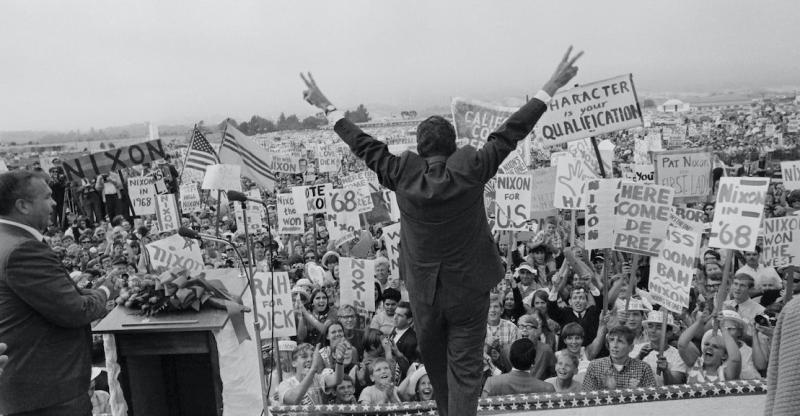
But looking at the historical record, the power of crime as a political issue can seem exaggerated at times. In 1968, Hubert Humphrey almost came back to defeat Nixon, despite the law-and-order posturing. Two years later, Spiro Agnew, Nixon’s vice president, launched a Trump-style campaign of invective in the off-year elections. The Democrats picked up 11 governorships, the party’s biggest statehouse gain since 1938. Even Willie Horton was a secondary factor in 1988, as the Bush campaign maligned Dukakis’s patriotism and slammed the Massachusetts governor for pollution in Boston Harbor.
The truth is that most Americans do not personally feel menaced by crime. In contrast, an out-of-control Republican Supreme Court threatens almost every right except the God-given liberty to carry a loaded gun virtually everywhere.
Tags
Who is online
272 visitors
In contrast SCOTUS doesn’t really directly threaten any of my God given or Constitutional rights.
Interesting you think they threaten nearly all of them.
They play up crime before elections and then even when Republican candidates who have the highest crime rates in their own districts run ads blaming a Dem. Same old playbook and voters keep falling for it. They seem to love fairy tales making the bad guy whoever they can blame for bad Republican policies.
Next door to the neighborhood I live in is a neighborhood that is 95% white. On their facebook pages they talk about how "dangerous" their neighborhood now is even though statistically it is one of the safest police precincts in the city. Its racism.
Oh by the way this particular neighborhood is the only one in Chicago where Trump got a majority of the vote in both '16 and '20.
I’m afraid many people and polls disagree with you John. Here is just one of them:
Inflation and crime top the list of voter concerns and it’s not even close really.