
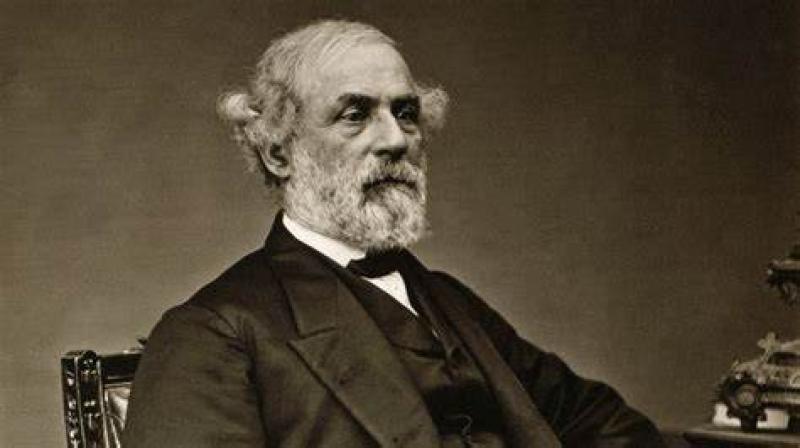
ROBERT E. LEE AND SLAVERY - The general’s own words plainly state his view of the Peculiar Institution.


For all those "patriots" who dont want children taught the history of racism.
 S E E D E D C O N T E N T

ROBERT E. LEE AND SLAVERY
By ELIZABETH BROWN PRYOR 3/16/2018
SHARE THIS ARTICLE The general’s own words plainly state his view of the Peculiar Institution.
...The first thing we can say about Robert E. Lee’s interaction with the institution of slavery is that it is extremely well documented. This may surprise some people. One biographer, Douglas Southall Freeman, claimed that Lee said “nothing of any consequence” about slavery. Statements like this have left many people with the impression that Lee was somehow outside the messiness of human bondage. Actually, he wrote hundreds of letters that show he fully participated in the institution and held strong opinions about it. Interestingly, this rich cache of information was in plain sight and had been available for decades. I was privileged to read a large number of recently discovered Lee family documents, but the most illuminating materials were already in well-known archives and courthouses, easily accessible to anyone. Because of this abundance of information no one has to interpret Lee’s attitudes or actions. He is very open in telling us about them himself.
To understand Lee’s viewpoint we have first to appreciate his day-to-day interaction with slavery. His earliest knowledge of the institution was gleaned on his father’s plantation. “Light-Horse Harry” Lee had been a bold Revolutionary War hero—and an equally bold financial speculator. By the time Robert was 14 months old, Harry Lee had lost most of his property and was thrown into debtor’s prison. Slaves were included on his “schedule” of debt payments alongside horses, dogs and hogs. Sometimes servants were snatched in the night by creditors trying to recover their losses. Others were hired away to bring in income, apparently with little attention to maintaining their family connections. Among the first lessons young Robert learned about slavery, therefore, was that when all was said and done, African Americans were simply property.
This view was reinforced when his family moved to Alexandria, Va., an important center of the slave trade. The Lees lived only a few blocks from some of the country’s major dealers in human flesh, and coffles of manacled slaves were a daily sight. Though some were sickened by these scenes, most people became inured to them and simply acquiesced. And that was what Robert E. Lee did: He acquiesced.
Lee’s other significant experience with slavery was at Arlington, his parents-in-law’s estate. George Washington Parke Custis, Lee’s father-in-law, had inherited hundreds of slaves from his grandmother, Martha Custis Washington. Custis had pretty standard ideas about slavery: He denounced the institution as a “vulture” that was preying on the society, but did nothing to overturn it. He was not really interested in managing his large labor force and left it to a series of uneven overseers. Some of these men “oversaw” reprehensible operations, and Custis was accused of “cruel, inhuman and barbarous treatment of slaves,” including at least one murder.
...And what about Lee’s own slaves? He inherited 10 or 12 from his mother, but it is difficult to determine whether he freed any of them. Before the Mexican War he wrote a will that would have liberated one family; however, since he was not killed, those provisions never went into effect. There is no evidence of Lee’s slaves being emancipated—no courthouse records, no mention of it in his massive letter books. One of his sons later said that he had freed all his slaves before the war, but had taken no legal action so they would not have to move out of Virginia. That seems questionable, however. A freed African American really could not exist in Virginia without papers; the law would put him right back into slavery.
In fact, we have an example of a freed couple without documents being thrown into jail in 1853 by Lee’s father-in-law, a justice of the peace. We also know that Lee was aware of the need to provide free papers, since he went to considerable trouble to get proper documents for the Custis slaves who were freed during the Civil War. In any case, his own papers show that he owned slaves well into the 1850s and considered buying another in 1860. He also used his wife’s slaves as personal servants throughout the Civil War.
Lee’s letters tell us much about his racial attitudes. He seemed to dislike the bondsmen’s presence and generally avoided dealing with them. (“Do not trouble yourself about them, as they are not worth it,” he counseled his wife.) He had a low opinion of blacks as workers and complained continually about their habits. (“It would be accidental to fall in with a good one,” he ultimately concluded.) He found the constant need to provide for the slaves burdensome, and as a result frequently rented them out.
As late as 1865 he was still asserting that “the relation of master and slave…is the best that can exist between the white & black races.” He had equally dismissive views of other groups who threatened white aspirations, including Mexicans and American Indians, whom he several times described as “hideous” and whom he believed to be culturally inferior. It is important to note that these are not random comments, written on a bad day, but a constant pattern in Lee’s writing.
Of course, Lee was not the only person to hold these views in his day. This kind of thinking led not only to the justification of slavery, but also to the Mexican War and aggressive actions against American Indians. Indeed, most Americans, North and South, were unable to envision a multiracial society based on equality. Even those opposed to slavery had trouble doing so. Abraham Lincoln, for example, never considered African Americans his equal and only reluctantly relinquished his plans to deport freed blacks to Central America or Haiti.
What is striking about Lee’s writings is the consistency of his disdain for black people. We see no attempt at all by Lee to wrestle with the morality of these views. Washington, Jefferson, George Mason and Henry Clay—just to name a few—all struggled with the ethical consequences of their racial beliefs. Many never took action to free their slaves or to right legal wrongs, but they did agonize over the contradictions they perceived. So did several of Lee’s Army friends, who sympathized with the Indians and ultimately opposed slavery. By contrast Lee never seems to have suffered any spiritual pain over the inequitable society surrounding him.
In 1856 Lee summarized his beliefs in a telling letter to his wife. “In this enlightened age,” he wrote,
there are few, I believe, but will acknowledge that slavery as an institution is a moral and political evil in any country. It is useless to expiate on its disadvantages. I think it, however, a greater evil to the white than to the black race, and while my feelings are strongly interested in…the latter, my sympathies are stronger for the former. The blacks are immeasurably better off here than in Africa, morally, socially, and physically. The painful discipline they are undergoing is necessary for their instruction as a race, and, I hope will prepare and lead them to better things. How long their subjugation may be necessary is known and ordered by a wise and merciful Providence.
On first reading, this letter seems confusing and contradictory. Lee acknowledges that slavery is evil, but then says the evil is greater for whites than for blacks, without giving an explanation of how this could possibly be. He says he assumes that the institution will fade away, but offers no prescription for hastening that day. Instead he takes a complicated middle ground in which he regrets the existence of slavery but claims it is necessary, and then sidesteps any responsibility for the slaves’ condition by saying that that is up to God, not man.
In fact, what seems like a convoluted assessment is actually an unusually clear statement of the proslavery views of Lee’s era. Apologists admitted that slavery was regrettable but concocted elaborate justifications for its continuation. The belief that slaves were better off than blacks living in Africa; that their character needed somehow to be elevated by whites; that it was necessary to prolong slavery into an unpredictable future—even a Divine Sanction for it all—were themes of sermons, pamphlets and newspaper articles. Proslavery advocates such as James Henry Hammond, George Fitzhugh and Thomas Dew underscored that they were not responsible—God had created the institution, and some sort of providential action would make it disappear.
Amazingly, this letter has sometimes been used to point to Lee as an abolitionist. This view is particularly hard to understand because in the same letter Lee slams those who opposed slavery. “The abolitionists,” he wrote, “have neither the right nor the power to interfere in what he has no concern. Still I fear he will persevere in his evil course.” So the question arises: How could anyone turn this letter into proof of Lee’s antislavery views? Is this wishful thinking, or possibly part of the “Lost Cause” propaganda?
...Which leads us to ask another question: Would his own servants have been likely to agree with the statement that Lee was a kind master?
Our best information about the slaves’ thinking comes from the time when Lee was executor of his father-in-law’s estate. George Washington Parke Custis died in 1857, leaving a messy will. To sort out matters, Lee got temporary leave from the Army. As executor he had legal authority over the slaves, as well as day-to-day responsibilities for their supervision.
And what did the slaves say about Robert E. Lee? One called him “the meanest man I ever saw.” “He was a hard taskmaster,” confided another. “He tried to keep us slaves, when we was as free as he,” was another comment. In addition, the slaves showed their feelings by their actions. During the time Lee was master at Arlington he had a chronic problem with runaways. They also frequently refused to recognize his authority, ignoring his orders or trying to undermine his plans. On one occasion they even physically threatened Lee. “Only the merciful hand of Kind Providence and their own ineptness prevented a general outbreak,” wrote Lee’s wife.
A slave rebellion at Arlington? How did such chaos come about? As previously mentioned, Lee’s father-in-law had written a complicated will. He freed all his slaves, but with the vague provision that it should be done sometime within five years. He also bequeathed extravagant legacies to his granddaughters that proved difficult to pay from the estate’s earnings. As executor, Lee interpreted this to mean that he could keep the African Americans enslaved until he had paid the legacies. Actually the will stipulated that he should sell land to pay the bequests, but Lee did not want to do this, even though the Custis estates contained thousands of acres.
The slaves, however, who had excellent lines of communication, believed they had been freed. Despite Lee’s efforts to make their lives more comfortable (repairing long-neglected houses, for example), they were angry at being kept in bondage and increasingly tested their new master. “Reuben Parks & Edward, in the beginning of the previous week, rebelled against my authority—refused to obey my orders, & said they were as free as I was, &c, &c,” Lee told a son. “I succeeded in capturing them however, tied them and lodged them in jail.” To increase the estate’s earnings, Lee relied on his old habit of hiring out the slaves to other masters. Many of them were sent hundreds of miles away and were extremely unhappy. The slaves who were hired out had no idea where they were going or when—if ever—they might return; no way of contacting their relations, and no guarantee of a sympathetic master. In addition, by hiring all the strong males away, Lee broke up every family at Arlington, something the Washingtons and Custises had taken great pains not to do.
When Lee realized he could not pay the legacies by the end of five years, things took a turn for the worse. Rather than sell land, he petitioned the local court to keep the slaves in bondage as long as needed to fulfill his daughters’ inheritance. He also sued for permission to send the slaves out of the state, which was not common practice. The local magistrate recognized this and ruled against Lee, who responded by appealing the case to a higher court.
The slaves, as usual, caught the drift of events and became actively alarmed. They may have thought that Lee would never give them their freedom. They must have feared that once sent out of the state, they would never again see their families. I should add that these two measures—sending the slaves south and breaking up their families—were against the socially accepted practices of Lee’s neighbors and relatives. It is this set of actions, which were considered harsh in his own time, and which jeopardized the future of people who had been legally liberated, that most clearly put Lee on the darker side of slavery.
This was when the slaves began to protest openly—verbally, as we have seen, as well as by running away, and even through physical violence. The situation at Arlington became so bad that several newspapers seized on the story. One of the things they reported was that after recapturing three of the runaways—one of whom was a woman—Lee had them brutally whipped. That story is corroborated by five eyewitness accounts, all of which agree in substantial detail.
Those accounts state that Lee was infuriated and wanted to set an example for other slaves who were rebelling against him. One newspaper maintained that Lee viciously whipped the woman himself, but the more sober witnesses state that he called in the county sheriff, Dick Williams, to serve out her punishment. Lee’s own account books show him paying an extraordinary sum of money to that very man “for capturing, &c, the fugitives.” At the time Lee told his son, “The New York Tribune has attacked me for my treatment of your grandfather’s slaves, but I shall not reply.” Many years later he maintained that there was “not a word of truth” in the story. But there was more than a word of truth in it—all of the details can be verified by Lee’s own writings.
Not only do Lee’s papers uphold the story, there is nothing improbable or out of character about this incident. We know there was a whipping post at Arlington and that Lee had a strong temper. Moreover, Lee was not only within his rights to lash the fugitives, it was actually the penalty prescribed by law. Sheriffs were routinely called in to do just that kind of demeaning work. As one Virginia constable de – scribed it: “It was part of my business to arrest all fugitive slaves….Next day they are examined and punished. The punishment is flogging. I am one of the men who flog them.”
In addition, we know Lee had little objection to this kind of chastisement. In one letter, for example, he argued with his wife about a slave who had been mistreated by a neighbor. Mary Lee thought they should buy the man to rescue him from his unkind owner. But Lee protested, asking: “Is everything to be yielded to the servant and nothing left to the master?” He then declared that buying the slave would set a bad precedent, undermining “the instruction and example that was intended for the others.” One of the men who was later punished for running away recalled that Lee said the whipping was meant to “teach us a lesson we would never forget.” Interestingly, using punishment to set an example was a disciplinary measure Lee also used while superintendent of West Point.
The lawsuit dragged on until 1862. While the court deliberated, Lee told his son he might ignore the five-year deadline for freeing the slaves and “just leave them as they are.” Ultimately the appeals court ruled against Lee, directing him to liberate the slaves by January 1, 1863. Only then did he free the bondsmen as his father-in-law had desired. In the end he sold property—just as the will had proposed— to pay the legacies to his daughters.
Remarkably, some biographers have labeled Lee an “emancipator” despite the clear record of his actions and beliefs. How can this be? I think the answer is rooted in the longing people have for their idols to be great in every way, rather than ordinary or imperfect. As heroes become iconic figures, people also want to attach their aspirations to them, in a process sociologists call “transference.” In their zeal, they hope their leaders will represent not only what they are as a society, but what they would like to be. It is fascinating and telling that what Southerners have wanted Lee to represent—the better self they want him to be—is an antislavery leader.
Lee’s experiences at Arlington and his role in capturing abolitionist John Brown in 1859 radicalized his feelings on slavery. He feared the increasingly powerful Northern majority, which he had been complaining about since the 1830s. It enraged him to feel defenseless in the face of what he saw as mounting Yankee humiliations. As the nation lurched toward crisis, his carefully crafted middle ground on slavery began to give way. He backed the Crittenden Compromise, which would have prohibited slavery from ever being abolished in the United States, saying that it “deserves the support of every patriot.” Though he denounced secession, and his own kin were sharply divided (a nephew and many close cousins fought for the Union), in 1861 Lee decided to defend the South’s way of life, of which slavery was the distinguishing feature.
After the war, Lee continued to hold attitudes about class and race that were chained to the old order. A few weeks after Appomattox he expounded to a newspaperman on the need to “dispose” of the freedmen. He not only advocated the deportation of African Americans, he backed a plan to replace them with destitute whites from Ireland, who would form a new servant class. He also signed a petition that proposed a political system precluding all blacks, and many poor whites, from voting.
...where then does this leave us? Should we conclude that Robert E. Lee was an immoral man, unworthy of historical interest? Throw him on the trash heap of history? Or should we apologize for him, and portray him as merely representative of his era?
In my judgment, we should take care not to go too far in either direction. We do have to recognize the intellectual and cultural norms of Lee’s time. We also have to recognize that as much as we might like to have principles that never vary, this is actually not the way societies behave. Values change over time, and human beings are often slow to catch up. We have to understand Lee within the context of his standards, not our own.
That being said, we cannot use this as a reason to absolve Lee from responsibility for his own attitudes. While we might be able to say, “Well, he wasn’t any worse than anybody else,” by the same token we also have to say that he wasn’t any better than anyone else. And there is the rub, because generations have been led to believe that Robert E. Lee was better than everybody else—even on this difficult issue of slavery. Yet all of the evidence shows he lacked the vision or the humanity that would have allowed him to transcend the petty opinions of his day. Nor did his racial attitudes ever grow or evolve as, for example, did Washington’s. While we can understand the reasons for that, we cannot award him the greatness that comes from being able to see beyond the commonplace and take actions that would raise him above the ordinary.
What I would propose is that all of us who admire Lee embrace him for the complex, contradictory, fabulous but flawed person that he was. If we try to make him more, we actually insult him. Every time someone maintains that he never used the word “enemy,” or that he never lost a battle (he just ran out of ammunition), or that he was opposed to slavery—any time we make these mistaken assertions, we are implying that the person he really was, is not good enough.
I would say simply: If you want to do Robert E. Lee justice, embrace the fine qualities that he truly has to offer us— and they are considerable—but also recognize his limitations and the injustices perpetrated at his hands. Then lend him your respect. It is the greatest compliment you can give him.
Elizabeth Brown Pryor’s book Reading the Man: A Portrait of Robert E. Lee Through His Private Letters won both the Lincoln Prize and the Jefferson Davis Award. Her list of sources for this article is in “Resources,” on P. 71.
Originally published in the February 2009 issue of Civil War Times.
Tags
Who is online
314 visitors
Are high school children taught about Lee's mistreatment of slaves? I suspect it never comes up.
Many white Americans believe that the removal of Lee statues from public spaces is unfettered "wokeism". It is more like long overdue.
Because most Americans dont have the view of Lee depicted by this award winning biographer, we need things like the 1619 Project.
We need to indoctrinate kids with a racialist narrative based on lies and half truths because of what exactly?
What schoolbook teaches that Lee opposed slavery? I'd be surprised if Lee's personal views on slavery are even mentioned in the survey level courses of American history that are taught before college.
Why did they build statues to Robert E Lee ? He had a University named after him. As someone pointed out, presidents of the United States spoke kindly about him.
I prefer the truth.
He was an outstanding battlefield tactician whose soldiers revered him.
Do you think they built statues of him because he owned slaves?
They built statues to him because he represented the Lost Cause.
He was the most famous Confederate and commander of the Confederate Army for most of the war. Of course many Confederate statutes would depict him. Who else?
One biographer, Douglas Southall Freeman, claimed that Lee said “nothing of any consequence” about slavery
and the article goes on at length to prove it.
Depends on how you define "of consequence".
Generations of kids were taught that Lee was one of the "good" confederates, who operated in that era only from the pure motive that he wanted to defend his homeland from the Yankee invader. This led people to believe that Lee opposed slavery , thus he was admirable to both sides of the war.
The writer of the article says that even though Lee must be judged through the lens of his times, he doesnt even measure up on that basis. Hopefully all the Lee statues will be gone one day.
FDR was at one point an American schoolchild, was he not?
Lee opposed secession , calling it a betrayal of the founders, which is why he was offered such a high position in the Federal Army. He was not a fire eater. He ultimately chose the confederacy because he couldn't bear arms against Virginia.
Public schools weren't good enough for FDR. He was first educated by private tutors. Then attended an exclusive boarding school, Gorton School before graduating from Harvard University and Columbia Law School.
Back then, citizens were loyal to their state first
Remember when the “first” black president, the former Governor of Arkansas merged Robert E Lee birthday with the newly created Martin Luther King holiday created by Reagan. It only took complete control by republicans to fix that racists mess.
I think that Lee was a very sad man in the last decade of his life. During the war, he wrote to his invalid wife, " You must endeavour to enjoy the pleasure of doing good. That is all that makes life valuable. When I measure my own by that standard I am filled with confusion and despair.”
All told, Lee lost 121,042 (20.2%) of killed or wounded in that war. I have walked the battlefields of a number of Lee's engagements, both success and failures, but will never understand his order for Pickett's charge at Gettysburg.
I finally saw Gettysburg last spring. Seeing the actual ground Pickett had to cover was eye opening. It makes sense why Pickett was so bitter towards Lee after the battle.
Yes, I think he had 69%+ casualties.
I would say it is totally ridiculous to judge a person that lived so long ago based on today's standards but those that feel morally superior to others would not understand.