
Why some law schools are removing the 'great' Chief Justice John Marshall from their names



 S E E D E D C O N T E N T
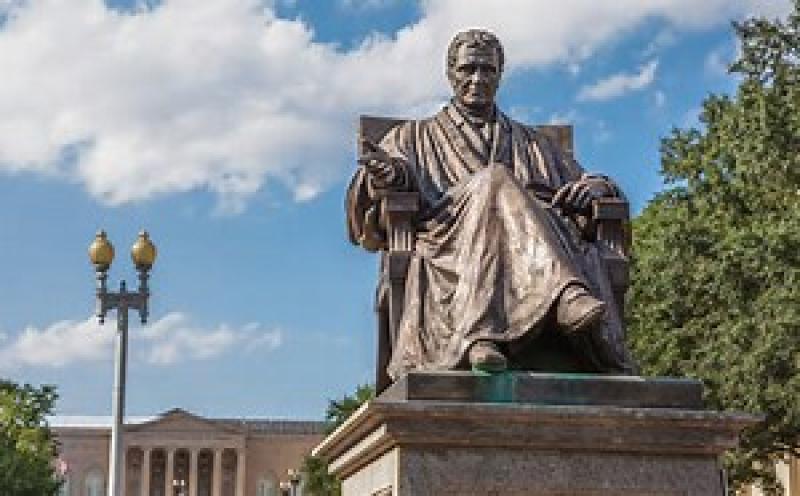
WASHINGTON – The tumultuous debate over the Founding Fathers' relationship with slavery has caught up with one of the nation's most revered and influential leaders of the Supreme Court in its 233-year history: Chief Justice John Marshall.
Two law schools have dropped Marshall from their name under pressure from students and faculty concerned about his opinions upholding slavery as well as his ownership of slaves. A third, Atlanta's John Marshall Law School, is "aware of the divisive issues" surrounding the early justice and has asked its diversity committee to review the name.
Marshall, who served on the Supreme Court from 1801 to 1835 – the longest tenure of any chief justice – crafted the court's opinion in Marbury v. Madison, which established the court's power to strike down laws approved by Congress as unconstitutional. The pivotal decision is central to the Supreme Court's role and modern constitutional law.
But a 2018 book asserted Marshall owned far more slaves than previously thought and a reexamination of his Supreme Court decisions about slavery prompted a petition to remove reference to him in the names of law schools. That effort picked up steam with the Black Lives Matter movement and in the wake of the murder of George Floyd.
Why are law schools dropping Chief Justice John Marshall's name?
Chief Justice John Marshall, nominated to the Supreme Court by President John Adams in 1801, is a widely venerated figure in the legal community. He wasn't the first chief justice – he was the fourth – but he was arguably the most influential.
But Marshall's personal embrace of slavery, as well as the outcome of many of his opinions, has drawn criticism and controversy amid a national reexamination of slavery, Reconstruction following the Civil War and systemic racism today.
After weighing those competing assessments of Marshall's legacy, the University of Illinois Chicago School of Law dropped his name in 2021 and the Cleveland State University College of Law followed suit last month.
Who was Chief Justice John Marshall?
Chief Justice John Roberts articulated the tension in Marshall's legacy in an interview for a 2020 documentary. Roberts described Marshall as a "great man" and noted that for "230 years, the court has generally fulfilled the role that he envisioned." But, Roberts said, Marshall didn't reveal "any real sensitivity" about slavery.
"And I’m not sure he can rely on the justification that 'well, nobody was concerned about it at the time' because people were and he was not," Roberts said in an interview for the film, John Marshall: The Man Who Made the Supreme Court.
In Marbury v. Madison, Marshall's most celebrated opinion, the court held it could not force Secretary of State James Madison to deliver paperwork to complete the appointment of William Marbury as a justice of the peace – even though Congress had passed a law in 1789 granting it that power. The law, the court ruled, conflicted with the limits the Constitution placed on the Supreme Court.
Marshall, in other words, struck down a law that would have given the court additional power. By doing so, he established that the Supreme Court had the power to invalidate laws that conflict with the Constitution.
Others point out a Marshall decision involving a captured slave ship in which the Supreme Court upheld the international slave trade in 1825. Marshall acknowledged slavery was "contrary to the law of nature." That, critics say, only made his personal ownership of slaves that much more problematic.
"He's a guy who never met a slave that he didn't think should be a slave," said Paul Finkelman, a visiting professor at Gustavus Adolphus College who published a book in 2018 about how Marshall and other justices upheld slavery. "There's a difference between acknowledging his importance to the growth of American constitutional law and honoring him over and above that."
Marshall's successor as chief justice, Roger Taney, wrote the court's majority opinion in Dred Scott v. Sandford, which held that African Americans could not be U.S. citizens. The House voted on Wednesday to remove a bust of Taney from the U.S. Capitol and replace it with one of Thurgood Marshall, the Supreme Court's first Black justice.
What are law schools saying about honoring Marshall's name?
Cleveland State University College of Law spent months studying the issue after receiving a petition in 2020 to change its name from Cleveland-Marshall College of Law. Last month, the university's board of trustees voted to remove Marshall's name.
A majority of the law school's alumni wanted to keep the justice's name, according to a survey by the university, but students, staff and faculty supported the change. The move came months after another school, the University of Illinois Chicago School of Law, arrived at the same decision.
Those developments shifted attention to Atlanta's John Marshall Law School. That school, with 340 students, was among the first Southern law schools to integrate its student body. In 2020, it named Jace C. Gatewood as its first African American dean.
Gatewood told USA TODAY that the school is aware of the "divisive issues" surrounding Marshall's name. The law school's name, he said, "is not tied to the Supreme Court justice and his past actions" but rather is "intrinsically tied to the school’s rich legacy of providing opportunity to a diverse student body in their pursuit of legal education."
He said the school "understands the complexities associated with a name change and the many constituents that it may affect." The school, he said in a statement, has brought the issue to its diversity and inclusion committee for "further discussion."
What's the reaction to name changes?
Not everyone has been on board with the changes.
In a report on its deliberations over the issue, Cleveland State University cited criticism from alumni who felt the decision was "profoundly ignorant," "ludicrous" and a "stupid instance of 'cancel culture.'"
Adam Carrington, a professor of politics at Hillsdale College, wrote for National Review in January that it was a mistake for schools to strike Marshall's name. That decision, he wrote, "makes no distinction between America’s great, even if flawed, founders and those who were true purveyors of evil and oppression." Marshall was dealing with the law as he found it, Carrington wrote, and the chief justice's written arguments in the slave ship opinion "proved much greater than his personal actions."
Carrington did not respond to a request for comment.
Hanna Kassis, a Cleveland businessman who attended the University of Illinois Chicago School of Law, disagrees. Kassis, who started the petition in 2020, said he wanted the law schools to at least conduct a thorough review and think about the name.
"Initially there was animosity because you're kind of breaking the fabric of the legal institutions as they know it," Kassis said. "And then I think it kind of just came around as, okay, if it upsets enough people then we should change."
Tags
Who is online
312 visitors
I think that is the crux of the matter, not only with Marshall , but with many other problematic historic figures in US history. Their contributions to the country can be written about and taught, but without elevating them to a higher public level by putting up statues and naming colleges after them.
My sister graduated from John Marshall Law School in Chicago, and when I told her in 2021 that the name had been changed to University of Illinois Law School she took it in stride. Maybe because she also graduated from U of I in Champaign.
Good to see that he is being removed. The Marshall Trilogy and Johnson v McIntosh took the rights of NA to own the land they could only be occupants of the land. The impact is still felt today..
I don't think that is true as lawyer John Marshall represented slaves in several pro bono cases. He won the freedom of mixed-race slaves, executed a will releasing around 100 slaves and also emancipated some slaves and certified the emancipation other's slaves.
Before judging Marshall by today's standards, one needs to first understand what he did in his life from a Revolutionary Soldier, a lawyer, a state delegate, a federal attorney, an envoy to France, Congressman, Secretary of State and Chief Justice of SCOTUS.
Second, It's important to understand what he and those around him were thinking. In regards to slavery, he wrote that he thought of slavery as evil, wanted the Atlantic slave trade ended and believed that it would ultimatly fracture the country. At the same time, if your income was based on agriculture, it was hard out of economic self-interest to release slaves. Perhaps more importantly, there was fear that the large number of slaves in the South could look for revenge if given the opportunity. There was also debates on whether the slaves could feed themselves if released.
Third, what was going on during his lifetime both in Virginia and were he served. What were the actions, reasons and context of his time and place?
If you understand that history, then you can begin to judge the man and his impact. Without that knowledge, you're simply following the current trend of presentism.
Is the only important thing about historical figures were they nice to blacks? Does anything else matter?
Why Some Law Schools Are Removing The 'Great' Chief Justice John Marshall From Their Names
A combination of ignorance, self righteousness and inferiority complexes.
If you wonder what sort of institutions these are, the John Marhsall Law School in Chicago suspended a Professor for using REDACTED "slurs" as examples on an Law School exam.
The entire school should be shut down and started over form the ground up, not renamed. Can you imagine the "lawyers" graduating from this school, unable to handle being exposed to words like "bitch"
"Adam Carrington, a professor of politics at Hillsdale College, wrote for National Review in January that it was a mistake for schools to strike Marshall's name. That decision, he wrote, "makes no distinction between America’s great, even if flawed, founders and those who were true purveyors of evil and oppression." Marshall was dealing with the law as he found it, Carrington wrote, and the chief justice's written arguments in the slave ship opinion "proved much greater than his personal actions."
Changing names doesn't change history. It simply makes present day race hustlers look stupider than they are.
Most normal people judge a person's character and worthiness by the sum total of their life's beliefs and actions. In the real world perfection doesn't exist