
Curses! Why All The Crude Talk? --- Thanks to a 'culture of uncivil discourse,' swear words that were once taboo can now be heard everywhere



 S E E D E D C O N T E N T
I'm at a loss for words to explain the growing use of coarse language in everyday conversation. When friends or colleagues use the F-word as matter-of-factly as my parents said "gosh" or "golly," it makes me cringe -- but I seem to be part of a bleeping minority.
I thought about this while watching the comedy series "Shrinking" on Apple TV+, starring Jason Segel and Harrison Ford as therapists practicing in Pasadena, Calif. Every character, including Mr. Segel's teenage daughter, played by Lukita Maxwell, uses the F-word with startlingly casual frequency. In a recent 29-minute episode, these well-educated, affluent Southern Californians said the word 30 times -- including nine utterances by Mr. Segel and six by Ms. Maxwell.
Are the producers trying to titillate viewers by writing foul language into dialogue where, in real life, it wouldn't be likely to occur? Or are they accurately depicting a linguistic trend?
There isn't much reliable research on how often Americans swear. A 2022 survey of 1,500 residents of 30 major U.S. cities found that they swore an average of 21 times a day, but it certainly seems that many Americans swear much more frequently than that. At a minimum, it's safe to say that Americans are swearing more than ever before.
Many assumptions about cursing -- for instance, that it correlates with lack of education -- are apparently wrong. Timothy Jay, author of six books on language and professor emeritus of psychology at the Massachusetts College of Liberal Arts, said, "People who have better vocabularies, which is related to intelligence and education, are better at swearing." Moreover, the use of taboo words helps with coping, storytelling and fitting in socially.
"We're the only animal that evolved to do this," said Prof. Jay. "If it wasn't useful, it would become obsolete."
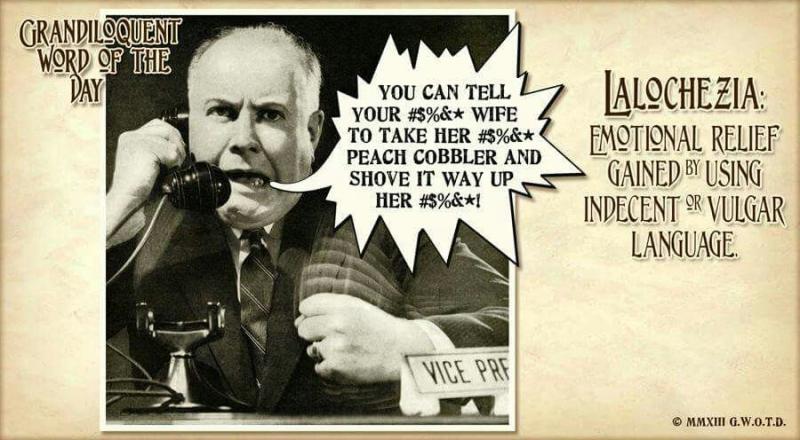
Science has actually given a name to the benefits of swearing: lalochezia. It refers to the emotional relief gained from using profane speech. As far as I know, however, there is no term for the discomfort that many of us suffer when friends and colleagues pepper conversation with words that seem to relate more to their quest for social liberation than to communication.
I asked Sophia McClennen, a professor at Penn State University who specializes in culture, politics and society, why cursing seems to be more prevalent nowadays. "It has to do in large part with the casual forms of communication that take place on social media that have increasingly infiltrated more traditional news, broadcasting and other forms of what you might think of as more serious speech," she explained. "The lines between casual and serious speech have blurred and that hybrid has influenced a lot of more formal spaces of communication."
She added that, "A culture of uncivil discourse -- what might be called s--- t talking -- is becoming more common."
But both she and Prof. Jay were quick to note that cursing is prevalent across society. "With privilege comes power and the ability to break rules," he said. "Donald Trump is a good example of that, as are a lot of executives and politicians."
As vice president, Joe Biden famously used the F-word when congratulating President Obama on completing the 2010 healthcare legislation. Mr. Obama's 2016 appearance at the White House Correspondents' Dinner included a video in which he jokingly says "F--- you!" to NBC's Chuck Todd. In an interview with Vanity Fair, Mr. Obama conceded, "I curse more than I should, and I find myself cursing more in this office than I had in my previous life." Politico has reported that President Biden swears frequently in staff meetings, favoring the F-word.
A study conducted last summer by the company Wordtips used Twitter feeds to assess which parts of the country swear the most and which words they favor. It turns out that Georgians curse with the greatest frequency, followed closely by residents of Maryland and New Mexico. The least swearing takes place in Minnesota, where the curse of choice is "hell."
No surprise: The F-word is the nation's most prevalent curse, followed by s--t. The F-word is most popular on the West Coast, as well as in Texas and parts of the Northeast.
Folks have always liked the daring nature of dirty dialogue, as comic George Carlin confirmed in his famous 1972 routine, "Seven words you can never say on television." My father, Allen Funt, tried to capitalize on this during his earliest days producing the television show "Candid Camera," circa 1950. He would occasionally bleep a clean word, making it seem as if something crude had been said. Audiences howled, but as soon as network executives caught on, they put a stop to it.
One thing I've learned since taking over "Candid Camera" decades ago is that average people don't curse as much as you might think -- at least when speaking with strangers, which is the case in most of our vignettes. That suggests to me that foul language is usually controllable and, therefore, its inclusion in other settings is often contrived.
Interestingly, the sequence that produced the most swearing was one in which people were alone -- or thought they were -- inserting a dollar bill into a change machine and getting back 100 pennies. Their shocked utterances set a record for bleeps on "Candid Camera."
I view the use of expletives as a sign of carelessness, much the same as dressing sloppily. Crude language bothers me most when I hear it from people who I know could do better if they cared to try.
So, what about the characters in "Shrinking"? Are they actually reflecting the behavior of SoCal professionals, or are they just pandering to the streaming audience?
I googled "therapists in Pasadena" and picked one at random from a rather long list. Jim Jacobsen's website says he specializes in treating "intellectually and creatively gifted individuals." I asked him if he uses the F-word a lot. "Yes," he said. "When I'm starting up with a new client I mention that I curse like a sailor, and if that's not OK, I will try to curb it. No one has ever objected. I'm fond of strong expressions, and it's certainly not always about anger."
"I guess people have decided to quit pretending that we're some kind of polite society," Dr. Jacobsen continued. Is cursing therapeutic? "I believe it is," he said. "It's part of my being genuine, which is one of the most important things I can do."
According to Prof. Jay, "People with a rich vocabulary, educated people, treat language like owning a lot of different styles of clothing. You change for whatever the context is." A regular viewer of "Shrinking," he offered this analysis: "Each flawed character in the series who openly swears has a deep underlying problem with depression, anger or fear that is unspeakable . . . Taboo words are the speakable taboos, and mental disorders and problems are the unspeakable ones. That's why we have therapy to dig beneath the speakable taboos."
I'll keep watching "Shrinking," even though I find the gratuitous cursing to be an annoying distraction. But if I ever need a therapist, I'm looking for one in Minnesota.
I think "cursing" is fine when used for emphasis or effect. When people drop f bombs because they lack any other discernible talent for self expression it is a little sad.
I do agree with the author that use of dirty words is overdone on television series.
I was watching the series FBI the other day and one of the agents called a suspect a "prick". FBI is on over the air broadcast which used to mean questionable language was taboo.
I wonder how long before we hear the word fuck used on an episode of The Goldbergs or The Connors.
The problem with habitual cursing is that those words then come out in inappropriate situations at inappropriate times in inappropriate places...
[✘]
lalochezia - I learned a new fucking word today!
Seriously though, it was a bit surreal watch the J6 hearings on msnbc. It was completely unfiltered live, and completely filtered when the pundits covered it on their shows minutes later.
In life everyone has their own line where swearing goes from expressive to obnoxious, so you’ll never be able to define a universal level of appropriateness for swearing. I once worked with a structural engineer who was a total professional at his job, but typically dropped two to four F bombs in every sentence. It was so over the top that it was kind of funny, like he didn’t even realize it was happening.
Mr G's best friend uses the f bomb every other word. When I have grandchildren I'm going to tell him to tone it down. If anyone is going to teach them to curse it's going to be me!
fuck was my oldest son's first word... ...oops.
I convinced my gullible rwnj mother he meant truck...
when I was going thru my divorce and losing everything, my 90+ year old grandmother made my jaw hit the floor and then I cracked up by her whispering to me "listen, I've always found that if it floats, flies, or fucks, you're better off renting".
My daughters have trucker mouths and their kids (five all under 15) hear it all day long. It’s weird because my ex-wife and I swore but did not swear around them.
It's so cute when you see an 8 year old say "fuck' and realize they dont know what the word means.
I have a grand nephew who has been cursing since he was bout 6 (10 now) although I think he may be losing the habit somewhat lately.
His mother is a Cook County sheriffs deputy who works narcotics and she is a bad ass. I'm sure he picked up most of it coming out of her mouth when he overheard her talking to other adults.
The funny thing is that my grandkids never cuss, at least not in front of their parents or other adults. I know I’ve never heard it.
My kids today only cuss around me when they're drinking. And then it's hilarious
speaking as a grandparent ....I have come to the realization , that , we dont have any control over the influences that would lead a child to learn to cuss or not we cant be there 24/7 , they will pick it up from relatives , friends , and just being out in public .
What i have settled on , is not so much trying to teach them NOT to cuss, its going to happen , but to refine both their timing , and delivery as they get older ...
as a grandparent , thats about the best i can do .
Yes, they must be taught to curse properly.
Remember during the 2016 campaign when Trump while complaining about another myriad of complaints said to the adoring throngs, "They can go f--- themselves." ?? It gained its legitimacy there.
No, I wrote Trump off at the beginning and never looked back.
Also 'S---hole countries," by Trump too. There are many other examples. Trump has a 'potty mouth.' He brought into the public discourse.
Overuse of cursing dilutes it's effectiveness
That is true. But the MAGA doesn't know the difference.