
The GOP’s Work-Requirement Scam



 S E E D E D C O N T E N T
The Republican Party is threatening to deliberately engineer a global financial crisis unless Joe Biden slashes aid for America’s most vulnerable. And the president seems inclined to pay that ransom.

In recent days, the parameters of a deal to raise the debt ceiling have come into view. The White House is reportedly prepared to make two big concessions. First, it is willing to cap discretionary spending at roughly its 2022 level for the next two years. This would constitute a roughly 13 percent cut to federal outlays, with adverse implications for myriad government programs and services . Second, it is ready to claw back billions of dollars in unspent pandemic aid.
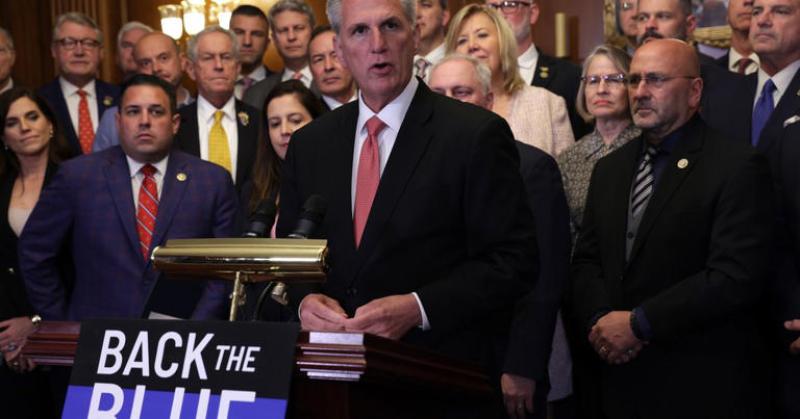
But this isn’t enough for the GOP. House Speaker Kevin McCarthy has insisted that any agreement to raise the debt limit must include new work requirements for social-welfare programs. And on Sunday, Biden indicated an openness to meeting this demand, telling reporters, “I voted for tougher aid programs. That’s in the law now, but for Medicaid it’s a different story. And so I’m waiting to hear what their exact proposal is.”
Biden’s meaning was plain: The president will not acquiesce to work requirements for health-insurance coverage but is more open to the GOP’s proposals for limiting eligibility for food stamps and the Temporary Assistance for Needy Families program.
It is worth taking a moment to underscore the perversity of this situation. Times of divided government necessarily require bipartisan compromise; even without a debt-limit fight, Democrats would need to secure Republican cooperation to keep the government funded this fall. Yet, as Jonathan Chait explains , Biden and McCarthy are not haggling over a normal bipartisan deal. In an ordinary negotiation between two parties that each enjoy a democratic mandate, both sides make concessions to the other’s agendas: If Democrats must acquiesce to social-spending cuts, Republicans would then reciprocate by accommodating some liberal priority, such as progressive tax increases.
But McCarthy isn’t interested in horse trading. He’s interested in extortion. Republicans are not offering a single concession to the Democratic agenda. They are merely offering not to plunge the U.S. into a financial crisis by blocking the Treasury from financing spending that Congress has already ordered. The GOP’s sole leverage in this negotiation is its reputation for nihilism. If it could be presumed that Democrats and Republicans were equally opposed to deliberately making Americans poorer, then the GOP would not be in a position to make any unilateral demands. Republicans’ being manifestly willing to sabotage the economy for partisan gain should be a scandal for the party. Yet much of the press is intent on portraying the GOP’s indifference to its most basic obligations to the public as a banal political reality that Democrats are duty bound to accept.
In this context, Biden’s inclination to pay the GOP’s ransom is understandable but misguided. Yes, all of the executive branch’s unilateral options for disarming the debt ceiling are freighted with risk, particularly in a context in which conservatives control the Supreme Court. But rewarding Republican extortion means harming various Democratic constituencies in the first instance and ensuring further debt-ceiling crises in the long run.
In any event, Democrats and the press should be clear-eyed about what Republicans are doing when they press for new work requirements on Medicaid, food stamps, and TANF. The ostensible purpose of these policies is to liberate the poor from dependence on welfare while increasing labor-force participation, but all available evidence indicates that the GOP’s proposals would yield negligible impacts on employment at the cost of cutting off health care and food aid to hundreds of thousands (if not millions) of working , low-income Americans because of missed paperwork and bureaucratic errors.
If work requirements do not actually serve their official purpose, they are highly effective at their actual one. The Republican Party does not want all working, low-income Americans to enjoy public health insurance and nutritional aid. Their aim is not merely to strip welfare from the idle poor but to slash social-welfare spending in general. They are quite explicit about this intention.
Work requirements allow them to make progress on this objective precisely because such rules reliably deny benefits to the working Americans who comprise the vast majority of prime-age social-welfare recipients. What’s more, the policy enables the GOP to slash aid to such beneficiaries in a politically palatable way.
The House GOP’s most egregious proposal is to append work requirements to Medicaid. On a theoretical level, it is difficult to see why denying someone access to basic medical care would render them more capable of contributing to the economy. The idea that many Americans are choosing not to work because they can get a check-up for free is quite strange. A comfortable material existence plainly requires many, many things beyond health insurance.
And the empirical case for Medicaid work requirements is even weaker than the theoretical one. According to the Kaiser Family Foundation, 93 percent of Medicaid beneficiaries ages 19 to 64 are either working, attending school, caregiving, or suffering from a disabling ailment. As for that remaining 7 percent: Giving people access to health-care coverage makes them more likely to obtain and maintain employment. Thus, Medicaid is itself a work-promoting policy.
The “laboratories of democracy” provide more concrete evidence for the folly of Medicaid work requirements. In 2018, Arkansas imposed work requirements on its Medicaid beneficiaries, and the policy accomplished none of its ostensible objectives . Not only did the requirements fail to increase employment, but they actually cost the state and federal government $26.1 million in the short term because of the administrative burdens of implementing the new requirements. Meanwhile, nearly 16,000 low-income Arkansans lost their health coverage. Only 1,232 of those individuals were actually nonworking. In other words: Roughly 92 percent of those who lost health insurance owing to Medicaid’s work requirements did so because of paperwork problems, not because they were neglecting to contribute to the economy.
This result was not hard to anticipate. Arkansas’s rules initially required Medicaid recipients to submit documentation of their work on a complex website that required both access to the internet and skill at navigating it. The website also shut down between 9 p.m. and 7 a.m. each day. And if Medicaid enrollees failed to complete their submission by the fifth day of every month, they lost their coverage.
If Republicans’ support for work requirements were genuinely motivated by a concern that Medicaid disincentivizes work, then Arkansas’s experiment would have led the party to abandon the policy. But if the GOP actually wanted to deny health insurance to the working poor — both out of an ideological hostility to social welfare and a desire to free up fiscal space for cutting taxes on the wealthy in the long term — then you would expect them to deem Arkansas a success story and push to take its policy national. They have, of course, done the latter.
Biden has thus far sworn off meddling with Medicaid. But the work requirements he has signaled openness to are similarly ill conceived. The Supplemental Nutrition Assistance Program, also known as food stamps, already has strict work requirements and time limits for Americans under 50. The House GOP’s proposal would extend these requirements to those between the ages of 50 and 55.
This is a solution in search of a problem. The labor-force participation rate among workers ages 25 to 54 is currently at its highest level since the 2008 financial crisis . And even if Americans in their early 50s were shirking work en masse, there is no evidence that appending work requirements to SNAP would significantly increase their workforce participation. Research from the Urban Institute shows the past imposition of work requirements and time limits did not meaningfully increase beneficiaries’ earnings or employment. Work requirements do reliably deny SNAP benefits to working Americans, however. Projections suggest that McCarthy’s proposal would cut off food aid to hundreds of thousands of people, a total far larger than the number of nonworking, able-bodied SNAP recipients between 50 and 55.
TANF, meanwhile, is already a highly restrictive program whose chief beneficiaries are children. McCarthy’s plan would force states to strengthen work-documentation requirements and, thus, administrative burdens for accessing aid. Already, those burdens are so formidable that 26 percent of Americans eligible for TANF do not receive it.
There is little reason to believe that denying anti-poverty funds to the parents of young children will improve their employment prospects. Meanwhile, research indicates that providing direct cash assistance to needy families increases the future labor-force participation of their children.
One final illustration of the GOP’s bad faith can be found in the work-promoting welfare reforms the party isn’t considering. For example, as the Center for American Progress notes , there is one way in which SNAP presently does discourage work: Currently, a SNAP recipient who participates in a workforce-training program that offers a stipend or financial support risks suffering a reduction in food aid or loss of eligibility altogether. This gives some SNAP recipients a short-term financial incentive to forgo such training programs. Congress could eliminate this perverse incentive by exempting income earned during training from SNAP eligibility calculations. This would make the program more supportive of work. But it would also increase its fiscal cost. Since the GOP’s actual concern is for reducing spending on the poor, not improving their employment outcomes, it has no interest in the training issue.
All this said, work requirements serve their actual purpose perfectly well. Cutting aid to the indigent to sustainably fund tax cuts for the rich is an extremely unpopular economic program. In a 2019 Pew poll, only 17 percent of Americans endorsed cutting “assistance to the needy.”
But work requirements reframe the debate over soaking the poor. Rather than presenting a trade-off between helping the needy and pampering the wealthy, work requirements appear to aid the industrious at the indolent’s expense. That is a broadly popular proposition in the United States: In 2018, a Kaiser Family Foundation poll found that 70 percent of Americans supported Medicaid work requirements.
Thus, by increasing the administrative obstacles to accessing social-welfare programs, work requirements enable the GOP to enact broad social-welfare cuts in a politically palatable way.
Republicans want the public to believe they are pushing for work-promoting social-welfare policies through ordinary bipartisan negotiations. What they are actually doing is threatening to deliberately induce an economic crisis unless Biden helps them cut off aid to hundreds of thousands of hardworking low-income Americans.
In an ideal world, Biden would call this bluff, aided by an unblinkered and widely trusted press. In our decidedly suboptimal world, however, he appears poised to shake down the poor to pay the GOP’s ransom.
Tags
Who is online
229 visitors
Glad the stupid moron who wrote this said on a "theoretical level" because if they aren't working they aren't contributing to the economy, they are takers not producers.
If the economy is so great- and good paying jobs at every level are so readily available- then no one should have any problem finding and holding a job. Including those with any type of disability or special need that would force them to work from home.
All of the job openings is the reason Brandon and Democrats are defending their open borders; and illegal immigration surge. Yet somehow it isn't nearly enough to fill all the openings.
Time for those who take to get off the sidelines and support themselves at least a little bit.
Can we just transport them directly from the border to Mar-a-lago? A known employer of illegal immigrants.
Iirst, it is willing to cap discretionary spending at roughly its 2022 level for the next two years. This would constitute a roughly 13 percent cu
You have to love how simply maintaining current spending levels turns into a double digit "cut."
Getting a handle of the deficit/debt is the most important thing Biden can do. It's amazing to me the people who champion massive spending are so ignorant of the costs of borrowing. We will soon be paying more simply to service debt than we do on our military. The days of free money are over and something has to be done to lessen these costs before entitlement funding blows up.
Haven't these Biden sycophants been telling us he fixed inflation? doesn't that work out to over 6% a year? the press has to count on Biden supporters being some of the dumbest people on earth.
Not that I know of, perhaps you have different sources.
It's the same tactic they use every damned time this comes up. They take the leveling as a cut. They think that proposing an increase means the budget should be at that level and for whatever dumbass reason, consider holding said spending as a cut. Stupidity abounds and their constituents buy in to that shit.
And both sides use it.
In practical terms, it is a cut. If I were to say we are going to freeze your income for the next five years, do you think that 5 years from now that same income will buy what it buys today? Even with low inflation that would not be the case.
Yup
Doesn't matter. It still isn't a cut. It is up to the "cuttee" to find ways to ease the pain.
Unfortunately, it is the democrat's way. just throw more money at it. No need for resourcefulness.
It's much the same as in industry especially where labor unions are concerned. A job will take as long as the time allotted to it. As long and the money keeps coming in, unbridled waste will occur as the till will never run empty.
I'm a big fan of that but it only happens up here in provincial or federal politics which in the end means municipalities get defunded and they have to recoup these 'lost' monies by raising my property taxes ... "and the painted ponies go up and down".