
The fourth leading cause of death in the US? Cumulative poverty

By: the Guardian


 S E E D E D C O N T E N T
Reverend William Barber and Gregg Gonsalves
We hear so much about crime rates, opioids, and gun violence in America, but so little from our elected leaders about the poverty crisis
Can you name the top 10 causes of death in America? Without too much trouble, most Americans could likely come up with some of them: cancer, heart disease, stroke, accidents. But it would come as a surprise to many to know that poverty is right up there with these other dreaded scourges - much higher, in fact, than many ills that have inspired investigative committees, major policy investments and sustained attention from the public and private sectors in American life.
A recent study by one of our colleagues shows that cumulative poverty over many years is the fourth leading cause of death in this country. Current poverty - just being poor right now - is seventh on that list, and it alone causes 10 times as many deaths as homicide, close to five times as many deaths as gun violence, and 2.5 times as many deaths as drug overdoses. Cumulative poverty that lingers year after year is associated with approximately 60% more deaths than current poverty, putting only heart disease, cancer and smoking-related deaths ahead in the number of Americans it kills.
But if this is true, why do we hear so much about crime rates, opioids and gun violence in America, but so little from our elected leaders about the crisis of poverty? Why is there no "Surgeon General's Warning" on low-wage jobs? The relationship of poverty to disease and death is a well-established fact detailed in reports by the World Health Organization, the World Bank and our own government. But we as a people have become numb to the unnecessary deaths that are normalized by the ways we often think and talk about the economy in public life.
Sadly, the United States is the leader in poverty among the rich countries of the world. As of 2019, the US had the worst poverty rate overall (17.8%) and in children specifically (20.9%) among the other 25 wealthy countries that are part of the Organization for Economic Co-operation and Development (OECD).
In addition, poverty affects us all. Seventy-five per cent of all Americans between 20 and 75 years of age will be among the "current" poor or near poverty for at least one year of their lives. Contrary to popular belief, poverty is hardly just the province of the inner city: only 10% of poor Americans live in high-poverty census tracts - most are spread out across the country. They are our neighbors. And although the rates of poverty are highest among communities of color, by sheer volume most people living in poverty are white.
Finally, poverty is a drag on our economy. Child poverty alone in the US presents an $800bn to $1.1tn price tag, based on reductions in adult productivity, criminal justice costs and the costs of healthcare for children from poor families.
But what if we could end poverty in America, the misery and suffering it generates - the 500 deaths a day it causes in this country? Our colleague Matthew Desmond, a sociologist at Princeton University, estimates that we could lift everyone within our borders above the poverty line for less than 1% of our national GDP - $177bn. Ending poverty is within our grasp. It is something we can accomplish together. So what's stopping us?
As the economists Daron Acemoglu and James Robinson said in their 2012 book Why Nations Fail, "those who have power make choices that create poverty. They get it wrong not by mistake or ignorance but on purpose." Matthew Desmond elaborates a similar theme in his recent book Poverty, By America: "Tens of millions of Americans do not end up poor by a mistake of history or personal conduct. Poverty persists because some wish and will it to."
It is difficult to believe that some people are pro-poverty. The incentives for maintaining the status quo, for keeping many Americans poor, rest on the fact that some people find considerable financial benefit from presiding over the misery of others. This is what a young Friedrich Engels - observing the deaths of factory workers, the conditions of the slums and the exploitation of children in Manchester, England in the mid-19th century - called "social murder". Many were dying, while a few made a killing from their suffering. It was true then, and it is true now.
But this is not our destiny. We can be the generation that abolishes poverty, the country that goes from the bottom of the heap among its peers - whether it's about poverty, or life expectancy - to the top of it. We can rise to lead and "we the people" of the US can stand up to form a more perfect union, lifting this generation and the generations after it out of poverty, wiping away the deaths being poor causes in this nation.
But this means holding up a mirror to who we are as a country. Those who gain from keeping people in the chains of poverty, condemning them to early death, must be confronted with a movement that names poverty in the richest nation on Earth as a public health crisis, an economic dead weight, a moral abomination and a stain on the republic. When the poor and low-wealth people of this nation link arms to make the moral case for an economy that works for everyone, we have the power to change the conversation about what is possible in Washington and in our statehouses.
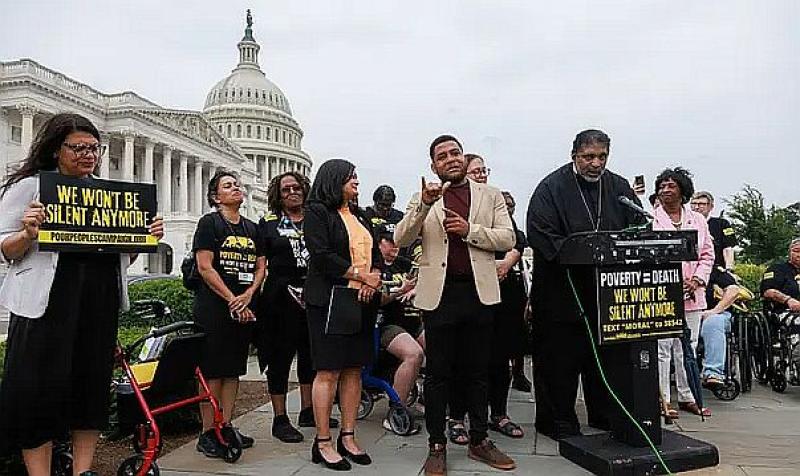
The US claims to be a beacon of democracy abroad and a nation committed to justice and general welfare at home. This cannot be true as long as poverty is the fourth leading cause of death in the richest nation in the history of the world. Poor and low-wealth people are fighting for their lives and for the life of our democracy through the Poor People's Campaign: A National Call for Moral Revival, which worked with members of the US House of Representatives last year to introduce a Third Reconstruction Resolution that outlines policy priorities that can guide legislation to end poverty.
In an echo of the Bible, this movement is saying, "Woe unto those who make unjust laws and rob the poor of their right." But this prophetic challenge isn't a condemnation. It is an invitation to life. Together, we can become the land of "liberty and justice for all" that has never yet been. Indeed, people who know that they do not have to accept the death sentence of poverty are leading the way.

Tags
Who is online
155 visitors
Poverty has never been a popular topic among politicians, probably because they know that our economic system creates it, and there isnt any appetite to change our economic system.
Among developed nations, the US is the only one with declining life expectancy. It has the highest population in poverty. D'ya think they're maybe the same thing?
Not true.
Please stop lying.
The United States poverty rate, on your list, is higher than EVERY major country in Europe, as well as Canada and Australia.
Interesting spin John. As noted by others here that was not what I pointed out but since you did let’s talk about it.
You bring up Australia and Canada. About 38 and 26 million respectively. Both Japan and Mexico are much larger “developed” nations. 126 and 129 million respectively. Both have higher poverty rates than the USA.
Do they count?
Did you look at your data?
None of the data is “mine.”
Lol …. Just stop lying please.
I would be curious to know how they came up with a 500 deaths a day caused by poverty. It would seem hard to quantify like other causes of death listed. Maybe that is why it does not get attention some think it deserves as far as being a leading cause of death.
I suspect it goes something like this:
They died of heart disease but that was arguably caused by poverty. They died of gun violence but that was arguably caused by poverty. They died of drug overdoses but that was arguably caused by poverty ….. etc, etc.
In other words disinformation and guessing
You know what they say. There are three types of lies:
Lies
Damned lies
And statistics……
According to the cdc and not "one of their colleagues ".
Medical errors are the third leading cause of death, think of how long we’d live if we just got rid of doctors.
Lol … exactly.
That rates right up there with lowering crime by getting rid of cops.
Progressives are such a crazy, kooky group.
Makes sense yet some people would rather obfuscate.
Poorer people have less access to medical care, food security, higher crime rates, etc.
Personally I am not disagreeing with your comment. My issue is with the method used to come up with a ranking of 4 and 7 as far as reasons for death.
Yeah, I don't put much faith in statistics as they can be manipulated.
I still agree with the overall premise though.
One can play with stats all day long, the fact remains the richest country in the world has a poverty rate of 15.1% out of a population of 332,000,000 or roughly 50,000,000 people.
For a country that is exceptional and rich, we should not have that amount of poverty, we can and should do better.
What you say is glaringly obvious.
That's why the Usual Suspects must urgently deflect.
"we can and should do better?
How?
Raise taxes?
Tax the rich more?
More social programs?
What are the societal costs of hunger, disease, homelessness, hopelessness and utter despair?