
Kagan Decries Use Of Right-Wing 'Doctrine' In Student Loan Decision As 'Danger To A Democratic Order'

By: Kate Riga (TPM)


 S E E D E D C O N T E N T
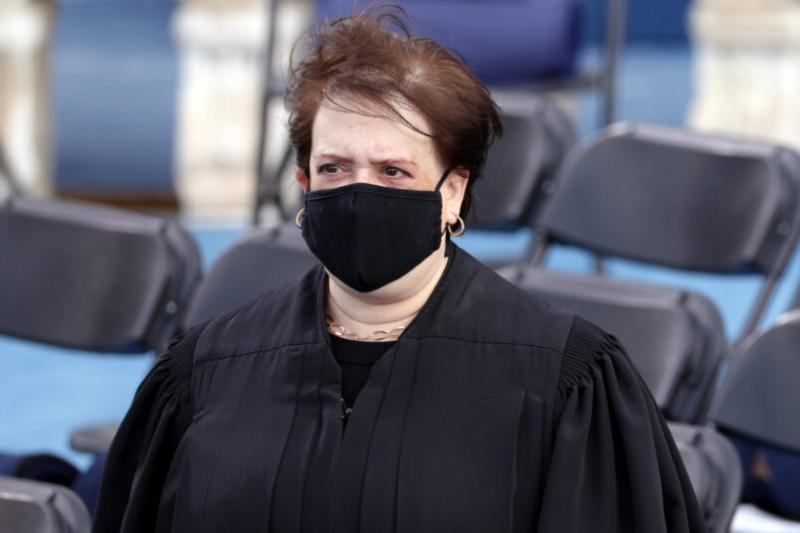
WASHINGTON, DC - JANUARY 20: U.S. Supreme Court Associate Justice Elena Kagan (Photo by Alex Wong/Getty Images) By Kate Riga | June 30, 2023 12:27 p.m. Start your day with TPM. Sign up for the Morning Memo newsletter
In knocking down President Joe Biden's student loan forgiveness plan, the right-wing Supreme Court majority does more than keep millions of American saddled with debt — it continues to shift enormous power away from Congress and the executive branch to itself.
The majority — "as is becoming the norm," Justice Elena Kagan narrates in her dissent — relies heavily on the major questions "doctrine," a theory in vogue in right-wing legal circles. It dictates that when executive branch agencies take action of major "economic and political significance," they lose the usual judicial deference they enjoy. That standard of significance is wholly in the eye of the beholder — an amorphousness the majority has continually taken advantage of. That has usually translated, in the hands of this conservative Court, into various Biden administration actions meeting their doom.
While the Court often protests that it's really shifting power back to Congress when it knocks down agency actions, it does so knowing that Congress is usually stalemated by various factors (split party control, the Senate filibuster) that make it extremely difficult for the legislature to pass many major laws.
It also disrupts the usual separation of powers balance: Congress writes broad laws authorizing agencies to deal with issues (letting the Environmental Protection Agency regulate air pollution or the Education Department deal with federal student debt), passing on the responsibility of crafting the specifics to the expert-staffed agencies. But this Court continues to impose itself on that process, deciding that Congress didn't meet some vague standard of specificity in its delegation and knocking down agency actions it doesn't like.
"This Court objects to Congress's permitting the Secretary (and other agency officials) to answer so-called major questions," Kagan writes, referring, in this case, to the Secretary of Education. "Or at least it objects when the answers given are not to the Court's satisfaction. So the Court puts its own heavyweight thumb on the scales."
This is more than just a constant barrier for Democratic administrations that seek to limit pollution, regulate workplace safety, shore up housing stability or mitigate ballooning student debt. It's also an unprecedented power grab, as the unelected justices substitute themselves for the much more democratically accountable entities meant to decide and craft policy.
Kagan points out that Congress is directly elected by the people, and that agencies derive their power from the President.
"But this Court?" she asks incredulously. "It is, by design, as detached as possible from the body politic. That is why the Court is supposed to stick to its business — to decide only cases and controversies, and to stay away from making this nation's policy about subjects like student-loan relief."
In a footnote, Kagan points out that Justice Amy Coney Barrett's concurrence includes beliefs that overlap with Kagan's own about the limitations of major questions — perhaps a ground-softening attempt to win Barrett, who has some stated qualms about the doctrine, into the liberals' fold on future decisions.
Chief Justice John Roberts, writing for the majority, seethes at Kagan's candor, calling it a "disturbing feature" of recent opinions that the dissenting liberals have called out the Court's appropriation of power.
In a thinly veiled warning, he says that a "misperception" that such criticisms are "disparagement" rather than "heartfelt disagreement" would be "harmful to this institution and our country."
Kagan is unbowed by the reprimand to simmer down.
"Justices throughout history have raised the alarm when the Court has overreached — when it has 'exceed[ed] its proper, limited role in our Nation's governance,'" she responds. "It would have been 'disturbing,' and indeed damaging, if they had not. The same is true in our own day."
Start your day with TPM. Sign up for the Morning Memo newsletter Kate Riga (@Kate_Riga24) is a D.C. reporter for TPM and cohost of the Josh Marshall Podcast. Have a tip? Send it Here! includes: administrative stateElena Kaganstudent debtSupreme Court

Tags
Who is online
142 visitors
So the Supreme Court is making decisions based on "theories" in vogue in right wing legal circles. Not a surprise at all.
Interesting take, at least she didn't pull the race card on this. All this ruling really did was show that the Administration over-reached again and the power to forgive debt is with Congress and not the White House.
But if she's really all that fed up with SCOTUS she could always resign. Then President Biden could nominate another to take her place.
Where is the "major questions doctrine" in the Constitution ?
Do you even know what the "major questions doctrine" is? It would appear not as no, it's not in the Constitution.
I bolded an important piece of this. As I said, this ruling basically stated that Congress has the power to forgive debt, the Administration does not and has not been granted that power in this case by Congress. Even Pelosi stated that back in 2021.
I think I said that first.
I phrased that poorly. What I meant to say was
It would appear that you do not know what it is due to the question you ask, and no it's not in the Constitution.
I put up a link to a a document from congress.gov that explains what the Major Questions Doctrine is. And as I stated, all this ruling does is return the power of the purse to Congress.
I stopped reading the Rolling Stone years ago. Glad to see they are still doing what they do best, pushing fear to help the next election cycle. As for their predictions, guess we'll just have to wait and see. But their track record is not one to be proud of IMO.
How much did their lies in the UNC Jackie rape case cost them?
cue the idiotic Fox deflection in 3..2..1
She won’t know, they lost $4.65M in two lawsuits.
Kagan has it ass backwards. The doctrine takes powers from the court and the executive and returns it to congress, the most democratically responsive branch of government. Kagan would like the president to have almost unlimited power to unilaterally order whatever he wants based on the most tenous relationship to a law congress actually passed.
look what happened here
1. The speaker of the house says the president doesn’t have the power to unilaterally order loan forgiveness.
2. Biden does it anyway.
3. Congress passes a bill making clear congress rejects the presidents claimed power to do this. Biden vetoes the bill.
Kagan thinks that’s fine. It turns the legislative power on its head, granting it to the president and forcing congress to stop it was 2/3 majorities.
Conservatives are fond of "theories" that allow them to decide cases in whatever way they want. They are supposed to be originalists who follow the text of the Constitution. Where is the "major questions doctrine' in the Constitution ?
Lets imagine for a second that Elena Kagan, not John Roberts, was Chief Justice of the Supreme Court, and the liberals held the majority. Does anyone think we would have the decision we have today?
She would be no less "correct" that Roberts, and probably more so. The Supreme Court is no longer remotely deciding cases on the merits as found in the Constitution, they are making national policy.
Well I guess if that was true and liberals held the majority this would have been passed in favor of the Administration. And IMO the downstream ramifications for this would have lead to more inflation and runaway spending by the Administration and faster growth of the National Debt due to increased borrowing.
The Higher Education Relief Opportunities For Students (HEROES) Act of 2003, allowed the Administration to grant relief to recipients of student loans in connection with our "Wars on Terrorism" war or other national emergency. It allowed waiving of federal student loans for three categories of individuals: active-duty military or National Guard officials, those who reside or are employed in a declared disaster area, or those who have suffered direct economic hardship as a result of wars, military operations, or national emergencies.
That is not what the administration tried to do.
I agree with what you posted, but to be honest Covid was declared a national emergency on March 13, 2020 by President Biden.
However I always disagreed with what the WH was trying to do with their student loan forgiveness plan and you show exactly where the issue lies. They were not going to determine who was placed in a worse position financially but were planning a blanket forgiveness plan.
who declares a national emergency ?
obviously the theory of the case is that student debt is a national emergency. who's to say it is any less of an emergency than "the war on terror" ?
No, actually it was Covid that was the national emergency. And there were people who lost their jobs due to Covid so those are the people who should be helped by this. But I do not agree that a blanket forgiveness plan was the best approach here. Even Pelosi said that the Biden Administration did not have the authority to do what they tried to do.
I know this is gonna shock you (/s) but I do agree with the SCOTUS ruling on this. It returns the power of the purse to Congress which is where it belongs.
Joe and Nancy knew it 2021 that this wasn't legal but Joe let the progressives push him into a corner and make false promises.
For the purposes of the HEROES Act, the President has to declare the national emergency.
What national emergency are all of these households earning up to $250K facing?