
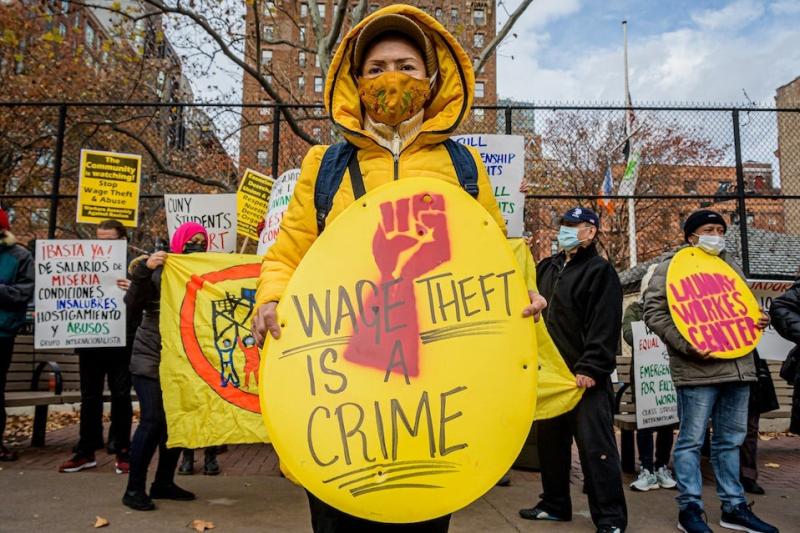
The Real Crime Isn’t Shoplifting—It’s Wage Theft



happy labor day
 S E E D E D C O N T E N T
Last weekend, I stumbled across a viral tweet thread that provided a rather thorough debunking of one of my big bugbears: the insipid shoplifting panic that’s been coursing through the media the past two years. Over several posts, WBAI radio host Rafael Shimunov punctures what’s become a classic “too good to check” story and discovered that many of the foundational ideas behind what’s been sold as a bona fide crisis were falsehoods—and not particularly well-constructed ones at that.
Once the evidence was sorted and the numbers run, Shimunov estimated that the total cost of our shoplifting horror show amounted to “seven cents per 100 dollars in losses.” The real “shoplifting crisis,” in fact, may be simply the way this nonstory has become so indelibly imprinted in the zeitgeist: Shimunov, after all, was pulling his evidence largely from a Los Angeles Times article from 2021 , one of many pieces that explored these claims and found a hoax at the center instead. What will it take, then, to dislodge this falsehood from the public consciousness? Perhaps what we need here is a better enemy—and if the public wants a pound of flesh from a gang of conniving thieves, I’ve got one: corporate America’s runaway wage theft .
Unlike shoplifting, this is not a penny-ante crime , and it’s carried out every day with the ruthless efficiency of the boardroom. An L.A. Times column of a more recent vintage, courtesy of Michael Hiltzik, tells a fuller story . He enumerates many ways in which employers pull their own coordinated smash-and-grab jobs on their employees’ paychecks: “They may pay workers less than the legal minimum wage, fail to pay overtime, deny workers legal meal breaks or rest periods, divert workers’ tips, or require them to work off-the-clock to prepare for their shifts or to perform duties after their shifts have ended.”
And those are some decidedly old-school techniques. The “one neat trick” to screwing workers in today’s gig economy is simply to misclassify them as independent contractors, “thus sticking the workers with expenses that would be covered for employees.” All in all, the true cost of wage theft amounts to something substantially north of chump change: A 2017 study from the Economic Policy Institute “estimated that low-wage workers lose more than $50 billion annually to wage theft.”
Moreover, a 2021 study from the Center for Public Integrity found that while firms that “hire child care workers, gas station clerks, restaurant servers and security guards are among the businesses most likely to get caught cheating their employees,” wage theft is a way of life at “many major U.S. corporations.” One such scofflaw that gets top billing in Hiltzik’s column is Home Depot, which in June settled a class-action lawsuit over wage theft to the tune of $72.5 million . That the firm’s former CEO Bob Nardelli was recently on Fox Business hyping up the threat of shoplifting is enough to make a cynic wonder: Is he fomenting public fear over an urban legend to distract from the real thieving?
Fortunately, in some quarters, wage theft is being treated with the seriousness it deserves. Just this week, ProPublica produced a blockbuster report on wage theft in New York City, finding that from 2017 to 2021, “more than $203 million in wages had been stolen from about 127,000 workers in New York.” And Documented, which partnered with ProPublica to produce the piece, this week launched its Wage Theft Monitor , which allows anyone to dig down into the data of who got ripped off and who did the stealing.
Under Biden, the Labor Department—whose acting secretary, Julie Su, made her name helping workers keep their hard-earned money from being pilfered by their bosses—has been frisky in the fight against wage theft. Last October, the agency reversed a Trump-era rule that permitted gig-economy employers to misclassify their workforce. A month later, an agency investigation led to Krispy Kreme paying $1.2 million in damages and back wages to more than 500 workers who’d been denied overtime. And this week, the department extended overtime protections to 3.6 million workers, the estimated equivalent of an additional “$1.2 billion in employees’ pockets, both in the form of more overtime pay and also salary increases by employers to ensure their white-collar workers will be exempt from the new rules,” according to the L.A. Times .
Naturally, we’ve a ways to go before all of the money that corporations have absconded with is back with whom it belongs. Perhaps the biggest policy change we could make in support of that effort, as TNR contributing editor Osita Nwanevu has written in the past , is to pave the way for worker ownership of firms . In the meantime, however, whenever you hear about a shoplifting crisis, remember that the actual theft isn’t occurring in the aisles of your nearby chain stores; it’s occurring in their boardrooms.
This article first appeared in Power Mad, a weekly TNR newsletter authored by deputy editor Jason Linkins. Sign up here .
Tags
Who is online
122 visitors
I wonder how many of the executives that greenlight stealing workers labor are "good Christians" ?
More than a few I bet.
Exactly, it’s payback time for them. The workers when off work disguise themselves and shoplift or smash n’ grab their employer to even things the best they can.
Home Depot has been accused of violating wage theft laws in California 1 2 3 . The company has agreed to pay $72.5 million to settle a lawsuit over alleged violations of wage theft in California 1 . Home Depot employees recently filed a class action lawsuit against the home and garden giant, accusing the company of wage theft 2 . The lawsuit alleges that Home Depot broke the law by failing to properly pay overtime wages, pay California minimum wage, furnish workers with proper pay stubs, pay workers in a timely manner during the course of employment and after termination, and reimburse supervisors for business-related expenses 3 .
Democrats do love their criminals. This article is absolute proof of that.
Ignore the left's beloved criminals. Concentrate on corporations instead. You know, the ones closing up shop in leftist run bastions of stupidity leaving people unemployed and their beloved criminals with less to steal.
Nice to know you approve of wage theft.
We can focus o. Two problems at once no? Drawing attention to one issue does not mean ignoring another.
This has been a problem for years with some corporations, good to see it being brought to light.
Meanwhile, here in the nation’s capital:
I would submit that using shoplifting as a rationale for the acceptance of wage theft is a warped view.
So called wage theft is not a major problem in this country, not matter how much you search and cherry pick isolated data.
However, widespread and organized shop lifting, mostly by minority youth, in liberal led cites, continues to grow.
'Flash mob' ransacks Topanga Mall Nordstrom - YouTube
The author disagrees, that’s why he included both in the seed.
The vast bulk of the article is about wage theft. Your comments are the fringe. What else is new?
Wage theft vs shoplifting is not an either /or.
Exactly, but your comment here seems inconsistent with 5.1.3
So called wage theft is not a major problem in this country, not matter how much you search and cherry pick isolated data.
However, widespread and organized shop lifting, mostly by minorities youth, in liberal led cites, continues to grow.
'Flash mob' ransacks Topanga Mall Nordstrom - YouTube
Wild video shows mob of looters bum-rushing Compton gas station, stealing thousands in goods - YouTube
I guarantee wage theft is a bigger problem that you care to admit. Not sure why you are so hostile to the idea of going after business who are cheating their employees. I say punish shoplifters and businesses that are stealing from others.
This is already self/correcting as e-commerce replaces retail. Then self-drive delivery trucks and delivery drones will start replacing drivers. The thieves will have a new sport shooting down drones and ambushing vehicles.