
The World Can No Longer Sideline the Israeli-Palestinian Issue



 S E E D E D C O N T E N T
In September 2020, former President Donald Trump hosted a White House signing ceremony to celebrate the Abraham Accords, a series of peace agreements his administration helped broker between Israel and several Arab states. In a moment of triumph, Trump hailed these historic peace deals as “the dawn of a new Middle East.”
On Oct. 7, 2023, a new Middle East appeared to emerge. But it was not the one that Trump, or President Joe Biden after him, hoped for.
Israel has endured its fair share of violence over the years. Yet the shocking attacks by Hamas have ushered in a grim new chapter in the region that highlights a bitter truth: While Israel’s normalization with other Arab states is an important diplomatic achievement, it hasn’t brought Israel peace or security.
For the past six years, U.S. leaders, along with Israeli officials and some Arab states, have concluded the Palestinian issue was too intractable to solve right now. And so they have instead opted to pursue normalization in the region between Israel and its Arab neighbors. Trump had the Abraham Accords, a stark departure from Arab nations’ longstanding pledge not to negotiate with Israel until the Palestinians received their own independent state. Viewing Israel’s further integration in the Middle East as a tool to help stabilize the region, and allowing him to focus his foreign policy on China and Russia, Biden sought to build on the Abraham Accords by pursuing a deal between Israel and Saudi Arabia that strengthened security and economic ties.
But this week, Biden finds him thrust back into the heart of the Israeli-Palestinian conflict. The recent attacks, among the worst in Israel’s history and involving American hostages, have proven yet one more time that no administration can forge ahead with plans that would allow it to disengage from the region while the Israeli-Palestinian issue remains unsolved on the back burner. They have shown that it was a mistake to pull back from the conflict with no other actor stepping into the peacemaker role and U.S.-designated terrorist forces like Hamas still bent on wreaking havoc on Israel. Even as he grapples with other global challenges — particularly the war in Ukraine — Biden faces a Middle East crisis that threatens to spiral into a broader regional conflict, pulling in new players and old adversaries.
But the region is also changing, and in interviews for this article, analysts suggested that after this current conflict, it might finally be time for a new kind of peace process framework, where the U.S. is not the sole broker — as long as it ensures that regional actors are able to effectively step into the void.
“The proliferation of Mideast conflicts over the last decade in Syria, Libya and Yemen has shifted the focus away from the Israeli-Palestinian conflict. But it’s a fallacy to believe just because the conflict wasn’t hot and live that it’s gone away,” says former Egyptian Foreign Minister Nabil Fahmy. “It never truly disappeared; it simmered beneath the surface."
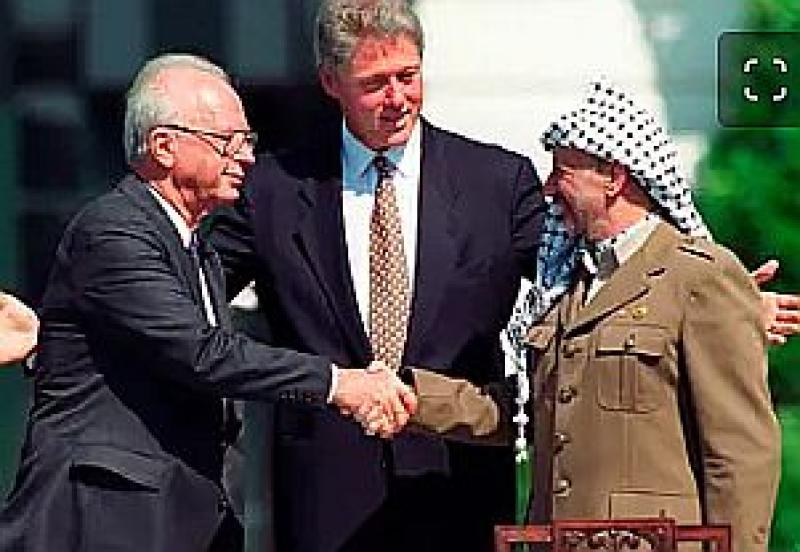
The United States has a long history of playing peacemaker in the Israeli-Palestinian conflict, even as the crown jewel — a comprehensive deal forging a lasting peace between Israelis and Palestinians — remained elusive. From the aftermath of the Yom Kippur War to the Camp David Accords in 1979, which saw Israel and Egypt make peace, the U.S. was an undisputed broker of peace. The Madrid Conference in 1991, the Oslo Accords in the 1990s, the 1995 peace treaty between Israel and Jordan and the Camp David summit in 2000 — all were driven by American diplomacy. The 1990s, in particular, marked a period of relative calm and cooperation between Israelis and Palestinians, facilitated by U.S. efforts.
But the United States’ last attempt at peace — the Camp David summit in 2000 — failed, and it left tensions in the region boiling while the United States began to gradually withdraw its involvement in the conflict. The Second Intifada, which erupted after the summit, left deep scars from which neither side has fully recovered. The Israeli withdrawal from Gaza in 2005 only led to a divided Palestinian national movement, with Hamas taking control of Gaza in 2007 and the Palestinian Authority retaining the West Bank.
Post-9/11, the Bush administration was consumed by the war on terror. The Barack Obama era marked a pivot to Asia, reflecting a belief that the Middle East was no longer as vital to U.S. interests — only to be drawn back by the Arab Spring.
Trump pursued broader normalization between Israel and its neighbors in the region. He also waded into the Israeli-Palestinian conflict — but in a way that only aggravated it rather than working toward peace. Trump decided to recognize Jerusalem as Israel’s capital and relocate the U.S. embassy there, abandoning the longstanding U.S. stance that Jerusalem would ultimately be a shared capital between Israelis and Palestinians. This move effectively crushed Palestinian aspirations for East Jerusalem to be their future capital.
Trump also slashed financial support for Palestinian institutions. Jared Kushner’s 2020 “peace plan” seemed more a nod to Israeli interests than a balanced approach, sidelining Palestinian concerns. Concurrently, Israel’s footprint in the West Bank grew, as the government increased settlements and bolstered its military presence there. Gaza, on the other hand, remained under a stringent blockade, which had been in place since 2011.
Trump’s policies seemed to embolden Israeli Prime Minister Benjamin Netanyahu, suggesting that Israel could foster global ties, especially with Arab nations wary of Iran and extremist factions, all while sidelining the Palestinian issue. This was evident in the strengthening of ties between Israel and Gulf nations, notably Bahrain and the UAE. This rapprochement led to direct flights, fostering tourism and economic ties.
If Trump’s policies favored Israel, the Biden administration relegated the Middle East to a secondary concern. Preoccupied with domestic challenges like Covid and international issues such as Afghanistan’s withdrawal and Russia’s war on Ukraine — and handicapped by Palestinian dysfunction and Israeli intransigence — he let the Israeli-Palestinian situation simmer.
Instead of pursuing peace between Israel and the Palestinians, Biden encouraged the Israeli-Arab normalization process initiated by Trump, aiming to facilitate a deal between Israel and Saudi Arabia that would secure some concessions for the Palestinians and preserve the possibility of a two-state solution — an agreement that would create an independent state for the Palestinians in the West Bank and Gaza Strip alongside Israel — down the road.
The Biden White House largely ignored Gaza, hoping that economic development programs instituted by the Israelis might temper Hamas’ militancy and offer Palestinians a semblance of stability, even under occupation.
“I have never seen the U.S. peacekeeping role to be as limited in ambition as I see it now,” says Fahmy. “You’re seeing an erosion of a two-state solution with only, if I may say, a half-hearted commitment on the part of the Americans.”
Fahmy argues that the lack of U.S. engagement and the absence of a serious peace process is creating a vacuum, allowing Hamas to feed on the grievances of the Palestinian people.
“Those who are more extreme, less supportive of a peace process, can feed on the frustration that’s being generated by the lack of any serious effort,” he says. “So the absence of a peace process is a major mistake."
Today, Fahmy argues, sustained engagement on the Israeli-Palestinian issue is more critical than ever — a time when the very tenets of the peace process are being challenged, whether through settlement expansion, violence in the West Bank, Israel’s far-right government dismissing the notion of a once-envisioned two-state solution — and, most recently of course, the brutal attack by Hamas on Oct. 7.
“While Hamas, Palestinian Islamic Jihad, Iran have no interest in resolving the conflict and in peace,” says Jeremy Ben Ami, CEO of J Street, a progressive Washington lobbying group, which strongly supports a peace agreement with the Palestinians, “there are plenty of Palestinians who do, and our entire policy should be directed at bolstering and building up those Palestinians and other players who genuinely want to create a productive, peaceful and thriving Middle East. If you do that, then Hamas and the bad actors won’t find fertile ground to build on.”

Tags
Who is online
117 visitors
“While Hamas, Palestinian Islamic Jihad, Iran have no interest in resolving the conflict......there are plenty of Palestinians who do, and our entire policy should be directed at bolstering and building up those Palestinians and other players who genuinely want to create a productive, peaceful and thriving Middle East. If you do that, then Hamas and the bad actors won’t find fertile ground to build on.”
The first step should be cornering and eradicating the Hamas terrorists. Only then will peace have a chance.