
Third Option For Israel In Gaza - Richard Haas



 S E E D E D C O N T E N T
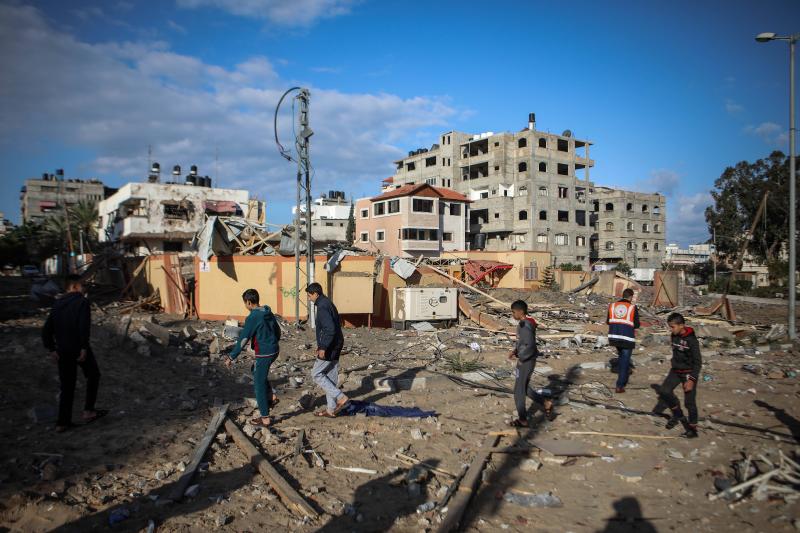
...I worry about the long-term impact of what is taking place in Gaza on American views of Israel. The era of goodwill that coincided with Israel’s founding and the 1967 War is long gone. David has become Goliath in the eyes of many. The strong emotional response for Israel in the wake of the horrific October 7 attacks has largely faded as the story for many observers is increasingly one of civilian casualties caused by Israeli military action. A less democratic Israel is still a possibility, as is one that rules a large number of Palestinians for years or even decades. None of this bodes well for the future of this relationship.
But to suggest that what Israel is doing in Gaza is proving costly and may well not succeed is not to argue (as many are doing) for a ceasefire. Israel has the right and the need to strike at Hamas, both to retaliate for October 7 and to prevent future such attacks. Indeed, so long as Hamas remains Hamas, a full ceasefire is unimaginable as Hamas would not forever give up the option of attacking Israel and Israelis, and Israel could not be expected to give up the option of preventive or preemptive strikes against a Hamas dedicated to destroying the Jewish state.
There is a third option, an alternative to both large-scale Israeli attacks from the air and ground followed by an occupation and to an immediate ceasefire. It would be more measured and more patient. The characteristics of this third option would be as follows:
Israel’s right to take military action would be open-ended, with no permanent ceasefire, so long as Hamas existed with its current agenda.
Military action by Israel would only be undertaken when intelligence indicated Hamas targets could be attacked from the air or by Israeli commandos without causing substantial collateral damage.
There would be pauses (possibly for 24-hour periods or even several days) in the military operations to allow for aid to enter Gaza and hostages to be exchanged for either aid or prisoners. Pauses would also calm the diplomatic waters without requiring Israel to give up on what would be an open-ended effort to degrade Hamas.
This option would also come to include a political dimension, one that would aim in the near term to preserve the possibility of a Palestinian state through American pressure on Israel to restrict settlement expansion and forego any new annexation. Over time, the United States and Israel would need to work together to build up a Palestinian partner in the West Bank that is willing to eschew violence and negotiate with Israel. Only then could negotiations aimed at bringing about a Palestinian state commence. Gaza would remain outside the process so long as Hamas was in charge. Either a version of the status quo would continue (a de facto three entity solution), or a revamped Palestinian Authority would gain popular support in Gaza and come to succeed a Hamas that is rejected by most of the locals.
What would this third option require? Israel’s military effort would be recast as long-term and low intensity rather than short-term and intense. Israel would need to forego military strikes that would likely result in a large number of civilian casualties. Israel would accept pauses, if Hamas did as well, restrain settlement activity and hold off any further annexation. Settler violence would be reined in and dreams of transfer of Palestinians out of occupied territories would be jettisoned.
I expect much of this would be unacceptable to Bibi Netanyahu, Israel’s embattled prime minister. It would be up to Israel’s parliament to replace him or the Israeli public to elect someone prepared to back something along the lines of this third option. I expect this would only have a chance of happening if President Biden were to become a strong advocate for such an Israeli policy. That both Biden and Secretary of State Blinken are now calling for pauses in Israeli military activity is an encouraging sign.
Speaking of Bibi Netanyahu, the New York Times ran a story about Israeli intelligence and political failures in the run up to October 7. It is hard to see how Netanyahu survives the inevitable investigations, which may explain his embrace of an intense military campaign that he believes has the potential to eliminate Hamas and thereby offset his failures in the run up to October 7. It is also possible that Netanyahu believes a long military campaign will by definition delay the investigations and reckoning with these failures.
Tags
Who is online

134 visitors
I think something like this would be best for longer term peace in Israel.
I hear that there is a lot of abandoned land in Syria and a government more to their liking.
Great idea!
..I worry about the long-term impact of what is taking place in Gaza on American views of Israel.
Let me get this straight....Haas thinks those protests represent the views of average Americans?
He is living in a bubble.
Which means what, specifically? What would it look like? Like just more of the previous status quo?
In other words, ensure maximum effectiveness in Hamas using the civilian population as a shield.
Let Hamas call a time out whenever it suits them to do so.
Although those settlements never should have happened in the first place, this needs to especially be put in effect at this time so Hamas can say their actions attained desired results.
Again, same thing.
Who's dreaming that?
Was this article written by Hamas?