
The Sick Man of North America | Washington Monthly

By: Anne Nelson (Washington Monthly)


 S E E D E D C O N T E N T
A few decades ago, as Germany was painfully navigating the path to reunification, it was often labeled "the sick man of Europe." Since then, the country has recovered nicely, and it is now the United States that's considered the "sick man." The political system that once served as ballast to Western democracies is both uncertain and unstable. Disruptive political violence has extended from local polling places to the halls of Congress, and trust in public institutions has reached a nadir.
God, Guns, and Sedition: Far-Right Terrorism in America by Bruce Hoffman and Jacob Ware Columbia University Press, 448 pp.
Less than 20 years ago, the mood was different. The U.S. had just elected its first Black president, and the threats from al-Qaeda and other foreign terrorist organizations had abated. What changed? The causes of our current crisis are as diverse as the meteorological factors in a perfect storm. Some make the argument for Christian nationalism; others for dark money in politics; still others for the hypnotic power of the MAGA movement. These are necessary, but not sufficient, descriptors for our times.
In their new book, God, Guns, and Sedition, Bruce Hoffman and Jacob Ware make a powerful argument for an additional piece of the puzzle: a violent strain of the American psyche that goes back to the Reconstruction era, and has metastasized in recent decades, thanks to the proliferation of guns and the catalyst of the internet and social media.
Hoffman, a Georgetown professor and senior fellow at the Council on Foreign Relations, is uniquely qualified to analyze the situation. He began working on American right-wing domestic terrorism in 1981, early in his career, largely because it had been generally overlooked by other scholars. Following the September 11 attacks, he became a ranking expert on religious extremism originating in the Middle East, but now, he writes, circumstances have obliged him to turn his attention back to domestic terrorism. His coauthor, Jacob Ware, is an adjunct professor at Georgetown and a research fellow at the Council on Foreign Relations.
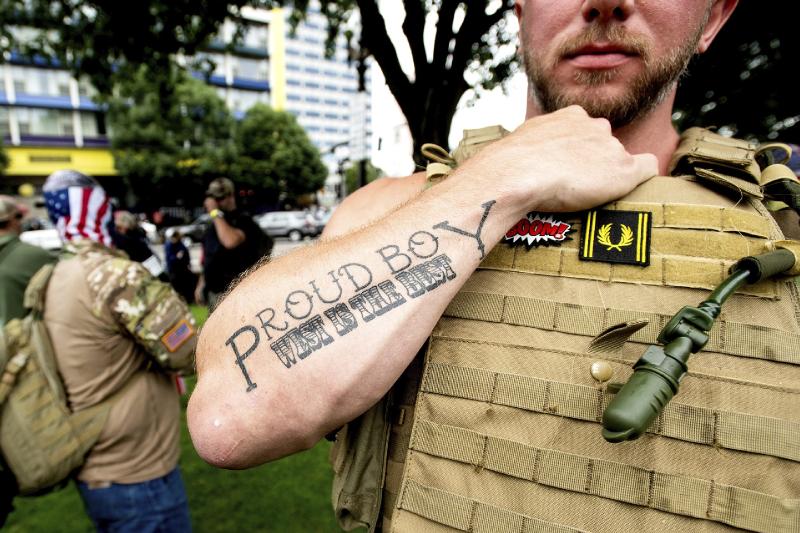
Early on, Hoffman took special interest in The Turner Diaries, a 1978 dystopian novel that has served as a foundational text for right-wing extremists. Hoffman and Ware's book notes how The Turner Diaries cast its influence over events ranging from Timothy McVeigh's bombing of the Alfred P. Murrah Federal Building in Oklahoma City to the gallows erected on the grounds of the Capitol on January 6. The throughline for the attacks is the desire to topple the U.S. government as we've known it. The reigning philosophies include white supremacy, driven by the "great replacement theory" that religious and racial minorities are usurping the place of an entitled population. The means often depend on what Hoffman and Ware call "leaderless resistance," in which loosely networked groups carry out plans for individual acts of terrorism, difficult to monitor but easy to replicate.
The authors point out that many of these elements have been with us for decades, but a new catalyst has emerged: the idea of "accelerationism." The term is borrowed from the Marxist strategy of revolution, they note, but it
is also the contemporary manifestation of a decades-old white power strategy to foment violent chaos as a means to seize power … In this current usage, accelerationism is embraced by a spectrum of white supremacists, white nationalists, racists, antisemites, xenophobes, and antigovernment militants as a clarion call to revolution.
These elements hold that "the modern Western liberal state is so corrupt and inept that it is beyond redemption and must be destroyed in order to create a new society and way of governance." It's easy to draw parallels with the apocalyptic visions that are prevalent among Christian extremists. Why bother to uphold good governance and nourish our public institutions if they're scheduled for eradication?
The concept of Christian nationalism has diverged from its connections to Christian theology and emerged as a movement of strategically fueled grievance that seeks to overthrow American governance in its current version, with no promise of anything better to come.
The adherents to these beliefs represent a minority among the roughly 164 million American adults who identify as Christian. But this minority, heavily concentrated among Southern Baptists, other fundamentalist sects, and Pentecostals, punches above its weight politically, especially in the South and the West. These congregations have been targeted and radicalized by massive campaigns that are waged by direct mail, from the pulpit, and, most dangerously, online. In the process, the concept of Christian nationalism has diverged from its connections to Christian theology and emerged as a movement of political identity based on strategically fueled grievance. It doesn't matter that this cohort represents a minority among American Christians, and that its voters embrace minority positions on social and political issues. Just as the Apocalypse promises to overthrow earthly kingdoms, the apocalyptic political vision seeks to overthrow American governance in its current version, with no promise of anything better to come.
Much of God, Guns, and Sedition is an encyclopedic examination of the many acts of terrorism—both domestic and foreign—that have grown out of this inchoate movement. The chronicle of the Ku Klux Klan is provocative; although popular culture tends to identify the Klan with the former Confederacy, it has been a nationwide phenomenon. Ohio, for example, was the leading locale for the Klan's second generation, with some 400,000 members; at one point, both future President Harry S. Truman and future Justice Hugo Black belonged. The hate-filled echoes of the lynching era resound in the recent attacks on synagogues and Black churches.
But the authors report that the race-based tensions of that era had economic and geographical dimensions as well. The incubator for much of the right-wing domestic terrorism of the late 20th century lay in agricultural areas, where "a combination of falling crop prices, poor weather, and soaring interest rates were driving farmers into bankruptcy at a rate not experienced since the Great Depression." These farmers were predominantly the descendants of European immigrants from the 19th century, for whom farming was both a legacy and a way of life. In 1920, some 32 million Americans—nearly a third of the total—lived in farming communities. By 1987, the number had plummeted to under 5 million, or 2 percent of the population.
On a local level, this translated into many farmers' inability to pay taxes and finance their operations. Cherished family homesteads were lost to corporate factory farms, in some cases leading to the demise of entire towns. There were political implications, as what would later be called blue states turned purple and purple states turned red. More critically, right-wing extremists took advantage of this pain by establishing footholds in Idaho, Montana, Wyoming, and parts of Oregon and Washington—an area collectively known as the "American Redoubt." Hoffman and Ware describe the region's role in the Posse Comitatus movement, which mounted a series of violent actions in the 1970s and '80s, reporting that "by 1978, the FBI had identified seventy-eight chapters in nearly two dozen states with an estimated membership of some 12,000 people." (The Redoubt's dream of a militant theocracy lives on, as chronicled in Bradley Onishi's recent book, Preparing for War: The Extremist History of White Christian Nationalism—and What Comes Next.)
Hoffman and Ware amply demonstrate that the roots of white supremacy, Christian nationalism, and terrorism offshoots extend well back into the past, but why are they burgeoning now? The authors offer three compelling reasons. One is the role of video gaming and social media, which allow seditious activity to proliferate in dark corners of the internet. In one instance, they describe how a user instigated physical violence online by cloaking it in gaming terminology. They also note that social media makes it easy for extremists to engage psychologically vulnerable youths, citing the example of the Atomwaffen Division, a small but virulent international neo-Nazi network. Three of its young recruits have been convicted of committing a total of five murders. It was found that all of them suffered from an array of mental illnesses and neurological disorders, including autism in each case.
Just as digital media lower the bar to communications promoting violence, America's lax gun laws make it easier for these violent acts to be carried out. On every front, the authors show, the United States has fallen behind its European counterparts in its response. In the rosy dawn of the web, it was presumed that digital platforms would take on the responsibility of policing themselves. Those efforts are going backward. The Twitter of Jack Dorsey made some good-faith attempts to limit violent and hate speech. In November 2022 and twice in 2023, however, Elon Musk's X made cuts in its trust and safety team, which handles content moderation, and in its unit monitoring hate speech and harassment. Likewise, despite efforts to require background checks and limit the sale and possession of the kinds of semiautomatic weapons commonly used in domestic terrorism and school shootings, American gun laws have grown more lax. (Ironically, roughly 90 minutes after the Oklahoma City bombing in 1995, McVeigh was arrested at a traffic stop for unlawfully carrying a handgun. As of 2019, due to Oklahoma's revised gun laws, he would not have been subject to arrest on that count.)
According to Hoffman and Ware, another accelerant has been Donald Trump, amplified by media allies such as Fox News. Domestic terrorism is fueled by anger, resentment, and a sense of disentitlement. Trump's rhetoric attacking immigrants, Muslims, and African Americans has now been tied to dozens of physical assaults. The authors cite extensive social media posts lauding Trump as a leader. On the website of Stormfront, a neo-Nazi forum, one user comments, "At this point, if you still don't support Trump I'm seriously questioning whether or not you're [a white nationalist]." Another writes that Trump gets his more violently inclined supporters so "riled up" that "they would charge and attack if he told them too [sic]. They love Trump. He is almost like a Fuhrer."
Trump has had international help. Hoffman and Ware write of "Russia's repeated, malignant interference" in the 2016 elections.
But since that time the Kremlin's continued manipulation of Western democracies has delivered to Russia a potential strategic victory: succeeding where decades of Soviet-era subversion during the Cold War had failed by undermining public trust and confidence in the Western state system and the democratic process.
This is perhaps the most critical point of many made in this compelling work. The internet represents America's porous frontier. We've been invaded and lack the strategy to mount an effective defense.
Hoffman and Ware bravely set out in their final chapter to offer recommendations. They look to Congress to respond to the threats with intelligence and common sense: Pass laws that would allow the prosecution of domestic terrorists with the same vigor as their foreign counterparts. Strictly regulate the kinds of weapons that cause the most carnage. Expand the designation of "foreign terrorist organization" to apply to more neo-Nazi and white supremacist groups. Investigate the extremists' infiltration of the U.S. military and law enforcement agencies. Finally, help Americans distinguish between fact and disinformation in their online diets. None of these measures is impossible, as various European democracies have shown. But if Hoffman and Ware are relying on Congress to implement these measures, they should take the position of the current House leadership into consideration. Are they promoting a vision of the peaceable kingdom—or Apocalypse now?
Related
Anne Nelson
Anne Nelson is an author whose works include Shadow Network: Media, Money and the Secret Hub of the Radical Right and Red Orchestra: The Berlin Underground and the Circle of Friends Who Resisted Hitler. She is a research scholar at the Saltzman Institute of War and Peace Studies at Columbia's School of International and Public Affairs.

Tags
Who is online
149 visitors
It’s no longer about Jesus and the Bible
There’s quite a bit of good writing about Christian Nationalism these days largely because we’re spending a tiresome amount of time in Iowa which is the heartbeat of white conservative evangelicalism. This one (gift link) from the NY Times is quite good. And this one from Benjamin Wallace Wells in the New Yorker is really excellent. They both report that today’s evangelical GOP evangelicals are different than they used to be.
Wells interviews a number of Iowa pastors and politicians and they’re all interesting. But this one really struck me:
Think about that. Donald Trump inspired someone to become a pastor in order to fulfill his vision. That gives me a headache.
The upshot in both articles is that we are no longer dealing with Republican evangelical Christian ity as we’ve known it. There are plenty of the old guard left who eye the new guard with suspicion. But they’re following along with the new guard which is Christian Nationalist. Religion is now a means to power nothing more. The theology is incidental.
A friend pointed out to me the other day that Charlie Kirk, the young wingnut leader who runs Turning Point USA, one of the biggest far right organizations, has suddenly and quite abruptly started using Christian Right rhetoric. It’s no longer a Church thing. It’s a Trump cult thing.
“It’s a Trump cult thing.”
So sadly true.
That there are unbelievably millions that ignorantly invest in his brand, and it is just a brand, says all one need to know about how dysfunctional we have become.
Let's do some more conspiracy theories.
So, I imagine the poor Jehovah Witnesses or Mormons or Church of God or those classifying themselves as atheists are gonna get a buy off???
How 'bout using the Ol' Dem/Lib "Here - pull my thumb" for the next Sky is falling theory?
I dont have the slightest idea what you are trying to say.
[Deleted]
[Deleted]
And that's what bothers me. They don't have anything better. They want tyranny and nothing else
Ah yes, the "White Christian racists are under every pillow" crowd got their dander up to fight largely imaginary racists. Yet he only people using slurs on this site are good, card carrying progressives. Projection in action.
"Hoffman and Ware amply demonstrate that the roots of white supremacy, Christian nationalism, and terrorism offshoots extend well back into the past, but why are they burgeoning now?"
But are they burgeoning now? There is very little credible evidence of that. The organizations and splinter groups that supposedly support and practice such activities are few in number and lower in members, having not much clout or presence in the scheme of things. What's getting all the attention lately is the left wing anti-Israel pro Hamas destructive demonstrators, who a reasonable person would consider to be more of a threat to a democracy than anyone else.
I have no idea how any adult can possibly argue that Christianity and White supremacy are "burgeoning" now. They would have b to b e amnesiacs or otherwise lack knowledge of what's happened in their lifetimes.