
Data Don’t Lie: Biden’s Economic Record is Much Better than Trump’s



 S E E D E D C O N T E N T
Data Don’t Lie: Biden’s Economic Record is Much Better than Trump’s

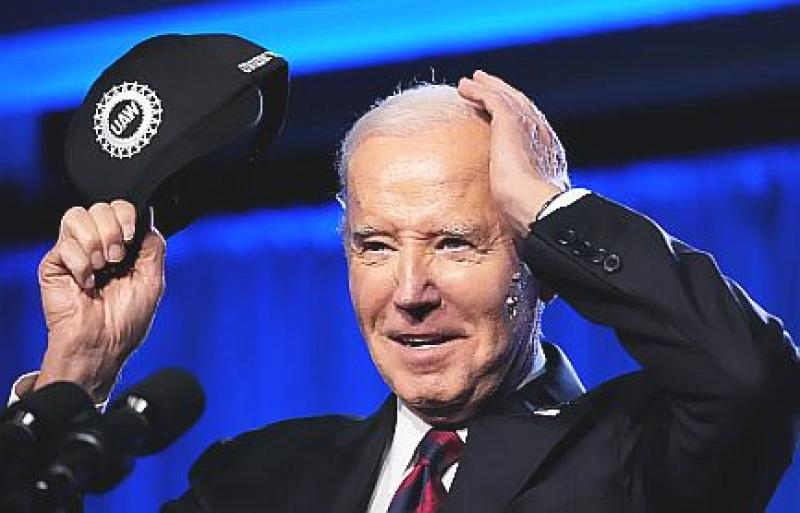
President Joe Biden speaks during a United Auto Workers' political convention, Wednesday, Jan. 24, 2024, in Washington. (AP Photo/Alex Brandon)
Donald Trump’s prospects for a second presidential term may well rest on whether voters accept his proposition that facts no longer matter. A case in point is his narrative that the economy was stronger during his presidency than under President Joe Biden. With few reality checks from the economic media, most of the public apparently agrees: One recent survey found that voters prefer Trump over Biden on the economy by 59 percent to 37 percent.
As Trump closes in on his third GOP presidential nomination, it’s time to set the record straight: By virtually every measure, that narrative is patently false.
From growth and jobs to investment and business creation, the economy has performed substantially better under Biden than it did under Trump. Biden’s superior record holds even if we set aside the pandemic’s impact in 2020. The exception, of course, is inflation. But just as the COVID-19 pandemic led to the collapse in GDP and employment during Trump’s last year in office, it was also the main reason prices rose so much for a time here and globally, according to new analysis from the Federal Reserve.
The most basic measure of the economy is how much it grows. The official data from the Bureau of Economic Analysis (BEA) are clear: After inflation, real GDP has grown at a 3.4 average annual rate since Biden became president, while Trump trails badly at an average 1.8 percent growth. Trump allies aren’t wrong when they complain that the 2020 downturn wasn’t his fault, so we’ll give him a pass for the year. The result still shows more robust growth under Biden: From 2017 to 2019, the economy grew an average of 2.8 percent per year, a rate still 18 percent slower than under Biden.
Biden’s stronger growth wasn’t by happenstance: He and congressional Democrats actively promoted it with the American Rescue Plan, the March 2021 stimulus enacted over united Republican opposition, and the November 2021 infrastructure act that Trump talked about but never delivered.
Biden beats Trump not just in overall growth: Based on investment rates, American business has preferred Biden’s economy: Since January 2021, real fixed business investment has increased at a 5.4 percent annual rate, twice the 2.7 percent average rate under Trump. And here, too, Trump lags Biden even with his pandemic pass for 2020: Real business investment increased on average by 5.0 percent per year from 2017 to 2019, compared to Biden’s 5.4 percent annual rate.
Based on spending, consumers also prefer Biden’s economy. From 2021 to 2023, real personal expenditures increased an average of 4.5 percent per year, versus Trump’s record of 2.6 percent from 2017 to 2020. In this case, a pandemic pass for Trump increases Biden’s advantage: Real consumer spending grew 2.0 percent per year from 2017 to 2019, an annual rate that trails Biden by 55 percent.
On employment—on top of growth, investment, and consumer spending—Biden puts Trump’s record to shame. The Bureau of Labor Statistics (BLS) reports that since Biden became president, the number of Americans with jobs has increased by 14.3 million—versus a net loss of 2.7 million over Trump’s term, the first decline since Herbert Hoover.
There’s a reasonable argument that a more accurate picture of job creation under Trump and Biden should set aside the collapse in employment during the early pandemic and the bounce back from that collapse in 2021. Even so, Biden beats Trump handily. Under Biden, from January 2022 to December 2023, employment grew at an average annual rate of 2.4 percent compared to a 1.5 percent rate under Trump from January 2017 to February 2020. That’s another Biden win, this time by a margin of 60 percent.
It’s the same story with unemployment rates that account for people dropping out of the workforce. Under Biden, the monthly jobless rate in 2022 and 2023 averaged 3.6 percent versus nearly 4.0 percent under Trump from January 2017 to February 2020. Trump boasts about low Black unemployment, and Biden beats him here, too: Under Trump from January 2017 to February 2020, Black unemployment averaged 6.5 percent compared to 5.8 percent under Biden from January 2022 to December 2023. Ditto for Hispanics: Their unemployment rate averaged 4.3 percent in 2022 and 2023 versus 4.5 percent from January 2017 to February 2020.
New business creation is another gauge of the economy’s health. There’s no reason to set aside 2020 and 2021 since entrepreneurial activity thrived during the pandemic. Based on the official data from the Census Bureau, applications to start new businesses averaged 304,000 per month over Trump’s term, peaking at an average of 365,000 monthly in 2020. It’s a decent record but not as good as Biden’s: From 2021 to 2023, applications for business starts averaged 444,000 per month, an average nearly 50 percent higher than under Trump.
That leaves Biden’s sticky wicket, inflation. The best measure is the BEA’s GDP deflator , which shows all prices rising an average of 2.1 percent per year under Trump compared to an average rate of 5.4 percent under Biden—though slowing under Biden to a 2.1 percent rate in 2023.
If Trump deserves a pass for most of 2020 because forces beyond his control drove down GDP, jobs, and investment, new research shows that Biden deserves a similar pass for the runup in prices in 2021 and 2022. That’s because the major forces driving inflation were the pandemic’s impacts on global and national supply chains and OPEC production policies.
Supply chain disruptions happen constantly—for example, when a hurricane closes a port. However, sustained problems with the U.S. and global supply chains are rare, and when they occur, they produce shortages that push up prices. According to a new analysis from the Federal Reserve, that happened to prices under Biden: Fed researchers found that supply chain disruptions in 2020 and 2021 were three to four times normal. The shortages associated with those disruptions account for 60 percent of the runup in U.S. prices in 2021 and the first half of 2022.
Strong consumer demand promoted by the 2021 stimulus also played a part. But Biden deserves credit for that stimulus, not blame. Like the stimulus packages passed in 2020 under Trump, the checks to 90 percent of households in early 2021 offset a dramatic increase in personal savings during the worst of the pandemic. Facing the unknowns of a global pandemic, the personal saving rate of Americans jumped from 7.4 percent in 2019 to 24.5 percent in the second quarter of 2020 and averaged 16 percent from March 2020 to June 2021. Without those government checks, demand could have collapsed, and the economy could have slipped into a depression.
The other force driving inflation was the Saudis’ decision to offset its 2020 losses by restricting production in 2021 and 2022. As a result, the average price of a barrel of imported oi l jumped from a low of $38.22 in 2020 to $59.78 in the first half of 2021, $70.95 in the second half of 2021, and $98.75 in the first half of 2022 when Europe also suspended energy imports from Russia.
Oil prices finally fell 40 percent to $70.36 per barrel in the first half of 2023 because oil production expanded sharply in the United States. Saudi production averaged 9.1 million barrels per day in 2021, 10.4 million in 2022, and 9.6 million in 2023. However, U.S. production increased to 11.8 million barrels by mid-2022, 12.6 million barrels in early 2023, and 13.3 million barrels by December 2023. Oil prices receded when, under Biden, U.S. production overwhelmed the Saudis and drove down the global price.
Far from mismanaging inflation, Biden tamed it. As a result, America has fared better than other advanced countries. In 2023, while U.S. consumer prices rose 3.3 percent, they increased 4.1 percent in France, 3.9 percent in Great Britain, and 3.7 percent in Germany. And we beat inflation without sacrificing growth: In 2023, real GDP grew 2.5 percent in the United States compared to growth rates of 1.0 percent in France, 0.5 percent in the United Kingdom, and negative 0.5 percent in Germany.
I’ve been a pushover for data ever since I oversaw the Bureau of Economic Analysis and Census Bureau as the Under Secretary of Commerce in the late 1990s. But politicians and the press must also take real economic numbers seriously. It’s time to reframe the narrative based on data that rigorously tracks what happens in the economy and not on mythmaking. President Biden’s record not only eclipses Donald Trump’s, but when policy made a difference—on growth, employment, investment, and inflation—Biden stepped up and improved our economic conditions. Those are the facts.

Tags
Who is online
115 visitors
One thing that can never be sold is how people are doing financially. People either feel they are doing well, or they are feeling the pinch.
Good luck with it.
There is a lot of propaganda out there.
If inflation is a persistent worldwide issue, how is the US alone supposed to avoid it ?
Don't propose $trillion budgets.
If the President isn't responsible for inflation, why does he take credit for low unemployment?
Inflation doesn’t work that way. Inflation in each country is driven largely by each countries individual monetary policy.
Case in point inflation in the US is about 3.4%. It’s about 190% in Venezuela.
Are people really dumb enough to fall for this? The economy crashed in 2020 because of Covid. Biden took over at a low point, making a rebound inevitable.
One thing I've learned about inflation, once food prices go up, they seldom come down.
Same with Obama. Recession hit 2008 election year. Then the buzzwords going forward became "jobs created" when indeed they were actually "jobs recovered".
Yep, standard Democrat tactic and their useful idiots eat that stuff up with a serving spoon.
The recession ended in June, before a single thing Obama did had a chance to affect. but knuckle draggers still give him credit.
A case in point is his narrative that the economy was stronger during his presidency than under President Joe Biden. With few reality checks from the economic media, most of the public apparently agrees: One recent survey found that voters prefer Trump over Biden on the economy by 59 percent to 37 percent. As Trump closes in on his third GOP presidential nomination, it’s time to set the record straight: By virtually every measure, that narrative is patently false.
So once again the strategy is to tell voters they are too stupid to understand how good the economy is and give Biden credit for it.
Economy is doing great!/S
.
That is Bidenomics for you. Stick it to the average American.
No problem, Joe will expand his student loan debt forgiveness to credit card debt forgiveness. S/
Actually the people getting stuck the worst are the people sleepy Joe says he is fighting for. The working class and the poor. Inflation after all is not really a rich man’s problem. That is to say, not a Biden problem.
Data don't lie:
Record number of Americans can't afford rent
Hooray Bidenomics!
Here’s what happened while the two were in office.
Economy, inflation, debt
Trump
Biden