
This is about Donald Trump’s war on history.


This is a long article but I am seeding it because it strikes me as an important topic we dont hear much about on a day to day basis.
 S E E D E D C O N T E N T

This is about Donald Trump’s war on history.
But before I begin, I need to explain why you and I should care. After all, the news is full of urgent and frightening headlines. Some involve life and death. And you only have so much care to go around. If the man responsible for all those headlines is also twisting history and collective memory to his liking, why should you spend any of your limited attention on that?
I could quote the Party slogan in Orwell’s 1984: “Who controls the past, controls the future. Who controls the present, controls the past.” Orwell imagined this control being exercised by an army of bureaucrats constantly revising old documents to suit the Party’s present politics — inconvenient facts disappear into the “memory hole” and are replaced by frauds — but less thorough authoritarians have applied the same lesson in less extreme form down through history. Twisting history to serve political ends is a very old story.
You may not find that compelling, however. It’s easy to imagine Donald Trump wanting to manipulate history this way but it’s impossible to imagine him doing so with even a fraction of the efficiency of the Ministry of Truth. Trump is incompetent. His administration faithfully reflects the man in charge, including his incompetence, so the idea that the Trump administration would be capable of thoroughly rewriting history seems fanciful.
So let me instead cite, as I often do, the historian Arthur Schlesinger: “History is to the nation as memory is to the individual. As a person deprived of memory becomes disorientated and lost, not knowing where they have been or where they are going, so a nation denied a conception of the past will be disabled in dealing with its present and its future.”
The Trump administration is capable of destruction. And that’s what it’s doing now to American history, by tearing into the Smithsonian and other institutions where historians do the painstaking work of making sense of the past and presenting it to the public.
Each visitor to a Smithsonian museum is another synapse formed in collective memory. Damage the Smithsonian, damage the synapses, and, bit by bit, damage collective memory.
As gaps and distortions increasingly appear in America memory, so America will, like a person afflicted with Alzheimer’s, become increasingly disorientated and lost.
Like dementia, this won’t be fatal immediately. It won’t even be dangerous at first. But in time, it could become as damaging as the worst of Trump’s other actions.
That is why Donald Trump’s war on history matters.
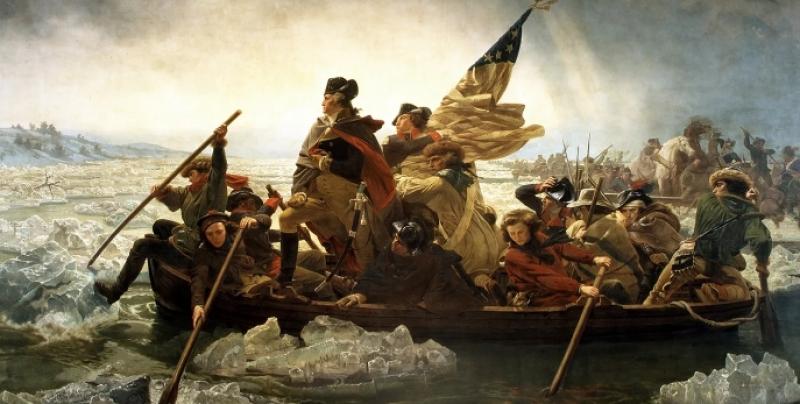
An acceptably heroic George Washington crosses the Delaware.
The war began in Trump’s first administration. Aside from American historians, few people noticed. For a good reason.
In September, 2020, Trump issued an executive order creating a “1776 Committee” to promote American history and citizenship, or as he put it, “patriotic education.” In another time, from another president, that would have been motherhood and apple pie, not controversial in the least.
But 2020 was arguably the high-water mark of “woke” identity politics. And Trump’s executive order made it clear the purpose of the 1776 Committee was to do battle in that culture war. Even its name was an attack. The year before, The New York Times had launched its “1619 Project,” whose name marked the year the first African slaves were brought to the United States. Slavery was so central in the story of America, suggested project leader Nikole Hannah Jones, that 1619, not 1776, could be considered the year America was founded. The “1776 Committee” was a riposte to that.
After an opening with the standard talk of noble ideals laid down by America’s founders, the executive order said this:
Against this history, in recent years, a series of polemics grounded in poor scholarship has vilified our Founders and our founding. Despite the virtues and accomplishments of this Nation, many students are now taught in school to hate their own country, and to believe that the men and women who built it were not heroes, but rather villains. This radicalized view of American history lacks perspective, twists motives, ignores or distorts facts, and magnifies flaws, resulting in the truth being concealed and history disfigured.
“Heroes and villains.” That’s the key phrase.
Binary thinking is central to Trump’s whole war on history — from the executive order, to the report it spawned, to the steps Trump is taking now. In the Trumpian view of American history, there have always and only been two sides and a bright line running between the two.
On one side are heroes who are inspired by timeless American principles to build American greatness. On the other, villains who reject those principles and hate America. This binary continues today, as American heroes like Trump and company battle anti-American “woke” leftists. As Trump said at a press conference announcing his executive order in September, 2020, “the left-wing rioting and mayhem are the direct results of decades of left-wing indoctrination in our schools.”
This framing is worse than crude. It is juvenile. Any serious historian would sooner swallow hemlock than accept this frame and pick a side.
But even saying that is misleading. This really isn’t history at all. It is, to borrow a phrase from Clausewitz, politics by other means.
The creation of the 1776 Committee was a transparent attempt to stoke the already red-hot culture war, and it followed an even more transparent attempt a few months earlier, on July 4, 2020, when Trump issued another executive order stating “the chronicles of our history show that America is a land of heroes” so he would create a “National Garden of American Heroes” to “reflect the awesome splendor of our country’s timeless exceptionalism.”
At a time when the removal of statues was a burning issue, Trump said he would not only erect a statue or two of his own, he would create an immense park filled with two-hundred fifty statues. The list of those to be honoured — everyone from Founding Fathers to generals, celebrities, and pop stars — read as if it had been assembled one night by junior staffers quaffing beer, which would explain puzzling choices like including George Patton while excluding Dwight Eisenhower. No matter. The point was that crazy leftists were tearing down statues and heroes so Trump was for statues and heroes.
These provocations failed to provoke. Trump lost the election.
But on January 5th, 2021 — two weeks before Trump had to leave office — he took time out from his “stop the steal” campaign to appoint the members of his 1776 Commission. There were no professional historians on the list of 14 members. (Victor Davis Hanson is a historian of sorts, but he’s far better known as a political polemicist.) Academics on the panel were ultra-conservative political scientists from small, ultra-conservative colleges. Other members were lawyers, radical political activists like Charlie Kirk, and Republican politicians.
The January 6th insurrection erupted the next day. Leading Republicans all turned against the president and it seemed Trump’s political career was finished. The only question was whether Congress or a criminal court would mete out his punishment.
In that mad atmosphere, the 1776 Committee raced ahead and delivered a short report on January 18th, two days before Joe Biden was sworn in. It seemed to be the deadest of dead letters. It was widely ignored.
But historians took note. And they were stunned.
The report called for history that is “accurate, honest, unifying, inspiring and ennobling,” on the apparent assumption that the whole vast, complex American story, if it is “accurate and honest,” will be always be “unifying, inspiring, and ennobling.” It then proceeded to deliver a quick sketch of two-and-a-half centuries of American history that demonstrated this supposed truth.
The principles of the Founding Fathers are unerring and eternal, the report states as fact and at length, and all of American history should be understood as the unfolding of those principles. A single to-be-sure sentence acknowledges that “the American story has its share of missteps, errors, contradictions, and wrongs” — none cited — but it quickly adds that “these wrongs have always met resistance from the clear principles of the nation, and therefore our history is far more one of self-sacrifice, courage, and nobility.”
In the commission’s learned view, all of American history can be summed up as the “heroes” who sided with American principles and built American greatness while fighting and defeating — real Americans never lose — the “villains” who opposed them. One might think the Confederates would be included in the latter category, but the Civil War is mostly ignored. Instead, the report identifies a series of villainous movements that heroic Americans struggled against.
The first is slavery, which is portrayed as an institution somehow thrust upon Founding Fathers, who were, we are assured, either fierce abolitionists or at least abolitionist in sentiment. Why the large majority of the signers of the Declaration of Independence owned slaves, or why some of these freedom-loving abolitionists personally owned hundreds of slaves, is not explained.
The next odious doctrine is the Progressive movement, the late 19th- and early-20th century reform movement that ended child labour and created regulations like the Pure Food and Drugs Act. It doesn’t mention child labour and the like, however. Instead, it says Progressivism abandoned individual rights for group rights and created an undemocratic, permanent administrative state. Which heroic Americans have fought ever since.
That’s followed by fascism and communism, two more leftist movements, in the committee’s view, that denigrated individual rights.
However distorted this scheme is as history, it has the virtue of arranging two-and-a-half centuries of complex history into a pleasing morality tale so simple even children can grasp it. And it leads to a pleasing conclusion at a time when conservative spirits were low: In battling against the forces of woke leftists spreading mayhem in the classrooms and streets, Donald Trump and the 1776 Committee are the latest generation of American heroes defending Americanism against the latest generation of anti-American villains.
“We are united by the glory of our history,” the report concludes.
You can get the gist of historians’ reactions to the report from the following headline, which appeared in the Washington Post.
Ironically, if we swap a single word — read “hides” in place of “magnifies” — a sentence from the executive order that created the committee neatly sums up the report it produced: “This radicalized view of American history lacks perspective, twists motives, ignores or distorts facts, and magnifies flaws, resulting in the truth being concealed and history disfigured.”
Princeton historian Sean Wilentz, who was one of the leading critics of the 1619 Project, fiercely condemned the 1776 Report. “It reduces history to hero worship,” he told the Washington Post. “It’s the flip side of the polemics, presented as history, that charge the nation was founded as a slavocracy, and that slavery and white supremacy are the essential themes of American history. It’s basically a political document, not history.”
I think that sums it up perfectly. In fact, I wrote a short piece in 2022 about how both the far left and the far right promote cartoons in place of American history — and their cartoons are mirror images of each other.
But that’s where the similarities between the extreme left and the extreme right end. Since 2021, the political fortunes and cultural prominence of the extreme left have ebbed so rapidly that the polemics of the likes of Nikole Hannah Jones already feel like relics of another era. But the extreme right has been on a tear, with an unleashed Donald Trump restored to the presidency, an administration filled exclusively with lunatics and sycophants, and the Republican Congress as mindlessly obedient to the leader as the SA after the Night of the Long Knives.
Naturally, Trump has not only renewed the war on history in his second term, he has expanded it. On March 27th, he issued a new executive order with the subtle and nuanced title of “Restoring Truth and Sanity to American History.”
“Over the past decade,” it explains, “Americans have witnessed a concerted and widespread effort to rewrite our Nation’s history, replacing objective facts with a distorted narrative driven by ideology rather than truth. Under this historical revision, our Nation’s unparalleled legacy of advancing liberty, individual rights, and human happiness is reconstructed as inherently racist, sexist, oppressive or otherwise irredeemably flawed.”
So what does sweeping away this extremist ideology and replacing it with truth mean in practice? Tales of heroes defeating villains. And no more talking about racism, sexism, bigotry, or other ugliness unsuitable for a Fourth of July parade.
Do I exaggerate? Consider the following passage discussing the Smithsonian Institution, a cluster of globally revered museums in Washington DC:
Once widely respected as a symbol of American excellence and a global icon of cultural achievement, the Smithsonian Institution has, in recent years, come under the influence of divisive, race-centred ideology. This shift has promoted narratives that portray American and Western values as inherently harmful and oppressive. For example, the Smithsonian American Art Museum today features “The Shape of Power: Stories of Race and American Sculpture,” an exhibit representing that “[s]ocieties including the United States have used race to establish and maintain systems of power, privilege, and disenfranchisement.”
The statement “societies including the United States have used race to establish and maintain systems of power, privilege, and disenfranchisement” is not edgy wokeism. It is a simple fact. I’m confident any serious historian working in a relevant field would agree. Indeed, it can reasonably be described as a truism.
But it is not a congenial fact in the Trumpian view — which makes it an outrageous lie told by villains.
It is the policy of my Administration to restore Federal sites dedicated to history, including parks and museums, to solemn and uplifting public monuments that remind Americans of our extraordinary heritage, consisting progress toward becoming a more perfect Union, and unmatched record of advancing liberty, prosperity, and human flourishing. Museums in our Nation’s capital should be places where individuals go to learn — not to be subjected to ideological indoctrination or divisive narratives that distort our history.
To advance this policy, we will restore the Smithsonian Institution to its rightful place as a symbol of inspiration and American greatness — igniting the imagination of young minds, honoring the richness of American history and innovation, and instilling pride in the hearts of all Americans.
Under the heading “Saving Our Smithsonian,” the order directs officials to “remove improper ideology” and “prohibit expenditure on exhibits or programs that degrade shared American values, divide Americans based on race, or promote programs or ideologies inconsistent with Federal law and policy.”
In reference to parks, the order goes on to order officials to “remove improper ideology,” restore statues or other monuments previously removed, and ensure that texts around statues and other monuments contain nothing that “inappropriately disparage[s] Americans past or living… and instead focus on the greatness of the achievements and progress of the American people, or, with respect to natural features, the beauty, abundance, and grandeur of the American landscape.”
In plain language, Trump has ordered that all the nasty bits of American history be removed, while inspiring tales of heroes will get the full Disney treatment. At least, that’s how I interpret it. The White House itself summed up, when asked by The New York Times, that “President Trump is ensuring that we are celebrating true American history and ingenuity instead of corrupting it in the name of left-wing ideology.” Note the “celebrating.” In Trump’s view, American history should make Americans feel good.
The president does not control the Smithsonian directly. But he can fire and hire those who do. And the executive order directs Vice President J.D. Vance, who sits on the Smithsonian board, to cleanse the museums. Presumably, the superb scholars who run the Smithsonian now will have to choose between submitting sufficiently to earn Vance’s approval or resign and be replaced by MAGA podcasters, perhaps, or Fox News hosts.
And it won’t end with the Smithsonian. The Trump administration’s astonishing assaults on private universities — Columbia largely surrendered, Harvard has dug in for a fight — include attempts to control what is taught in classrooms and who is doing the teaching. History departments haven’t yet been singled out but if the administration gets the upper hand, it’s surely only a matter of time before the pressure starts. Grants for a conference on the history of Jim Crow? Unacceptably woke. A research program on the Wilmington massacre, genocide in California, or the Red Scare of 1919? Too divisive. Things may never get to that point, but there can’t be any doubt that the president would quite like them to.
One of the oddest indications of how the administration will pursue its historical rewrites came shortly after Pete Hegseth, Fox News weekend host, was installed as Secretary of Defense. Like all Trumpians, Hegseth opposed the removal of any honours for Confederates. In particular, he was angered when the Biden administration renamed Fort Bragg, one of the biggest military bases in the world, “Fort Liberty.” Biden made the switch because Fort Bragg had been named in honour of General Braxton Bragg, a Confederate general best known for losing a string of battles. So one of Hegseth’s first acts as Secretary of Defense was to switch the name back to “Fort Bragg.” But perhaps sensing that swapping “Liberty” for “Slavocracy” wasn’t a good look, Hegseth had officials comb the archives for another soldier named Bragg who won medals. They found one. So today Fort Bragg officially honours not Confederate General Braxton Bragg but Private Roland Bragg, a paratrooper who fought in the Battle of the Bulge.
This is what passes for deft handling in the Trump administration.
Confederate Gen. Braxton Bragg, for whom Fort Bragg is definitely not named.
In 1986 the legendary historian William H. McNeill published a fascinating and provocative essay about the work of historians and how it is used by groups. It was entitled “Mythistory, or Truth, Myth, History, and Historians.”
Collective memory is essential for any group, McNeill notes, and collective memory requires shared stories from the past. Stories that inspire. Stories that inform. Stories that warn. These “myths” shape and guide the group, making it stronger in the face of adversity. McNeill cites the example of Britain in 1940, when Winston Churchill appealed to old stories of the indomitable British spirit to strengthen the nation’s resolve.
Inevitably, a certain self-flattery is embedded in these stories. “Belief in the virtue and righteousness of one’s cause is a necessary sort of self-delusion for human beings, singly and collectively,” he writes. “A corrosive version of history that emphasizes all the recurrent discrepancies between ideal and reality in a given group’s behaviour makes it harder for members of the group to act cohesively and in good conscience. That sort of history is very costly indeed. No group can afford it long.”
This is a criticism of the relentlessly negative history of the sort that Howard Zinn pioneered not many years before McNeill wrote his essay, as well as “woke” historians of more recent vintage. But McNeill is quick to criticize the opposite extreme as well. Cut out the darkness from a group’s history and one may conclude the group is always virtuous — so there’s no need for self-criticism, say, or to beware pride becoming arrogance, and arrogance becoming folly and injustice.
No matter how scrupulous historians may be, McNeill writes, no matter how determined they are to stick with provable facts and not wander into the realm of fiction, they cannot divorce themselves from group identities. Their work inevitably entwines with the group’s storytelling.
“As members of society and sharers in the historical process,” McNeill concludes, “historians can only expect to be heard if they say what the people around them want to hear — in some degree. They can only be useful if they also tell the people some things they are reluctant to hear — in some degree. Piloting between this Scylla and Charybdis is the art of the serious historian, helping the group he or she addresses and celebrates to survive and prosper in a treacherous and changing world by knowing more about itself and others.”
This “piloting” is best described as a fusion of myth — the useful tales the group tells — and the rigorous, evidence-based interrogation that is modern historical scholarship. McNeill calls this fusion “mythistory.”
I can think of no better illustration of “mythistory” than the Smithsonian Institution, or at least the Smithsonian before Donald Trump got his hands on it: A fealty to facts and preservation of artifacts, no matter how uncomfortable; an awareness that its work contributes to the collective memory which shapes and guides the nation; an insistence on telling both the positive, inspiring stories that invite pride alongside the darker stories that call for reflection. That’s the Smithsonian.
This moderate, thoughtful, and constructive approach also happens to be supported by the great majority of Americans.
In December, 2022, the research group called “More In Common” released a report entitled Defusing the History Wars: Finding Common Ground in Teaching America’s National Story. “America is embroiled in a culture war over whether we should see our national history as a source of pride or a source of shame,” the report begins.
Note the binary again: Pride or shame.
Heroes or villains.
The 1776 Report or the 1619 Project.
Donald Trump and his garden of statues or Nikole Hannah-Jones and slavery as the leitmotif of America.
This is how the debate is routinely framed, even in news reports. And given the polarization of American society, that may seem reasonable.
But in a 2019 report, “More In Common” found that when questions were not framed as binary choices, and the views of American were examined with more nuance, the apparent bifurcation of American society dissolves. Breaking Americans down into seven clusters of opinion showed that a mere eight percent of Americans fell into the most progressive category on the far left (which they called “Progressive Activists”) and six percent were in the most conservative category on the far right (“Devoted Conservatives”). But these extremes dominate social media and other public debate. As a result, Democrats tend to think average Republicans are far more radical than they are while Republicans misperceive Democrats the same say.
The 2022 report brought that testing method to bear on what Americans think about American history.
“We found that for the vast majority of Americas, the differences in how we perceive and want our national story taught are far narrower than a few high-profile polemics might suggest,” the report concluded. “We found that a majority of Americans across political affiliations agree on fundamental ideas about our national history and how it should be taught…. A clear majority of Americans wants American history to be taught in ways that include both the inspiring and the shameful; that highlights the histories of minority groups alongside history that elevates a shared American identity; and that allows students to learn from eh past without feeling guilt or disempowered by the actions of prior generations.”
Most Americans see no binary choice, no either/or. They stand in the middle. And they want American history that spans the spectrum of American experience — as the Smithsonian delivered it before the second Trump administration.
Unfortunately most Americans do not know most Americans are so moderate and reasonable.
The perception gap identified in the first report — each side thinks the other is more extreme than it really is — appeared again in the report about history.
These two charts say it all.
Donald Trump may be the president but his views on history represent only a very small, extreme faction of Americans.
The same is true for those at the opposite end of the spectrum who see little more than a relentless tale of racism and oppression in American history.
Both extremes in the culture war represent only tiny minorities of Americans.
But they are loud out of all proportion to their numbers. And in Donald Trump’s case, powerful.
That could be tragic.
Tags
Who is online

126 visitors
The people who support the 1619 movement complaining about this. They have no shame.
Well done sir.
You get today's Edward R Murrow award.
History is written by the winner.
We'll have to wait for Xi to write it.
I think historians cannot avoid writing about the Biden years. That is the vindication for anything Trump does.
istory departments haven’t yet been singled out but if the administration gets the upper hand, it’s surely only a matter of time before the pressure sta
History departments are among the most uniformly left wing of any in academia. THe idea they are in some sort of danger of turned into right wing propaganda mills is hilarious. The left wing has exercised such total domination of the academia that even the suggestion of some balance causes mass hysteria in their bubble.
Were you taught about the existence of the Tulsa Race Massacre when you were in school? It wasnt mentioned when I was in grammar school or high school US history classes. These are the reasons we needed "black history". And there are a lot of them.
Trumps 1776 commission would reduce US history to a parade of folk heroes like Paul Bunyan and Washington throwing a coin across the Potomac River and the daring escapades of Stonewall Jackson. That is the Trump level of understanding. Those and William McKinley's tariffs.
I don't know John. I don't know specifically if Tulsa was covered, or the Chicago race riot. I do know that the country's instability after WWI was focused on, from race riots, the Wall Street Bombing, labor violence and the red scare. I cannot say for sure whether one incident from that era received much coverage, particularly because I do recall the teacher hurrying through the 20th century to try and get through WWII before the year ended.
A commission wasnt established 75 years after the fact out of the goodness of the red state's heart. It was established because the state was forced into embarrassment.
So what?
What is your obsessive focus on one race riot? What did the Tulsa race riot change? If it didn't happen, how would America be different? I get it was incredibly traumatic for the families involved but its actual impact on American history is relatively limited. It's essentially local history. A high school class tries to cover 500 plus years. Somethings don't get much attention.
One of my good friend's grandfathers was murdered in the 1919 Chicago race riot. He was sitting on the street eating lunch during his break and two teens came up and shot him. Obviously very traumatic for his family and altered their lives. But do people in Tacoma need to to be taught the ins and outs of a Chicago race riot that killed more people than the one in Tulsa? Is it a particularly determinative moment in American history? Not really. It's importance on a national scale is as one terrible event among many in an era of tremendous social upheaval with levels of violence we are not accustomed to today.
How did the Chicago race riot start ?
The riot began after a Black teenager was killed for swimming in a white-only area, leading to days of violence that resulted in 38 deaths (23 Black and 15 white) and over 500 injuries .
So what?
Does that make it something students in tacoma need to learn about when trying to learn 500 years of american history in a year? Not everything can be studied in depth in a survey course.
I haven't read a history of the Spanish Civil War written during the regime of Francisco Franco... but I wouldn't bet on unbiased coverage.
Prior to the turn of the 21st century I havent heard of any school or grammar or high school course that even mentioned it.
The Tulsa incident had a significance that the Chicago riot did not have , the blacks in Tulsa were attacked and burned out precisely because they had created a successful community of entrepreneurs and professionals.
Until just the last couple of decades students in some states were being taught that the Civil War wasnt fought over slavery, but rather because of a legitimate dispute about states rights, and also taught that most slaves were happy because they were being housed and fed.
Trumps "history" would be along those lines.
no, the riots started when armed groups of blacks and whites confronted each other over rumors that a black man would be lynched over an attempted assault of a white teenager. Gunfire was exchanged between the two groups and violence spread out throughout the city.
Looking further into it, that actually seems to be a bit of historical mythologizing that's grown up in the last few decades. Durham NC, at the time, was known as the "black Wall street" and Atlanta also called part of it's city that. In contrast, per the 1972 Journal of Black studies,
And let us not forget Detroit in 1967, all over a raid on an illegal bar being raided by LEO's. We are talking big time.
And, further down the road, we have the LA riots of 1992. Even worse. As they outdid the Detroit one.
.
Where is the outrage over these two? I think I know the difference. Let's see who else may.
Do you know anything, at all , about why a civil rights movement was necessary? It seems like all you want to do is find a false equivalency between centuries of prejudice against people of color and a handful of incidents that were a reaction to that prejudice.
Like you did with the Tulsa thing?
You are out of your depth.
Jim - 1 JR - 0
"Were you taught about the existence of the Tulsa Race Massacre when you were in school? It wasnt mentioned when I was in grammar school or high school US history classes."
I didn't learn about it either. what would be the value in that?
The only reason to teach them is to stir up feelings of resentment and victimhood among Blacks
Wow.
I suppose teaching about WWII would only stir up resentment against Germans, Italians, and Japanese, too.
Shhhh! You can't try and bring reason and logic to a debate with a rightwing conservative Trump supporter. I mean you can but it will just go unappreciated and ignored by those on the right. White conservative Christians don't believe they've ever done anything wrong, ever. They believe themselves on the right side of history in every case, from the civil war to civil rights, so confronting them with where their ancestors actually stood would apparently just "stir up feelings of resentment". I mean what racist likes to be reminded they're racist? It's like telling someone with BO that they stink. They're clearly already nose blind, and while they should be embarrassed if you point it out in public, MAGAites just lift an arm with a crazy grin on their face and then aggressively sniff their underarm finishing with a euphoric sigh of pleasure as if they just smelled divinity. They wallow in their ignorance, they don't want to be reminded of history, they don't want their or their ancestors past exposed.
It is pretty funny though that here we have a conservative making the case that remembering the unpleasant history of white Americans massacring black Americans has no value, and yet has likely defended confederate monuments saying they should stay up even though they celebrate slave owners and racists because we shouldn't forget history.