
How Trump and Corporations Manufacture ‘Pseudo-Realities’



 S E E D E D C O N T E N T
How Trump and Corporations Manufacture ‘Pseudo-Realities’
Boorstin’s ‘Pseudo-events’
In her 2024 book Invisible Rulers: The People Who Turn Lies Into Reality , Georgetown University professor Renée DiResta discusses what the late historian Daniel J. Boorstin called “pseudo-events”: events manufactured specifically for the purpose of generating media coverage. Like a news conference that announces the formation of a task force that will produce a non-binding report, pseudo-events have no significance in and of themselves; they exist to create the illusion of significance.
Once a pseudo-event has been hallucinated into existence — such as an announcement in a news release or, these days, a mention in an Instagram influencer’s story — its significance cascades outward as more news outlets and social media influencers and online scrollers report on it and cite it and share it. This “narrative laundering,” as DiResta calls it, helps transform a pseudo-event into reality — or, at least, pseudo-reality .
“Once a pseudo-event has been hallucinated into existence — such as an announcement in a news release or, these days, a mention in an Instagram influencer’s story — its significance cascades outward as more news outlets and social media influencers and online scrollers report on it and cite it and share it.”
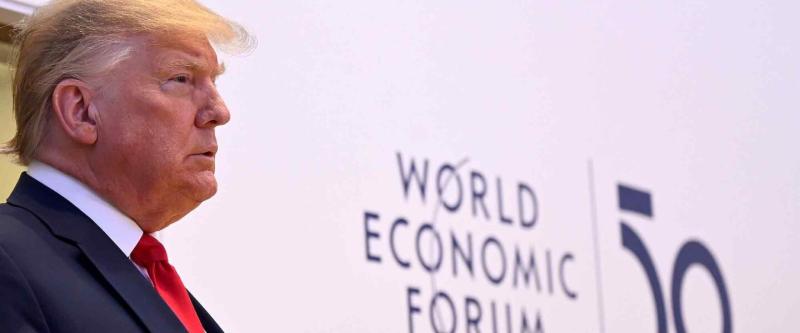
The WEF and its corporate members are master crafters of pseudo-events. Indeed, the gatherings of the WEF high in the Swiss Alps, or at June’s “ Summer Davos ” in Tianjin, China, are themselves pseudo-events.
They attract legions of wealthy and powerful people, alongside their PR teams and journalists. From behind closed doors emerge plenty of headlines and pledges, endless content and commitments — but no new laws, no binding emissions reductions, no new taxes to help pay for the climate adaptation that “the future of our planet depends on.” And, crucially, their high-profile pronouncements and publications can say whatever they deem most helpful for them to say in that moment.
Out of nothing emerges a pseudo-reality that portrays corporations as they wish to be seen. And in this alternate reality, the real world — in which companies operate as they always have, capitalizing on the sociopathic imperatives of capitalism — is mostly irrelevant.
Trump, Tariffs, and Pseudo-Realities
Of course, what validated, to some extent, the disbelief of the executives and Wall Street analysts on “Liberation Day” is the fact that Trump is a serial fabricator. Over the past decade, no one has been more successful than this president of the United States in spinning up and cashing in on pseudo-realities largely untethered from what he is actually doing.
Shamelessly promising whatever is convenient in the moment, with no intention of following through; profiting off the manipulation of supporters while condescending to them; acquiring power by constructing an alternative narrative of how the world is ; performing that pseudo-reality into existence by repeating it over and over again: This is the Trump playbook. But it is also the corporate playbook.
.....Despite their initial shock, companies quickly found that there was value in the tariff narrative. Reports are already documenting executives explaining how the expectation of tariff-driven price increases provided an ideal cover for increasing prices — even on products not impacted by tariffs.
In April, asked on CNBC whether corporations were “raising their prices…just because they can,” one oil executive responded, “Exactly. Yes. … It gives them room to move prices up,” as The Lever ’s Luke Goldstein noted .
Whether price-gouging under the cover of tariffs , or offering tired-but-effective national security justifications for doubling down on fossil fuels, predicting something and then using your prediction to justify what you already wanted and/or planned to do is a key two-step in what LSE’s Edwards called “organized lying.”
Only in an alternative reality could the PR and influence industry, whose business model includes laundering the reputations of autocrats and creating astroturf front groups to generate the illusion of broad public support, be seen as an authority on public trust. Yet it seems not to matter whether the pseudo-realities they manufacture are genuinely believable — only that they are just believable enough to serve a purpose.
And that purpose is often as simple as preventing the coherence of an alternative narrative, like the fact that corporate profiteering, which rose during the COVID-19 crisis, is exacerbating tariff consequences for consumers. Or that the fossil fuel industry is (still) exploiting public anxieties to preserve its lucrative business model as long as possible, as Amy Westervelt discussed recently for Drilled .
Were narratives like these to cohere, they might generate broad public enthusiasm for new taxes or regulations or consumer protections or unions or even popular movements. As long as a pseudo-reality prevents the truth from cohering, it serves its purpose.
In Invisible Rulers , DiResta notes a consequence of living in a world of pseudo-realities, one in which it becomes difficult for ordinary people to be certain about what is true and what is not (which is also a defining characteristic of authoritarian propaganda states).
“People are simply overwhelmed,” DiResta writes. “The world feels unimaginably complex, and millions believe that they are being manipulated — they’re just not sure by whom and to what end.”
Those millions are often correct.
Tags
Who is online
248 visitors
It may take months, but prices will most certainly rise and the average consumer will, as always, bear the brunt. Food, energy, transportation, medical care, housing…all essentials will become more expensive under the draconian policies spewed by this administration.
Alternate Facts?