Washington Post: Trump orders National Gallery of Art to remove photo of slave with scarred back
CNN Newsource staff 1-1 minutes 9/16/2025
(CNN) – President Donald Trump has ordered the removal of information on slavery from national parks, according to The Washington Post .
The Post cited four people familiar with the matter.
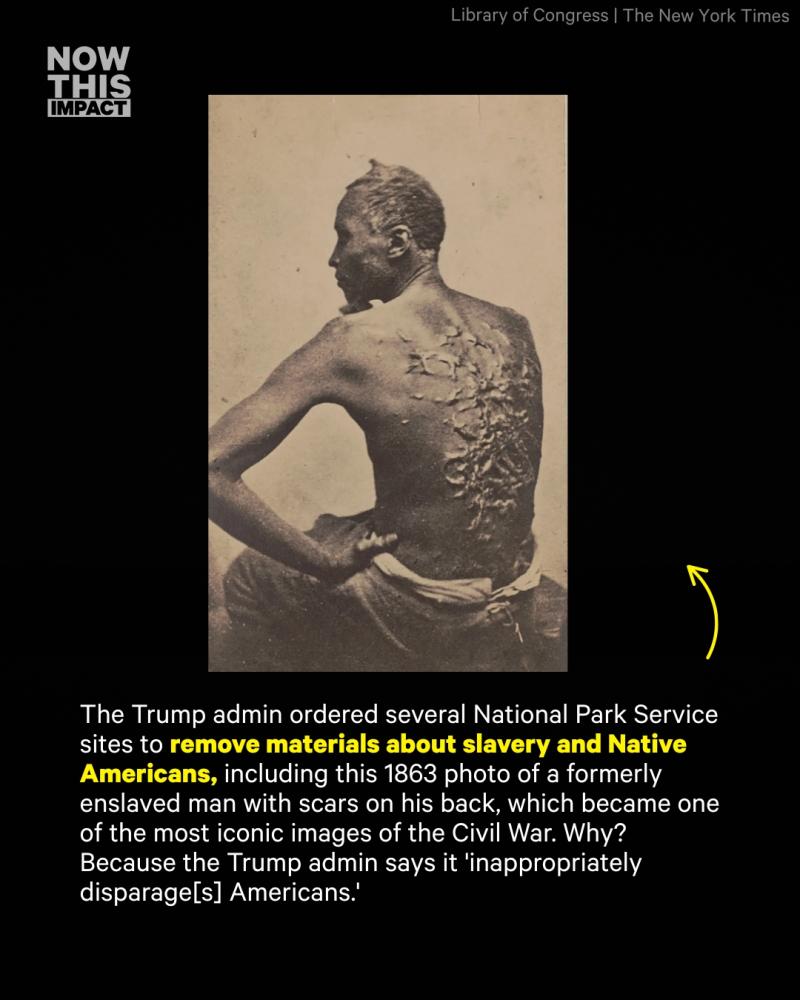
A historic photograph at Washington’s National Gallery of Art is one item that will be removed.
The photograph is called “The Scourged Back.” It shows a formerly enslaved man named Peter Gordon in 1863.
Gordon’s back is to the camera that took the photo, showing heavy scarring from slave masters cruelly punishing him with whips.
When it was taken, the photo spread quickly in the Northern United States, shocking the people there.
According to The Post, removing information on slavery is an effort to scrub national parks of what the Trump administration calls “corrosive ideology.”
The White House’s efforts to recast the focus of the Smithsonian – with its 21 museums and National Zoo -– reflect Trump’s opposition to what he described in a March executive order as a “revisionist movement seeks to undermine the remarkable achievements of the United States.”
“Under this historical revision, our Nation’s unparalleled legacy of advancing liberty, individual rights, and human happiness is reconstructed as inherently racist, sexist, oppressive, or otherwise irredeemably flawed,” states the order titled, “Restoring Truth and Sanity to American History.”
Minimizing parts of history deemed “bad,” however, does a disservice to America’s central underdog narrative and lessens national-level achievements, experts warned.
“It’s just not the same story without the backdrop,” said Stevenson, executive director of the nonprofit Equal Justice Initiative, which runs The Legacy Museum, The National Memorial for Peace and Justice and Freedom Monument Sculpture Park that address the US history of slavery, lynching and racial segregation.
Stevenson points to exhibits at the Smithsonian’s National Museum of African American History and Culture that focus on the accomplishments of NBA legend Michael Jordan and “King of Pop” Michael Jackson, as well as the extraordinary achievements of former President Barack Obama and other African Americans who reached the pinnacles of success in business, politics, sports and entertainment.
Similar figures – from Revolutionary era hero Crispus Attucks to flight trailblazer Amelia Earhart – would be honored in a “National Garden of American Heroes” Trump has championed.
“But you won’t appreciate the success of the Tuskegee Airmen, the Navajo Code Breakers or other people of color who’ve done great things if you don’t understand the burdens and the barriers and the obstacles they had to overcome,” Stevenson said.
“We all like stories about people who suffer injuries but recover and go on and achieve great things, people who fall down but get back up,” he went on. “But you don’t skip the part about how they were unfairly targeted, unfairly injured, unfairly held back. You have to emphasize that to appreciate their achievement.”
US standing in the world is at risk
Key in the Trump administration’s review of the Smithsonian is the notion that deep historical rifts continue to impact the country in a negative way, the White House aide leading the process told Fox News last month.
“There’s a lot of history to our country – both positive and negative – but we need to keep moving forward,” Lindsey Halligan said . “We can’t just keep focusing on the negative. All it does is divide us.”
But minimizing difficult or harmful parts of the nation’s history could pose a broader potential consequence of “diminishing our stature as a nation on the international stage,” said John Chrastka, executive director of EveryLibrary, a nonpartisan organization working toward “sustaining libraries as they evolve and grow in the 21st century.”
Most countries have history that is difficult, he said. Owning it, especially alongside steps to try to make up for systemic injustice, has become a global mark of distinction from the Netherlands to Japan to Australia .
“I don’t think that we can be a country that’s world-class,” Chrastka said, “I don’t think we can be a nation that’s mature, I don’t think we can be a nation that leads amongst other nations, if we bury our own truths.”
People also need to understand the fulsome truth to make informed decisions on a range of issues affecting daily life, Stevenson said.
“No one goes to the doctor and tells their doctor, ‘If I have high blood pressure, if I have diabetes – don’t tell me! I forbid you from telling me! I don’t want to know about it!’ Because that’s a recipe for poor health, for early death,” Stevenson explained. “The way we get better, the way we stay healthy, is by learning the truth about our history, about our health, about our society, about what’s a threat, what’s not a threat, and then confronting it and then overcoming it.”
Taking a position that facets of US history weren’t “‘that bad,’ even though it’s empirically proven to be ‘that bad’ … really makes it much more difficult for us to have honest conversations with each other as neighbors,” Chrastka added.


 S E E D E D C O N T E N T


www.wect.com /2025/09/16/washington-post-trump-orders-national-gallery-art-remove-photo-slave-with-scarred-back/
Washington Post: Trump orders National Gallery of Art to remove photo of slave with scarred back
CNN Newsource staff 1-1 minutes 9/16/2025
(CNN) – President Donald Trump has ordered the removal of information on slavery from national parks, according to The Washington Post .
The Post cited four people familiar with the matter.
A historic photograph at Washington’s National Gallery of Art is one item that will be removed.
The photograph is called “The Scourged Back.” It shows a formerly enslaved man named Peter Gordon in 1863.
Gordon’s back is to the camera that took the photo, showing heavy scarring from slave masters cruelly punishing him with whips.
When it was taken, the photo spread quickly in the Northern United States, shocking the people there.
According to The Post, removing information on slavery is an effort to scrub national parks of what the Trump administration calls “corrosive ideology.”
It will be replaced with a new gold statue of Donald Trump shaking hands with Robert E Lee and Nathan Bedford Forrest.
now that's funny
The whitewashing continues…on every issue and in blatant disregard for the lessons learned and in hopes of not repeating the mistakes made.
While I don't agree with taking the statues down i don't agree with taking the pictures down either.
I don't think we should ignore our history