
Cavalry Soldiers Who Massacred Hundreds at Wounded Knee Get to Keep Their Medals of Honor

By: Senators Elizabeth Warren (Native News Online via Yahoo News)

 S E E D E D C O N T E N T
Department of War
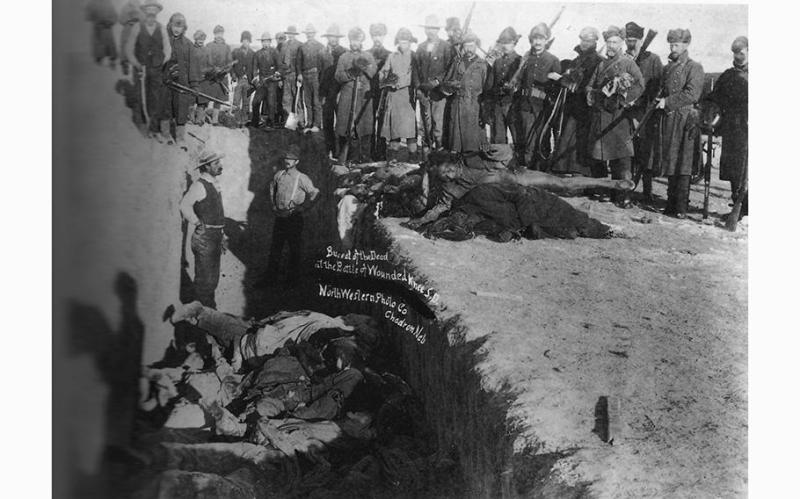
Pete Hegseth used social media on Thursday night to announce that U.S. 7th Cavalry soldiers who massacred hundreds of innocent Lakota during the 1890 Wounded Knee Massacre will retain their Medals of Honor. The Medal of Honor, which is the highest award of valor presented to military service members, was given to 20 soldiers.
These medals were given despite the fact that the incident involved the killing of at least 250-300 Lakota people, the majority of whom were women, children, and elders.
"Under my direction, we're making it clear, without hesitation, that the soldiers who fought in the Battle of Wounded Knee in 1890 will keep their medals, and we're making it clear that they deserve those medals," Hegseth said in a video posted on the social platform X.
In July 2024, then-Defense Secretary Lloyd Austin had established a five-member panel to reassess the commendations awarded to troops for their actions at Wounded Knee.
The Biden administration stated that the panel would evaluate each medal recipient's service and records individually to ensure that "no soldier was recognized for conduct that did not merit recognition under the standards applicable at the time."
Hegseth did not release the findings of the panel during Thursday's social media announcement.
"We are not surprised, but disheartened that Secretary Hegseth has decided to follow former Defense Secretary Austin's footsteps and follow recommendations by what I believe to be a panel that was established to ensure a specific outcome," O.J. Semans, Sr. (Rosebud Sioux), co-founder and co-executive director of Four Directions, Inc., told Native News Online on Thursday evening.
The violence began when the U.S. Cavalry attempted to confiscate weapons from those taken into custody; a shot was fired, prompting troops to open fire and kill at least 250 Lakota men, women, and children. Around 25 U.S. soldiers also died, likely as a result of friendly fire.
For several years, Native organizations have urged Congress to pass the Remove the Stain Act that would rescind the Medal of Honor to those awarded for their violent deeds at Wounded Knee.
In May 20205, Remove the Stain Act of 2025 was reintroduced by Senators Elizabeth Warren (D-MA) and Jeff Merkley (D-OR), along with Representative Jill Tokuda (D-HI),
"We cannot be a country that celebrates and rewards horrifying acts of violence against Native people," Sen. Warren said when the legislation was reintroduced. "Congress must recognize how shameful this massacre was and take an important step toward justice for the Lakota people."
"We must acknowledge our history and take concrete steps to right historic wrongs from America's darkest chapters," said Sen. Merkley. "Moving forward together as a nation demands we remember, reflect on, and work to rectify the abhorrent massacre of hundreds of innocent Lakota men, women, and children at Wounded Knee. This horrific injustice is not deserving of our nation's highest award for military valor, and our long-overdue bill helps finally set the record straight by revoking these medals."
Semans still hopes Congress will pass the legislation.
"We will continue to work with Congress to ensure Americans know the truth," Semans said.
Earlier in the year, Hegseth also directed the restoration and refurbishment of a Confederate memorial at Arlington National Cemetery that had previously been removed.
About the Author: "Levi \"Calm Before the Storm\" Rickert (Prairie Band Potawatomi Nation) is the founder, publisher and editor of Native News Online. Rickert was awarded Best Column 2021 Native Media Award for the print\/online category by the Native American Journalists Association. He serves on the advisory board of the Multicultural Media Correspondents Association. He can be reached at levi@nativenewsonline.net."

Tags
Who is online
149 visitors
In 1890 American Indians were considered "less than", which is part of why these medals were considered appropriate to begin with. Of course American soldiers were brave there, just as soldiers everywhere have been brave in combat incidents that were otherwise dishonorable. The question is not whether these soldiers deserved medals as individuals, but whether the action of the unit was honorable.
apnews.com /article/wounded-knee-hegseth-soldiers-medal-of-honor-0310c47952ad7aeabb176f94d8af4d52
Pete Hegseth says Wounded Knee soldiers to keep Medals of Honor | AP News
Konstantin Toropin 4-5 minutes 9/26/2025
WASHINGTON (AP) — Defense Secretary Pete Hegseth has announced that he has decided that the 19 soldiers who received the Medal of Honor for their actions in 1890 at Wounded Knee will keep their awards in a video posted to social media Thursday evening.
Hegseth’s predecessor, Lloyd Austin, ordered the review of the awards in 2024 after a congressional recommendation in the 2022 defense bill — itself a reflection of efforts by some lawmakers to rescind the awards for those who participated in the bloody massacre on South Dakota’s Pine Ridge Indian Reservation near Wounded Knee Creek.
While the events of that day are sometimes described as a battle, historical records show that the U.S. Army, which was in the midst of a campaign to repress the tribes in the area, killed an estimated 250 Native Americans, including women and children, of the Lakota Sioux tribe, while attempting to disarm Native American fighters who had already surrendered at their camp.
“We’re making it clear that (the soldiers) deserve those medals,” Hegseth said in the video, before adding that “their place in our nation’s history is no longer up for debate.”
After the fighting, Medals of Honor were given to 19 soldiers from the 7th Cavalry Regiment, and their awards cite a range of actions, including bravery, efforts to rescue fellow troops and actions to “dislodge Sioux Indians” who were concealed in a ravine.
The event became a celebrated part of the regiment’s history, with its coat of arms still featuring the head of a Native American chief to “commemorate Indian campaigns,” according to the military’s Institute of Heraldry.
In 1990, Congress apologized to the descendants of those killed at Wounded Knee but did not revoke the medals.
According to Hegseth, the review panel ordered by Austin “concluded that these brave soldiers should, in fact, rightfully keep their medals from actions,” but an official from the defense secretary’s office couldn’t say if the report he was referencing in the video would be made public.
President Donald Trump issued an executive order in March titled “Restoring Truth and Sanity to American History,” which decried efforts to reinterpret American history and, since then, Hegseth has undertaken multiple actions that have subverted the recommendations of a congressionally mandated commission that examined the use of Confederate names and references in the military.
He reverted the names of several Army bases back to their original, Confederate-linked names, though by honoring different figures.
Hegseth also restored a 1914 memorial to the Confederacy that was removed from Arlington National Cemetery. The monument features a classical female figure, crowned with olive leaves, representing the American South, alongside sanitized depictions of slavery.
In September, the U.S. Military Academy at West Point, New York, also confirmed that a painting of Gen. Robert E. Lee dressed in his Confederate uniform was back on display in the school’s library after being removed in 2022. The portrait, which shows a Black man leading Lee’s horse in the background, had been hanging in the library since the 1950s before it was placed in storage.
___
Our government and institutions are retreating from decency as we watch.
Hegseth could have said nothing. If a 2024 committee decided the medals should stay, then that is the conclusion.
Hegseth made a show of it, to display his "warrior ethos" and try and dominate the "woke" people who think that Congressional Medals Of Honor should not have been awarded to soldiers who took part in a massacre.
Hegseth is a bad ass , he doesnt need any stinking empathy for anyone who disagrees with him.
I do not think that he receives that much, anyway
I may have mistaken this for Pete Hegseth's resume
Stripping dead soldiers of their medals is asinine.
I dont think the dead soldiers care too much anymore.
But, Custer still wore his arrow shirt - and he can keep it.
Sadly -supposedly three of the MOH "soldiers" were the camp cooks who remained in the background and did not engage in the hostilities - BUT - the Army decided they were to be given the award due to the extreme emotional/psychological stress they encountered.
So, why did Billy Walkabout not receive the MOH for his activities during his tours in Vietnam
Military records show that Bill Walkabout, a Cherokee, received the Distinguished Service Cross, five Silver Stars, 10 Bronze Stars (including five with valor device), seven Air Medals, 10 Army Commendation Medals (including five with valor device) and six Purple Hearts - the most decorated Native American of the Vietnam "excursion".
He was awarded his Distinguished Service Cross “for his actions in a reconnaissance mission behind enemy lines in November 1968. Under fire for several hours, Sergeant Walkabout was seriously wounded, three members of his 12 strong team were killed at the scene, and one other died later from injuries. The citation for his award notes that he simultaneously returned fire, helped his comrades and boarded injured soldiers onto evacuation helicopters. He spent six months in a coma, recovering and later returned to Vietnam. He retired as a Second Lieutenant.”
Why? According to the chain of command, his actions were according to his ethnicity - he was an Indian and that was his "make-up" (can't find the citation for that statement).
And the "Wounded Knee" recipients? See below. Medal of Honor eligible? Pure Bullshyte.
Recipients