
Chicago's street vendors vanish from corners during ICE surge

By: Laura Rodriguez Presa (Chicago Tribune)

 S E E D E D C O N T E N T

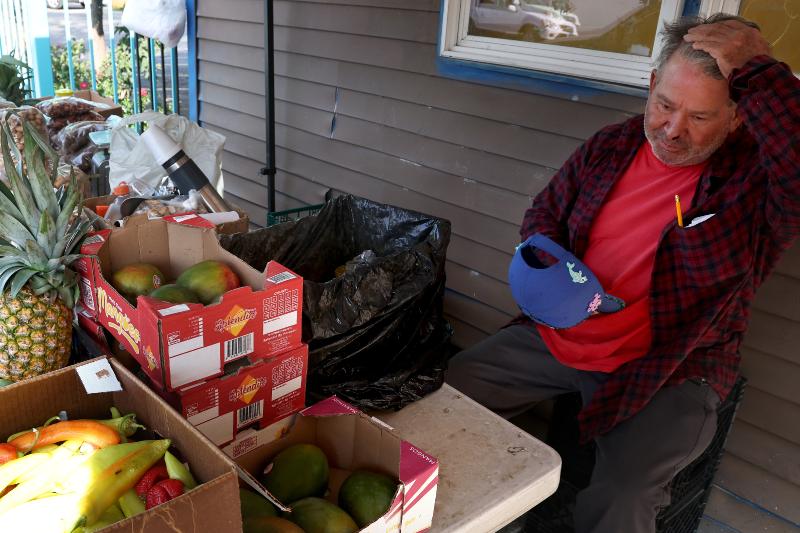
A gentle breeze carried the scent of sweet fruit and earthy vegetables from Rodolfo Espinoza's produce stand on an early Tuesday morning on the Southwest Side of Chicago.
Espinoza and his wife carefully arranged their produce under a blue tarp: bananas nestled among the tomatoes, serrano peppers between the strawberries, avocados stacked next to mangos. The tarp serves as a makeshift shelter that shields their products from the hot sun in the summer and biting wind during winter.
" ¡Buenos dias, pasele, pasele! " Espinoza cheerfully called out to passersby, inviting them to browse his offerings. "Good morning, come in, come in."
A senora , wrapped in a rebozo and wearing an apron, stopped to buy peppers. Most of Espinoza's customers, he said, are familiar faces from the neighborhood.
After his first sale of the day, Espinoza made the sign of the cross. Lately, sales have been slow.
"People don't really go out anymore. They're scared of ICE. We're scared too, but we have no other choice," Espinoza said. "With God's grace, nothing will happen to us."
In the three weeks since President Donald Trump's Department of Homeland Security announced the start of "Operation Midway Blitz," its latest immigration enforcement surge in the Chicago region, street vendors and their customers have vanished from familiar corners across the city. The crowds no longer gathered around the elotero after church, paleteros outside of schools.
Their quiet disappearance marks not just a loss of income, it's also the erosion of a culture cherished by many in the city. Street vendors have long been a vital thread in Chicago's societal and economic fabric, their work revolving around traditional dishes and products that often can't be found anywhere else in the city. They serve fellow immigrants craving a taste of home.
"Close your eyes in the summer and you'll hear children laughing at the park, dogs barking and the familiar bells of the paleteros ," said Chuy Reyes, a Chicago-based photographer who documents the lives of street vendors. "They bring joy and flavor to our city and some of the most beautiful people I've met; that's why I share their stories — so they can be seen and heard. What they do is a dying art, born of love."
Now, their livelihoods, many of them older immigrants who have been in the country for decades, are under even greater threat with the immigration enforcement surge. They've historically been among the city's most vulnerable workers, often facing financial uncertainty, a lack of benefits and danger because of precarious work conditions, such as targets of crime.

A few remain, relying on faith to keep going, such as Espinoza and his wife. But for most, the uncertainty has only deepened after legal protections were rolled back by the Supreme Court earlier this month, allowing federal immigration agents to target individuals based on race, language, or the type of work they do.
Street vendors are especially at risk "because historically most, if not all in Chicago, are Latino immigrants — Mexican to be exact — and speak Spanish," said Dolores Castaneda, a community organizer and researcher.
Data on street vendors remains limited as their transient nature makes them difficult to track. Chicago legalized street vending in 2015, and that same year, a study by the Illinois Policy Institute counted roughly 2,000 street vendors in the city. Today, the Street Vendors Association of Chicago puts the estimate closer to 3,000, said Martin Unzueta, director of Chicago Community and Worker's Rights, who works closely with the association.
For many, becoming a street vendor is pure necessity, and sometimes a sacrifice. They are often without legal documents, have age limitations or face other life circumstances that prevent them from working elsewhere.
But as they tread along, they serve fellow immigrants nostalgic, familiar flavors such as pan artesanal, camotes, gorditas or tepache .

For Rodolfo Alvarez, that taste is tamales .
Alvarez, owner of Alvarez Hardware on 18th Street in Pilsen, has lived in the area for 62 years. Recently, a friend stopped by Alvarez's shop with tamales that he planned to sell at his nearby cafe. They were good, Alvarez said, but "too Americanized."
He feels the same way about the tamales sold at popular Mexican restaurants, who tend to cater to customers who might not be as "spice-tolerant," Alvarez said with a laugh.
"They just aren't spicy enough, they have too little salt or too much — but I love it hot; even my grandkids like spicy," Alvarez said. But the homemade tamales , usually tamales rojos from a nearby street vendor, never fail to satisfy his craving.
"Those are the ones that remind me of home," he said.
Throughout the decades, Alvarez has witnessed changes to the local landscape in Pilsen, the ebb and flow of new development, shifting demographics and cultural conservation.
But nothing has been as drastic as the too-quiet streets on Mexican Independence Day. He's hopeful it's only temporary.
"The street vendors used to always go through the streets shouting what they have … candies or ice cream or popsicles or corn — all the kids will come out, and even grown-ups too," Alvarez said. "Maybe they missed a flavor from their (youth) … that's what we had here, and I think we will keep up with the traditions again."
Streets are nearly empty of vehicles, pedestrians or street vendors along 18th Street near a a CTA train station in Chicago's Pilsen neighborhood, Sept. 17, 2025. (Antonio Perez/Chicago Tribune)

Street vending gained increased popularity among Mexicans in Pilsen and Little Village during the 70s, according to Lilia Fernandez, a history professor at the University of Illinois Chicago. Migration from Mexico continued but as jobs declined at industrial warehouses across the steel mills, railroads, packing houses and stockyards, many Latino communities turned to the informal economy to survive.
In a way, street vendors stepped into an untapped market and are often overlooked as essential contributors to society.
"Immigrant vendors and small business owners often provide goods that aren't readily available in the mainstream market," Fernandez said.
Still, the work is not easy.
Vendors Rodolfo Espinoza and wife, Celia, stock bags of peanuts for sale at their produce stand in Chicago, Sept. 18, 2025. (Antonio Perez/Chicago Tribune)
Take Espinoza. After taking some hard hits in his life, the 60-year-old said there's not much else he can do to make a living. The sidewalk produce stand has sustained him and his wife for six years. He turned to vending after losing his job and falling ill during the pandemic.
"We survived then, and we worked mostly every day out here," Espinoza said smiling. Today, he intends to resist the odds yet again.
But advocates worry that vendors, especially those on the Southwest Side, are being targeted by immigration agents, racially profiling them to meet their quotas.
Vendor Reynaldo Martinez on his bike after selling all his burritos and gorditas, Sept. 9, 2025, in Chicago. (Antonio Perez/Chicago Tribune)
On Sept. 7, U.S. Immigration and Customs Enforcement agents detained a flower peddler with no known criminal record. Concerned bystanders recorded his arrest and the video went viral. He was deported a few days later.
Five days later, images of federal immigration agents arresting two palateros selling popsicles in Mount Prospect circulated on Facebook, garnering hundreds of comments. Many of them said they had bought a popsicle from the vendors a day ago, or that buying from those paleteros had been a long-standing tradition for families in that neighborhood.
"This is very detrimental to Latino people — Mexicans, Hondurans, Guatemalans — everyone is just trying to make a living, to pay rent and buy clothes and food for their children by selling small things," said Obdulia Delgado, a well-known community member who shared the images on Facebook.
Delgado said the street vendor presence in Mount Prospect and nearby Palatine is dissipating. There were always fewer vendors in the suburbs compared to the city, she said, now they are even more vulnerable.
Vendors sell their products in Chicago's Little Village neighborhood, Sept. 9, 2025. (Antonio Perez/Chicago Tribune)
A recent study by the University of Illinois Chicago, funded by the Center for Healthy Work, focused on the experiences and health impacts of vendors in South Lawndale to showcase their struggles and find ways to support them.
The research, led by Castaneda, found that informal work offers limited social protections, advancement opportunities, and leaves workers vulnerable to discrimination and exploitation. Many face unsafe working conditions, irregular income and the constant fear of deportation, all contributing to stress.
"It's cruel to step on someone already vulnerable knowing well that they're not criminals — these are honest people working, contributing to the economy — just because they want to reach deportation numbers, just because they look Mexican," Castaneda said. "They're forgetting the richness that they have brought to our city, to our country."
Castaneda and others have been working to educate vendors about their rights, urging them to prepare in case of an arrest and to identify safe spaces if federal immigration agents are spotted in the area while they're working.
Ciria, who asked that her last name be withheld for safety reasons, said she keeps her elote cart close to home, with her door left open at all times.
" Si la migra viene, corro para la casa ," Ciria said. "If ICE comes I'll run home to hide."
The Mexican grandmother has been in the country for nearly three decades, but like most longtime immigrants, has not been able to legalize her status because of complex policies. She said she would be required to leave the country for10 years or more before starting the legalization process.
"People think it's easy to fix your papers. 'Get in line,' they said. That's foolish, there's no line," Ciria said.
Vendor Faustina Vargas sells homemade bread in Chicago, Sept. 9, 2025. (Antonio Perez/Chicago Tribune)
Faustina Vargas, 51, who sells homemade bread early each morning, shares a similar story. By 10 a.m. on a recent Tuesday, she had sold only one bag for $6.
Vargas has lived in Chicago for 28 years and managed to buy a home with her husband.
"It was a dream come true and something we worked so hard for," Vargas said, who refused to stay home even after the news that ICE would be patrolling the area where she sells her bread. "But right now, even if we've paid our taxes every year, even if we pay our mortgage, it doesn't feel like it's ours."
Still, she holds on to hope.
"I pray every day," she said. "When I start getting anxious or nervous, I pray again. I pray for us, immigrants and for them, so that God softens their hearts."
Originally Published: September 21, 2025 at 5:00 AM CDT
RevContent Feed

Tags
Who is online
123 visitors
Patriotic Americans do not like what they are seeing from ICE and the Trump government. There is no chance in hell this will end with peaceful submission to authoritarianism.
A 50 something year old woman who has lived here for 30 years and has no criminal record was snatched up as she was walking down the street to a grocery store in the Cook County town of Cicero.
Patriotic Americans do not accept this as the way they want their government to operate.
What other people do you think laws don't apply to?
Are you under the delusion that all "criminals" are arrested and put in jail?
If you arrest peaceful people who are simply walking down the street in front of their homes or picking their children up at school , then you deserve whatever protests and opposition you get. Why isnt ICE sticking with the announcement made in the beginning that they would concentrate on "the worst of the worst"?
Leave the 50 and 60 year old grandmas that are minding their own business and trying to struggle through life the hell alone.
Of course not. That doesn't mean you let criminals go because you can't catch all of them. Are you against arresting murderers on that principle too?
simply walking down the street in front of their homes or picking their children up at school , then you deserve whatever protests and opposition you get.
What part of the law gives people immunity from arrest if they aren't committing a crime at the exact moment they are arrested?
I think illegal immigrant murderers should be in prison for the rest of their life, like all murderers.
Nah! That's too hard. Churches and schools are the easiest places for these snatch and grabs.
Why don't you ask Trump? He wasn't arrested until years after he committed his crimes.
you are trying so hard to shoehorn trump in but couldn't stick the landing. Try thinking that through and coming back with a rejoinder that makes sense.
Funny. You and Steven Miller are on the same page. He just tweeted this
Stephen Miller is a psychopath.
But very correct in his assessment.
"Patriotic Americans"??? What is a "Patriotic American"? Someone who sez - "Ahhh - we don't need no friggin' laws - we're 'Murikans"
I consider myself to be a "Patriotic American" - vote in local/state/fed elections/etc., served OUR country for over 45 years, just returned from serving on an Honor Flight for Veterans to our federal wastelands in DC, proudly wear my USMC/USCG hats/shirts/jackets, and will fight in a minute to defend my family.
Am I one on your "Patriotic Americans" or do I need to start violating local/state/fed laws/regulations/policies because "I wanna" to fit your definition??
You need to run away from Trump then.
So, basically, you can't answer the question - very typical.
John - the next time you "try" to embarrass me by tying me to Trump, the RA and others are gonna be all over your butt.
You've been warned way too many times to stop and you refuse - and they have been copied.
Stop - for the last time because I consider your "response" a personal insult.
LOL. You have trying , ineptly, to harass me for years. Complain to the RA, I look forward to talking about this.
Do these vendors have business licenses? Are they paying sales tax? Are they subject to health inspections and all the bureaucratic hoops citizens have to jump through to operate a business?
Maybe Chicago should take this chance to start over and treat all business owners the same.
Does her Kitchen meet the safety and cleanliness standards that businesses have to uphold? how is the raw materials stored? roaches and mice? When was her last inspection from the health department?
You mean like this -
Look what happens when you do actual inspections, so yes exactly like that only worse because the stupid bitch doesn't have to worry about a health inspector showing up.
You dont know if she has cockroaches. We do know that Trump does though.