
Make Money Not War: Trump’s Real Plan for Peace in Ukraine



 S E E D E D C O N T E N T
Three powerful businessmen—two Americans and a Russian—hunched over a laptop in Miami Beach last month, ostensibly to draw up a plan to end Russia's long and deadly war with Ukraine.
But the full scope of their project went much further, according to people familiar with the talks. They were privately charting a path to bring Russia's $2 trillion economy in from the cold—with American businesses first in line to beat European competitors to the dividends.
At his waterfront estate, billionaire developer-turned-special envoy Steve Witkoff was hosting Kirill Dmitriev, head of Russia's sovereign-wealth fund and Vladimir Putin's handpicked negotiator, who had largely shaped the document they were revising on the screen. Jared Kushner, the president's son-in-law, had arrived from his nearby home on an island known as the " Billionaire Bunker ."
Dmitriev was pushing a plan for U.S. companies to tap the roughly $300 billion of Russian central bank assets, frozen in Europe, for U.S.-Russian investment projects and a U.S.-led reconstruction of Ukraine. U.S. and Russian companies could join to exploit the vast mineral wealth in the Arctic. There were no limits to what two longtime adversaries could achieve, Dmitriev had argued for months: Their rival space industries, which raced one another during the Cold War, could even pursue a joint mission to Mars with Elon Musk's SpaceX.
For the Kremlin, the Miami talks were the culmination of a strategy, hatched before Trump's inauguration, to bypass the traditional U.S. national security apparatus and convince the administration to view Russia not as a military threat but as a land of bountiful opportunity, according to Western security officials. By dangling multibillion-dollar rare-earth and energy deals, Moscow could reshape the economic map of Europe—while driving a wedge between America and its traditional allies.
Dmitriev, a Goldman Sachs alumnus, had found receptive partners in Witkoff—Trump's longtime golfing partner—and Kushner, whose investment fund, Affinity Partners, drew billion-dollar investments from the Arab monarchies whose conflict with Israel he had helped mediate.
The two businessmen shared President Trump's long-held approach to geopolitics. If generations of diplomats viewed the post-Soviet challenges of Eastern Europe as a Gordian knot to be painstakingly unraveled, the president envisioned an easy fix: The borders matter less than the business. In the 1980s, he had offered to personally negotiate a swift end to the Cold War while building what he told Soviet diplomats would be a Trump Tower across the street from the Kremlin, with their Communist regime as a business partner.
"Russia has so many vast resources, vast expanses of land," Witkoff told The Wall Street Journal, describing at length his hopes that Russia, Ukraine and America would all become business partners. "If we do all that, and everybody's prospering and they're all a part of it, and there's upside for everybody, that's going to naturally be a bulwark against future conflicts there. Because everybody's thriving."
When a version of the 28-point plan leaked earlier this month, it drew immediate protests. Leaders in Europe and Ukraine complained it reflected mostly Russian talking points and bulldozed through nearly all of Kyiv's red lines. They weren't assuaged even after administration officials assured them that the plan wasn't set in stone, worried that Russia—after violently redrawing European borders—was being rewarded with commercial opportunities.

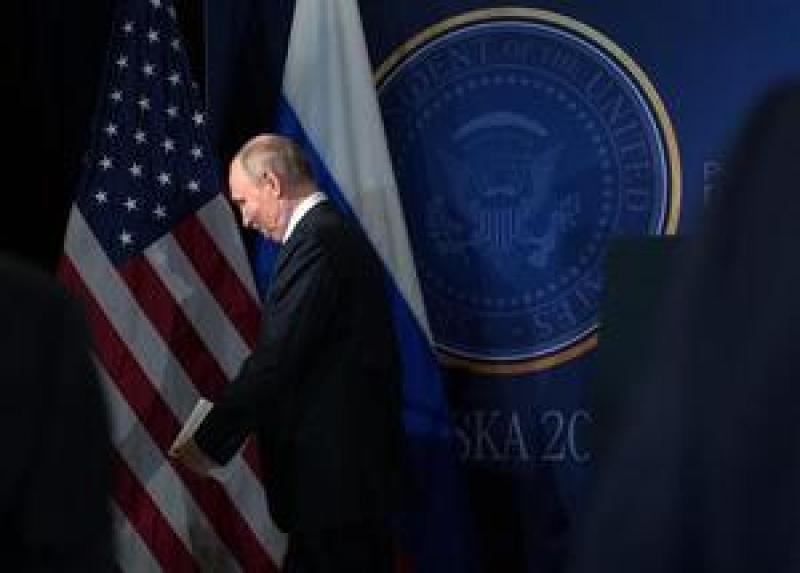
Russian President Vladimir Putin leaves the podium during an ill-fated summit with President Trump in Alaska. PHOTO: Andrew Harnik/Getty Images
As Western leaders convened this week to digest the plan, Poland's prime minister Donald Tusk offered a pithy summary: "We know this is not about peace. It's about business."
For many in the Trump White House, that blurring of business and geopolitics is a feature, not a bug. Key presidential advisers see an opportunity for American investors to snap up lucrative deals in a new postwar Russia and become the commercial guarantors of peace. In conversations with Witkoff and Kushner, Russia has been clear it would prefer U.S. businesses to step in, not rivals from European states whose leaders have "talked a lot of trash" about the peace efforts, one of these people said: "It's Trump's 'Art of the Deal' to say, 'Look, I'm settling this thing and there's huge economic benefits for doing that for America, right?'"
A question for history will be whether Putin entertained this approach in the interest of ending the war, or as a ploy to pacify the U.S. while prolonging a conflict he believes is his place in history to slowly, ineluctably win.
One sign that he may be serious is that some of his most-trusted friends, sanctioned billionaires from his St. Petersburg hometown—Gennady Timchenko, Yuri Kovalchuk and the Rotenberg brothers, Boris and Arkady—have sent representatives to quietly meet American companies to explore rare-earth mining and energy deals, according to people familiar with the meetings and European security officials. That includes reviving the giant Nord Stream pipeline, sabotaged by Ukrainian tactical divers, and under European Union sanctions.
Earlier this year, Exxon Mobil met with Russia's biggest state energy company, Rosneft, to discuss returning to the massive Sakhalin gas project if Moscow and Washington gave the green light.
Elsewhere, a cast of businessmen close to the Trump administration have been looking to position themselves as new economic links between the U.S. and Russia.
Gentry Beach, a college friend of Donald Trump Jr. and campaign donor to his father, has been in talks to acquire a stake in a Russian Arctic gas project if it is released from sanctions. Another Trump donor, Stephen P. Lynch, paid $600,000 this year to a lobbyist close to Trump Jr. who is helping him seek a Treasury Department license to buy the Nord Stream 2 pipeline from a Russian state-owned company.
There is no evidence that Witkoff, the White House or Kushner are briefed on these efforts or coordinating them. A person familiar with Witkoff's thinking said the envoy is confident that any settlement with Russia would benefit America broadly, not just a handful of investors.
Witkoff, who hasn't traveled to Ukraine this year, is set to visit Russia for the sixth time next week and will again meet Putin. He insisted he isn't playing favorites. "Ukrainians have fought heroically for their independence," said Witkoff, who has tried to inspire Ukrainian officials with the idea of soldiers disarming to earn Silicon Valley-scale salaries operating American built AI data centers. "It is now time to consolidate what they have achieved through diplomacy," he said.

Tags
Who is online
90 visitors
it'sall about the ole mighty buck forthis moralless fck
Is it a breakthrough to "guarantee" peace through business dealings with Russia ?
Some say Vladimir Putin is the richest man in the world, is making money for Trump cronies more important to him than conquering Ukraine?
As Obama said, Ukraine is not a national security issue for the US. It is for Europe. Why haven't they stopped Russia yet? They've had years at this point.
Trump would sell his daughter Ivanka into sex slavery if he could make a buck off it.