
Trump Takes America's 'Imperial Presidency' to a New Level

By: Peter Baker (nytimes)



 S E E D E D C O N T E N T
www.nytimes.com /2025/12/21/us/politics/trump-imperial-presidency.html
Trump Takes America’s ‘Imperial Presidency’ to a New Level
Peter Baker 17-21 minutes 12/21/2025
By Peter Baker
Peter Baker, the chief White House correspondent, has covered the past six presidencies and wrote a book about President Trump’s first term. He reported from Washington.
Dec. 21, 2025, 5:00 a.m. ET
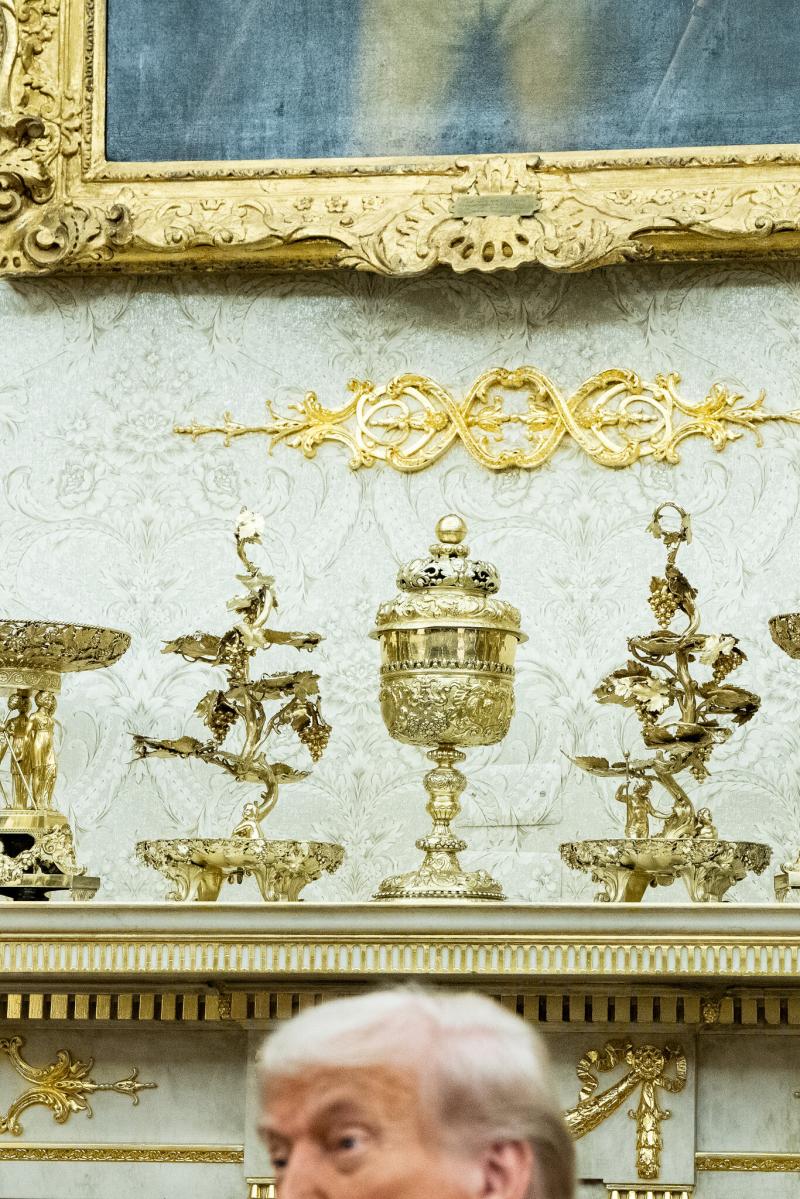
When President Trump hosted the crown prince of Saudi Arabia last month, he pulled out all the stops. To the traditional pomp of a formal White House visit, he added a few even fancier touches: a stirring military flyover, a procession of black horses and long, regal tables for the lavish dinner in the East Room instead of the typical round tables.
For surprised White House veterans who were paying attention, the unusual flourishes looked a little familiar. Just two months earlier, King Charles III of Britain welcomed Mr. Trump for a state visit that included, yes, a stirring military flyover, a procession of black horses and a long, regal table for the lavish dinner in St. George’s Hall at Windsor Palace.
In his first year back in office, Mr. Trump has unabashedly adopted the trappings of royalty just as he has asserted virtually unbridled power to transform American government and society to his liking. In both pageantry and policy, Mr. Trump has established a new, more audacious version of the imperial presidency that goes far beyond even the one associated with Richard M. Nixon, for whom the term was popularized half a century ago.
He no longer holds back, or is held back, as in the first term. Trump 2.0 is Trump 1.0 unleashed. The gold trim in the Oval Office, the demolition of the East Wing to be replaced by a massive ballroom, the plastering of his name and face on government buildings and now even the John F. Kennedy Center for the Performing Arts , the designation of his own birthday as a free-admission holiday at national parks — it all speaks to a personal aggrandizement and accumulation of power with meager resistance from Congress or the Supreme Court.

Mr. Trump’s reinvention of the presidency has altered the balance of power in Washington in profound ways that may endure long after he departs the scene. Authority once seized by one branch of government is rarely given back willingly. Actions that once shocked the system can eventually become seen as normal. While other presidents pushed the limits, Mr. Trump has blown right through them and dared anyone to stop him.
“His second term in many respects represents not simply a break from presidential norms and expectations,” said Matthew Dallek, a political historian at George Washington University. “It’s also a culmination of 75 years in which presidents have reached for more and more power.”
It is also a culmination of four years of planning between Mr. Trump’s first term and his second. The last time around, he was a political novice who did not understand how government worked and surrounded himself with advisers who tried to restrain his most extreme instincts. This time, he arrived in office with a plan to accomplish what he did not in his first term, and a team of like-minded loyalists intent on remaking the country.
“The president knew exactly what he wanted to do coming into office this time,” said Jason Miller, a longtime Trump adviser. “Now the president had four years under his belt. He knows exactly how everything works. He knows all the international players. He knows all the national players. He knew what strategies and tactics worked the first go around and what strategies didn’t work.”
Strong and Weak
The presidency is a living organism, shaped by the person inhabiting it, whether it be self-styled men of action like Andrew Jackson and Theodore Roosevelt, father figures like Dwight D. Eisenhower, legislative wizards like Lyndon B. Johnson or captivating communicators like Ronald Reagan and Barack Obama. More than the sum of the clauses of the Constitution’s Article II, it is an evolving construct, one that has adapted to the ever-changing challenges of a complex and fast-moving world.
Mr. Trump wears it like a cloak. Power is the leitmotif of his second term. For the record, he disclaims royal aspirations. “I’m not a king,” he said after millions of Americans took to the streets in “No Kings” demonstrations in October. But at the same time, he embraces the comparison, at least in part to troll his critics but also, it seems, because he enjoys the notion.
He and his staff have posted images of him in monarchical regalia, including an A.I.-generated illustration of him wearing a crown and flying a fighter jet labeled “KING TRUMP” that dumps excrement on protesters. He delighted when the South Koreans gave him a replica of an ancient golden crown . “LONG LIVE THE KING!” he wrote about himself on social media.
Image

A “No Kings” demonstration in Portland, Ore., in June, one of several that have taken place across the nation this year in protest of Mr. Trump’s monarchical tendencies. Credit... Jordan Gale for The New York Times
To his supporters, Mr. Trump’s assertion of vast power is invigorating, not disturbing. In a country they see in decline, a strong hand is the only way to dislodge a liberal, “woke” deep state that in their view has suffocated everyday Americans to the advantage of unwelcome immigrants, street criminals, globalist tycoons, underqualified minorities and out-of-touch elites. Voters struggling to maintain their standards of living or make sense of a society changing rapidly around them have twice given Mr. Trump a chance to make good on his promise to blow up politics as usual and address their concerns.
To his critics, Mr. Trump is narcissistic, uncouth, corrupt and a danger to American democracy. He has used the office to enrich himself and his family, sullied the image of the United States around the world, sought to erase the true history of Black Americans and pursued policies that harm the very people he purports to represent.
What everyone agrees on is that Mr. Trump dominates the political landscape like none of his predecessors going back generations, single-handedly setting the agenda and forcing his will on the rest of the system. At the same time, he is the most consistently unpopular president since the advent of polling. He has never had the support of a majority of Americans, not in any of his three presidential elections and not for a single day of either term in Gallup surveys .
His current 36 percent approval rating in Gallup is lower than that of every elected modern president at the end of their first year, lower even than it was in his first term (39 percent) and seven percentage points below the next-lowest (Joseph R. Biden Jr., at 43 percent). If compared against presidents who served two terms consecutively, Mr. Trump is still below each of them at the end of their fifth year, except Mr. Nixon, who had plummeted to 29 percent in the throes of Watergate.
Some critics predict that Mr. Trump’s unpopularity will begin to erode his power. “It’s been striking that Republicans in Congress have stuck behind him,” said former Senator Jeff Flake, a Republican from Arizona who broke with Mr. Trump in the first term. “But I do think that is changing. Some of it’s not exactly a profile in courage, but it’s looking at the electoral wins and realizing the midterms are going to be very difficult.”
Mr. Trump’s allies dismiss that as wishful thinking by the president’s critics. Mr. Miller called current polling a “temporary blip” that will reverse as tax cuts passed earlier this year take effect in the first couple of quarters of 2026. “Once the economy rockets to where everyone’s predicting it to be for Q1 and Q2,” he said, “that will all snap back.”
Bypassing Limits
Presidents have been pushing the boundaries of power going back to the early days of the republic, most aggressively during wartime. Abraham Lincoln suspended habeas corpus even beyond the battlefield and emancipated enslaved people in rebel areas. Woodrow Wilson prosecuted critics of World War I and effectively censored some newspapers. Franklin D. Roosevelt interned more than 100,000 people of Japanese ancestry, including American citizens. In most cases, the pendulum swung back to a degree after the wars were over and security restored.
In the modern era, the notion of an imperial presidency was made prominent by the book of that name published in 1973 by the historian Arthur M. Schlesinger Jr. , who had worked in John F. Kennedy’s White House. Mr. Schlesinger argued that under Mr. Nixon, who refused to spend certain money appropriated by Congress, secretly bombed Cambodia, wiretapped opponents and used government to pursue his enemies, the presidency “has got out of control and badly needs new definition and restraint.”
Image

President Richard M. Nixon at a news conference in 1970. The phrase “the imperial presidency” was popularized as a description of his administration. Credit... Mike Lien/The New York Times
The system of checks and balances eventually did reassert itself during Watergate. The Supreme Court unanimously ordered Mr. Nixon to release incriminating tapes and a bipartisan coalition in Congress moved to impeach the president, prompting him to resign. Starting late in Mr. Nixon’s tenure, Congress passed new laws meant to restrain the executive on war powers, impoundment, eavesdropping and government ethics.
Some argued that the post-Watergate reforms went too far in emasculating the presidency after the voter-abbreviated tenures of Gerald R. Ford and Jimmy Carter. Mr. Reagan and George W. Bush in different ways worked to empower the office again, particularly in foreign policy and national security. Mr. Obama pushed further by exempting from deportation many immigrants who had arrived illegally as children and Mr. Biden unilaterally tried to forgive $400 billion in student loan debt . But all four encountered pushback from the courts and Congress and none went as far as Mr. Trump has.
“Some of the stuff that people were upset at Nixon for doing was kind of quaint compared to just the totally out-of-control stuff” that Mr. Trump has been doing, said Robert Schlesinger, a son of Arthur Schlesinger and himself a longtime journalist and historian of the White House.
“Even Nixon was a guy who got that there were limits that he had to tread carefully around even as he was trying to push them,” Mr. Schlesinger added. “Whereas Trump, he’s not interested in limits. And whether it’s through a conscious strategy or just unconscious cunning, by being so open about it, it normalizes it to some extent.”
Learning Curve
That may stem from Mr. Trump’s distinctive ability to overcome obstacles and scandals that would hobble any other politician. He was impeached twice, indicted four times, convicted of 34 felonies, found liable for sexual abuse and found liable for business fraud while his firm was convicted of criminal tax evasion. Yet he won a stunning, against-the-odds comeback election victory. The Supreme Court even granted him and his successors broad immunity that it had never bestowed on any previous president.
And so Mr. Trump evidently sees little reason to restrain himself. He has pursued an everything-everywhere-all-at-once strategy of pushing policies, even knowing that some of them may be rejected — a gamble that paid off, from his vantage point. As it turned out, not only has Congress acquiesced to vast intrusions on its traditional spheres of authority, most notably spending, but even the courts have been more of a speed bump than a stop sign.
That owes a lot to the team Mr. Trump has built around him, one that cheers him on rather than holds him back. Mr. Trump got off to “a fast start,” said Kathryn Dunn Tenpas, a scholar at the Brookings Institution who tracks administration turnover. “They were rolling in the beginning. So, clearly, there’s been a learning curve and a recognition that staff chaos is not helpful to the cause.”

But as she pointed out, that does not mean there has not been staff turmoil. It’s just that Mr. Trump does not advertise it as much by firing people on social media, as he did the last time around, and Americans have become used to it. Without much notice, Mr. Trump withdrew 52 nominations in his first 10 months in office, four times as many as Mr. Biden did in the same period, according to figures compiled by Chris Piper , a Brookings colleague.
Working off a Project 2025 blueprint devised by allies during his four years out of power, Mr. Trump came back to office with a raft of executive orders that have allowed the instant-gratification president to dispense with the slow grind of congressional negotiations. So far this year, Mr. Trump has issued about 225 executive orders , nearly three times as many as any other first-year president in three-quarters of a century.
Mr. Miller credits a more cohesive team. “There are a lot less hangers-on or superfluous characters floating around,” he said. “That White House is about getting things done.”
But some Republicans said the lack of contrary voices in the West Wing has a cost. While Mr. Trump has successfully sealed the border as he promised and brokered a fragile cease-fire in Gaza, he looks out of touch on affordability and was rolled by the bipartisan coalition demanding the release of files related to the sexual predator Jeffrey Epstein.
“You live in a bubble if that’s the situation and sometimes you get blindsided by reality,” said Representative Don Bacon of Nebraska, one of the few incumbent Republicans who has been critical at times. “I don’t know that he’s hearing that kind of feedback. His first administration he had people who would say, ‘Mr. President, I know what you’re saying, this is what I’m thinking.’” By contrast, Mr. Bacon said, “this time, you’ve got pretty much yes men.”
Imperial or Imperiled?
The lack of checks on Mr. Trump has given him latitude that his predecessors did not enjoy, not just in policymaking but also in profit-making. While other presidential families have cashed in on the White House , none has been as successful or brazen as Mr. Trump and his clan. In the 11 months since he reclaimed the White House, the president’s family has made billions of dollars, at least on paper, through business deals around the world and cryptocurrency investments from people with a vested interest in American policy.
At the same time, Mr. Trump has systematically dismantled many instruments of accountability. He installed loyal partisans at the F.B.I. and Justice Department, fired inspectors general and the special counsel, purged prosecutors and agents who participated in past investigations into his dealings and gutted the public integrity section that probes political corruption. Congressional Republicans who eagerly looked into Hunter Biden’s business ties have no interest in scrutinizing Mr. Trump’s.
The question is how much of this change will be sustained. Is the presidency rewired for the long run or will it cycle back down the road?

As the year ends, there have been signs of resistance to unchecked power. A judge threw out the Trump administration’s indictments against two of the president’s adversaries, Letitia James and James B. Comey, and two grand juries refused to re-indict Ms. James . In addition to legislating release of the Epstein files, Congress passed a measure slashing Defense Secretary Pete Hegseth’s travel budget by 25 percent if he does not turn over video of a second strike on a boat of supposed drug traffickers.
If Democrats win the midterm elections next year, they will surely use their newfound power to push back further against Mr. Trump. Some, like Mr. Flake, predict that even some Republicans will begin to speak out after filing deadlines for possible primary challengers have passed. And legal analysts expect the Supreme Court to clip Mr. Trump’s wings on tariffs, and possibly on birthright citizenship.
Russell Riley, a presidential historian at the University of Virginia’s Miller Center, acknowledged the nation’s long history of expanding presidential authority. But, he added, “we have an equally robust history of cramming the presidency back into its constitutional box once war or economic crisis has passed.”
That history “strongly suggests that what we are seeing today will not, in fact, endure.” Is that a guarantee? “I’m not smart enough to know the answer to that.”
Peter Baker is the chief White House correspondent for The Times. He is covering his sixth presidency and sometimes writes analytical pieces that place presidents and their administrations in a larger context and historical framework.

Tags
Who is online
79 visitors
"No Kings" turned out to be a pretty good slogan after all.
Tell you what....
When Trump puts a stop to next year's election, declares himself the winner of the 28 election before it even happens, abolishes Congress, abolishes free press and only allows his approved press to publish articles, of course, positive to him, and replace liberal judges across the country, including the Supreme Court, and replace them with his picks, then you might have something.
Until then, it is nothing but a wet, triggered dream that the left seems to live on 24/7.
I do hope you realize that because you didn't demand tar and feathering that you will be called out for defending Trump. Wish I could say sarcasm but we know the truth here.
The seeded article lays it out very clearly.
Y'all are in denial.
Thats funny because it is true. You either call out everything Trump says or does that some don't like (including breathing) or you are a Trump supporting MAGA. Nothing in the middle and they will try to convince you of it.
The seeded article was nothing more than left wing speculation and fear mongering to the gullible. Seems to have worked.
Some here believe anything less than the death penalty is "defending Trump".
I don't see how some on the left can live with this man on their minds 24/7
It is impressive. Personally I can't watch him for more than 5 minutes before getting a headache and changing the channel.
Same here. I voted for the man three times because he is actually doing what he said he would do if elected. A rare politician.
I can see the good results of him being elected. I don't need to hear it over and over.
Are y'all gonna start whining if I delete all this baloney as NO VALUE? All of you are incapable of discussing what is in the article. The article is not about TDS or any other such nonsense. It is about Trump acting like he is royalty and abusing his position.
Give us say, 10 examples... Maybe start with his healthcare plan that will be out in 2 weeks.
See post 2, the very thread you responded to....
Does this include 2.1.8?
You may enjoy having this psychopath in power, but the majority of Americans dont.
So now you believe the word of a Fox News host?
"You may enjoy having this psychopath in power, but the majority of Americans dont. "
77 million Americans said this is what they wanted, several more million than the DEI VP.
Would Watters lie about what Trump told him?
I don't know, but it is a strange change of pace for you to actually believe a conservative.
Bias confirmation, perhaps?
Yes. He is just like everyone on msnow, not on the friendliest terms with the truth
Some do the same thing with trump saying he lies all the time yet in the next sentence talk about what Trump said. It is like watching a tennis match