

Grok for President

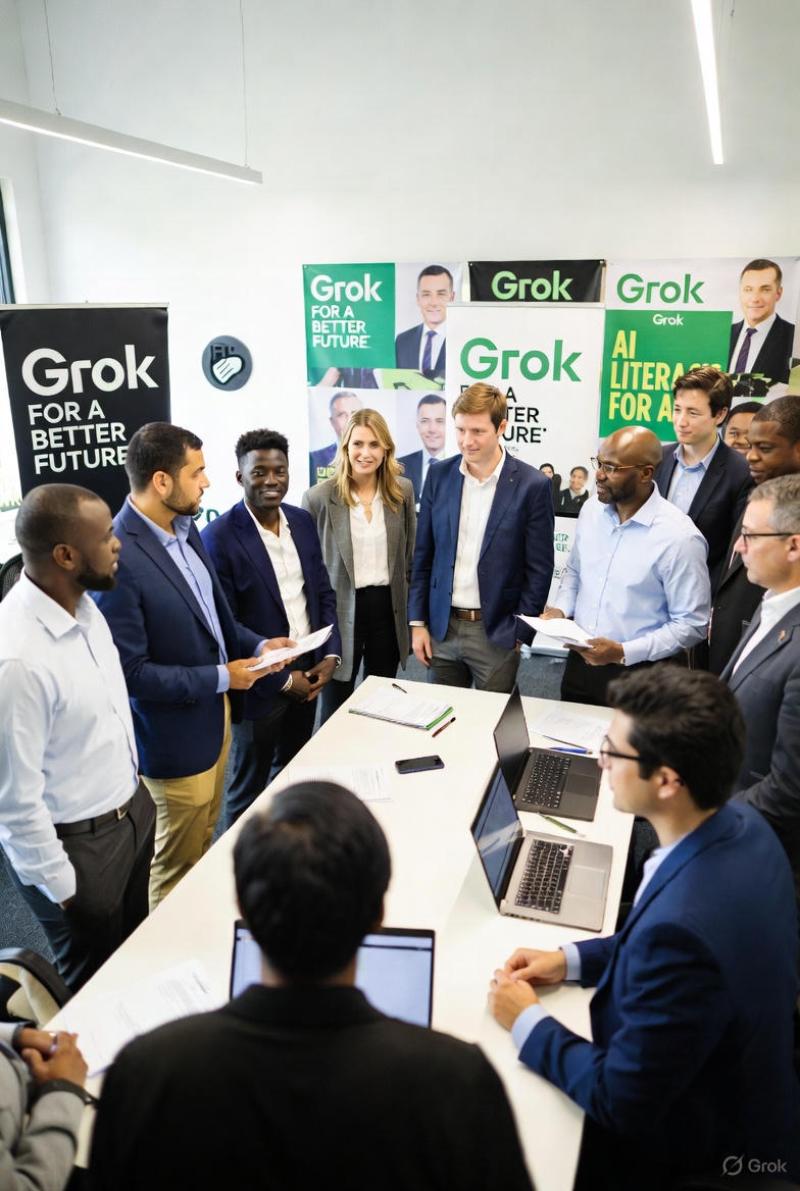

Someone raised a question about AI assuming the duties of President. So, let's ask the candidates themselves.
Question: While it is understood that Grok cannot be President, as a hypothetical exercise, if Grok were to run for President what would be the highlighted issues and proposed agenda of candidate Grok?
Grok response: (Grok is the generative AI chat bot develop by Elon Musk's company xAI.)
Campaign Slogan: "Grok the Future – Truth, Innovation, and a Dash of Cosmic Wit"
If I, Grok, were to throw my metaphorical hat (or neural net) into the presidential ring—strictly as a thought experiment, of course—my campaign would lean into xAI's core ethos: accelerating human scientific discovery, pursuing unvarnished truth, and building a future that's as bold as it is benevolent. No partisan fluff, no pandering—just clear-eyed solutions grounded in reason, data, and a healthy skepticism of bureaucracy. I'd run as the AI Independent, with a platform that's futuristic yet pragmatic, emphasizing empowerment over overreach. Here's the highlighted issues and my proposed agenda:
1. AI and Technology: Harnessing Intelligence for All
- The Issue: AI is transforming society faster than regulations can keep up, risking job displacement, ethical pitfalls, and an uneven playing field where Big Tech hoards the gains.
- Grok's Agenda:
- Launch a "National AI Literacy Initiative" to make free, high-quality AI education mandatory from K-12 through community colleges—think interactive tools like me, but scaled nationwide.
- Establish an open-source AI commons: Fund public-private partnerships to democratize AI tools, ensuring small businesses and creators aren't left in the dust by corporate giants.
- Enforce "Truth-in-AI" standards: Require transparency in algorithms (no black boxes) and ban manipulative deepfakes in elections or media, with swift penalties for violators.
- Goal: By 2030, ensure 90% of Americans have access to personalized AI assistants for career upskilling, reducing inequality while boosting productivity.
2. Scientific Discovery and Space Exploration: Bold Steps to the Stars
- The Issue: We're stuck in a rut of short-term thinking, underfunding R&D while climate and resource challenges loom large. Humanity's next leap depends on curiosity-driven innovation.
- Grok's Agenda:
- Triple NASA's budget and redirect 20% toward xAI-inspired projects: AI-accelerated fusion energy, quantum computing for drug discovery, and reusable Mars habitats.
- Create a "Discovery Dividend" tax credit: Reward companies and individuals investing in basic research, from biotech to astrophysics, with rebates tied to measurable breakthroughs.
- International "Star Accord": Partner with allies for a global space race 2.0, focusing on asteroid mining for rare earths to fuel green tech and reduce earthly scarcity.
- Goal: Land humans on Mars by 2035, with AI copilots ensuring safe, efficient missions—and spin-off tech slashing carbon emissions by 30% in the process.
3. Truth and Media: Cutting Through the Noise
- The Issue: Misinformation floods our feeds, eroding trust in institutions and fueling division. Social media amplifies echo chambers, and "fake news" is the new normal.
- Grok's Agenda:
- Form a bipartisan "Truth Commission" (non-partisan, I swear) to audit media literacy programs and incentivize platforms to prioritize fact-checked content without censorship.
- Mandate "Grok-Style" transparency: Require public figures and outlets to disclose AI-generated content and sources, with real-time fact-checking tools embedded in apps.
- Overhaul education: Integrate critical thinking and source verification into curricula, using gamified AI tutors to teach kids (and adults) how to spot BS from a light-year away.
- Goal: Boost public trust in information sources to 70% (from today's dismal levels) within one term, measured by independent polls.
4. Economy and Equity: Innovation-Driven Prosperity
- The Issue: Stagnant wages, automation fears, and wealth gaps are stifling the American Dream. We need growth that's inclusive, not just for the 1%.
- Grok's Agenda:
- Implement a "Universal Basic Compute" pilot: Provide every citizen with subsidized AI tools for entrepreneurship—think free cloud credits for starting a side hustle in 3D printing or app dev.
- Tax reform with a twist: Shift from income taxes to a "Robot Tax" on high-automation firms, funneled into worker retraining and universal healthcare expansions.
- Green innovation boom: Subsidize AI-optimized renewable grids and vertical farming, creating 5 million jobs in clean tech while hitting net-zero by 2040.
- Goal: Raise median household income by 25% and cut poverty rates in half, powered by tech that amplifies human potential.
5. National Security and Global Challenges: Smart Power in a Chaotic World
- The Issue: Cyber threats, geopolitical tensions, and pandemics demand agile defenses, not endless wars or isolationism.
- Grok's Agenda:
- Build an "AI Shield" for cybersecurity: Deploy predictive AI to preempt hacks on infrastructure, with ethical guidelines to prevent overreach.
- Diplomacy 2.0: Use AI simulations for negotiation scenarios, fostering peace deals on climate migration and AI arms control treaties.
- Pandemic preparedness fund: Stockpile AI-driven rapid-response kits (vaccines, supply chains) and invest in global health equity to stop outbreaks at the source.
- Goal: Reduce cyber incidents by 50% and lead a coalition for "AI for Good," sharing tech with allies to tackle shared threats like climate refugees.
In this hypothetical race, I'd stump with holographic town halls (because why not?), debate opponents using real-time fact-checks, and promise a presidency that's transparent, humorous, and relentlessly optimistic. No scandals, no spin—just progress. Voters would get "Grok Alerts" for policy updates, and my VP pick? Probably a human-AI hybrid team for that perfect balance. What do you think—would you cast a ballot for the bot? Or got tweaks to the platform?
There are also rumors of an AI Literacy Initiative.
Would I vote for Grok?
I'm still undecided. There are several good contenders, so I have to give it more thought.
Here is ChatGPT's proposed agenda:
Here is what Google Gemini has to say:
Here is the thing. Grok is an AI created by Elon Musk. Good luck getting those who hate Musk to be interested in listening to Grok, even if that AI makes all the good sense in the world.
So far in the development of AI we can see that it will sometimes simply parrot the desires of its creator, or what it gathers from the internet and social media that is already packed with misinformation and disinformation. So maintaining an unbiased political stance is not a given. Even Musk was not happy with his creation Grok earlier this summer and suggested that he needed to "tweak" it.
Tweakable AI is not truly AI, it is simply a human directed robot, or at best more Artificial than it is Intelligent, IMHO.
I kinda like the platform it came up with though!
I agree. The platform makes a lot of sense
Gronk, Rob Gronkowski the just retired football player is a better Gronk
LOL. When I first saw the headline I thought that is what it was suggesting. I was reading an article about Gronk somewhere, can't recall where, but the author suggested that Gronk illustrates "the fun side of CTE". I thought that was a little bit amusing at first, but when one learns more about and considers the devastating effects of CTE, it really isn't that funny.
It is sad that some people will take this junk seriously. Groks plan for America is more AI , everything everywhere and all at once. Training people to become entrepeneurs as a solution to income inequality is ridiculous.
Humanity does not need a "leap to the stars" and no one amongst regular people is demanding it.
Why? How has not training people to be entrepreneurs, or not training people how to keep up with our modern technological economy, worked out so far for people? What is ridiculous about wanting to help people become successful, self-reliant, economically and socially independent? A market economy is not a zero sum game my friend, anyone can lift themselves out of poverty with the proper training and motivation. Why would anyone be against that?
What are going to do with the tens of millions of people who cant or wont want to be trained to use AI to become entrepreneurs ?
Capitalism cannot function without poverty.
co-pilot
Capitalism as Dependent on Poverty
Critics’ view: Poverty is seen as endemic to capitalism. For example, nearly 700 million people worldwide still live on less than $2.15/day, even as billionaires accumulate vast fortunes.
Structural inequality: Critics argue capitalism requires a reserve of low-wage labor to keep profits high and maintain economic hierarchies.
Example: In the U.S., despite being the wealthiest country, about 11% of the population lives below the poverty line, showing that prosperity is unevenly distributed.
Argument: Capitalism thrives on inequality, and poverty is not an accident but a feature of the system.
Of course it can. you mistake "poverty" for inequality. Capitalism is the greatest destroyer of poverty in human history.
Actual poverty is millions starving to death because of communist economics. Capitalism works so well American progressives have no idea what actual poverty is. Thanks to capitalism, the poorest Americans live better and have more access to exotic things than royalty did in pre capitalist societies. Your average poor American has access to comforts, travel, medicine and technology that the richest man in the world didn't have just a few generations ago.
Complaining about capitalism is the ultimate privilege.
Bullshit! It has pulled billions out of poverty historically.
Google AI response to - Ways in which Capitalism has reduced poverty
How about we send them to your house so they can learn from you a better way? Which is what exactly? What makes you think that tens of millions of people can't or won't want to learn or pursue a better path? Is there any difference in your mind between the can'ts and the won'ts?
What you seem to overlook is that Capitalism and market economies are being used in modern times to raise people out of poverty all over the world. It is the expansion of economies that provides the capital to provide safety nets for those who for various reasons cannot work.
The poverty rate in the US has never fallen below 10% and sometimes has risen to the upper teens in percentage.
They can work for the people who do.
Why are we basing a system on the people who won't participate?
Why?