
Scientist Warn: Toxic Chromium Could Form in Drinking Water Pipes

By: Cheng Tan, Sumant Avasarala and Haizhou Liu (SciTechDaily)


Science searching for a politically significant problem. The scientific research successfully obtained funding from the National Science Foundation.
Notice there isn't any mention of studies to determine if hexavalent chromium (Cr(VI)) in drinking water is a real problem? Politically driven science to obtain research funding is being used to make hair-on-fire assertions that may not reflect reality. Those seeking research grants employ a form of political extortion; fund the research or people die.
 S E E D E D C O N T E N T
The water crisis in Flint, Michigan, brought much-needed attention to the problem of potentially toxic metals being released from drinking water distribution pipes when water chemistry changes. Now, researchers reporting in ACS' Environmental Science & Technology have investigated how hexavalent chromium, known as Cr(VI), can form in drinking water when corroded cast iron pipes interact with residual disinfectant. Their findings could suggest new strategies to control Cr(VI) formation in the water supply.
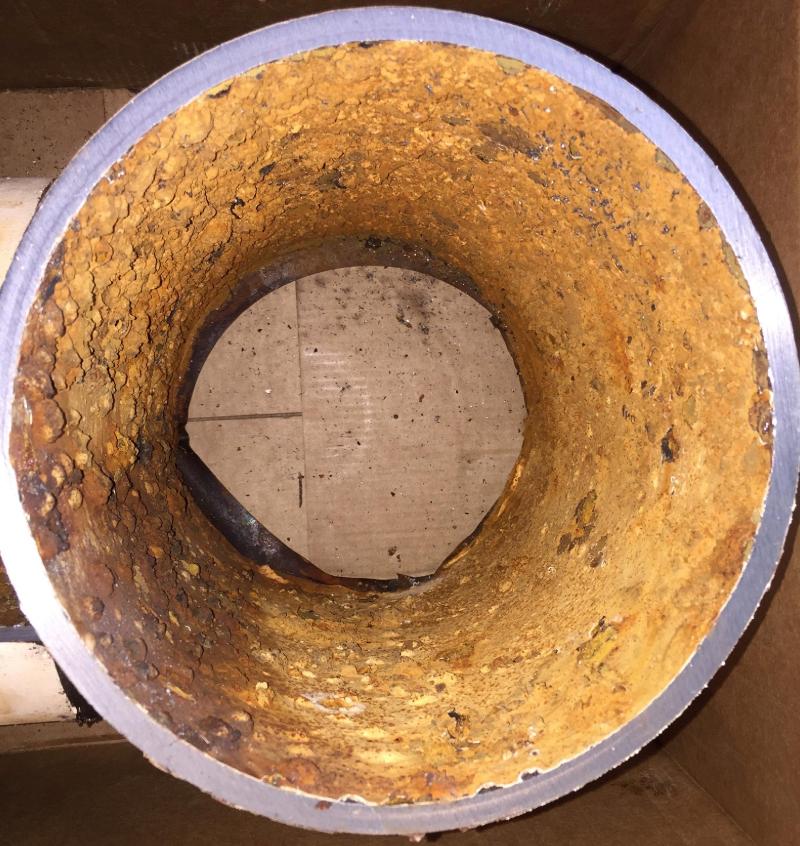
The metal chromium, known as Cr(0), is found in cast iron alloy, which is the most widely used plumbing material in water distribution systems. As pipes corrode, a buildup of deposits, known as scale, forms on the pipes' inner walls. Trace chemicals in water can react with scale, forming new compounds that could be released into the water. Some of these compounds contain Cr(VI), which, at high doses, can cause lung cancer, liver damage, reproductive issues, and developmental problems.
In 2014, California set a drinking water standard of 10 µg/L Cr(VI), but the guideline was later withdrawn because no economically feasible treatment to remove Cr(VI) from tap water existed. Haizhou Liu and colleagues wanted to find out how exactly Cr(VI) makes its way into drinking water, which might reveal new ways to prevent its formation.
The researchers collected two sections of cast iron pipe from two drinking water distribution systems in the U.S.: one from a system using groundwater with naturally high Cr(VI) levels (11-24 µg/L), and the other from a system using surface water with undetectable Cr(VI). The team scraped off scale from the pipes and analyzed its composition. The levels of total Cr were about 18 times higher in the first pipe than in the second. In both pipes, chromium existed in two oxidation states, Cr(0) and Cr(III).
When the researchers added a chlorine- or bromine-containing disinfectant to the scale, it quickly reacted with Cr(0), rather than Cr(III) as previously suspected, to form Cr(VI). To help mitigate Cr(VI) levels, adding less-reactive disinfectants to treat drinking water could be explored, and cast iron pipes with chromium alloy should be used with caution, the researchers say.
Reference: "Hexavalent Chromium Release in Drinking Water Distribution Systems: New Insights into Zerovalent Chromium in Iron Corrosion Scales" by Cheng Tan, Sumant Avasarala and Haizhou Liu, 30 September 2020, Environmental Science & Technology.
DOI: 10.1021/acs.est.0c03922
The authors acknowledge funding from the National Science Foundation.

Tags
Who is online

114 visitors
The competition for research funding is not objective. Researchers must make political hair-on-fire claims to justify funding. It's a form of extortion. Fund the research or people die.
Defund The Police? What about Trump defunding the EPA? What about Trump not even enforcing established water safety standards and signing executive orders to stop the enforcement of those still standing. Or worse, Trump doing away with water safety standards and compliance efforts altogether? Huh? You cannot have it both ways...
Don't worry. President Joe will expand every part of government the same way he plans to expand the police. And President Joe will use politically motivated science, like that in the seed, to justify everything.
President Joe wants you to believe the science. Of course, that will require picking & choosing the science that fits the politics while ignoring reality.
Hexavalent chromium is a well known carcinogen. Investigating the propensity for pipes to scale and then flake hexavalent chromium, or for common disinfectants to react with Cr(0) to form Cr(VI) seems like an entirely worthy area of research.
A higher chromium content in iron or steel reduces the rate of corrosion of the pipe - increasing their life expectancy, reducing cost to the consumer, but if the corrosion that does occur can result in Cr(VI) because of the additives that are being placed in your water - it's something to be aware of. The propensity for cast iron to corrode is one of the reasons that in home plumbing copper has been more popular.
The problem was only in galvanized pipes but the bad reputation included cast iron unfairly.
Once the galvanized coatings wore off, the interior rusted and began collecting debris.
Modern spun iron pipes are quiet and vibration free compared to the PVC that is now favored, and iron will not burn like PVC...
Now PEX flexible lines are gaining favor in new construction and retrofitting.
My house is 90% PEX. From an installation perspective, a couple of quick cuts and a crimp certainly seems easier for me personally than spending an hour with a torch and solder, and have previously had a few copper pipes burst over the years where they weren't insulated properly.
Few times I've ever had to do any work on cast iron pipes in my own homes has had me swearing within fifteen minutes.
True. The older iron pipes that were leaded together are a bear. Newer installs use rubber sleeves and dependable old fashioned hose clamps.
Yes, hex chrome is a carcinogen. But the research didn't address whether or not hex chrome is observed in water systems.
Chromates (CrO4 ions) are corrosion inhibitors. Chromates protect the scale. Several different types of corrosion inhibitors are added during water treatment to protect pipe scale. The addition of corrosion inhibitors are required by EPA.
The nabob scientists first disrupted the scale which broke the electrochemical corrosion cell that protects both the scale and the pipe. The nabob scientists then exposed the unprotected scale to harsh chemicals without the addition of corrosion inhibitors as required by EPA.
These nabob scientists performed a high-school science fair experiment because of the political notoriety of the issue. And these nabob scientists used hair-on-fire political arguments to justify funding by the National Science Foundation.
(Just so everyone knows, EPA conducted more in-depth research on pipe scales over 30 years ago. The reported research isn't new, novel, or needed.)