
The dark side of 'green energy' and its threat to the environment

By: Amy Joi O'Donoghue (Deseret News)


Green energy is not clean energy. Back-end decommissioning will inevitably increase front-end costs. Dependence upon mining and extraction of resources will inevitably lead to exploiting mineral deposits that cannot be produced easily, cheaply, or cleanly. What is happening now with green energy is predictable because green energy is following the same path as the industrial history of humanity.
Some will view this as an indictment of green energy for a variety of reasons. But these issues are being raised so we do not repeat the same stupid mistakes made in the past. Ignoring these problems to support an ideological naivete or opportunistic profiteering will not avoid the inevitable future for green energy. The future of green energy will require much more than publicly funded incentives and government regulations.
Government investment in the front-end of green energy is a short sighted environmental half measure that will only bite us in the back-end. We should be expecting more from government. Otherwise our industrial history will only repeat itself.
 S E E D E D C O N T E N T
What happens to old solar panels, windmills and high tech batteries?
Wind farms and massive arrays of solar panels are cropping up across public and private landscapes both in the United States and abroad as users increasingly turn to "green energy" as their preferred flavor of electricity.
President Joe Biden, in fact, has directed the Interior Department to identify suitable places to host 20 gigawatts of new energy from sun, wind or geothermal resources by 2024 as part of a sweeping effort to move away from a carbon-based economy and electrical grid.
But how green is green?
Although countries are feverishly looking to install wind and solar farms to wean themselves off carbon-based, or so-called "dirty" energy, few countries, operators and the industry itself have yet to fully tackle the long-term consequences of how to dispose of these systems, which have their own environmental hazards like toxic metals, oil, fiberglass and other material.
A briefing paper released by the U.S. Environmental Protection Agency predicts these startling global numbers for countries by 2050 just for solar waste:
- United States, 10 million tons.
- Germany, 3 million tons.
- China, 20 million tons.
- Japan, 7.5 million tons.
- India, 7.5 million tons.
Solar arrays have a life cycle of about 30 years, but the rapid adoption of solar in the United States and elsewhere has the problem of disposal creeping up in the rearview mirror — faster rather than later.
Green waste growth
In 2019, according to the Solar Energy Industries Association, the United States surpassed 2 million solar installations, just three years after it hit the milestone of 1 million installations.
The paper points out that the growth of solar waste is already straining recycling and disposal capabilities, with some panels improperly ending up in municipal landfills or stacking up in warehouses while the wait continues for more inexpensive routes to recycling.
Research underscores there are few incentives to recycle solar panels, as the cost of recovering the materials outweighs the costs of extracting what can be recycled — even without adding in transportation expenses.
The issue foreshadows the potential for the creation of a new class of hazardous waste sites under EPA Superfund designations as clean energy operators walk away from a large volume of materials that contaminate the soil and groundwater.
"It is foreseeable that the same kind of practices could occur with respect to (solar) panels in the absence of very effective programs for the collecting and recycling of PV panels available where PV panels are used," the paper said.
The problem is not limited to large-scale solar utility farms but also to individual households and businesses that over the years have opted to install rooftop solar panels.
"More homeowners are installing solar panels as they have become cheaper, but those modules have less potential for recycling and recovery of materials due to their smaller size and lower number of panels versus commercial installation," the paper noted.
The disposal of hazardous waste is regulated and monitored under Utah law, and landfill operators are trained on what material to look for that poses potential threats to the environment, said Brian Speer, solid waste manager for the Utah Department of Environmental Quality.
"Certainly these wastes are on our radar, but we are currently not seeing a demand to dispose of these wastes in any significant quantity," he said.
That specter of demand is just a couple decades away as some of the early photovoltaic modules reach their end of life and homeowners, businesses and utility-scale operators face the prospect of safe disposal.
Speer said he is hopeful that the research being done by the U.S. Department of Energy and the EPA will provide an environmentally safe pathway for proper disposal.
"The capacity issue is one we hope is answered before the need arrives," he said.
Kate Bowman, Utah Clean Energy's renewable energy program manager, said there needs to be more research on how to safely recycle high-value materials such as cobalt and lithium.
The research, she added, will help address the waste problem.
Cost hiccups
The solar industry is looking to use fewer precious metals and other elements in the manufacturing process, decreasing the amount of silver in panels by 70% since 2010.
While using less silver is economically attractive up front and less labor intensive, it makes recycling the solar panels less attractive. The cost decrease in the panels themselves has the potential to backfire, the paper warns, and some of these newer panels are more fragile and likely to break, hastening the need for their disposal.
The report notes that "not much has been done in the United States to address the PV waste issue," and most novel policies in this arena are emerging from Europe.
In 2017, the state of Washington became the first in the nation to require recycling for these systems and to mandate a "take back" program for manufacturers at no cost to the homeowner. Utah, at this point, does not have such a mandate and it remains to be seen how effective the law will be. The EPA notes that such a law still does not address issue of where the waste winds up.
Wind turbines that are part of the Milford Wind Corridor Project north of Milford, Beaver County, are pictured on Friday, Jan. 15, 2021. As turbines or other "green energy" products such as solar panels wear out, they are creating a new class of hazardous waste that must be dealt with.Spenser Heaps, Deseret News
Tilting at windmills
Wind power also is taking off as a clean energy resource, but the EPA notes that windmills are the least energy producing and most physically difficult renewable energy waste stream to address.
The sheer size of the windmills and the difficulty of disposing of them at recycling stations led the agency to conclude that each new wind farm is a "towering promise of future wreckage."
While there is a market for second-hand windmills in Eastern Europe, Asia and Latin America, the tactic of shifting used windmill components to other countries simply delays the waste disposal problem and puts it on the shoulders of countries less equipped to deal with the challenge, it noted.
Like coal mining or other natural resource extraction, certain entities in Utah and elsewhere have addressed the afterlife issues of wind and solar farms by requiring environmental remediation or the posting of a reclamation bond to ensure proper cleanup and disposal.
"This is something we have thought a lot about," said Keli Beard, general counsel with the Utah School and Institutional Trust Land Administration.
The first wind project in Utah came online in Milford in 2009 and eventually expanded to a 306-megawatt facility in Beaver County.
Nine of the windmills are on school trust lands, with each of them accompanied by a reclamation bond required by the agency, Beard said.
For any of the renewable energy projects located on school trust lands, Beard said there is a requirement that the reclamation plan be conducted by an independent engineer to assure it appropriately repairs the landscape.
The contractural arrangement provides for operating agreements that can be extended over the life of the project, which Beard says gives them as the landowner a way to invoke new requirements as disposal technology advances.
"Often in that operations period there is an option to renew or extend the agreement," she said. "We are concerned that at the end of life of these projects, the cost of recycling and removing them will be far more than the value of what is left on the land."
Beaver County enacted environmental assessment and disposal requirements for solar farms within its boundaries.
Kyle Blackner, zoning administrator, said when a project is decommissioned the plant's components and associated infrastructure would have to be removed to a depth of 36 inches from the site.
"Milford Solar (or the current owner) would salvage economically recoverable materials, and unsalvageable materials would be recycled/disposed of at a location authorized by Beaver County."
The Bureau of Land Management, too, requires bonds sufficient to reclaim the land to its original state. But these reclamation requirements still don't address the looming problem of what happens to these materials at disposal, and they don't guarantee the operator won't simply forfeit the bond and walk away regardless.
An electric vehicle is charged at the Capitol in Salt Lake City on Tuesday, Dec. 31, 2019. Concern is rising over what to do with "green energy" equipment — such as lithium ion batteries, solar panels and wind turbines — as they reach the end of their productivity lifespans and cannot be recycled.Jeffrey D. Allred, Deseret News
Electric vehicles bring own challenges
As state fleets and the general public increasingly embrace electric vehicles, that "clean" move comes with its own environmental challenges.
The value of the materials recycled from lithium ion batteries is only about a third of the cost of the recycling operation — and the expense of extracting old lithium is about five times the cost of mining for lithium, according to the Institute for Energy Research.
There is some innovation playing out, however, with Japan's Nissan repurposing batteries to power streetlights. In the United States, General Motors is backing up its data center in Michigan with used Chevy Volt batteries.
The EPA notes, however, that these sort of "adaptive reuses" still only delay the time for final disposal of the batteries and the need to deal with materials in the batteries that can cause fires or leach hazardous chemicals.
On the wind power front, GE announced last year it had reached a multiyear agreement with Veolia North America to launch the United States' first wind blade recycling program, according to an article in Utility Dive.
Nearly 90 % of the blade material, consisting of fiberglass, would be repurposed for cement production, cutting carbon dioxide emissions from that source by 27%.
With the release of its paper, the EPA is calling on researchers, states, industry and other federal agencies to ensure green waste is sustainable from end to end and that gaps in renewable energy waste management are addressed.
"While consumers may purchase renewable energy or renewable energy-based products with good intentions, that does not prevent the unintended adverse environmental consequences of these products," it said.
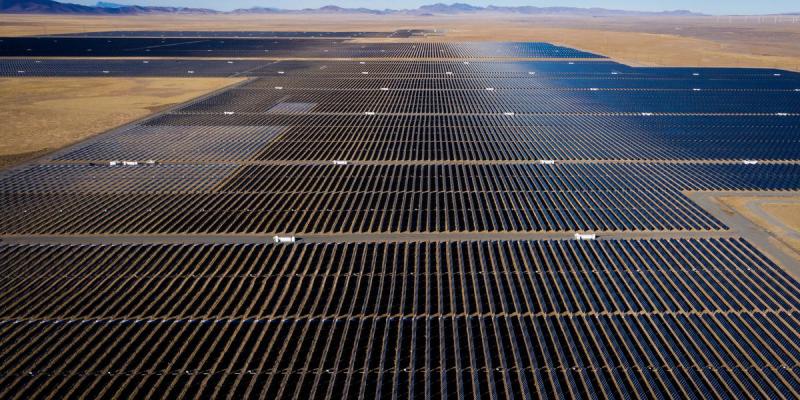
A photovoltaic solar panel installation north of Milford, Beaver County, is pictured on Friday, Jan. 15, 2021. As solar panels or other "green energy" products such as wind turbines wear out, they are creating a new class of hazardous waste that must be dealt with.

Tags
Who is online

65 visitors
Government investment in the back-end decommissioning of industrial technology is as important as investment in the front-end development and deployment of industrial technology. Hoping for the best by ignoring the inevitable won't provide a sustainable future.
People are thinking about the problems presented in the article...
What articles like this miss are simple facts like US gasoline cars injecting over a billion metric tons of CO2 into the atmosphere every year. All the fluids (antifreeze, oil, transmission) that these cars need and discard yearly. The complexity of gasoline cars (up to 2,000 components in the drive train) vs electric (about 20 components) results in lots of garbage during the car's life.
What you're seeing now are people planning for the recycling of components like Li ion batteries. Requiring bonds to cover end of product life costs. In the past, we just poisoned the atmosphere and environment, so fossil fuel based solutions seemed cheaper and there was no consideration for the damage done by their operation or end-of-life. But, as we have found out, there are tremendous healthcare costs associated with dirty energy. The amount of damage being done to farming by climate change is also becoming intolerable to those trying to make money there. I think you'll see lots more people realizing that we have to move away from fossil fuels. GM just announced the phasing out of gasoline cars by 2035. Initial investment by the gov't solved many problems; industry is seeing the writing on the wall and is moving to capitalize.
No. That is incorrect. But that hype misses the fact that every solar panel in pictured array share the same end of service life. It's not that a solar panel will need to be replaced, the entire array will need to be replaced. And while the pictured array is off line for replacement, either we accept less electricity generation or we built another array to maintain supply. The incentive will be to abandon the array and avoid the cost of disposal or recycling.
Government regulations will establish an incentive for each of these large arrays to be operated by an independent company. At the end of service life the company declares bankruptcy and abandons the array. We've seen how this works before.
That's the same way nuclear energy was handled. Nuclear energy was hyped as cheap, clean energy, too. And there were regulatory requirements for bonding and decommissioning. Plans were put in place to either dispose or recycle the waste. But those back-end costs significantly increased the front-end cost.
The government hoped for the best and ignored the inevitable. Today's green energy is following the same path as nuclear energy.
That's not an indictment of green energy. But that is an indictment of repeating the same mistakes we've made in the past.
That's what government does best. /s
Provide a shiny new toy with lots of promise while kicking the can of problems down the road for the next guy to figure out. Current government isn't interested in the after effects because they've already gotten your vote for the new shiny toy.
That has been a recurring problem with political solutions. Every hole politicians dig can be filled with taxpayer money.
In the end we throw up our hands and give up because the problems are too big to tackle. But that's only because we hoped for the best and ignored the inevitable.
The future of green energy is predictable. We've done the same thing many times. And we are doing it again.
It is correct and there is no hype, just facts. In the US: Cars do generate over 1 billion metric tons of CO2 annually. Coal power plants generate about 2 billion tons of CO2 annually. There are about 3,000 tons of solar panels in use. These offset 70 million tons of CO2 that would have been generated by fossil fuel plants. If we use your lifespan of 30 years, that's 100 tons of waste per year to offset 70 million tons of CO2. Negligible.
A straw man -- solar is not nuclear, the waste is not radioactive for eons, or even seconds. You also don't have massive, radioactive structures.
Here are the capital costs for power generation: gas combined cycle: $1,000/KW; solar: $1,060/KW; wind: $1,600/KW. Only gas has ongoing fuel costs. Power companies are building wind plants -- tells you that fuel costs are pretty significant. But, feel free to carry the conservative line in the face of capitalism (power companies, car companies, ...) rolling over you. Truthfully, I really have a lot of trouble understanding such nonsense.
P.S. the capital cost/KW for nuclear plants is about $6,000. Doesn't seem viable at all.
That is incorrect. Replacing nuclear generation and hydroelectric generation with green energy won't reduce carbon emissions. Electricity consumption has been increasing as green energy has been deployed. The numbers are phony.
Nuclear generation doesn't emit carbon dioxide, either.
Those figures do not include the back-end cost of decommissioning, disposal, and recycling. More phony numbers.
Because the back-end costs have been added up front.
Two more straw men, we are not talking about nuclear & hydro, we are talking about solar & wind. Why would we eliminate nuclear & hydro plants anyway, they are green tech.
Which is exactly the reason we need to find green methods of satisfying the ever increasing demand, rather than further screwing up the planet and making people sicker. China has implemented cap and trade because burning coal has resulted in a huge healthcare costs. Conservatives complained when Obama invested $30 billion in green energy. China is investing $299 billion -- do you think the National People's Congress is composed of 3,000 Bernies?
There are an estimated 1.5 million solar panels in use in the conterminous US. Solar panels weight 2 - 4 lbs, multiplying the two numbers gives less that 3,000 metric tons. Using fossil fuels to produce the energy they produce would push about 70 million tons of CO2 into the atmosphere. Even if the weight of the total solar panels is off by two orders of magnitude, you're still scrapping/recycling 10,000 tons/year to avoid pushing 70 million tons of CO2 into the atmosphere every year.
The capital costs I listed are the build cost/KW for the various generation methods. Gas & solar are pretty much the same. You're probably buying just as much 'stuff' in each case so disposal should be similar. The big differences are that the solar plant has no fuel costs and does not pump massive amounts of CO2 and toxins into the atmosphere. So we pay massively all along the way with fossil fuels, and we dispose of similar amounts of decommissioned stuff as well. It's not as if gas plants require no maintenance; they're huge machines. Finally, you 'forget' to include the healthcare and climate damage costs caused by burning fossil fuels.
Nope. The $6,000 is just the capital cost of the build. Nuclear is a green tech, but it has the problems of huge initial cost, radioactive waste disposal, possible widespread contamination, and needs to be extremely well protected against terrorists. It should be a viable power alternative, but it seems as though the world has changed too much to support it.
The only way the industry worries about the damage done by their quest for money is if we regulate them into worrying.
BS
More BS.
Maybe we should spend a little effort finding ways to reduce consumption.
The restrictions put in place because of the pandemic has lowered our carbon emissions by 7 pct. We are consuming less and we are polluting less.
Why do we need to spend public money to build electrical generation for bitcoin mining? Make bitcoin illegal and we can reduce our carbon emissions.
What is the objective for addressing climate change? Protecting the environment or making boatloads of money? If we consume less energy then we won't need to spend as much money. And that seems to be the biggest fear for those advocating technology that may be green but certainly isn't clean.
You seem to think I oppose green energy. What I oppose are profiteers and pirates, disguised as environmentalists, attempting to exploit consumers.
The pandemic restrictions have reduced our carbon emissions by an estimated 7 pct. Maybe we can learn something from that.
We are. LED lighting reduces power consumption to less than a quarter of incandescent -- this is significant because 20% of electricity is used for lighting. Computers have made gasoline cars far more efficient. Improvements in battery technology have made electric cars not only possible, but desirable because of the low per mile maintenance and energy costs. The pandemic is likely to have the long term effect of eliminating a lot of unnecessary commuting. Homes are much more heavily insulated...
I don't think we spend public money on building power plants. Bitcoins have real value, if the cost of mining them is less than their value does it not make sense to mine them? Should we eliminate expenditures on art, sports, landscaping because they're not necessary? I'm sure any one of those uses orders of magnitude more energy than Bitcoin mining. Have said that, I'm with you on Bitcoins. I understand that a currency has value because people think it does; almost no currency is backed by any real asset. People create cryptocurrencies and poof, they have value.
I think it started out as the first, but as industry saw $$$ there it became the second as well. I think that's good for us. It may be that you're right and we'll have some kind of refuse crisis in some green energy sectors. Counterpoint is that fossil fuel energy is doing tremendous damage right now. What's your solution? Do we do nothing about our energy sources because there might be a problem in future with a cleaner tech?
And since CFL and LED lighting is greener we can use more of them. I haven't seen any reporting that suggests that electricity consumption for lighting has decreased. Do you have any such information?
Maybe if we only turned on lights when we needed them we wouldn't be consuming as much electricity.
My 1969 Volkswagen Beetle reliably achieved 35 mpg. And there wasn't anything like a computer installed. The fuel efficiency for a model T Ford was 21 mpg. The average fuel efficiency today is 27 mpg. Over the last century we've added bulk and technology to vehicles which has adversely affected fuel efficiency. But a model T Ford would still do what today's modern cars are expected to do which is travel from one place to another.
Today we are traveling farther and faster. But do we really need to? Modern electric cars will reduce the distance we can travel and may reduce the speed that we can travel. We could reduce distances and speeds with gasoline vehicles and lower our carbon emissions, too. Maybe it's time to consider fuel rationing.
Electric cars were being manufactured in 1902. There were public charging stations. Those 1902 electric cars could do what modern electric cars can do which is travel from one place to another.
No. Bitcoin serves no useful purpose and should be banned. Bitcoin wastes energy for no useful benefit.
What this seed fails to recognize is the fact that the only truly "clean energy" option is to reduce consumption, but the reality is humans are simply unwilling to take that path. Green energy alternatives are providing the power humanity demands at a lower environmental cost, not "no environmental cost". And unlike most of the dirty non-renewable rape and profit methods of the past, "green energy" is at least attempting to mitigate the environmental cost and are requiring bonds and other measures to take care of the waste as it occurs. Notice there was no talk about massive hazardous waste dumps that require tax payer "superfund" cleanup as has happened often with dirty non-renewable extractions.
If you simply look at the green energy environmental cost without factoring in the existing dirty non-renewable environmental cost as a comparison, of course it might sound scary because any waste sounds scary when not compared to the alternative.
Is the, as they call it "specter of", waste from green energy something humans will have to find ways to address in the next few decades? Of course it is, but the alternative of unlimited burning of fossil fuels, waste from extraction and the millions of oil drills and infrastructure, to maintain our energy dependent lifestyles is far worse. Should we still be cautious and look ahead carefully and start mitigation methods now while the green energy industry is starting to truly boom? Of course we should, and no doubt we will be developing better methods of disposal and recycles as well as better technology that uses less hazardous materials as more money is pumped into the green energy industry. Simply claiming because there will be waste we should go back to our dirty non-renewable past is just monumentally ignorant and dangerous and something only those in or working for the current dirty fossil fuel industry are likely to push.