
Supreme Court strikes another pandemic-related restriction on religious services

By: Robert Barnes (Washington Post)


What should be ringing alarm bells is Elena Kagan's dissent based on the interpretation of the 1st amendment as intended to provide an equal outcome. Kagan has elevated secularism to the same protected status as religion; therefore, views secularism as religion under the 1st amendment.
Kagan's interpretation opens the door for secularism to become the state sponsored religion of the United States. Kagan supports a dangerous interpretation of the 1st amendment.
 S E E D E D C O N T E N T
In another late-night ruling, the Supreme Court on Friday blocked another California coronavirus restriction on religious gatherings, saying the state’s limits on home-based Bible study and prayer sessions violated constitutional rights.
The 5-to-4 order on an emergency petition illustrates how a new majority on the court — with Justice Amy Coney Barrett playing a decisive role — is now in control when the court considers if pandemic-related restrictions cross the line to endanger religious rights.
Constitutional protections are implicated any time a state treats “any comparable secular activity more favorably than religious exercise,” the majority wrote. “It is no answer that a state treats some comparable secular businesses or other activities as poorly as or even less favorably than the religious exercise at issue.”
In this case, the majority said, gatherings of more than three households were banned at prayer meetings in homes even though California permits “hair salons, retail stores, personal care services, movie theaters, private suites at sporting events and concerts, and indoor restaurants to bring together more than three households at a time.”
The opinion was unsigned, but the majority was composed of Barrett and Justices Clarence Thomas, Samuel A. Alito Jr., Neil M. Gorsuch and Brett M. Kavanaugh.
Chief Justice John G. Roberts Jr. indicated the court should not have granted the emergency petition challenging the restrictions but did not explain his reasoning. Justice Elena Kagan wrote a biting dissent for the court’s liberals.
The First Amendment requires a state to treat religious conduct as well as it treats comparable secular conduct, Kagan wrote.
California “does exactly that,” she wrote, adding that it adopted a blanket restriction on home gatherings to three households, “religious and secular alike.”
“California need not, as the [majority] insists, treat at-home religious gatherings the same as hardware stores and hair salons — and thus unlike at-home secular gatherings, the obvious comparator here,” Kagan wrote.
“The law does not require that the state equally treat apples and watermelons,” she wrote, joined by Justices Stephen G. Breyer and Sonia Sotomayor.
The challenge was brought by Santa Clara County pastors Jeremy Wong and Karen Busch, who said the restrictions prevented their usual weekly Bible study and prayer sessions. The pair “sincerely believe assembling for small-group, ‘house church’ fellowship is just as indispensable to their faith as attending Mass is for a Catholic,” they said in their petition to the court.
The issue of when state restrictions put in place to curb the pandemic unfairly limit religious activity has sharply divided the court.
Before the death of Justice Ruth Bader Ginsburg, Roberts and liberal justices formed a majority that generally left the issue up to elected officials, saying judges don’t have the expertise or power to overrule decisions made with the public’s health in mind.
But the court’s more conservative members protested, saying that was an abdication of the court’s responsibility. “In certain quarters, religious liberty is fast becoming a disfavored right,” Alito said in a speech to the Federalist Society.
After the death of the liberal Ginsburg and the confirmation of the conservative Barrett to her seat on the court, the dynamic shifted. The new majority struck limitations on religious services in New York put in place by Gov. Andrew M. Cuomo (D), and has continued that pattern since.
Friday’s majority opinion, issued just before midnight, expressed impatience both with the U.S. Court of Appeals for the 9th Circuit, which upheld the household limitation, and with California officials, led by Gov. Gavin Newsom (D).
“This is the fifth time the court has summarily rejected the Ninth Circuit’s analysis of California’s covid restrictions on religious exercise,” the majority opinion stated. The 9th Circuit is often held up as a liberal outlier, although the judges who ruled for California in this case were nominated by Presidents George W. Bush and Donald Trump.
And the majority rejected California’s plea to stay out of the case because the restrictions were constantly changing, based on infection rates, and they are scheduled to expire.
“Although California officials changed the challenged policy shortly after this application was filed, the previous restrictions remain in place until April 15th, and officials with a track record of moving the goal posts retain authority to reinstate those heightened restrictions at any time,” the opinion said.
The challengers “are irreparably harmed by the loss of free exercise rights ‘for even minimal periods of time’; and the state has not shown that ‘public health would be imperiled’ by employing less restrictive measures,” the opinion said, citing the precedents it said were set in the New York case.

Tags
Who is online

116 visitors
The Supreme Court is drifting towards an interpretation that rights enumerated in the Constitution are intended to provide an equal outcome. That elevates secularism to the same status as religion and opens the door for the government to become the nation's secular church.
Hardly. The government already is (or should be) secular, so that anyone of any religion or non-religion are viewed equally.
It does? Since when is religious conduct equal to secular conduct?
Secular conduct has always been easily regulated by the state, and subject only to a Rational Basis test. This means that in court, the burden is on the plaintiff (the person complaining his rights are being violated) to show that the state action lacks a rational basis. It’s a very low bar and the state almost always wins.
By contrast, in matters of religious conduct, the First Amendment controls and the state action is subject to Strict Scrutiny. This means the burden is on the state to show that the the action was taken to serve a compelling government interest and that the action achieved this goal through the least restrictive means possible. It’s a very high bar and the state almost always loses.
Now Kagan wants to claim that the state need only treat religious conduct comparably? That would be totally new.
She is right. If I can't have a party with friends, why can religious groups gather...
It's just a matter of law. I'm not even the one saying one is superior to the other. The law does.
Kagan elevated nothing. Although I can understand why conservatives and especially MAGA conservatives have a problem with anything that even remotely rings of equality.
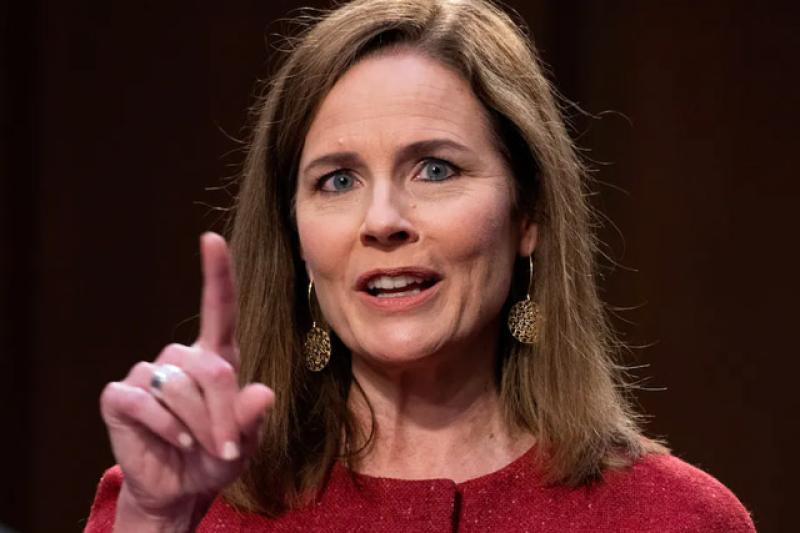
Besides, the photo of Barrett with her finger pointed up means what? She a Yankee or Red Sox fan?
Ultimately the right approach should be based on factors such as gathering size, the local environment where gathering takes place, the nature of the activity conducted there, etc. Whether or not the gathering is religious is entirely irrelevant.
But some sure like to make a big deal out of it.
Its not about singling anyone out. It's about gatherings. That's where Covid can best infect people. The type of gathering doesn't matter.
The nature of the activity as a factor is a cop out. Under Elena Kagan's standard of comparable treatment, these gatherings should receive treatment comparable to mass vaccination or Congress in session or a cabinet meeting or the holding facilities for migrant minors.
The BLM protests last year set a standard for comparable treatment.
How obnoxious. The 'nature of the activity' is far too general a descriptor for you to blindly deem it a cop-out.
By 'nature of the activity' I am referring to what people are doing at the site. (This should be obvious.) For example, there is a clear difference between people sitting quietly reading (such as in a library) versus a bar where they are screaming, laughing, dancing, etc.
See?
And to make this crystal clear to you: a Sunday School class is close to a library gathering whereas a church service (especially in very active churches) is closer to a bar gathering. It does not matter if it is religious, political, educational, medical, legal, scientific, entertainment, business, etc. What matters (as one factor) is what the people are actually doing relative to the size of the area, ventilation, etc.
Especially very active churches? I've never attended a church service that was even remotely comparable to a bar gathering.
Let's apply Elena Kegan's comparable treatment standard to the real world.
People can practice religion in private all they want. But they cannot impose their religion on others.
People can practice politics in private all they want. But they cannot impose their politics on others.
Kegan doesn't differentiate between religious and secular activities. Neither are you. So, a restriction on any activity must be applied so that all receive comparable treatment. By citing a comparable treatment standard Kegan has changed 'rights' to 'rights but'. We have rights but exigency takes precedent. Once that standard has been established it's only a small step to slip down the slope from exigency to expediency.
Kegan is making a dangerous argument.
I have to explain everything to you Nerm? How can anyone be unaware of church services where there is active singing, dancing, etc.? They do indeed exist. Not all church services are like a Catholic Mass. What do you think I meant by 'very active'? Do you think that translates into 'normal, conventional'?
Here is an example of a mildly active church service with Trump:
Here is an example of a more active church service:
Here is a very active church service (skip to 1:33):
Ever see this before?
And I wrote 'closer to a bar gathering'; that was a relative statement. Sunday-school⇔Library vs. very-active-church-service Service⇔Bar. Not a difficult thing to understand.
I will leave it up to you to find even more active churches such as those engaging in snake-charming services.
Anyway, Nerm, the point that you pretend to not grasp is that it does not matter why people are gathering; what matters is the nature of the environment of the gathering and what the people are doing while gathered (among other things).
When it comes to a pandemic it does not matter whether the gathering is religious, political, educational, medical, legal, scientific, entertainment, business, etc. What matters (as one factor) is what the people are actually doing relative to the size of the area, ventilation, etc.
Your seem to be arguing that religious gatherings should be treated differently than, say, educational gatherings. Why? Explain yourself.
After all, COVID-19 does not care why you are gathered. It will infect you in church, a bar, a grocery store. It all depends on what you are doing and the environment in which you are doing it.
I agree with the SCOTUS. In my opiniion, if those religious fanatics are so determined to meet their maker, why stop them?
Because they could turn around and infect you and me.
Damn, there goes the Rastafarian meeting tonight.
If you can smoke dope at home, you can pray to a Dope at home.
True but it seems one doesn't have to smoke dope at home to pray to a dope at home.
Swing and a miss... "Fair and loving"... Care to explain childhood cancer?
Didn't think so.
Not according to the bible. Especially the OT. God was a downright sadistic psychopath.
Thanks but first I don't need anyone's permission and second I don't worship any GOD.
Third I doubt the GOD I believe in isn't much different that the one you worship.
Considering you seem to believe as I do that GOD created everything.
My beliefs come from reading all the major religious books, the old testament, the new testament, the King James Bible, the Book of Mormon and parts of the Koran, visiting many denominations of churches, a lifetime of observation and much reflection.
I did all that on my own, no one told me what to believe because IMO: No one alive knows for sure anyway.
Ancient texts are just that ancient texts, words written by humans.
And GOD inspired me to say that. Before I wrote it.
That is the most real I have ever seen you be.
By the way, as much as I bitch...I hope everything is alright.