
Playbook: A reality check for Trump’s megalaw

By: Garrett Ross; with help from Eli Okun, Bethany Irvine and Ali Bianco (POLITICO)

First of all we need to acknowledge that the only real purpose of the One Big Beautiful Bill was to avoid sunsetting $400 billion in tax cuts and causing a recession. The MAGA priorities of border security and realigning the economy toward manufacturing can be easily separated from all the other Republican stupid shit in the OBBB. Trump got his so now he can throw the Libertarian and TEA Party phonies under the bus and walk away.
This is the last gasp of the 'small government' Libertarian nitwits and TEA Party obstructionists because there is nothing left to cut. Further tax and spending cuts would push the United States off the cliff. That may be good news for diehard Republican lemmings but the rest of the country would likely revolt.
Republicans have to do this again to enact the FY2026 budget by Oct. 1. Using the Democrats' reconciliation dirty trick to enact the OBBB probably won't work for the budget this time. And the trend toward omnibus budgets means some of OBBB cuts will likely be restored; especially if a budget impasse devolves to a CR cycle. Since the OBBB was not a budget bill, falling back on continuing resolutions to keep the government running may be an easy way to override some of those cuts. What do you think Democrats are going to do?
The DOGE Libertarian and TEA Party factions died on the hill of fiscal idiocy just to give Democrats political fodder to oust them from Congress. Goodbye, good riddance, these fake Republican won't be missed.
 S E E D E D C O N T E N T

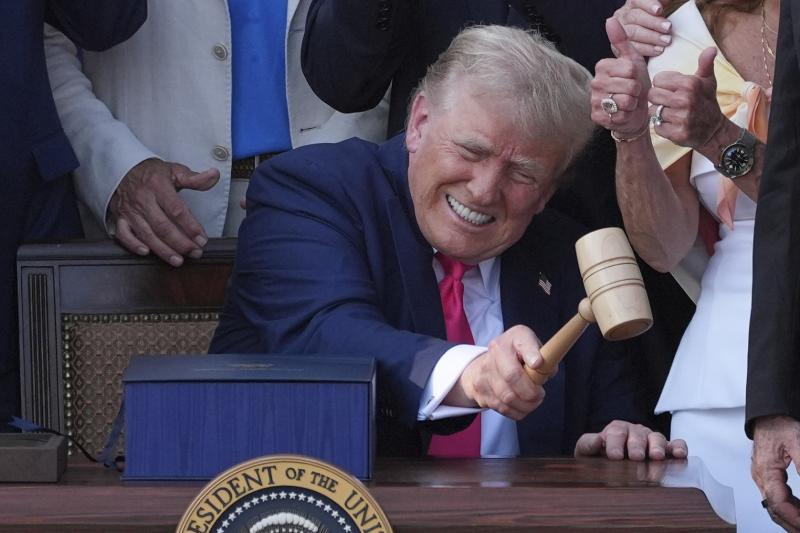
MAKING IT MEGALAW: President Donald Trump signed the sprawling megabill designed to jumpstart his domestic policy agenda into law in a July Fourth ceremony at the White House yesterday.
The scene at 1600 Penn: “Flanked by Republican legislators and members of his Cabinet, Trump signed the multitrillion-dollar legislation outside the White House, and then banged down the gavel that House Speaker Mike Johnson gifted him that was used during the bill’s final passage Thursday,” AP’s Darlene Superville and colleagues write. “The White House was hung with red, white and blue bunting for the Independence Day festivities. The U.S. Marine Band played patriotic marches — and, in a typical Trumpian touch, tunes by 1980s pop icons Chaka Khan and Huey Lewis. There were three separate flyovers.”
What Trump said: “America’s winning, winning, winning like never before,” the president said, also referencing the recent strikes against Iran. “Promises made, promises kept, and we’ve kept them.”
FIRST IN PLAYBOOK — Here we go again: If the dramatic votes in the House and Senate this week marked the end of a months long process of negotiation, infighting and compromise, it also started the clock ticking down the days before Congress has to do it all over again, POLITICO’s Benjamin Guggenheim writes this morning.
Cliff jumping: “That’s because the super-sized domestic policy legislation includes a sharp cliff for tax cuts and deep safety-net restrictions — teeing them up to be the subject of fierce political battles in the 2026 midterms and the 2028 presidential election. The most politically explosive cuts to Medicaid and the nation’s largest food program, for instance, are set to take effect in 2028. Meanwhile, Trump’s most popular tax cuts and a key deduction prized by blue-state Republicans are set to sunset in 2028 and 2029, respectively.”
In a pinch: Maine Sen. Susan Collins and Pennsylvania Rep. Brian Fitzpatrick are the only two Republicans who voted against the bill that are currently top targets for Democrats in 2026. But the structure of the legislation “ensures that the most politically perilous provisions in the bill will remain a hot potato — and an opportunity for moderates — for years to come,” Benjamin writes.
And beyond: The benefit cuts could crop up in the 2028 presidential race, too, when VP JD Vance, who cast the tie-breaking vote in the Senate and is seen as a key salesman for it, will likely be vying for the presidency. “Meanwhile, lawmakers in virtually every state will face pressure in 2028 as provisions kick in requiring most states to shoulder part of the costs of federal food aid for the first time.”
BURIED IN THE BILL: POLITICO’s Brian Faler ticks through the series of special tax breaks — costing tens of billions of dollars — that quietly caught a ride on Republicans’ sprawling megabill. Included are carveouts for venture capitalists, Alaskan fisheries, spaceports, private schools, rum makers and others.
“The legislation is primarily designed to prevent $4 trillion in looming tax increases set to hit at the end of this year. But, shortly before approving the plan, Senate Republicans added a new crop of unrelated, bespoke tax breaks. House GOP lawmakers got in their share, too. Many are the sort of narrowly targeted breaks Republicans have long complained are unfair, reward influential special interests and unnecessarily complicate the tax code.”
On immigration: The new law delivers the White House $170 billion for border and immigration enforcement. Now, the timer to spend it all has started, POLITICO’s Myah Ward writes. “The Trump administration has three-and-a-half years to drastically expand the nation’s border enforcement and deportation infrastructure, a massive logistical challenge for which there is no easy comparison.”
And the Trump administration knows it has a major lift ahead of it. “Look, this isn’t easy. Ten thousand ICE officers? Never happened before,” border czar Tom Homan told Myah. “But I’ll say this: It’s about time … with more money, we can do more.”
THE RESPONSE: The general consensus from blue state governors and lawmakers boils down to: Sit tight for now and blame Republicans, POLITICO’s Natalie Fertig reports. “Congress’ Medicaid cuts came as dozens of state legislatures dried the ink on their own annual budgets and adjourned — some for the summer, many for the year. But in the face of a funding chasm no state can bridge, uncertainty over the effects of the cuts and the view that Republicans will take the lion’s share of the blame, many blue states are opting to wait and see before trying to solve a problem they didn’t create.”
The real-world impact: With the bill now signed into law, state governments are already “bracing for impact as Washington shifts much of the burden for health care, food assistance and other programs onto them,” NYT’s David Chen and Pooja Salhotra report.
“Even before the bill’s final passage, state capitals were contending with a slowing economy and federal spending cuts implemented by the Department of Government Efficiency run by Elon Musk. Now they will be expected to administer complex new work requirements for Medicaid and food aid; rework some state health insurance exchanges under the Affordable Care Act; and decide how much they can do to keep their citizens insured and fed once they start losing federal assistance.”
THE REALITY CHECK: Despite Trump’s insistence that he’s ushering in an era of success that hasn’t been seen in “decades,” as he said at the White House yesterday, there are plenty of signs that — much like the cliffs built into his coveted new law — there is uncertain terrain on the horizon.
On the megabill: Passing the megabill was the hard part. Now comes the other hard part: Selling it to an American public. Despite the months of debate inside the beltway, voters are still deeply unfamiliar with everything that’s in the new law and how it will impact communities across the country, WSJ’s Aaron Zitner and colleagues report.
“Polls show that the bill is unpopular. Opposition outweighed support by more than 20 percentage points in recent Fox News and Quinnipiac University polls. Some Republican lawmakers facing tough races next year represent the most Medicaid-reliant districts. They will have to defend the big cuts in the bill to Medicaid, the health-insurance program for low-income and disabled people, as well as to rural hospitals and to nutrition assistance, once known as food stamps. Those cuts help fund tax cuts in the bill that President Trump called for during the 2024 campaign.”
On the economy: Though there have been some gains (and wins for Trump) in recent economic readings, the long-term view is still extremely unclear, WaPo’s Rachel Lerman reports.
“Gross domestic product shrank in the first quarter of the year in part because of surging imports, and consumers are feeling hesitant and spending less. It’s also too soon to know the full effect of Trump’s widespread tariffs, especially with a deadline approaching to get deals completed with many countries before levies rise once more. And as immigrants leave the workforce, either voluntarily or by deportation, a lack of workers could create labor shortages in certain key areas and fuel wage inflation.”
TURNING ATTENTION: A handful of top Trump officials will be on the Sunday show circuit tomorrow to talk up the new megalaw and the economy. Their messaging will come as we enter a week that is likely to be dominated with headlines regarding Trump’s trade agenda as he tries to secure more deals with major trading partners ahead of his July 9 deadline, when his so-called reciprocal tariffs are set to snap back into effect. Wall Street is warily watching, Reuters notes.
If it seems like there’s little to show from the White House on the trade front thus far, that’s not worrying those inside the administration. Just last week, Trump said “we can do whatever we want” regarding the looming deadline. That ambivalence has been a hallmark of negotiations, POLITICO’s Daniel Desrochers and Megan Messerly write. “And it highlights an important tension of Trump’s second administration: The president’s long-standing affinity for imposing tariffs is clashing with his reputation as a canny dealmaker.”
The scramble: “Foreign officials, trade experts, lawmakers and even some White House allies have expressed a nihilistic view of the July deadline, questioning whether a deal with the Trump administration means anything at all given the president’s penchant for using tariffs as leverage to get his way.”
Quite the quote: “Trump knows the most interesting part of his presidency is the tariff conversation,” a person close to the White House told Daniel and Megan. “I find it hard to believe he’s going to surrender it that easily. It’s all fake. There’s no deadline. It’s a self-imposed landmark in this theatrical show, and that’s where we are.”

Tags
Who is online

399 visitors
Hey, here's a bright idea. Let's put all the Republican stupid shit in one omnibus bill and hand Democrats the political fodder they've wanted for decades.
Goodbye, good riddance, these Republicans won't be missed. Maybe Lisa Murkowski can be the Republican minority leader in the next Senate.