
Russia Is Losing the War—Just Not to Ukraine

By: Jeremy Shapiro (The Atlantic)
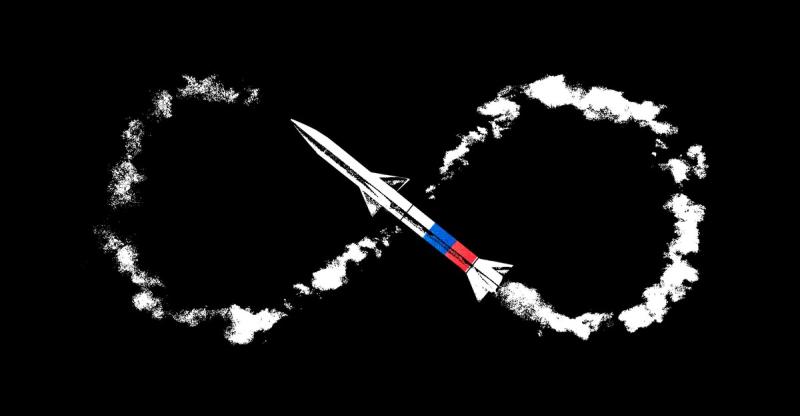


Russia is defeated again. But Ukraine is no longer important for that Russian defeat. In fact, the message now is that Russia consolidating the occupied Ukrainian territory doesn't avoid being defeated. Russia is going to be isolated and contained with or without Ukraine which represents defeat. Why is this shift in European objective important?
Russia had only served as Europe's bogeyman since the end of the Cold War and reunification of Germany. Russia had abandoned communism. Russia was not dominating trade. Europe and the United States had already invaded Russia with commercial investments and western capitalism. Russia was gradually being transformed into a market based economy. Russia was on the same path of economic development and western relations that had transformed China.
So what was the point of Obama aiding the newly appointed 'revolutionary' pro-western Ukrainian government so they could fight a civil war? What was the point of Joe Biden dragging the United States into the Ukrainian quagmire? Joe Biden choosing belligerence rather than diplomacy sacrificed the economic beachhead that had been established in Russia. Why was Ukraine so damned important to the United States?
 S E E D E D C O N T E N T
Vladimir Putin, we've been told since the start of the war in Ukraine, has goals that extend well beyond territory: He seeks to upend the post-Cold War international order, to reconstruct the Soviet sphere of influence, and to allow Russia to reassume its rightful position as a world power equal to the United States. Bilateral summits, such as the recent one between Donald Trump and Putin in Anchorage, offer a symbolic recognition of that aspiration—as Russian Foreign Minister Sergei Lavrov highlighted not so subtly by showing up in Alaska wearing a CCCP (U.S.S.R.) sweatshirt.
But summits and sweatshirts won't make Russia a superpower. Only a credible show of strength can do that. The war in Ukraine was meant to supply this, but it has instead become a slow-motion demonstration of Russia's decline—less a catalyst of national revival than a case study in national self-harm.
Moscow has devoted considerable resources, manpower, and political will to its invasion of the country next door. In purely military terms, it has managed not to lose and may even be eking its way toward some sort of attritional victory in the Donbas. But even if it consolidates its territorial gains and keeps Ukraine out of NATO, Russia will have won only a pyrrhic victory, mortgaging its future for the sake of a few bombed-out square kilometers. In other words, Russia is effectively losing the war in Ukraine—not to Ukraine, but to everyone else.
In virtually any likely end-of-war scenario, Ukraine will remain a hostile, Western-armed neighbor—a permanent sucking wound on Russia's western flank. Europe will continue to embargo Russian goods and build its energy future without Russia's Gazprom. The Russian army, having shown itself moderately adaptable to modern warfare, will nonetheless be gutted of equipment, bereft of its best cadres, and reliant on foreign suppliers. To reconstitute it will take years and many billions of dollars. By then, Russia's supposed mastery of modern drone warfare will probably be obsolete.
While Russia obsesses over Ukraine, its erstwhile friends and clients are quietly slipping away. In Africa, Wagner's heirs struggle to hold their franchises together, and China and the Gulf states are buying up influence, drawing from far deeper pockets. In the Middle East, Moscow's old claim to be an indispensable broker appears totally vacuous.
Nowhere is this clearer than in Syria. Moscow once celebrated its involvement in that country's civil war as part of a "Russian resurgence" that would restore the country to the ranks of great powers, showing that it could project influence and outmaneuver Washington in the Middle East. Now Syria has become a symbol of overstretch. The Bashar al-Assad regime, whose survival Putin once touted as existential for Russia, disappeared with barely a murmur from Moscow, leaving Turkey, Israel, the Gulf States, and the United States to carve up influence in the land it once ruled.
The South Caucasus were once Moscow's backyard playground: Azerbaijan and Armenia long depended on Russia for security guarantees, arms supplies, and mediation of their conflicts. Russia's implicit promise to Armenia was that its membership in the Collective Security Treaty Organization and its deep ties with the Russian military (as well as the Russian peacekeepers deployed on the disputed territory) would ensure protection against Azerbaijani aggression. But in 2020 and again 2023, Azerbaijan routed Armenia in the territory contested between the two states, showing how little weight Russian promises carried. Now the United States is negotiating peace between the two countries—something unimaginable even four years ago.
The one place Russia has effectively influenced is Europe, where NATO has expanded to include Finland and Sweden, and states have increased their military spending, courtesy of Russian belligerence. Putin appears to have engineered a strange geopolitical bargain: Moscow sacrifices its demographically scarce young men in the Donbas so that Europeans will finally buy air defenses.
At home, Russia's wartime economy looks like a parody of Soviet stagnation, exactly what Putin warned against in the early years of his presidency. Factories churn out shells and missiles even as the rest of the world invests in artificial intelligence, green technology, and microchips. The Kremlin has succeeded in building a fortress economy, but one that is fortified against the future more than against the enemy. This would be funny if it weren't so tragic for Russia's prospects: a petrostate doubling down on oil and artillery in the middle of a technological revolution. The Kremlin says it's waging a war of destiny; in reality, it's missing the 21st century.
The clearest proof that Russia is not winning lies in Beijing. Russia is running down its stocks of precision missiles, and without access to Western components, it has grown ever more dependent on imports from China to sustain its military machine. Each missile in turns costs millions of dollars (for example, approximately $1 million to $2 million for a Kalibr cruise missile) and increases Russia's need for fossil-fuel exports and capital. China is now Russia's largest oil customer, accounting for nearly 40 percent of Russian fossil-fuel-export revenue in 2025 so far (at discounted rates), and has also become its main source of foreign credit; Western finance has dried up because of the sanctions.
Far from making Russia a superpower, Russia's war against Ukraine has relegated it from would-be empire to China's disgruntled junior partner. For Xi Jinping, this war is a gift. It is diverting Western resources and bleeding Russia, all at bargain prices. For Putin, it's a trap.
Both Russia's defenders and its enemies suggest that a successful campaign in Ukraine will somehow produce a stronger, reinvigorated Russia capable of posing an immediate threat to Europe and beyond. But what exactly would Moscow have "won"? An angry, revanchist neighbor; a more unified, hostile Europe; a ruined economy; a gutted army; reduced international influence; and a boss in Beijing. That is not victory but self-inflicted decline.
This is perhaps why the Kremlin seems so uninterested in ending the war. A compromise peace would not expose a defeat on the battlefield but rather something far worse: the absence of any larger strategy. As one economist put it, "The Russian regime has no incentive to end the war and deal with that kind of economic reality. So it cannot afford to win the war, nor can it afford to lose."
In sacrificing its global influence for the chance to spend the past year pulverizing the previously unheard-of city of Pokrovsk in the Donbas, Russia has proved not its resilience but its near irrelevance. Russia has not rediscovered its imperial destiny. It has discovered only that it can still destroy—and that destruction is just about all that its foreign policy has to offer.
Jeremy Shapiro is the director of research and of the U.S. Program at the European Council of Foreign Relations.
Be a good human. Grossly derogatory comments, blatantly inflammatory comments, excessive trolling, mean-spirited taunting and insults, scamming, spamming, and off topic comments may be removed in compliance with the site's Terms of Service and the Code of Conduct. The moderators have the final word.

So, what do we do with a defeated Russia? Do we turn a defeated Russia into another Iran to justify NATOs continued existence? The plan outlined in the article assumes (or ensures) Russia will continue to be belligerent. That plan means Ukraine will not be allowed to recover; Ukraine will remain a battleground. NATO needs Ukraine so it can threaten a defeated Russia and justify its continued existence?
None of the scenarios discussing the end of the Ukrainian war include establishing peaceful relations with Russia. All the scenarios are contingent upon continued confrontation with Russia. That puts Ukraine in a no-win position.
Russia is going to be isolated.
By who?
By China?
By Mongolia?
By North Korea?
By Iran?
Belarus?
India?
Perhaps Turkey-- or even the make-believe country of "Palestine".
And then there are several countries in Africa who and friends with Africa and not the West!
As a member of BRICS, the Shanghai Cooperation Organization, the G20 and a voting member of the UN Security Council I doubt that Russia will be isolated. What is happening is "East is East and West is West and Never the Twain Shall Meet". Could a new Cold War be developing?