
Don’t expect correct change when paying with cash, some businesses warn

By: Addy Bink (The Hill via MSN)
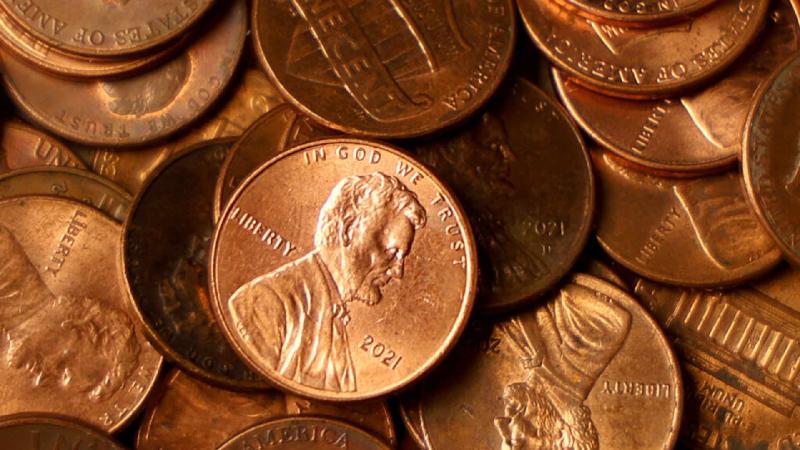


Neoliberal dundersharts wrecked our currency and now they're gaming the system to scrape another 2 cents off every purchase.
 S E E D E D C O N T E N T
(NEXSTAR) — As the saying goes, all good things must come to an end, and for the penny, the end may be coming sooner than expected.
Earlier this year, President Donald Trump called on the Treasury Department to stop minting new one-cent coins , calling them “wasteful.” A few months later, the Treasury confirmed it would stop putting new pennies into circulation in early 2026, with a spokesperson telling the Wall Street Journal in May that the final order of blanks had been placed.
Once there are no more blanks available, the U.S. Mint will stop producing pennies , the spokesperson said at the time. Without pennies, businesses will have to round cash transactions up or down, they added.
While 2026 is still more than two months away, some businesses have already found themselves facing a penny shortage.
As of late September, several Federal Reserve coin distribution sites have stopped fulfilling penny orders, taking penny deposits, or both.
The National Association of Convenience Stores warned last month that supply shortages were starting to emerge amongst its members, with more expected to be impacted.
Nexstar’s KFOR recently confirmed that dozens of Love’s convenience stores are being forced to round up change in favor of the customer during cash transactions. Penny shortages were expected in mid-to-late 2026, but the timeline had been sped up, leaving at least 54 stores feeling the pinch.
In early October, Wisconsin-based Kwik Trip announced it would adopt a penny-free cash rounding policy . The convenience store chain said it would round down cash purchases to the nearest five cents, Nexstar’s WFRV reported. Customers can, however, still pay with pennies — if they have them.
Other retailers have been warning cash-paying customers of potential impacts as well.
In a late-September Reddit thread , users claiming to be Home Depot employees said their stores had posted signs warning of a penny shortage, telling customers they need exact change for cash transactions. The home improvement chain did not respond to Nexstar’s repeated inquiries regarding the online comments.
Similar signs were seen at a PetSmart in Wisconsin and a Sheetz location in Pennsylvania.
In a statement to Nexstar, PetSmart confirmed its stores are “temporarily asking customers to pay with exact change when using cash, or to use credit, debit or other electronic payment methods.”
“We’re also offering customers the opportunity to round up their total to the nearest dollar, with the difference donated to PetSmart Charities to help pets in need,” the statement continued. “We appreciate our customers’ understanding and flexibility as we navigate this nationwide issue affecting retailers across the country.”
Nick Ruffner, public affairs manager for Sheetz, told Nexstar that some of the company’s stores “may experience limited availability of pennies.”
“To help manage this, we’re informing customers with in-store signage and encouraging the use of SheetzGo!, mobile app ordering or cashless payment options like debit and credit cards whenever possible,” Ruffner added. “Customers can also choose to trade in their extra pennies for a free self-serve drink or donate their spare pennies to support Sheetz For the Kidz. Donations can be processed through the register at all Sheetz locations to ensure all funds go directly to Sheetz For the Kidz, and the coins will then be recirculated for other customers.”
A spokesperson for Burger King also told Nexstar that while its U.S. restaurants are still accepting pennies, “exact change may not be possible” due to the shortage. Impacted Burger King locations may encourage customers to pay with exact change when using cash, they added.
There are concerns, however, about the potential confusion that rounding may cause among consumers. While Love’s and Kwik Trip are rounding in favor of the customer — rounding change up to the nearest nickel and rounding the total transaction down to the nearest nickel, respectively — there is precedent for transactions to be rounded in either direction.
Since Canada ditched its penny in the early 2010s, cash purchases in the country have been rounded up or down to the nearest nickel: a $19.82 purchase becomes $19.80 while $19.83 becomes $19.85.
However, the U.S. has so far not established such a process. In a letter to the Senate Banking and House Financial Services Committees late last month, the NACS called on lawmakers to establish a national law that would allow businesses to round cash transactions up or down, saying that “at least ten states and localities have cash laws that would prohibit this practice.”
A bill to do just that (and to halt the minting of the penny) was introduced by Rep. Lisa McClain (R-Mich.) in April. The House Committee on Financial Services recommended that an amended version of the bill be passed. It has since been placed on the calendar; however, amid the government shutdown, it’s difficult to say when the bill could reach the House floor, if at all.
As for now, if you’re planning to pay with cash at a store or restaurant, you may want to prepare to receive slightly more change than you’re actually owed.
Be a good human. Grossly derogatory comments, blatantly inflammatory comments, excessive trolling, mean-spirited taunting and insults, scamming, spamming, and off topic comments may be removed in compliance with the site's Terms of Service and the Code of Conduct. The moderators have the final word.

Tags
Who is online
197 visitors
Guess now the price of everything will end in '3' to grab a free 2 cents. Another centless act of unearned financial entitlement.
These welfare programs for the wealthy are becoming ludicrous.
Morning Nerm..not sure how you mob will work it but everything here still ends in odd cents...
It's is only the final total that is rounded up or down not individual prices...
So if you buy 6 items and they all end 3 cents, 2 cents, 7 cents etc and your total bill comes to $123.48 cents you pay $123.50...
It will cost you a heck of alot more to mint the coins out of your tax payer dollars than it does at the cash register..
It all works very well here...
Here is the States the odd cents on a transaction results from sales taxes applied after the sale. Government taxes (usually sales taxes) are charged on commercial transactions regardless of method of payment.
Yes, the rounding acts as a transaction tax similar to sales taxes. Card merchant fees are spread across the shelf prices so it wouldn't be difficult to round the shelf prices. But that doesn't avoid the problem of sales taxes.
$118 million to mint pennies (about $0.04 apiece). I don't know if that includes money recouped through seigniorage. Seigniorage is an inflation tax imposed by the Federal Reserve when new currency is ordered.
Some would consider this the cost of doing business. Neoliberals only claim they want government to run like a business so they can hide cheating the public.
Canada did it back in 2012 and the world didn't come to an end. If 3 or 4 pennies are the difference between getting a purchase and starving, I will submit that the person has much bigger issues to worry about.
So, move to Canada. Take the neoliberal geniuses with you.
Snuffy is correct and everyone in Canada is happy about it except for one or two of the elderly who took sadistic pleasure in counting out a pouch of pennies at rush hour.
1 - 2 cents are rounded down and 3 - 4 cents are rounded up. No matter how hard you try haystacks are not mountains.
Well, good for Canada. But this is not Canada.
In the United States, neoliberals will ensure that everything is rounded up. Neoliberals aren't going to give up free money.
Fuck no!!! They have two problems up there. Sky dandruff (snow for those who don't know) and really cold weather. I moved to Arizona many years ago and there are a couple of weeks in December if I don't wonder if I didn't move far enough south.
Morning...glad you translated sky dandruff I didn't have a clue what you were talking about..🤣
Umm didn't Arizona just have floods?? Tad wet there at the moment?
Yeah, 8 months of rain in 72 hours here in the Phoenix area. Too bad most of it ran off. A few areas around the state got hit very bad. A friend of mine lives in Globe, they have a lot of flooding in the past few years thanks to a fire that burned thru a very large area uphill from them. This time around he lost his car due to the flood. No house damage but a few belongs where so waterlogged they were destroyed.
I had no damage near me on the west side, the majority of the rain was on the east side of the valley.
What does that have to do with government providing services and standing behind the country's currency?
This is just another neoliberal bright idea. Neoliberals won't do anything that does not cheat workers, consumers, and savers. And it's not 4 cents, it's 2 cents on every transaction. Neoliberals would sell their soul for a 2 cent cut on every transaction.
Hundreds of millions of payment transactions take place every day in the United States. You actually think the neoliberals will stop at cash transactions? Neoliberals would argue that universal rounding for all transactions would be more consistent and improve efficiency. Forcing every transaction to round up to the nearest nickel would generate between $5 billion and $10 billion of free money each year.
The United States government cannot afford to stand behind its currency. If the Federal government won't back its own currency then what value does it really have?
Neither are the Neocryptos and they basically got Do-What-You-Want cards in addition.
So, who gets the additional money from the rounding? Does the merchant keep it or is it added to sales taxes?
There are all manner of taxes applied to economic transactions with sales taxes being the most common. So, will the subtotal be rounded (for the merchant) and then the total be rounded (for sales taxes)? Otherwise there will be questions over who gets the money from rounding.
Or should merchants be allowed to round the shelf prices? That would be similar to how card merchant fees are handled now. That way all transaction subtotals would add to the nearest nickel. Then the total could be rounded for sales taxes.
And the rounding wouldn't be limited to cash transactions. Those paying with a card, check, or electronic transfer at the register would also pay the rounded amount. And why would in-person transactions be handled differently than on-line or mail transactions?
The rounding in Canada is only on cash transactions and they only account for 11% of all retail sales.
Once again you are imagining a nonexisting problem.
Is the rounding applied to the subtotal or to the total? How are the proceeds from the rounding divided between merchant and government?
Here in the States there can be 3 separate sales taxes applied to one transaction. We can have state, county, and city sales taxes. That means the tax amounts are dependent upon location. And it's not unusual for sales taxes to be fractions of a percent. A sales tax of 7.65% on the subtotal isn't unusual. So how will the tax from the rounded total be divided among the taxing authorities? Or will the amount be rounded after each tax is applied?
Other fees can be applied to a purchase such as recycling fees, warranty fees, and shipping costs.
The need to perform rounding for cash payment and not for electronic payment introduces complexity and current registers may not be able to accommodate the new requirement. That problem was encountered with card merchant fees and the resolution of the problem was to average the merchant fees across shelf prices. But that won't work for the rounding problem.
These are not nonexistent problems. The rounding creates problems for both the merchant and the taxing authority. With an average of 750 million transactions per day in the US, the amounts of money are not inconsequential.
An item sold for cash at $19.97-99 will be charged at $20. An item sold for cash at $199.97-99 will be charged $200 ... buy a $9,999.97-98 item for cash and the bill will be $10,000; in all cases one is dealing with +or- 2 cents ... ouch @!@
The number of cash transactions in the USA are similar to any other modern economy: 10-12% of all retail transactions and those percentages are falling fast.
I suggest you worry more about the machinations of the cyber currency crowd who are trying to make the mint obsolete.
Which is why I said if that's going to make or break someone's day they have bigger problems to confront.
Morning Snuffs...geez you mob were late..
We got rid of 1 and 2 cent coins back in 1992...best thing we ever did..
Cost more to mint them than what they were worth...
So much for these....
Songs with “Penny” in the title
When I was a kid, I actually DID put pennies on the train track to flatten them out.