
Trump's Approval Rating Drops to 36%, New Second-Term Low

By: Megan Brenan (Gallup. com)


Trump is losing support among Republicans and Republican approval of Congress has tanked. Trump is not helping to turn around voter sentiment and whatever Republicans are doing isn't working.
An ill wind is blowing across the political landscape.
 S E E D E D C O N T E N T
WASHINGTON, D.C. — President Donald Trump's job approval rating has fallen five percentage points to 36%, the lowest of his second term, while disapproval has risen to 60%. The latest decline follows three months of stability, with 40% to 41% of Americans expressing approval of his handling of the presidency. His prior second-term low point in approval was a statistically similar 37% in July, and his all-time low was 34% in 2021, at the end of his first term after the Jan. 6 attack on the Capitol.
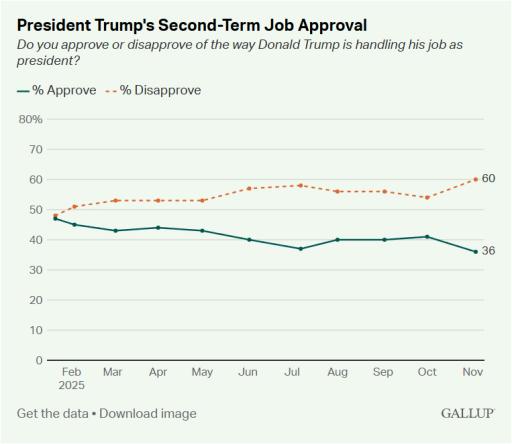
The latest findings are from a Nov. 3-25 Gallup poll that spanned off-year elections, which resulted in gains for Democrats. In addition, the poll was conducted as the federal government shutdown became the longest in U.S. history before its eventual resolution on Nov. 12.
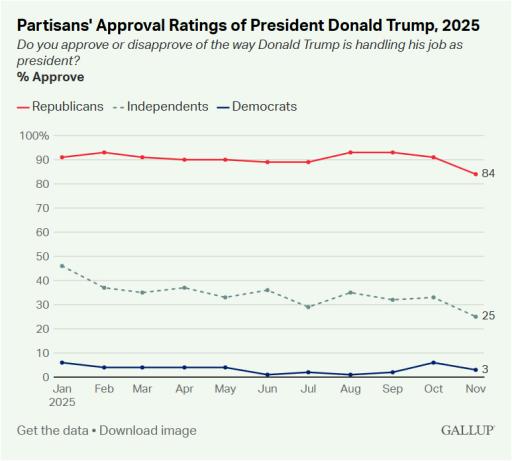
Both Republicans' and independents' ratings of Trump have worsened significantly since last month. Republicans' approval has fallen seven points to 84%, while independents' has slipped eight points to 25%. Republicans' rating is the lowest of Trump's second term, while independents' is the worst in either term. Trump's prior low point among independents, 29%, was last recorded in July and, prior to that, was only seen once before, in August 2017.
Meanwhile, Democrats' rating of the president remains mired in the low single digits (3%).
Trump Rated Best on Crime, Worst on Healthcare, Ukraine, Federal Budget
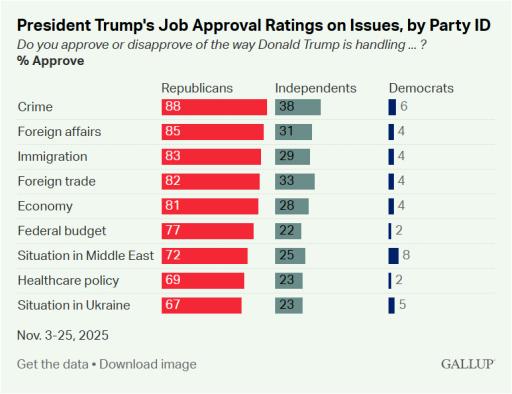
Trump is also rated more negatively than positively on nine foreign and domestic issues, but his approval ratings for four of these — crime (43%), foreign affairs (41%), foreign trade (39%) and immigration (37%) — exceed his overall job rating.
His ratings on the other five issues match or trail his overall rating and include the economy (36%), the situation in the Middle East between the Israelis and Palestinians (33%), the federal budget (31%), the situation in Ukraine (31%), and healthcare policy (30%). Notably, the federal budget and healthcare policy are specifically related to the government shutdown.
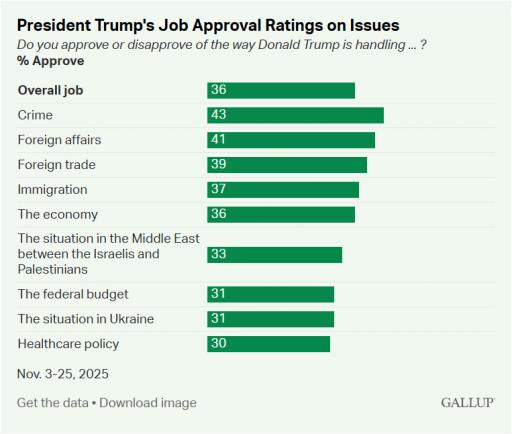
Trump's handling of most of the issues, all but crime and healthcare, was measured earlier this year, in July and August. Each of the current ratings is in line with the prior ones, but there has been a significant erosion in approval since February for Trump's handling of immigration (-9 points), the situation in the Middle East (-7 points) and the economy (-6 points). Since March, Trump's ratings have declined by double digits on the federal budget (-12 points) and the situation in Ukraine (-10 points).
Large majorities of Republicans, ranging from 67% to 88%, now approve of Trump's handling of the nine issues, with the situation in Ukraine and healthcare policy garnering the lowest ratings. Independents' approval ratings range from 22% to 38%, while no more than 8% of Democrats approve of his handling of any of the issues.
Congressional Approval Rating Remains Low
After dropping 11 points in October to 15% amid the federal government shutdown, Americans' approval of the job Congress is doing is essentially unchanged at 14%, with disapproval at 80%.
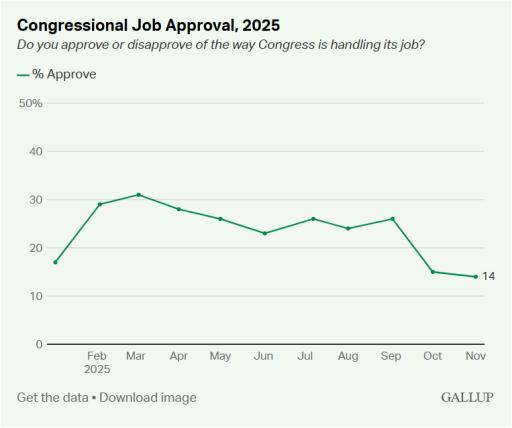
Though low, the current reading is not quite as poor as the all-time 9% low point that was recorded shortly after the 2013 federal government shutdown ended. In contrast, during the 2018-2019 government shutdown that was the longest before this year's surpassed it, Americans' rating of Congress was not significantly affected, as it remained near 20%.
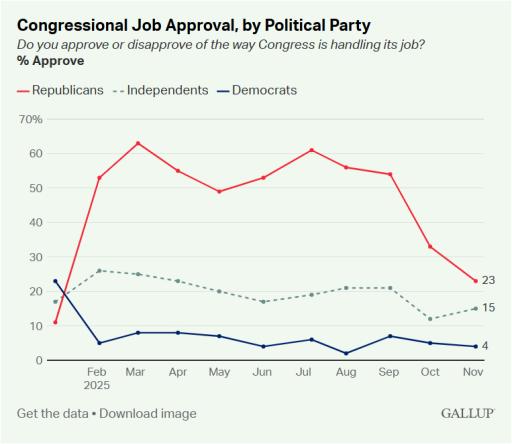
Republicans currently continue to offer a more positive rating of the Republican-led Congress than Democrats do, but the party gap is much narrower than it was earlier this year, as Republicans' approval has sunk to 23% from 54% in September, before the shutdown began. Meanwhile, 15% of independents and 4% of Democrats now approve of the way Congress is handling its job.
Bottom Line
The longest shutdown of the federal government, election losses for the Republican Party and continued concerns about affordability appear to have damaged Trump's standing with the American people in November, especially Republicans and independents. His overall job approval rating is down to the lowest point of his second term, and it is approaching the low from his first term. His ratings on individual domestic issues such as the economy, immigration and the federal budget deficit, which were previously areas of relative strength for him, are no longer.
Reduced majorities of Republicans approve of his overall job and his actions on many of the issues, and independents offer increasingly negative assessments of Trump. Coupled with the recent electoral losses for the Republican Party, this could be a sign of trouble for Republicans in next year's midterm elections, when the GOP will try to maintain full control of the federal government.
Be a good human. Grossly derogatory comments, blatantly inflammatory comments, excessive trolling, mean-spirited taunting and insults, scamming, spamming, and off topic comments may be removed in compliance with the site's Terms of Service and the Code of Conduct. The moderators have the final word.

Tags
Who is online
107 visitors
The 2014 midterm elections experienced the lowest midterm turnout since 1940. And this election looks like it could drive voter participation even lower.
The political brands for both parties could be used as fertilizer right now. So, what's the alternative?
There is no alternative. MAGA needs to be voted out.
The US is a two party country.
From your posted articles, I doubt you have any idea what MAGA means. Jesse Ventura's governorship of Minnesota was a preview of what the grassroots expects of MAGA. And Ventura did not try to drown the Minnesota government in any bathtub. Ventura really did try to reform government while avoiding throwing the baby out with the bath water.
Sez who??? Educate yourself John - educate yourself.
Amazing what an open mind can find, wouldn't you agree?
Not at all. Rage works. Democrats will show up and win the house and the senate. Republicans don't really show up without Trump on the ballot.
Elections aren't that complicated and the same pattern plays out over and over, especially when the out of power is out of their minds with rage and thus motivated to show up. .
I'm not sure that conventional rationale holds up to scrutiny in today's political climate. Gen Z voters have been waffling; they're an unreliable voting block for both parties. The MAGA base strongly approved of tariffs, do not whine about taxes, wants to cut NATO adrift, and really haven't complained about more government spending. Does that even remotely sound like conventional Republicans?
For this mid-term election a Republican candidate repudiating Trump won't cost anything. Republican candidates can compete with Democrat candidates as 'not Trump' alternatives because Trump is a Lame Duck. Trying to make the mid-term election a referendum on Trump won't go very far because Republicans won't need to defend Trump. What's the motivation to turn out voters with a 'not Trump' Republican and Democrat on the ballot?
Sure it will. Republicans won't for him or her and neither will a democrat. We've seen this play out time and time again the last decade. Kinzinger spoke out against Trump was gerrymandered out his district by Democrats and had zero chance of wining a republican primary. There is zero to be gained for a Republican to repudiate Trump and the downside is enormous.
hat's the motivation to turn out voters with a 'not Trump' Republican and Democrat on the ballot?
Democrats are energized. They don't care if the Republican is "not Trump" or not. They want to stick it to Trump by voting against a Republican. Democrats won't support a moderate democrat. Why would they support a moderate republican over a straight ticket voting democrat.
Issues don't matter in mid term elections. They only thing matters is which side turns out their base more and unless Democrats pull another Kavanaugh it's highly unlikely Republican voters will turn out to the extent democrats do.
Democrats may be energized but they're not unified. Chuck Schumer's government shutdown stunt eroded Democratic unity even further. Just being anti-Trump won't be enough to motivate Democrats. Everything will depend upon which faction a Democratic candidate represents.
Except for independents. Turnout for the mid-term election will be significantly influenced by persuading independent voters. Republican and Democrat candidates turning anti-Trump means they will have to run on issues to differentiate themselves. And Democrats typical Big Government advocacy may not go over well with independents this time.