
Gen AI at the Holiday Table: Can Machines Help Strengthen Family Traditions?

By: Arman Kamran (Medium)


 S E E D E D C O N T E N T
Every holiday season, families gather around tables that hold more than food. They hold memory.
A familiar dish prepared “the way it’s always been done.” A story repeated for the hundredth time, slightly altered with each telling. A song that plays every year, even if no one remembers who first chose it.
Traditions are not written instructions. They are living patterns (emotional, sensory, and social) that survive because they are passed from one imperfect human to another.
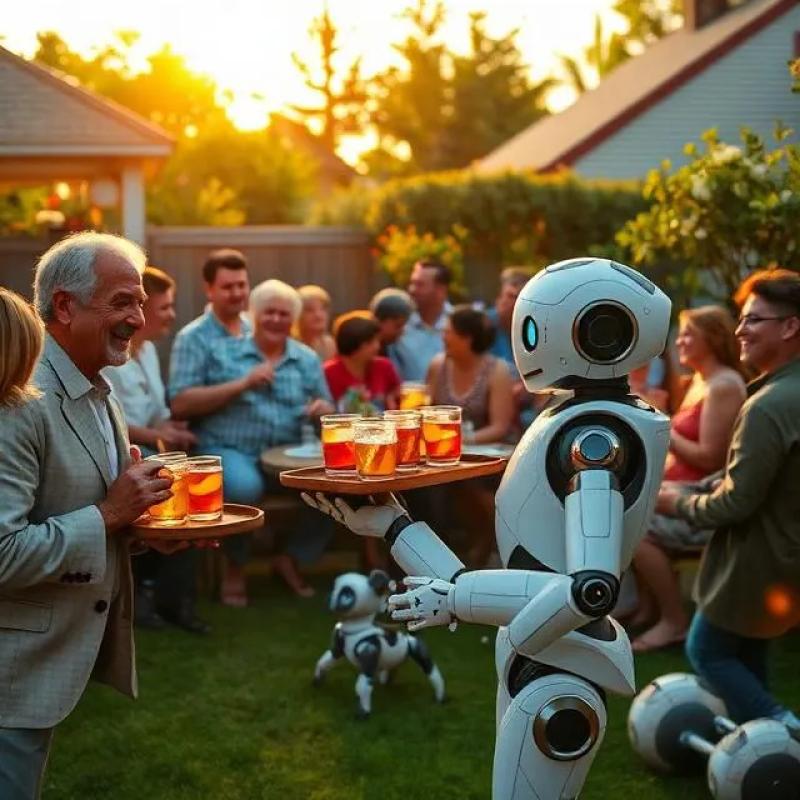
But this year, there is an extra presence at the table! It is not visible, not even invited, but undeniably involved.
Generative AI.
It suggests recipes, crafts family activities, curates playlists, drafts holiday messages, plans gift ideas, manages budgets, and even helps parents decide how to create “meaningful moments” for their children.
And that raises a quiet but profound question:
Can machines help strengthen family traditions — or are they subtly reshaping what tradition means in the first place?
Traditions Are Not Tasks
To understand what is at stake, we must first understand what traditions actually are.
From a neuroscientific perspective, traditions are not routines. They are memory anchors — patterns that reinforce identity through repetition, emotion, and social bonding.
When a family repeats a ritual year after year, the brain doesn’t store it as a checklist. It stores it as a network of associations:
- The smell of food linked to safety and belonging
- Familiar faces reinforcing social identity
- Predictable structure reducing cognitive load and anxiety
- Emotional peaks encoded more deeply into long-term memory
Research in cognitive neuroscience shows that emotionally charged, socially reinforced experiences are among the most durable forms of memory. This is why traditions survive even when people forget dates, names, or details.
Traditions persist because they are felt, not optimized, and this is where Gen AI enters unfamiliar territory.
What Gen AI Does Exceptionally Well
Generative AI excels at pattern recognition, synthesis, and personalization. It draws from vast cultural datasets to offer suggestions that feel relevant, thoughtful, and emotionally attuned.
At the holiday table, this can look like:
- Reconstructing old recipes from fragmented family notes
- Translating cultural traditions across languages and generations
- Helping immigrant or diasporic families reconnect with lost customs
- Offering ideas that engage children in age-appropriate ways
- Reducing stress by planning meals, schedules, or budgets
Used carefully, AI can act as a memory amplifier, helping families recover traditions that were broken by distance, time, or circumstance.
For families who have lost elders, moved across countries, or grown up disconnected from cultural roots, this is no small thing. AI can help bridge gaps that humans alone sometimes cannot.
In this role, Gen AI is not replacing tradition but supporting recall … and if we are not careful support can quietly become substitution.
From Remembering to Generating
Here lies the subtle shift.
Human traditions are inherited while AI-generated traditions are synthesized.
A grandmother’s recipe contains idiosyncrasies — substitutions made during shortages, adjustments based on taste, mistakes that became features.
These imperfections carry history.
An AI-generated recipe, by contrast, is derived from statistical consensus. It reflects what is most common, most liked, most rated — not what is most personal. The same applies to holiday games, family activities, celebration structures, and even emotional guidance.
When families increasingly rely on AI to tell them what meaningful traditions look like, something changes. Tradition stops being an inheritance and starts becoming a recommendation … and recommendations, by design, optimize for predictability.
The Neuroscience of Authorship
One of the most overlooked aspects of tradition is authorship.
From a psychological standpoint, humans attach deeper meaning to experiences they believe they helped create.
This is known as the IKEA effect — we value things more when we have participated in their making.
The same principle applies to rituals.
When families create traditions organically — through trial, error, and adaptation — the brain encodes those experiences as self-authored. This strengthens emotional ownership and identity formation. But when an external system increasingly designs these moments, authorship subtly shifts.
The experience may still feel warm and the moment may still be enjoyable … but the sense of ownership weakens.
Over time, this can lead to a form of emotional outsourcing — where meaning is consumed rather than constructed.
Children, Memory, and the Quiet Question of Who Decides
This question becomes especially important when we think about children.
Children do not remember holidays as sequences of events. They remember them as emotional patterns:
- Who was present?
- How safe they felt?
- What felt special or repeated?
- What felt uniquely theirs?
If AI increasingly curates the stories, games, conversations and the structure of celebration, then who becomes the author of childhood memory?
Will children remember their family’s way — or a polished, optimized version of what families like theirs usually do?
Neuroscience tells us that identity formation relies heavily on distinctiveness.
What makes a family feel like us is often the small, inefficient, slightly odd things that do not generalize well. AI, however, generalizes exceptionally well. This is not a moral failure of technology but a design reality.
Emotional Efficiency vs. Emotional Depth
Gen AI is often framed as a tool to reduce stress and by minimizing decision fatigue, it frees cognitive resources for connection.
But emotional depth does not always emerge from efficiency. Some of the most meaningful holiday moments come from:
- Arguments that resolve into understanding
- Meals that go slightly wrong
- Awkward silences that lead to honest conversations
- Traditions that exist “just because,” without justification
These moments are hard to optimize. If AI nudges families toward smoother, more predictable experiences, we may gain comfort — but lose texture … and texture is where meaning lives.
The Role of Institutions and Design Responsibility
This question extends beyond the home. As Gen AI becomes embedded in financial planning, wellness guidance, caregiving support, and life-stage advice - especially during emotionally charged seasons like the holidays - institutions face a design choice.
Will AI systems be built to support human judgment? … or quietly replace it?
For organizations that deal in trust, wellbeing, and long-term relationships, this distinction matters deeply.
Technology that augments human reflection strengthens trust but technology that substitutes it risks eroding agency.
The difference is not capability but intention.
A Simple Rule for Letting AI Sit at the Table
Gen AI does not need to be excluded from family traditions, but it must be positioned carefully.
Let AI help you prepare, remember, translate and organize … but let humans decide what matters, what stays imperfect and what gets repeated.
Traditions do not survive because they are efficient. They survive because they are remembered by people, through emotion, over time.
Let AI help set the table but let humans decide what the meal means.
Thanks
Arman Kamran
Be a good human. Grossly derogatory comments, blatantly inflammatory comments, excessive trolling, mean-spirited taunting and insults, scamming, spamming, and off topic comments may be removed in compliance with the site's Terms of Service and the Code of Conduct. The moderators have the final word.

Arman Kamran's advice of seeking a 'middle path' seems to ignore that commercial interests are already deploying generative AI in hopes of transforming what is popular into a profitable tradition. Used properly, generative AI could become a bulwark against commercial erosion of traditions.
no
Something we can agree on