
Trump tariff refunds: What to expect as fight for billions begins

By: Lori Ann LaRocco (CNBC)


DOOM LOOP!
Trump had a golden opportunity but pissed it all away. What else would an incompetent braggart do?
 S E E D E D C O N T E N T
Published Fri, Feb 20 202610:40 AM EST
- The Supreme Court ruling that many of President Trump's tariffs are illegal will lead to a process where billions of dollars in refunds, as much as $175 billion, will be sought by companies, but the ruling did not clearly grant refund payments.
- Importers also laid out billions for bonds and collateral required by U.S. Customs and Border Protection to guarantee payment of trade duties.
- The ruling provided no specific guidance on refunds, and in his dissent, Justice Brett Kavanaugh made a point of noting this, and he referred to comments during the oral arguments that the refund process may be a "mess."
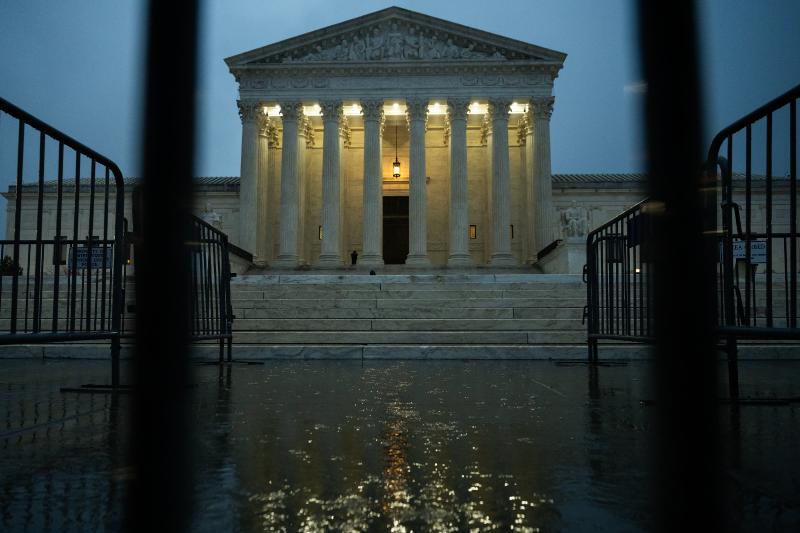
The US Supreme Court during a rain storm in Washington, DC, US, on Friday, Feb. 20, 2026. Annabelle Gordon | Bloomberg | Getty Images
U.S. importers will be facing double hurdles trying to recover billions in tariff costs now that the Supreme Court has ruled President Donald Trump's IEEPA tariffs are illegal.
Companies large and small may be eligible for refund payments that in total could reach hundreds of billions of dollars, but trade attorneys have warned that tariff refunds could be delayed, depending on how U.S. courts rule and how U.S. Customs goes about issuing payments.
Trump wrote in a social media post on Jan. 12 that "it would take many years to figure out what number we are talking about and even, who, when, and where, to pay." He added: "It would be a complete mess, and almost impossible for our Country to pay."
Record tariff revenue has been recorded by the U.S. government, with tariff collections surging in January to $30 billion and reaching a year-to-date total of $124 billion. That is up 304% from the same period in 2025.
The Supreme Court decision could mean as much as $175 billion sought in refunds, but the ruling was silent on whether tariffs that have been paid under the higher rates will need to be refunded.
In his dissent from the majority SCOTUS decision on Friday, Justice Brett Kavanaugh wrote, "the Court's decision is not likely to greatly restrict Presidential tariff authority going forward. But the Court's decision is likely to generate other serious practical consequences in the near term. One issue will be refunds. Refunds of billions of dollars would have significant consequences for the U. S. Treasury. The Court says nothing today about whether, and if so how, the Government should go about returning the billions of dollars that it has collected from importers. But that process is likely to be a 'mess,' as was acknowledged at oral argument."
Lori Mullins, director of operations at Rogers & Brown Custom Brokers, stressed that the decision does not grant or guarantee refunds. "They have remanded this back down to the lower courts to decide if refunds will be issued. Without knowing for certain, many believe that the refunds will not be issued retrospectively," she said.
For importers hoping for refunds, "the answer is yes, we have a ruling but we do not have a ruling on if any refunds will be granted. That will be handled by a lower court at a future date/ time."
"Keep in mind also that several countries have also already signed written agreements with specific tariff rates such as the signed agreement with the UK for a flat 15% tariff. This does not impact those already signed agreements so we are not sure, right now, how those country specific agreements will be impacted if at all," Mullins added.
In the lead-up to the decision, importers and customs experts have been pushing back on claims about refunds being a "messy" process, saying that because the tariffs being paid are itemized, the process for refunding the money should be straightforward.
Even if courts ultimately rule refunds are required, importers betting on a cash infusion from tariff refunds should be aware there's no set timeline and any rush for refunds could overwhelm the system and likely lead to long delays, Tim Keeler, partner and co-leader of international trade at Mayer Brown and former chief of staff for U.S. Trade Representative Susan Schwab, recently told CNBC.
The Court of International Trade is typically in charge of refund processes. For starters, the Court of International Trade and litigants who file cases against the tariffs, in coordination with the U.S. government, would need some time to figure out how to manage any refund process.
Trade experts have previously told CNBC the refund issue could be sent back to the CIT. The Department of Justice and the litigants in the tariff cases previously asked the CIT to appoint a steering committee to manage the more than 1,000 refund-related cases filed to date. It's common for a steering committee to be established to manage the tariff repaying process,
Companies will not only be seeking billions in tariff refunds, but billions are tied up in customs bonds and collateral. Tariffs not only lead to additional import taxes, but by inflating the cost of the products, result in the need for importers to increase the value of customs bonds the government requires them to hold.
International trade experts told CNBC that with some tariffs increasing from 10%-25% or more for certain products, importers are facing customs bond amounts that now range from the minimum bond amount by regulation of $50,000 to as high as $450 million.
The increase in bond values have left some companies forced to put up additional money in the form of collateral to ensure they could pay the tariffs.
The rise in tariffs and related need for bonds and collateral has led to a historic number of "bond insufficiencies." U.S. Customs told CNBC they identified over 24,000 customs bond "insufficiencies" valued at nearly $3.6 billion. That's double the 2019 level when insufficiencies first soared due to Trump's first-term tariffs under Section 301 of the 1974 Trade Act.
Importers have told CNBC because tariffs are itemized, as are their customs bonds and collateral documentation, in theory they should be able to receive their refunds quickly. However, trade attorneys also say it may also be difficult for companies to get any refunds on bond overpayment or collateral quickly because the insurers will want to make sure they are not exposed to any tariff payments.
Vincent Moy, international surety leader for Marsh Risk, recently told CNBC that companies should expect some lag time in receiving these customs bond funds due to insurance paperwork requirements. The insurance company will need to verify and audit the paper trail before it releases any collateral.
Some sureties have collateral return review procedures that can take 30 to 60 days for them to go back to underwriting to review. Many small and medium-sized businesses were expected to be reaching out to their insurers ahead of the SCOTUS decision to get the process of review started. "If you are hoping that the collateral will just be returned in due course, the squeaky wheel may make this happen a little bit faster," Jennifer Diaz, board-certified international attorney at Diaz Trade Law, recently told CNBC.
Be a good human. Grossly derogatory comments, blatantly inflammatory comments, excessive trolling, mean-spirited taunting and insults, scamming, spamming, and off topic comments may be removed in compliance with the site's Terms of Service and the Code of Conduct. The moderators have the final word.

Tags
Who is online
94 visitors
The US services economy simply cannot compete in an interconnected global marketplace. Now we've lost the last, best hope to reinvigorating the productive economy.
Thank you, Donald J. Trump, for pissing away the country's future. Pin a medal on his ass and kick him out the door. With friends like Trump, we don't need boogey men.
Of course it can. It has and it will continue to do so as long as we don't kill it with excessive regulation or taxation.
Don't pretend it has no value simply because you don't understand it.
The US cannot export insurance. The US cannot export merchant's fees. The US cannot export distributor services.
The value of the dollar has not decreased by 88% since 1971 because the economy has been productive. A services economy is very good at creating inflation that devalues the dollar. Devaluing the dollar to reduce the cost of debt does not create wealth.
Services are economically extractive activities that rely upon a large number of middlemen. Those middlemen contribute to inflation and devaluation of the dollar. Are you suggesting a middleman economy is productive?
We do so all the time. Along with banking, capital market services, software, advertising, architecture, engineering, legal services and a shit load of other services.
The value of the dollar has decreased because the US Govt spends too many of them and the Federal Reserve creates new ones out of thin air.
That's not how that works. Currency values rise or fall based on the relationship between their scarcity and the scarcity of the goods or services for which they are exchanged.
Lending creates new money. When you borrow money from a bank, you have the money in your account, but they also have your note on their books as an asset.
Nobody borrows more money than the US Govt.
Every time they borrow another dollar, they reduce the value of the existing ones. And they do that by the trillions.
So your assertion here is that there are fewer middle men in the auto industry than in the engineering industry? Have you been to a car dealership? I'm not sure that works out.
I'm suggesting your idea of a "services economy" fails to consider most of the services actually involved.
That's not how government debt works. Private debt creates dollars out of thin air. And, at present, there is 2.75 times more private debt than public debt.
Again, that's not how government debt works. The Federal government must extract existing money from the economy for every dollar it spends. Federal treasuries are purchased with existing money; not newly created money.
And, again, there is 2.75 times more private debt in the United States than public debt. The interest payment on public + private debt is currently around $6 trillion. The debt and credit industry is a purely extractive economic activity.
The engineering industry? That needs fleshed out a little more. Besides, you are attempting to compare two productive activities.
Wouldn't you say there are more middlemen in insurance than in the auto industry? Wouldn't you say there are middlemen in the financial sector than in the engineering industry?
That's possible. But I'm not sure your idea of productivity and wealth generation is economically sound.
That's inaccurate.
When the govt overspends, the Fed creates deposit accounts, most of which are swapped for US treasuries.
The Fed has directly purchased over $8 trillion in US treasuries since 2008 with newly created money. That's what quantitative easing is.
How, specifically?
Define "productive" as you're using it here. It would be a bit silly to disagree about words when we're not even using them the same way.
I guess that depends on how we define "middlemen".
When you use the term, who are you describing?
That's Quantitative Easing which creates bank reserves backed by US treasuries. That allows commercial banks to engage in more lending (which prints money) and is suppose to collateralize the created bank reserves. (As originally envisioned, QE would act as a deferred sale of US treasuries.)
The Fed had switched to Quantitative Tightening to combat inflation which allowed the treasuries on its portfolio to mature without repurchase. The Treasury had to auction those matured treasuries which extracts money from the economy.
At present the banking system is in an equity trap. The banking system now expands lending based on equity obtained from interest on reserves (including the reserves created by the Fed). If the equity flow is interrupted the banks exposure to un-collateralized debt increases. Banks become risk adverse and stop lending. The Federal Reserve is no longer engaged in Quantitative Easing (monetizing Federal debt) but cannot clear its portfolio with further Quantitative Tightening.
The Fed had purchased $9 trillion in treasuries (about $4 trillion during the 2008 recession and another $5 trillion from 2020 to 2022 for the COVID pandemic). The Fed had started Quantitative Tightening and shrank its portfolio to about $6.5 trillion. But the banking system is holding too much underwater and un-collateralized debt so the Fed may not be able to completely clear its portfolio.
A productive economic activity creates value that can be used as collateral. Middlemen are engaged in creating value that cannot be used as collateral.
The problem the United States is bumping up against is too much of the country's public and private debt is not backed by collateral. A services economy creates money (value) but not collateral. Our banking system has been underwriting debt with equity rather than collateral (tangible stored wealth).
QE is when the Fed buys treasuries directly. Creating accounts is different.
I don't think they have any intention of doing so. They stopped QT late last year and are already back supplying liquidity.
A huge amount of that is done by service businesses.
???
So if we take a car salesman, for example, he's creating cashflow for a business and (occasionally) goodwill. That can absolutely be used as collateral. Is he not a middleman? Same for a real estate agent or a dentist or an accountant or an engineer.
The guy at the construction company that does the bids, is he a middleman? They don't get any work without him, but you can't use bids he didn't win as collateral.
The problem we're bumping up against is too much of the debt is used for liabilities rather than capital investment. It's one thing to borrow money to build a business or build infrastructure. It's another thing entirely to borrow money for a vacation or a latte... or in the government's case borrow it to pay for "LGBT activism" in Guatemala or tourism in Egypt.
A car salesman does not create collateral. In fact, a car salesman sells financial services and extended warranties (insurance) in addition to vehicles. Financial services and insurance are not things that can be used as collateral.
Cashflow builds equity, not collateral. That equity cannot be repossessed in case of default. Making cash capital available for potential cashflow is investing based on risk, not lending based on collateral value.
Don't ignore government borrowing to pay for tax cuts. Tax cuts used for stock buybacks, speculation in cashflow, or creation of more middleman jobs is no different than spending on vacations and lattes.
In fact, according to Trump, imposing taxes on the middleman economy (tariffs) is supposed to encourage productive economic activities. 'Drill, Baby, Drill' is a call to create collateral. Obamacare subsidies are not going to contribute to creating a productive economy by selling insurance.
The repeal of Glass-Steagall was the biggest anti-industry deregulation is the history of the United States. Repealing Glass-Steagall was the beginning of our current parasitic economy.
Accounts receivable are most definitely collateral. If that dealership is carrying those notes, those debts are collateral.
So if that's not collateral, how does engineering count as a "productive activity". Drainage plans or electrical drawings are not collateral.
Again, I think your definitions here are really, really limited. If a "productive activity" is limited to things that can be used as collateral, what do you consider a bakery, butcher shop, paper mill or any enterprise that produces perishable or consumable goods?
Tax cuts are not an expense. That's AOC talking.
According to Trump, tariffs are supposed to encourage other countries to trade more fairly with the USA. According to traditional economic theory, they are supposed to protect domestic industries from unfair foreign competition.
The issues you describe began long before the repeal of Glass-Steagall. It was a terrible idea, no doubt, but we were already very far along in this process before that happened.
Or excessive tariffs!
Amen.
Don't hold your breath...
I see Trump has taken his crabby pills today and insists he's going to add a 10% global tax on top of all the existing tariffs.
Today he "lawfully" raised the 10% to 15% because he could.
Economists have a saying:
No one wins in a tariff war.
There a virtual tax on consumers (and/or manufacturers)..
And they are inflationary!