
Was this Trump’s last State of the Union?

By: Aron Solomon (The Hill)
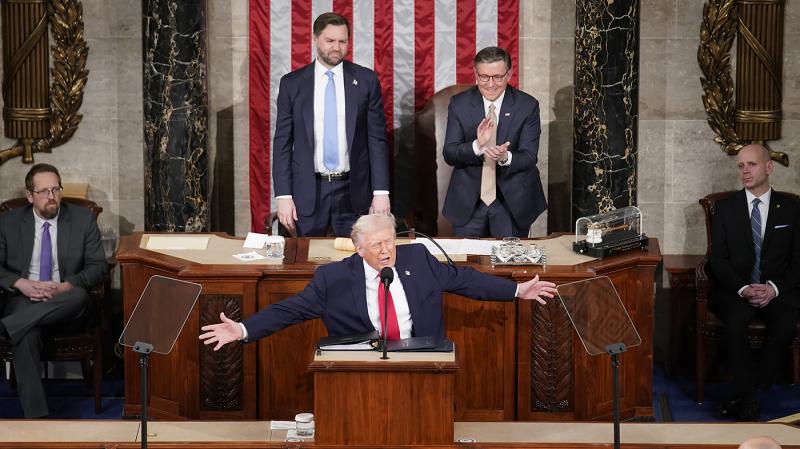


Trumpian lies won't obscure the fact that there won't be an American revival. Trump's words do not align with his actions. For example, the decision to stop minting pennies does not signal a strong economy. That's acceptance our money is worthless and that everything is going to cost more. Trump has signaled economic surrender.
Stolen glory, false praise, empty cheerleading, badgering, and bullying are not what will be necessary to achieve an American revival. What Trump really told us is that he has given up on MAGA. Trump delivered rhetoric and not results. MAGA is dead.
 S E E D E D C O N T E N T
Washington, Tuesday, Feb. 24, 2026.
Presidents do not usually lose power because of a single speech.
They lose power when a speech reveals something structural. A gap between what is being said and what the country is experiencing. A mismatch between ambition and capacity. A governing style that accelerates pressure rather than absorbing it.
That is why it is truly not outlandish to suggest that this may have been President Trump's final State of the Union address.
Last night's speech was designed to project permanence. The message was clear. The economy is roaring back. The border is locked down. America is respected again. A "golden age" is underway.
But the most important part of the speech was not the applause lines. It was the compression.
When a president makes sweeping claims about economic recovery while millions of Americans still feel squeezed by prices, he creates a credibility test. Inflation metrics can move in the right direction. Markets can rise. But voters do not live inside charts. They live inside grocery stores and mortgage payments. If the national narrative insists everything is booming while families are struggling, that disconnect becomes political oxygen for the opposition.
And when fact checks begin rolling out in real time across media platforms, long before the forced cheering in the chamber has even faded, the issue is not whether a statistic was stretched. The issue is that the presidency becomes reactive instead of agenda-setting. A State of the Union is supposed to frame the year. If it immediately becomes a dispute about basic facts, the frame slips.
The speech also leaned heavily into federal assertiveness: National voter ID, aggressive posture toward sanctuary jurisdictions, expansive claims of executive authority. Strong medicine plays well with a base that wants clarity and force. It also invites immediate litigation, state resistance and institutional friction.
That friction is not theoretical — it is baked into the constitutional design. Governors push back. Attorneys general file suit. District courts issue injunctions. Appeals courts narrow them. Policy implementation slows to a crawl while cable news fills the space.
A presidency can survive opposition. It is much harder to survive permanent injunction.
When everything becomes a legal test case, the White House stops governing and starts defending. Time gets consumed by fights that do not expand the coalition. Political capital burns faster than it can be replenished. Even victories come with delay and exhaustion.
The tone of the speech matters here. Trump's address was not a pivot to persuasion — it was a doubling down on confrontation as strategy. That approach has energized his supporters for years, but it has also narrowed his margin for error. When governing is framed as dominance rather than consensus, setbacks look larger and concessions look weaker.
The midterm elections sit in the background of all of this. They are not just another campaign cycle. They are leverage. If the president loses control of one chamber, every investigation intensifies. Every budget fight becomes existential. Every nomination becomes trench warfare. A presidency that is already juggling economic skepticism and legal challenges does not need a hostile Congress layered on top.
Supporters will argue that this speech showed strength. Critics will say it showed overreach. Both interpretations can be true at the same time. Strength can be real and still fragile. Overreach can energize and destabilize.
The more ambitious the agenda, the more dependent it is on precision. Economic claims must withstand scrutiny. Policy rollouts must survive court review. Messaging must resonate beyond the base. If even one of those pillars weakens, the entire structure starts to tilt.
There is also the simple reality of political fatigue. The country has lived in a constant state of escalation for years. Markets respond to uncertainty. Institutions respond to stress. Voters respond to exhaustion. A presidency that governs at maximum intensity must sustain that intensity every day. That is difficult under ideal conditions. It is harder when inflation, global instability and domestic polarization remain persistent.
None of this means collapse is inevitable. American institutions are durable. Presidents have survived far worse nights than a contested State of the Union. But structural pressure rarely announces itself with fireworks. It shows up in accumulation — court loss by court loss, approval dip by approval dip, legislative stall-out by legislative stall-out, and with the apparent ravages of aging poorly.
Last night's address projected confidence. What it also revealed was how much of this presidency depends on maintaining narrative control in a fragmented media environment and institutional control in a divided government. That is a delicate balance.
If economic optimism catches up with lived experience, if legal battles resolve cleanly, if midterm dynamics break in the president's favor, he will deliver another State of the Union next year and this analysis will read like overthinking.
But if prices remain stubborn, if courts block key initiatives, if Congress fractures, or if public trust erodes further, the speech we watched could end up being a high water mark rather than a starting point. He may have to step aside in shame — or he may not even be invited back.
Presidencies rarely end because of one dramatic moment. They end because the space between promise and reality widens faster than it can be closed.
Aron Solomon is chief strategy officer for AMPLIFY and has taught entrepreneurship at McGill University and the University of Pennsylvania.
Be a good human. Grossly derogatory comments, blatantly inflammatory comments, excessive trolling, mean-spirited taunting and insults, scamming, spamming, and off topic comments may be removed in compliance with the site's Terms of Service and the Code of Conduct. The moderators have the final word.

Tags
Who is online
92 visitors
The SOTU address was MAGA's epitaph. Trump has surrendered. Trump's remaining time in office isn't even about America any longer.
Amazingly, there are places where you can place a bet on what will be Trump's last year in office.
Whether he will flip off another person as POTUS,
which cabinet member will be the first to "leave",
will Trump be on the 2028 ballot?
Fascinating reading.
Talk to you in three years after his eighth SOTU. What will you say then?
Oops?
100% spot on.